Collection PL

About

Russia’s paper-money history is inseparable from the collapse of empire and the violence of revolution. By the early 20th century, decades of Imperial credit rubles and gold-backed issues had given way to wartime inflation and extraordinary borrowing. The First World War strained the state’s finances; the Revolution of 1917 and subsequent Civil War (1917–1922) shattered any notion of a single, stable currency.

In this vacuum, both the Bolshevik government and the various White formations — including the Armed Forces of South Russia — turned to short-term treasury bills and high-denomination obligations to fund military campaigns and administration. These instruments blurred the line between bond and banknote: payable to bearer at Treasury offices, denominated in hundreds of thousands of rubles, and often overprinted with new terms as regimes shifted or collapsed. Designs clung to pre-Revolutionary symbols such as the double-headed eagle and bilingual Russian–French legends, attempts by White governments to claim continuity with Imperial legitimacy even as the old order disintegrated.

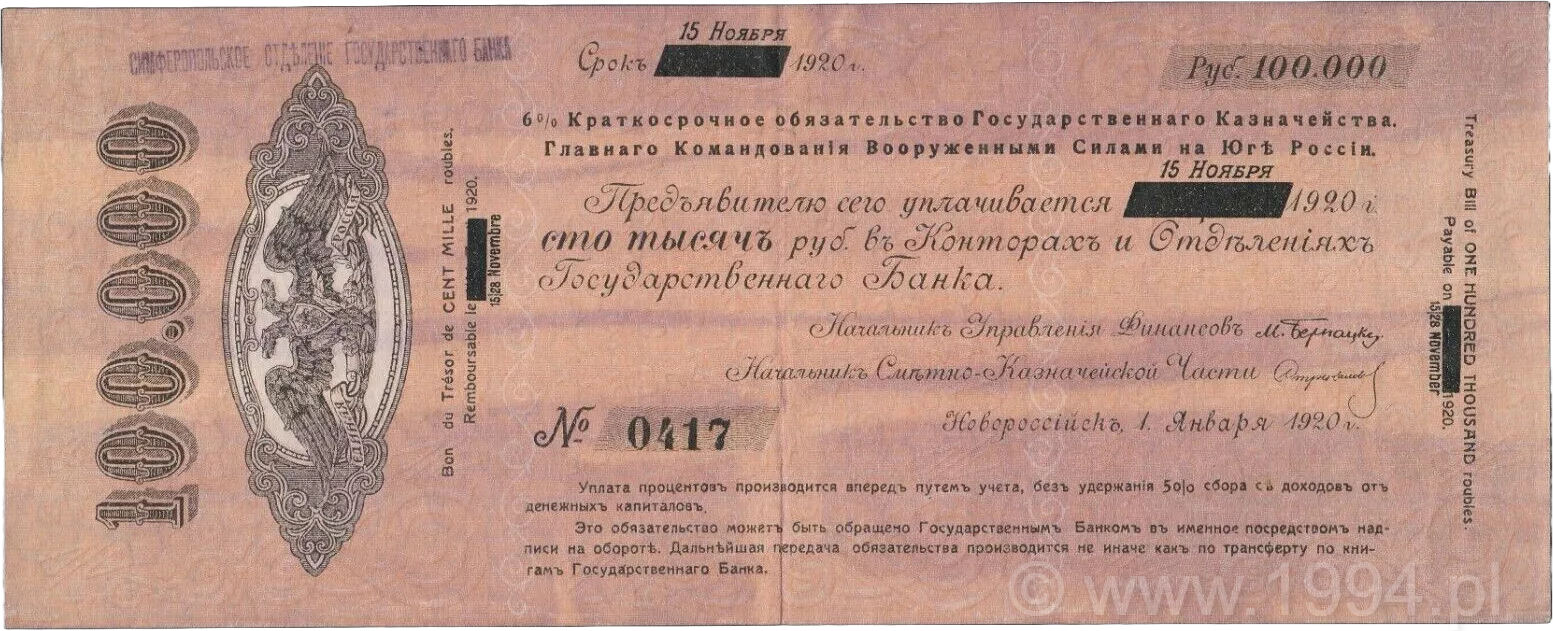
The note featured in this section — a 1920 South Russian 100,000-ruble treasury bill — comes from the final months of the White presence in Crimea, when General Wrangel’s government sought to finance retreat and evacuation. Printed with classical bond typography but used as a de facto high-denomination payment instrument, it captures the last reflex of a collapsing state trying to borrow its way out of defeat. Surviving examples of such paper are rare, most having been redeemed, destroyed, or demonetised by subsequent Soviet authorities.

As the Russia section grows, it will expand outward from this Civil War focal point to include earlier Imperial credit notes, Revolutionary emergency issues and Soviet-era fiscal paper — treating each piece as evidence of how regimes used design, denomination and language to claim authority during one of the most turbulent monetary histories of the modern world.

1 results · Page 1 of 1
Armed Forces of South Russia 100,000 Rubles Treasury Bill, November 1920 (Pick S431c), Imperial eagle at left

Russia 1920 — Armed Forces of South Russia 100,000 Rubles Treasury Bill (November Issue, Pick S431c)

Six-percent short-term Treasury bill for 100,000 rubles issued by the Government Treasury of the Armed Forces of South Russia during the final phase of the Russian Civil War. This is the November 15, 1920 payable issue (Pick S431c), printed after General Pyotr Wrangel transferred the White administration to Crimea. The note follows the classical Imperial layout: bilingual Russian–French legends, the double-headed eagle in an ornate oval cartouche at left, and a formal typographic bond structure intended to signal continuity with pre-1917 state finance. ... Read more →

RussiaTreasury Bond Note1920100,000 Rubles Treasury Bill100000 RublesFiscal DocumentHigh-Value DenominationGovernment ObligationBond IssueImperial EaglePick S431cRussian Civil WarWhite MovementArmed Forces of South RussiaWrangel GovernmentCrimea AdministrationCollapse of White RussiaEmergency FinanceExile Government HistoryTransitional Fiscal SystemsAnti-Bolshevik AdministrationRussiaCrimeaSimferopol1920Museum GradeR6 Extremely Rare
Held
↑ Top