Description and research notes
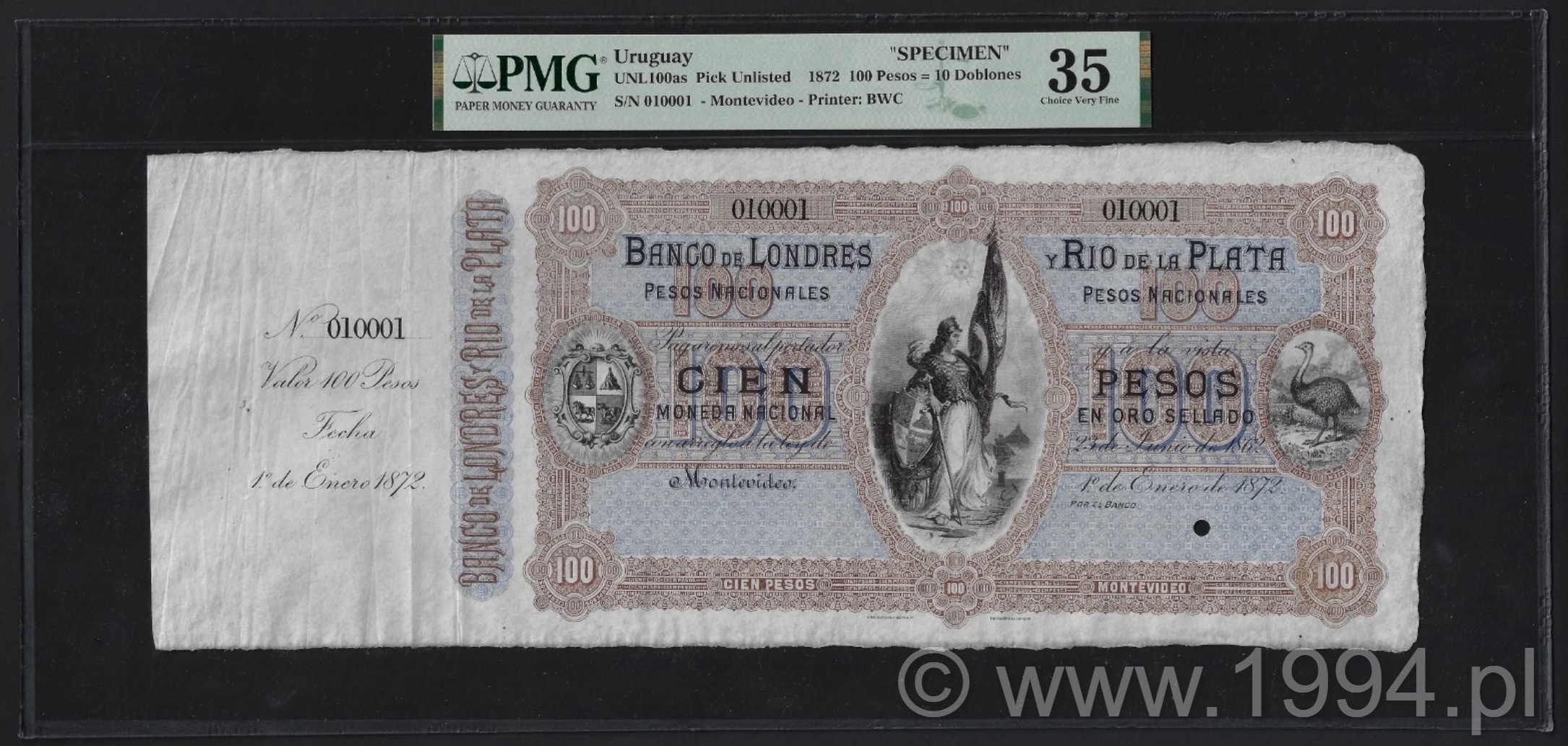
This face proof represents the 10 Pesos issue prepared for the Banco de Londres y Rio de la Plata in 1871. Pulled from the completed face plate during the engraving and plate-approval process, it records the finalized obverse design before serial numbering, circulation signatures, and full production. The piece preserves the technical stage at which the engraved face could be examined for layout, portrait work, lettering, denomination placement, line quality, and overall printing balance.
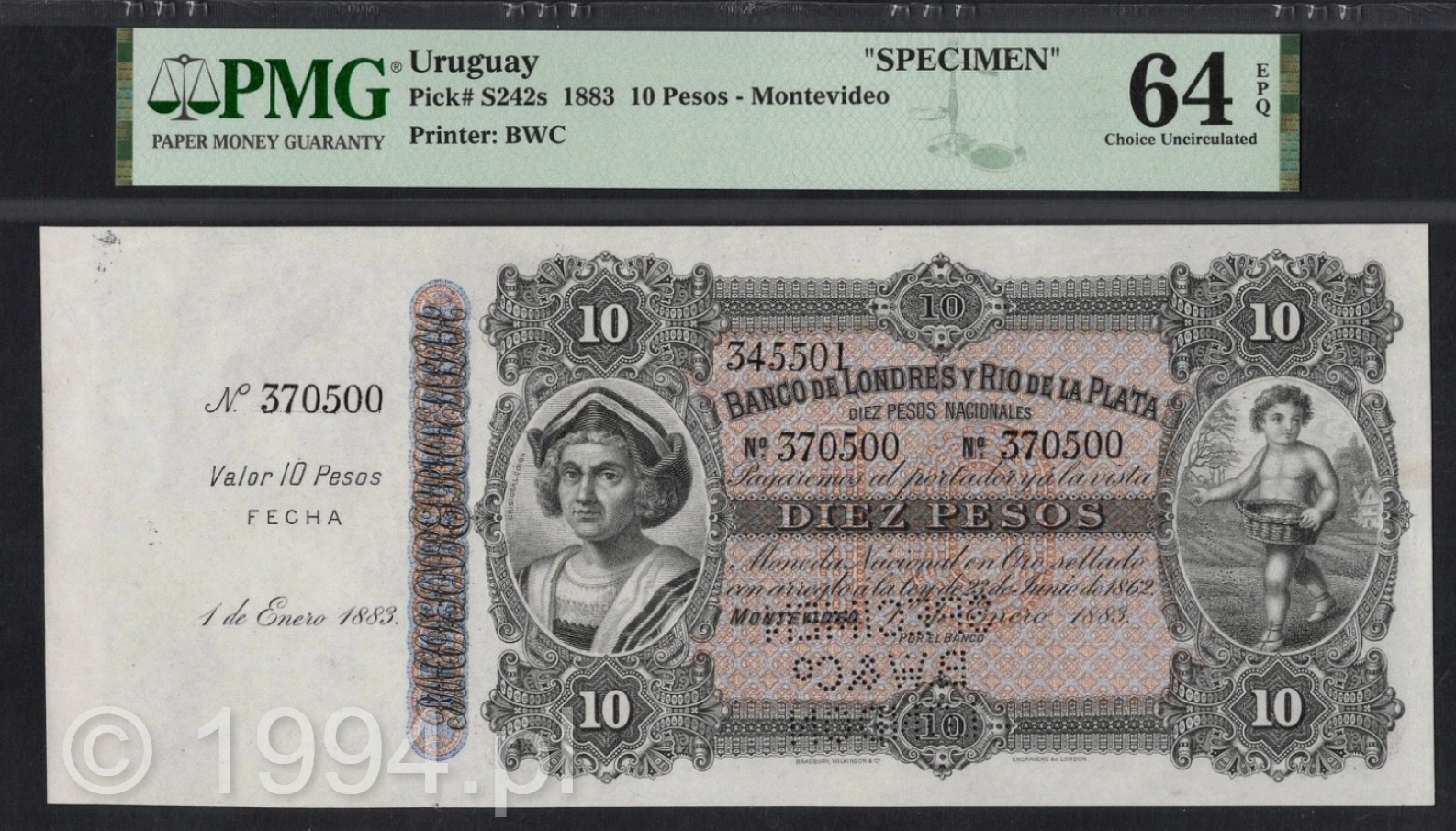
The obverse is dominated by a large engraved portrait of Christopher Columbus at left and a standing child vignette at right, both enclosed within elaborate ornamental frames. BANCO DE LONDRES Y RIO DE LA PLATA appears prominently across the upper central field with DIEZ PESOS NACIONALES beneath. The denomination is repeated through the large DIEZ PESOS panel at center and numerous numerical 10 devices placed around the border and within the ornamental structure. The lower payment language refers to Moneda Nacional en Oro sellado and cites the law of 23 de Junio de 1862, placing the note within the legal and monetary framework under which the bank operated in Montevideo.
The left side retains the broad counterfoil area with the printed denomination Valor 10 Pesos, FECHA heading, partial date structure, and corresponding control space. A tall ornamental security band separates the counterfoil from the principal note design. This retained margin preserves the full intended face arrangement, including the relationship between the accounting and control section and the engraved monetary instrument itself.
The engraved structure is exceptionally dense, combining portrait engraving, geometric guilloche work, ornamental denomination cartouches, fine-line borders, repeated value devices, and carefully controlled typography. Bradbury Wilkinson's security-printing method is evident throughout the composition, especially in the integration of portraiture, denomination panels, lettering, border architecture, and anti-alteration engraving into a unified design.
Face proofs occupied a distinct place within nineteenth-century banknote production. They were technical production artifacts used to evaluate and approve the engraved face before full note manufacture proceeded. This example therefore records the design at a critical production stage, preserving the approved plate work and original control layout associated with the 10 Pesos issue.
The Banco de Londres y Rio de la Plata was one of the principal foreign-linked banking institutions operating within the Rio de la Plata region during the nineteenth century. Its Uruguayan issues belong to an era in which privately organized banks supplied substantial portions of the circulating paper currency and relied on major international security printers to provide technically sophisticated notes capable of supporting public confidence and commercial use. The 10 Pesos denomination formed part of this broader private-bank monetary system operating through Montevideo and the surrounding regional economy.
This proof connects with the later 1883 Banco de Londres y Rio de la Plata 10 Pesos specimen preserved in this collection. The two pieces belong to different catalog issues and production dates, but together they document the continuing 10 Pesos denomination within the bank's nineteenth-century note history. The 1871 face proof preserves an earlier plate-approval state, while the 1883 Pick S242s specimen records a later completed two-sided specimen issue with full color, retained counterfoil, reverse design, and perforated SPECIMEN BW & Co LONDON cancellation. Their relationship provides a direct study of the denomination across separate production periods.
At the time of cataloging, no second face proof example of the 1871 10 Pesos type has been identified in grading records, auction archives, institutional holdings, or published references reviewed for this collection. PCGS identifies the piece specifically as a 10 Pesos 187x Face Proof under Pick S239p. Its retained counterfoil, complete engraving, production function, and independent survival place it among the most specialized artifacts associated with the bank's early Uruguayan issues.
As the presently unique documented face proof of Pick S239p, this piece occupies a reference-level position within the study of Banco de Londres y Rio de la Plata banknote production. It preserves the approved engraved face of the 10 Pesos issue at a critical stage of manufacture and provides a direct record of nineteenth-century Bradbury Wilkinson security printing for Uruguay. Its type-level uniqueness, technical function, retained counterfoil, and connection to the later 1883 10 Pesos specimen establish it as an R9 Extremely Rare museum-grade artifact within the history of Uruguayan private-bank paper money.