Description and research notes
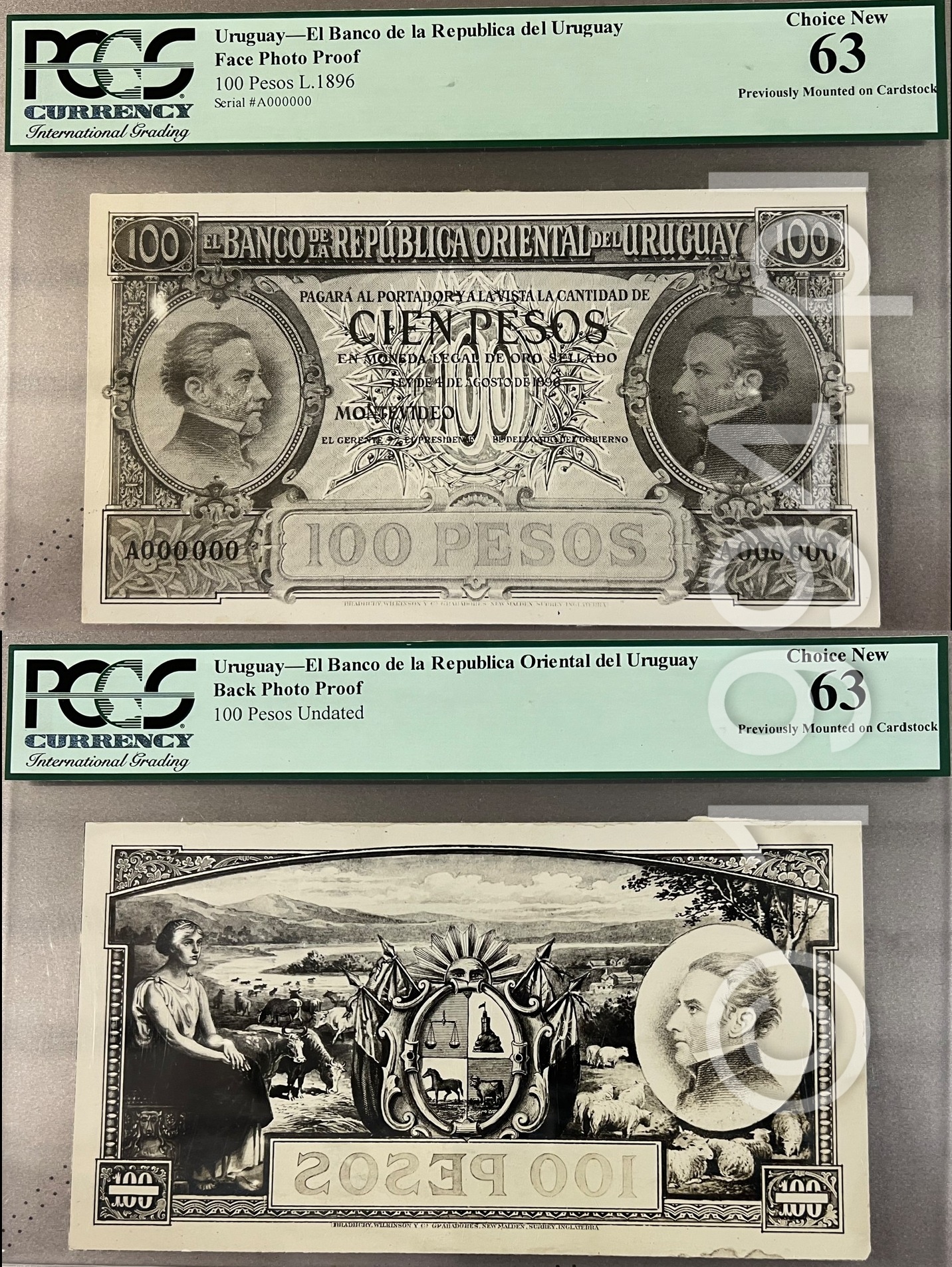
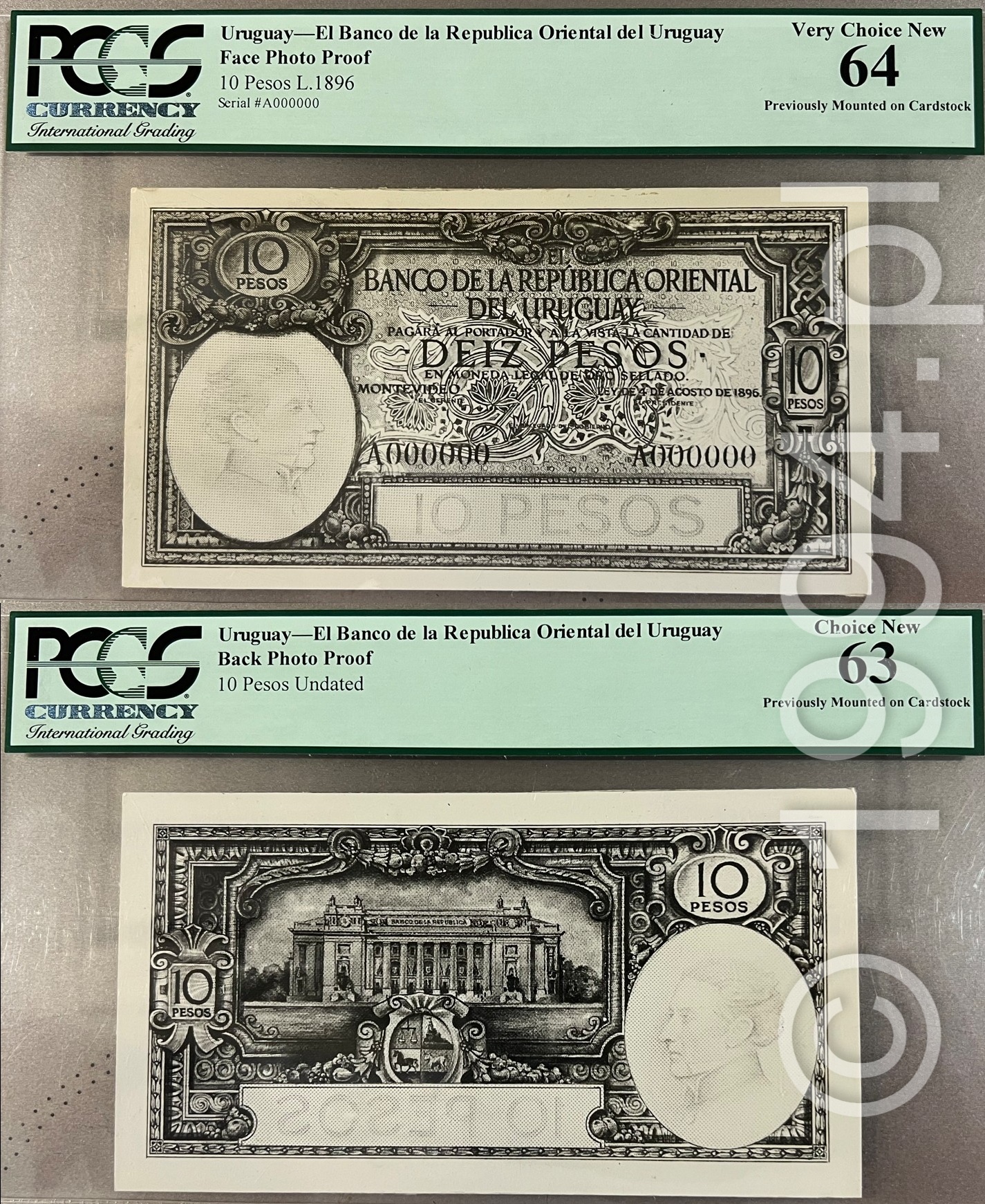
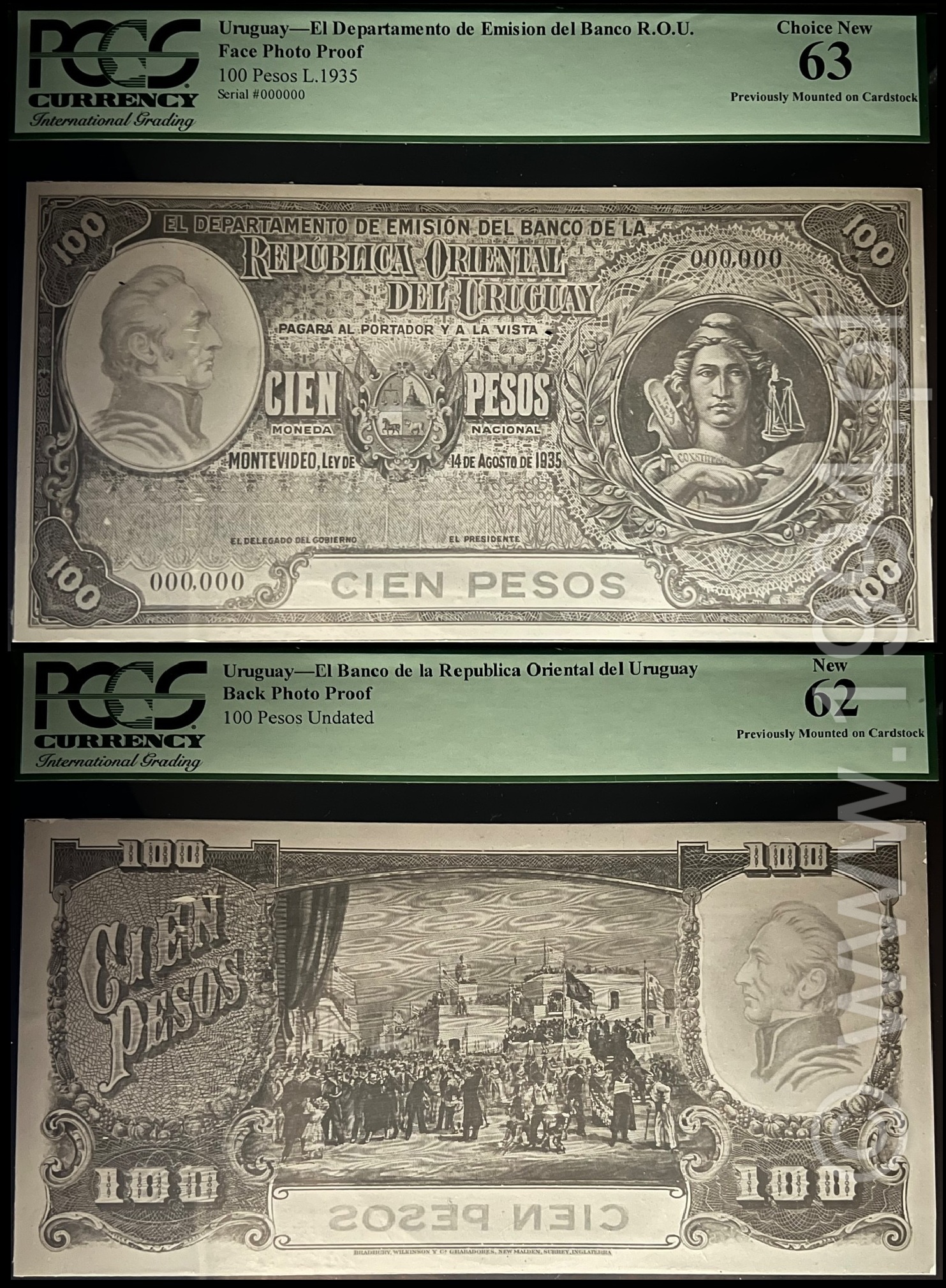
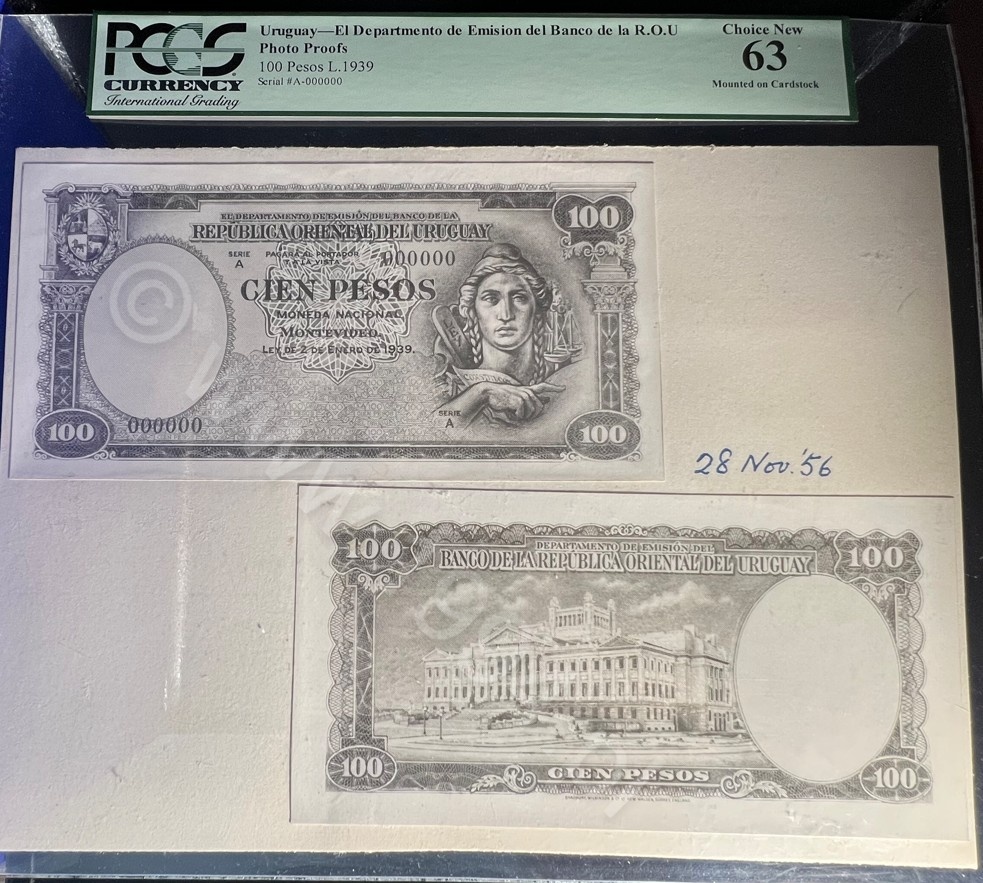
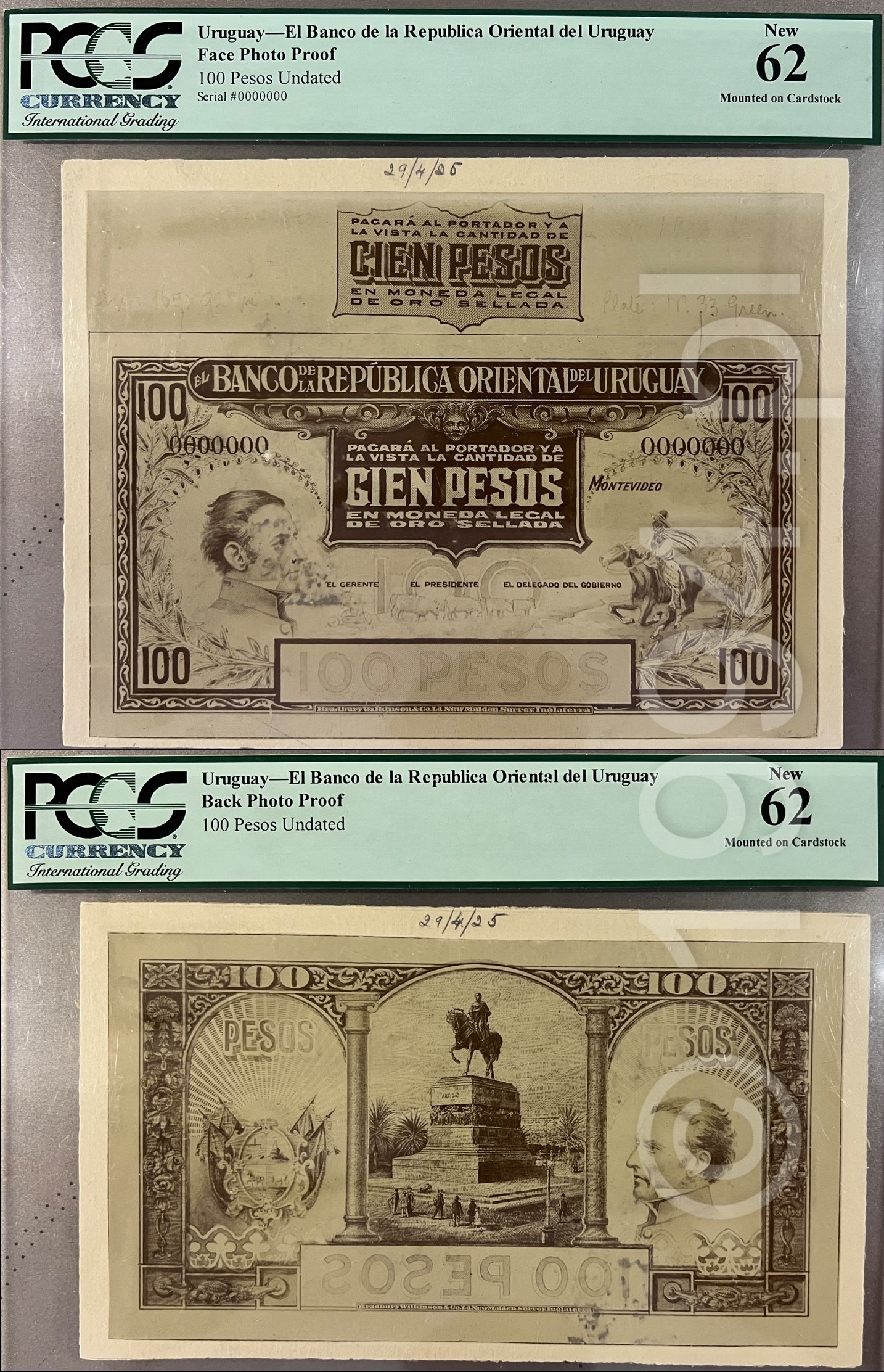
Issued for the Banco de la Republica Oriental del Uruguay, this mounted photographic proof pair preserves the face and reverse designs of an undated one hundred pesos banknote project in archival photographic form. Prepared by Bradbury, Wilkinson and Company Limited, the pair documents the denomination at a working design stage through full-size monochrome photographic impressions mounted on original cardstock and accompanied by handwritten production annotations.
The face proof carries paired all-zero serial numbers, preserving the complete placement and spacing intended for the future circulation numbering system. These zero serials identify the image as a controlled master reference prepared before individual circulation numbers were assigned. The photographic layout also includes the principal obligation text, denomination panels, issuer title, signature positions, portraiture, secondary vignette, and lower security field in their intended relationship.
A handwritten date of 29 April 1925 appears along the upper cardstock margin. This dated notation provides a firm archival reference point for the surviving proof assembly and places the documented review or handling of the design within the interwar period. Additional faint workshop annotations remain visible across the mount, including an internal numerical notation at left and a pencil instruction at right reading Plate 1C. 33 Green, recording a color or plate direction associated with the proposed printed design.
The face is headed by the full institutional title EL BANCO DE LA REPUBLICA ORIENTAL DEL URUGUAY. At center, the monetary promise states that the bank will pay the bearer one hundred pesos in moneda legal de oro sellada, directly connecting the proposed note with Uruguay's gold-based monetary framework. The wording gives the denomination the character of a formal bank obligation exchangeable within the legal gold currency system.
At left appears a military profile portrait of Jose Gervasio Artigas, Uruguay's foundational national figure. The portrait is enclosed by agricultural ornament and balanced against a mounted patriotic vignette at right. The cavalry subject evokes the rural military tradition associated with the independence struggle, joining the personal authority of Artigas with the broader image of mounted national forces.
The large central CIEN PESOS panel dominates the face and is repeated in an isolated photographic detail mounted above the complete design. This separate enlargement records the obligation and denomination typography independently from the surrounding composition, allowing the lettering, border shape, spacing, and tonal treatment to be reviewed as a distinct design component.
The reverse proof centers on the equestrian Monumento a Artigas in Plaza Independencia, Montevideo. Artigas is shown on horseback above the monumental pedestal, framed by classical columns and radiating ornamental fields. The composition transforms one of Uruguay's most important civic monuments into the central symbol of the denomination, presenting national memory through architecture, sculpture, and security design.
At right appears a profile portrait of Joaquin Suarez, a major statesman of Uruguay's independence era and the country's longest-serving head of state during the Great Siege of Montevideo. His inclusion creates a historical dialogue with Artigas, pairing the founding military figure of the republic with a civilian leader associated with constitutional endurance and national survival.
The national arms occupy the left side of the reverse beneath the large PESOS denomination field. Together with the equestrian monument and Suarez portrait, the reverse creates a layered statement of sovereignty, civic authority, and historical continuity. The architectural framing gives the design the appearance of a formal national monument translated into banknote form.
A faint reversed numerical marking reading 20239 00 appears near the lower center of the reverse photographic image. Its mirrored orientation is consistent with a tracking mark originating from the photographic negative or printer archive system. Along with the date, plate notation, color instruction, and other handwritten references, it forms part of the surviving production history of the proof pair.
The photographic format distinguishes this pair from plate proofs, color trials, and completed specimens. Rather than recording ink transferred directly from an engraved printing plate, the photographs preserve the assembled design as a visual master for review, annotation, comparison, and archival retention. The cardstock mounting created a stable working surface on which production information could be recorded without altering the underlying photographic image.
The pair documents a banknote concept in which older gold-standard monetary language was combined with interwar production records dated 1925. Its value lies in this convergence of monetary history, national iconography, printer documentation, and physical evidence of the design-review process. The all-zero serial numbers, separate denomination study, handwritten date, color notation, internal ledger references, and mirrored photographic tracking number preserve a rare approval and archival trail rather than a simple illustration of a proposed note.
Certified PCGS 62 New for both the face and reverse, the pair survives as a coordinated archival ensemble mounted on original cardstock. It is an exceptionally important documentary record of Bradbury, Wilkinson and Company Limited's work for the Banco de la Republica Oriental del Uruguay and of the methods by which a major one hundred pesos design was photographed, annotated, reviewed, and preserved within the security-printing archive.