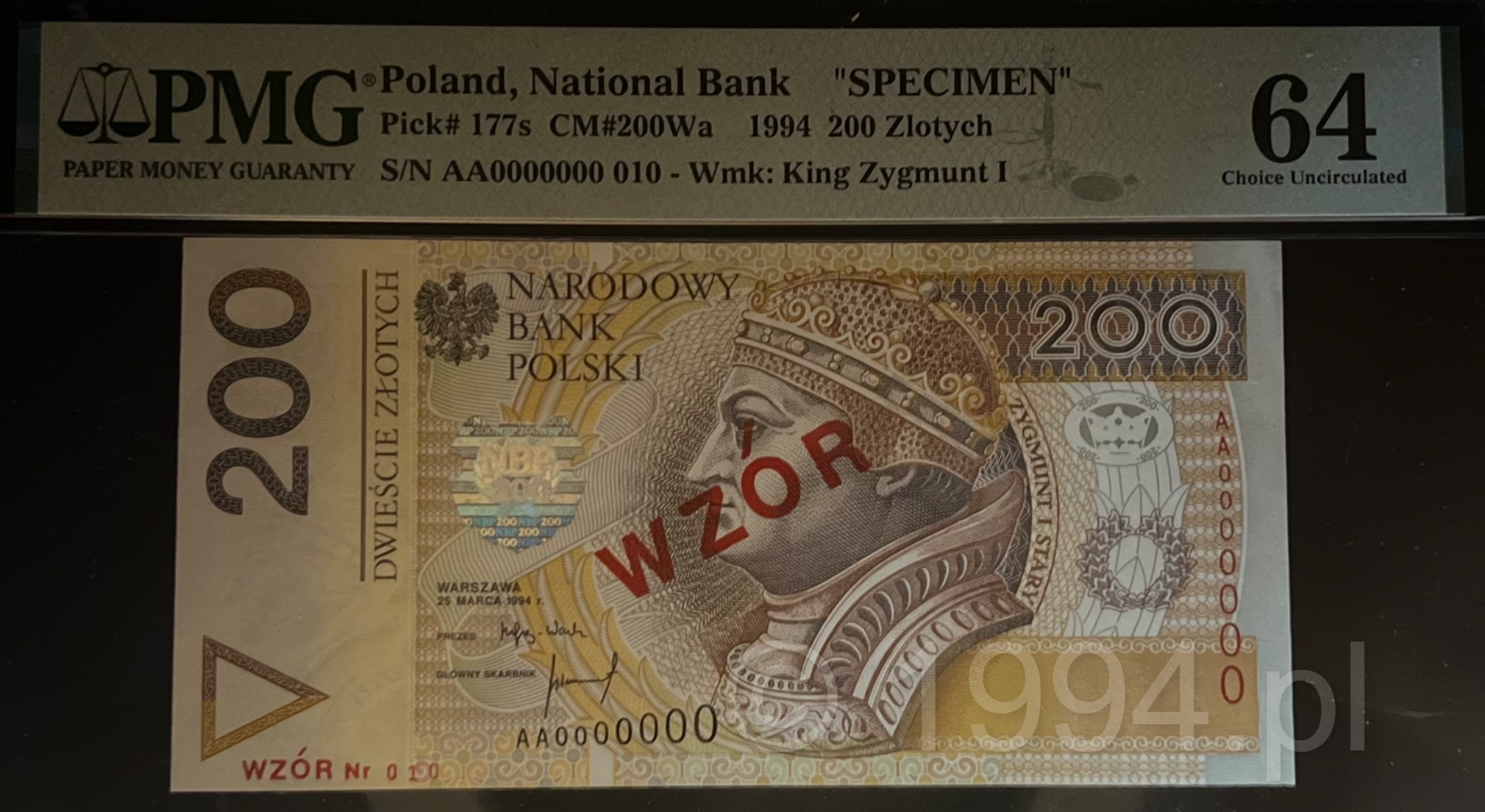
Poland 1994 - 200 Zlotych, Narodowy Bank Polski WZÓR Specimen Number 010 (Pick 177s)
This AA0000000, WZÓR No. 010 example completes the full five-denomination matching-number WZÓR 010 set preserved in this collection. Read more →
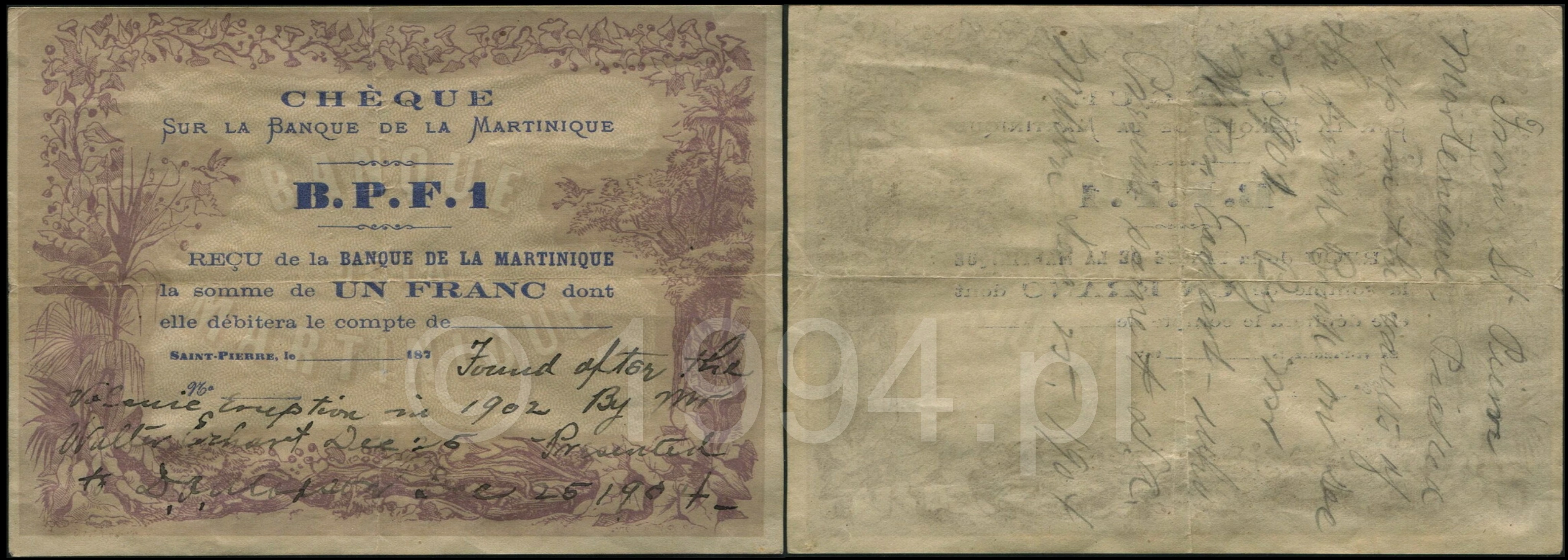
The Banque de la Martinique was established as part of France’s overseas banking framework, created to stabilize currency supply and facilitate commercial credit in the Caribbean colonies. Unlike metropolitan France, where centralized banking instruments were already standardized, colonial institutions relied on a mixture of notes, cheques, receipts, and drafts adapted to local economic realities. This cheque format reflects that transitional monetary environment, bridging formal banking practices and localized colonial commerce. Read more →
The physical condition of the cheque further supports its recovery narrative. The paper exhibits uniform toning, softened fibers, and surface wear consistent with exposure to heat, ash, moisture, and handling in a post-disaster environment. Folding patterns and overall texture differ markedly from pristine unissued examples, aligning instead with an object that survived a catastrophic event rather than archival storage. Read more →
The dates on this example carry its story into the years of the Napoleonic invasions. After the French army entered Portugal in 1807, the royal court moved to Brazil. During the invasion years, the exchange value of apolices fluctuated between 17 and 60 percent of face value. The impressions from 1809 and 1811 place this document's continuing fiscal recognition within that turbulent period. Read more →
The design closely imitates the official Imperial issue, including the central allegorical vignette, denomination cartouches, and surrounding geometric rosette framework. The engraving demonstrates a high level of technical competence, reflecting the reality that contemporary forgers were often trained engravers or printers capable of producing imitations that challenged official security measures. Such counterfeits were not crude novelties but functional monetary intrusions that tested the resilience of Brazil’s paper money system. Read more →
At the time of cataloging, no second face proof example of the 1871 10 Pesos type has been identified in grading records, auction archives, institutional holdings, or published references reviewed for this collection. PCGS identifies the piece specifically as a 10 Pesos 187x Face Proof under Pick S239p. Its retained counterfoil, complete engraving, production function, and independent survival place it among the most specialized artifacts associated with the bank's early Uruguayan issues. Read more →
The survival of this specimen is therefore exceptional. It documents not a single city’s response to crisis, but the structural mechanism by which municipal scrip could be deployed nationally under conditions of systemic financial stress. As such, it represents an infrastructural artifact of Depression-era municipal finance rather than a localized monetary issue. Read more →
This example is a true printer-issued specimen, identified by the serial number P0000 and the overprinted word SPECIMEN. It was not intended for circulation and was produced solely for approval, authorization, or archival reference during the establishment of the issue. Specimen material of this type was typically destroyed once authorization was complete, as it had no role in the operational funding process. Read more →
This specimen represents an official municipal scrip issued by the Borough of Palmyra, Burlington County, New Jersey, Series of 1933, and denominated Five Dollars. It originates from the most acute phase of the Great Depression, when local governments faced severe liquidity shortages and were compelled to issue interest-bearing scrip to meet ordinary municipal obligations in the absence of sufficient circulating cash. Read more →
Municipal scrip differed from tax anticipation notes and formal bond issues in that it functioned as a direct acknowledgment of indebtedness by the issuing municipality, intended for circulation or settlement within the local economy. In Palmyra’s case, the scrip was structured as a general obligation of the borough, transferable by delivery and bearing interest at the rate of three percent per annum from the date of issue. It was expressly acceptable in payment of taxes or other indebtedness to the borough, or redeemable on a date to be fixed by the Borough Council, embedding it directly into the municipality’s fiscal operations. Read more →
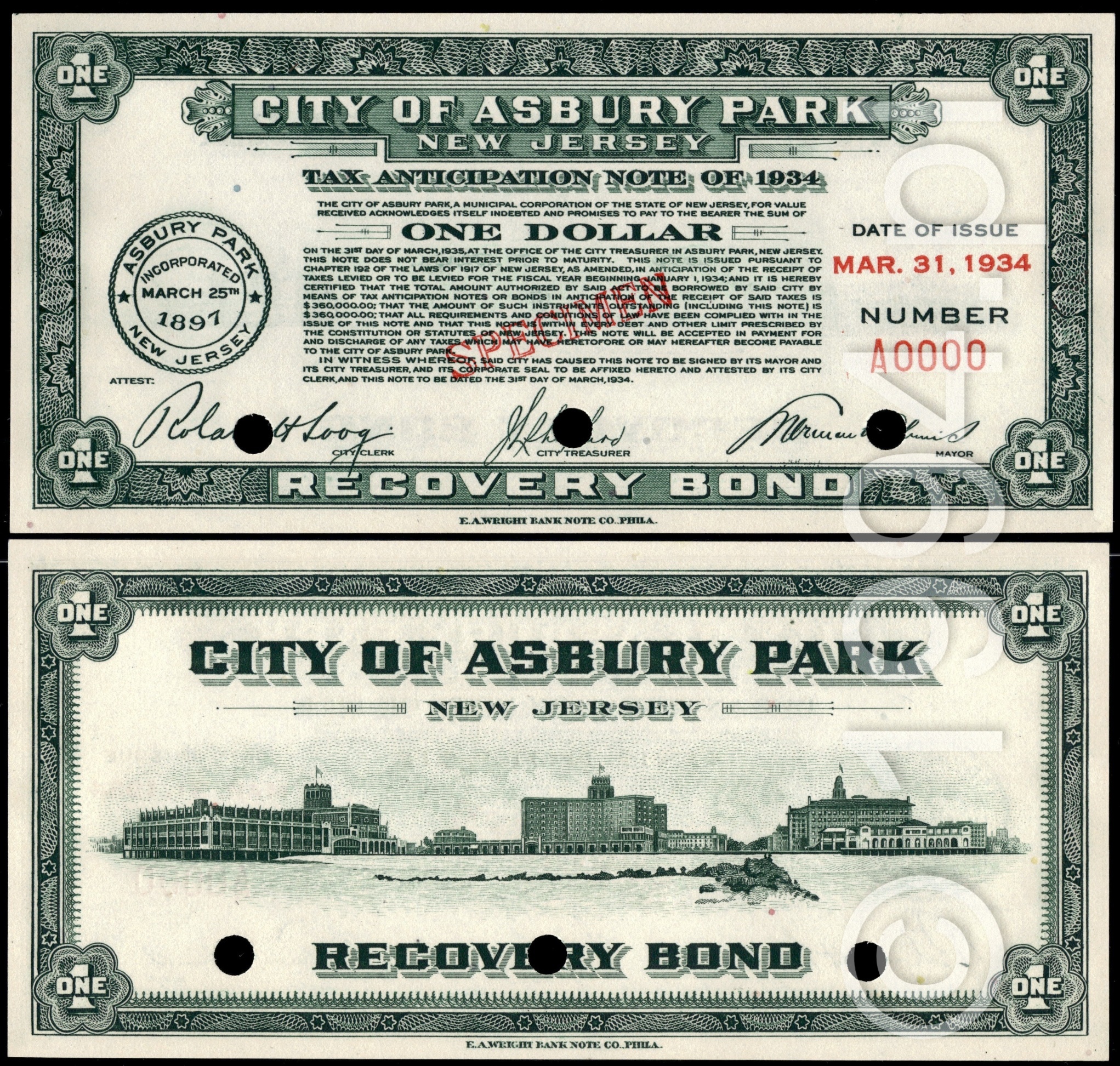
This specimen represents an official municipal tax anticipation note issued by the City of Asbury Park, New Jersey, dated March 31, 1934, and denominated One Dollar. Explicitly titled TAX ANTICIPATION NOTE OF 1934 and further identified on the design as a RECOVERY BOND, the instrument forms part of a structured municipal financing program implemented during the depth of the Great Depression, when local governments faced severe cash shortages and unstable revenue collection. Read more →
Specimen examples of tax anticipation notes were produced in extremely limited quantities and typically retained only temporarily within printer or municipal files once an issue was authorized. Unlike issued notes, which were redeemed, cancelled, and destroyed in the normal course of fiscal operations, specimens had no operational role and survived only by circumstance. Read more →