Description and research notes
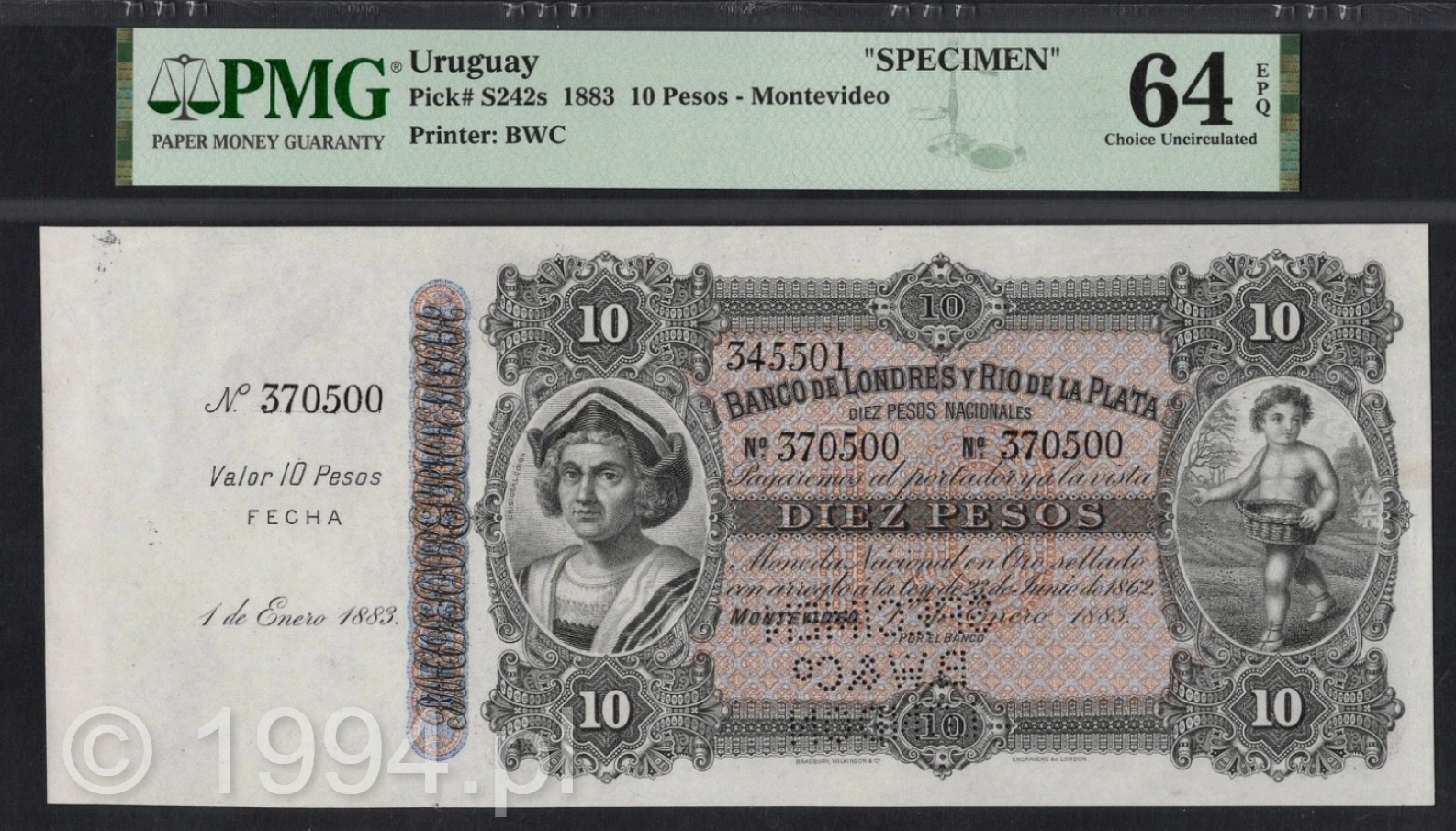
A 10 Pesos specimen prepared for the Banco de Londres y Rio de la Plata in Montevideo and dated 1 January 1883, engraved and printed in London by Bradbury, Wilkinson & Co. The piece preserves the complete specimen format of the bank's 10 Pesos issue, including the retained counterfoil, full multicolor face design, reverse engraving, production numbering, and printer-applied perforated cancellation.
The obverse combines formal banking text with an elaborate multicolor security design. BANCO DE LONDRES Y RIO DE LA PLATA appears prominently across the upper central field, with DIEZ PESOS NACIONALES directly beneath. The payment promise reads PAGAREMOS AL PORTADOR Y A LA VISTA, followed by the large central denomination DIEZ PESOS. The lower monetary language refers to Moneda Nacional en Oro sellado and cites the law of 23 de Junio de 1862. MONTEVIDEO and the printed date 1 de Enero 1883 identify the place and date of the issue.
The specimen carries a distinctive two-number production-control arrangement. The number 370500 appears three times across the complete format: once on the retained counterfoil at left and twice within the principal banknote design. A separate number, 345501, is printed above the bank title in the upper central field. The repeated 370500 links the counterfoil directly with the note body, while 345501 forms an additional printer-control element within the specimen. Together these numbers preserve an important part of the Bradbury Wilkinson production record associated with this specific specimen format.
The left side retains the complete counterfoil, carrying No. 370500, Valor 10 Pesos, the FECHA heading, and the printed date 1 de Enero 1883. A tall multicolor ornamental security band separates the counterfoil from the principal note. The full counterfoil preserves the original accounting and control structure of the printed sheet and remains integral to the specimen as produced.
The main engraved design is framed by dense geometric work and finely developed guilloche structures characteristic of Bradbury Wilkinson's nineteenth-century security printing. A large portrait of Christopher Columbus appears at the left of the principal note, balanced by a standing child vignette at the right. Repeated numerical 10 devices, ornamental value cartouches, fine-line backgrounds, layered color printing, and carefully structured typography create a complex security composition built around denomination recognition, institutional authority, and anti-alteration engraving.
Across the lower central field, the note is pin-perforated with the complete text SPECIMEN BW & Co LONDON. The perforation passes directly through the printed paper and records both the specimen designation and the printer identity. The wording identifies Bradbury, Wilkinson & Co. of London within the physical cancellation itself, making the perforation an important production feature of the piece and a direct part of its printer-control history.
The reverse is printed in a restrained brown-red palette and built around two opposing classical female profile medallions within an elaborate symmetrical guilloche framework. Numerous repeated 10 and DIEZ denomination devices are incorporated into circular ornaments, corner values, borders, and interlocking security structures. The two profile vignettes face inward toward the center of the composition, producing a balanced bilateral design surrounded by exceptionally dense ornamental engraving. A broad unprinted margin remains at the right, corresponding with the retained counterfoil area of the specimen format. The SPECIMEN BW & Co LONDON perforation passes through the paper and remains visible from the reverse.
Bradbury, Wilkinson & Co. was one of the major British security printers supplying banks, governments, and private issuing institutions across international markets during the nineteenth century. This specimen reflects the firm's mature engraving practice through portrait work, denomination repetition, multicolor underprinting, intricate geometric structures, counterfoil integration, production numbering, and printer-applied specimen control within a single private-bank issue.
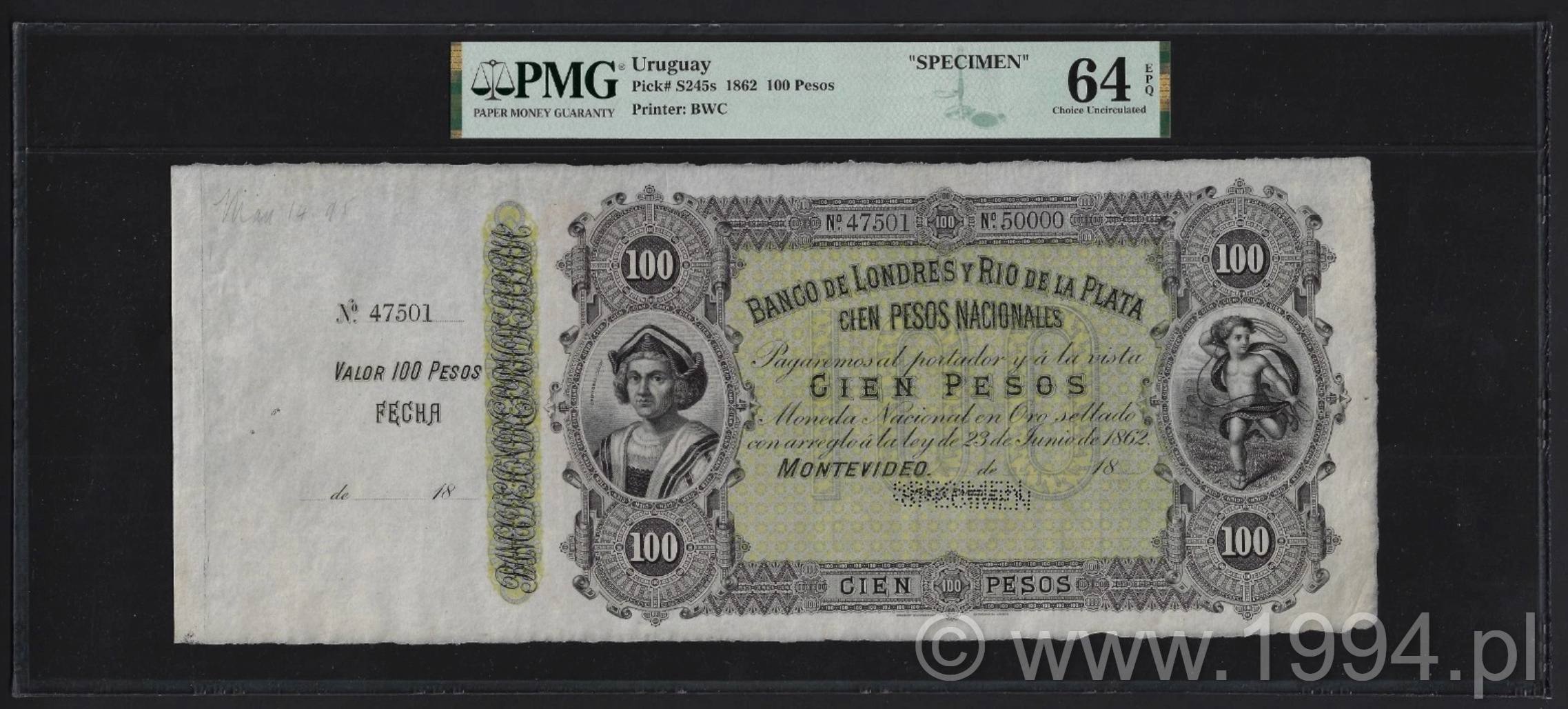
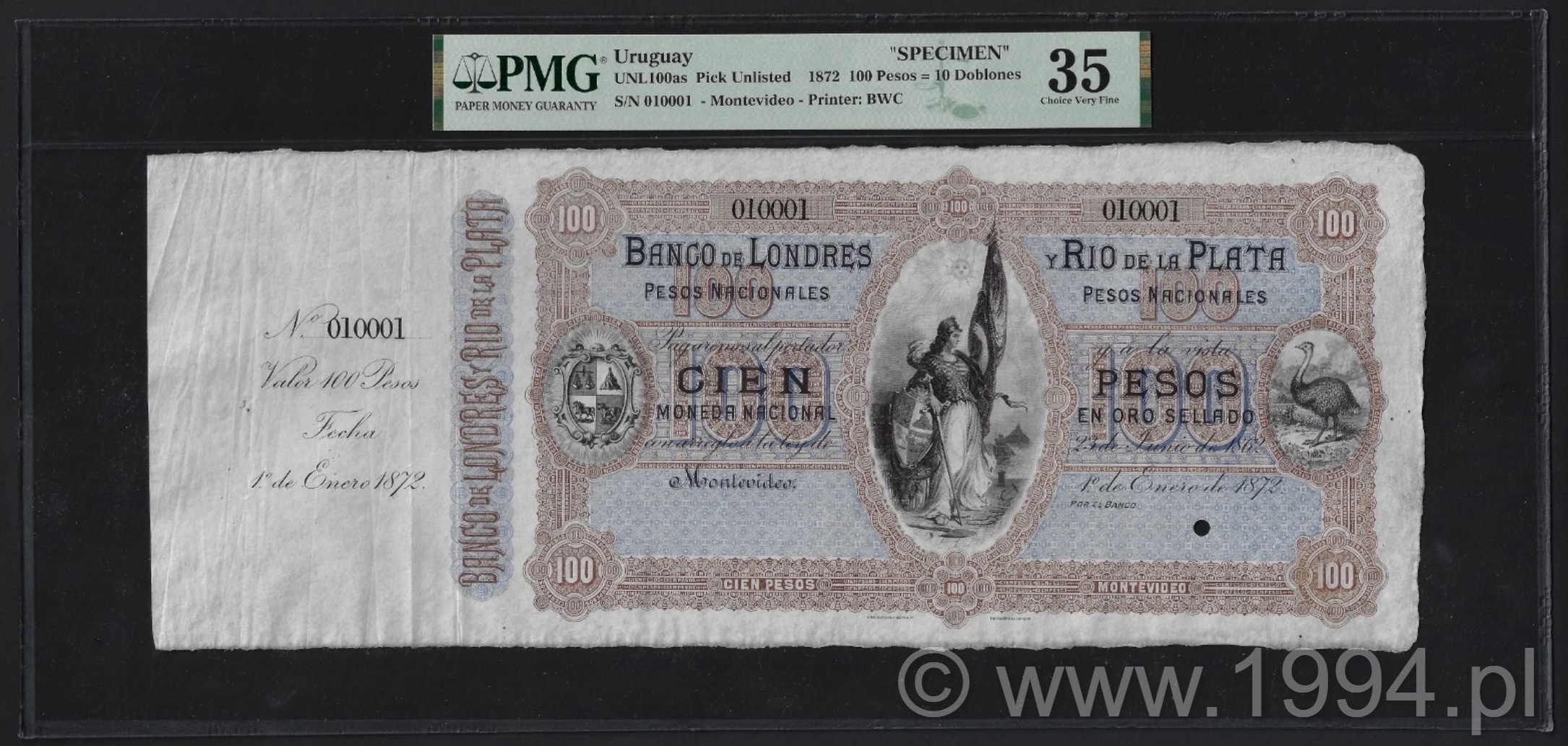
The Banco de Londres y Rio de la Plata issue belongs to an important period in Uruguay's nineteenth-century monetary history, when private and foreign-linked banks formed a substantial part of the country's paper-money system. Their notes document the commercial and financial networks connecting Montevideo with British capital, international trade, regional banking, and the specialized security printers responsible for producing negotiable paper for South American institutions.
This specimen also connects with the earlier Banco de Londres y Rio de la Plata 10 Pesos face proof preserved in this collection. Together, the two pieces document separate periods and production states within the bank's 10 Pesos history. The 1871 face proof preserves an earlier plate-approval artifact, while the 1883 Pick S242s specimen records a later completed two-sided specimen format with multicolor printing, retained counterfoil, reverse design, two-number production-control structure, and perforated SPECIMEN BW & Co LONDON cancellation.
The present specimen preserves a particularly complete record of the 1883 10 Pesos production format: counterfoil No. 370500, two corresponding 370500 numbers on the principal note, the separate upper control number 345501, the full engraved face and reverse, original denomination and legal wording, and the complete Bradbury Wilkinson perforated specimen designation. These features make the piece a direct reference artifact for the study of Uruguay's private banking era and Bradbury Wilkinson's South American security-printing work.
Certified PMG 64 EPQ Choice Uncirculated, this example is the sole PMG-certified Pick S242s specimen at the 64 EPQ grade with no examples graded higher, establishing it as Top Pop. Its complete printer-control format, retained counterfoil, distinctive 345501 and 370500 numbering, perforated SPECIMEN BW & Co LONDON designation, Bradbury Wilkinson engraving, and 1883 Montevideo issue context give it museum-grade significance within nineteenth-century Uruguayan private-bank paper money.