Description and research notes
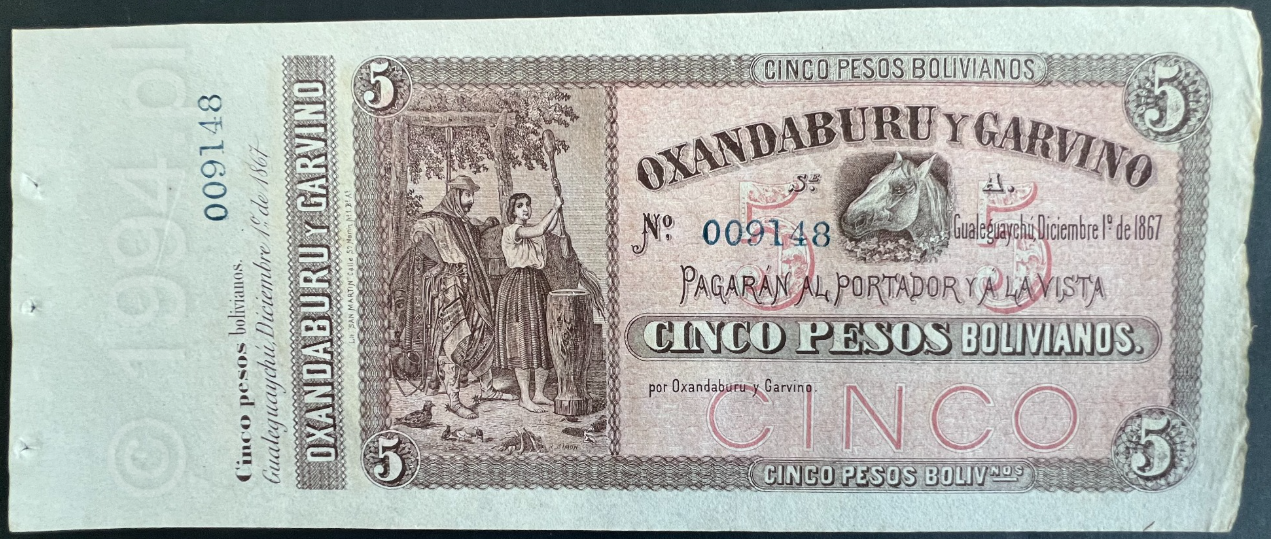
This 5 Pesos Bolivianos remainder was prepared in 1867 for Oxandaburu y Garvino of Gualeguaychu, Entre Rios, during an early period of private and provincial paper-money issuance in Argentina. The note preserves its original left counterfoil together with the complete unsigned banknote face and carries serial number 009148 on both sections, directly linking the retained accounting stub with the principal note.
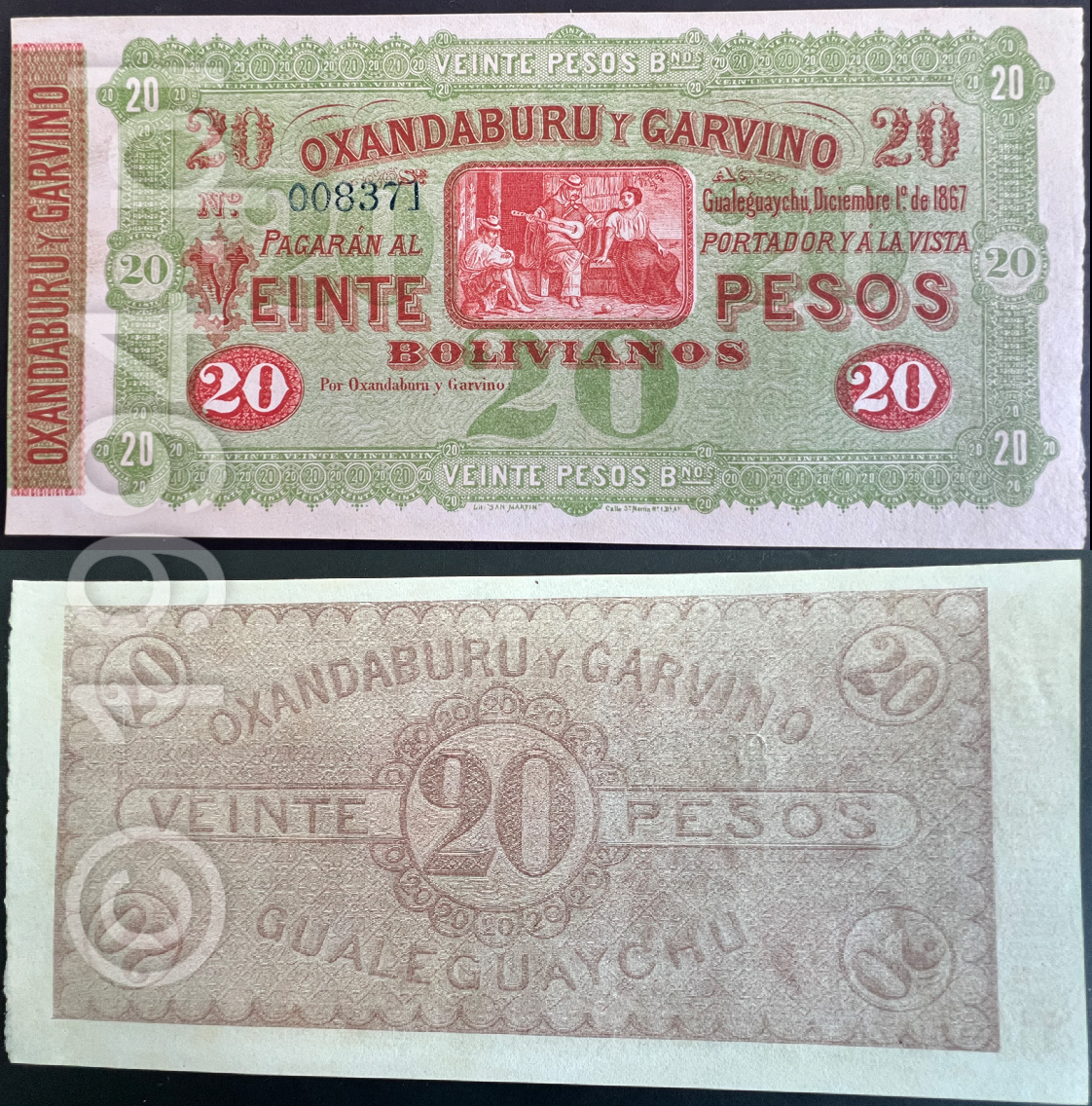
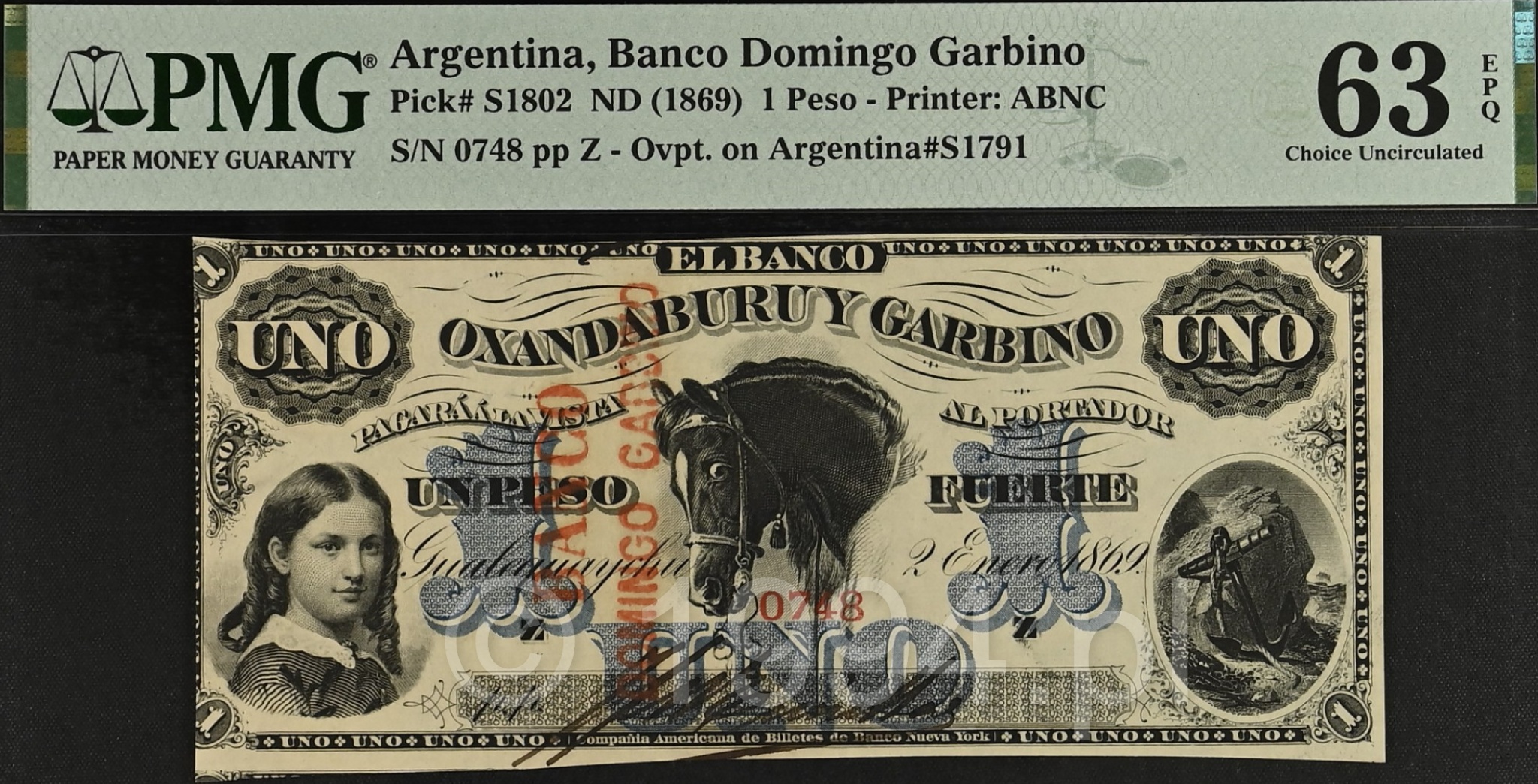
The most immediately distinctive feature is the issuer name printed across the face: OXANDABURU Y GARVINO. Historical records identify the partner as Domingo Luis Garbino, while the printed 1867 issue uses GARVINO with a V. This spelling is a defining feature of the 1867 partnership issue and is preserved again on the related 20 Pesos Bolivianos remainder of the same year. The bank's 1869 series appears under the corrected GARBINO form, preserving a clear spelling progression between the two issues.
The main note is denominated CINCO PESOS BOLIVIANOS and dated at Gualeguaychu, Diciembre 1 de 1867. The payment clause reads PAGARAN AL PORTADOR Y A LA VISTA, establishing the note as a bearer obligation payable on presentation. Large repeated 5 denomination devices, a pale red denomination underprint, engraved border work, and finely patterned security backgrounds organize the face around the central monetary promise.
The left counterfoil remains fully attached and repeats serial number 009148. It carries the denomination Cinco pesos bolivianos, the issuer name OXANDABURU Y GARVINO, and the same Gualeguaychu date. The retained stub preserves the accounting structure of the original banknote format, in which the bank could maintain a corresponding record when a note was separated and released for circulation.
Two principal engraved vignettes dominate the design. At left, a rural scene shows a standing man and woman within an agricultural setting, surrounded by elements of country life. At upper center-right, a finely engraved horse head appears above the payment text. Together with the denomination panels and ornamental engraving, these images connect the note visually with the rural economy and livestock culture that formed an important part of nineteenth-century Argentine commerce.
The note was produced by the American Bank Note Company in New York, whose imprint appears within the design. Its engraved line work, vignette treatment, repeating denomination devices, intricate borders, and layered color printing reflect the export security-printing methods used by ABNC for banks and issuing institutions throughout Latin America during the nineteenth century.
The denomination in Pesos Bolivianos records the fragmented monetary environment of Argentina during the 1860s. Bolivian silver circulated extensively through the interior provinces and served as a familiar monetary reference in regional trade. Private banking institutions could therefore issue paper obligations expressed directly in pesos bolivianos, linking fiduciary paper with the metallic currency already recognized in everyday commerce.
The 1867 Oxandaburu y Garvino issue forms an early stage in the banking sequence represented by related material in this collection. The 1867 notes preserve GARVINO on the printed issue, while historical records identify the partner's surname as Garbino and the bank's 1869 series appears under the GARBINO spelling. Later material associated with Domingo Garbino continues the GARBINO form, allowing the surviving notes to document the changing institutional and printed identity across these closely related issues.
As a remainder, the piece preserves the printed monetary form before completion for circulation. The signature fields remain unused, while the counterfoil and principal note survive together as produced. The reverse is blank, making the fully developed engraved face and attached accounting stub the complete printed structure of this denomination.
Pick S1776r, this 1867 5 Pesos Bolivianos remainder preserves an early GARVINO-spelling issue of the Oxandaburu partnership together with its matching serial-number counterfoil, ABNC engraving, Gualeguaychu issue context, Bolivian-denominated monetary language, and original unissued format.