Description and research notes
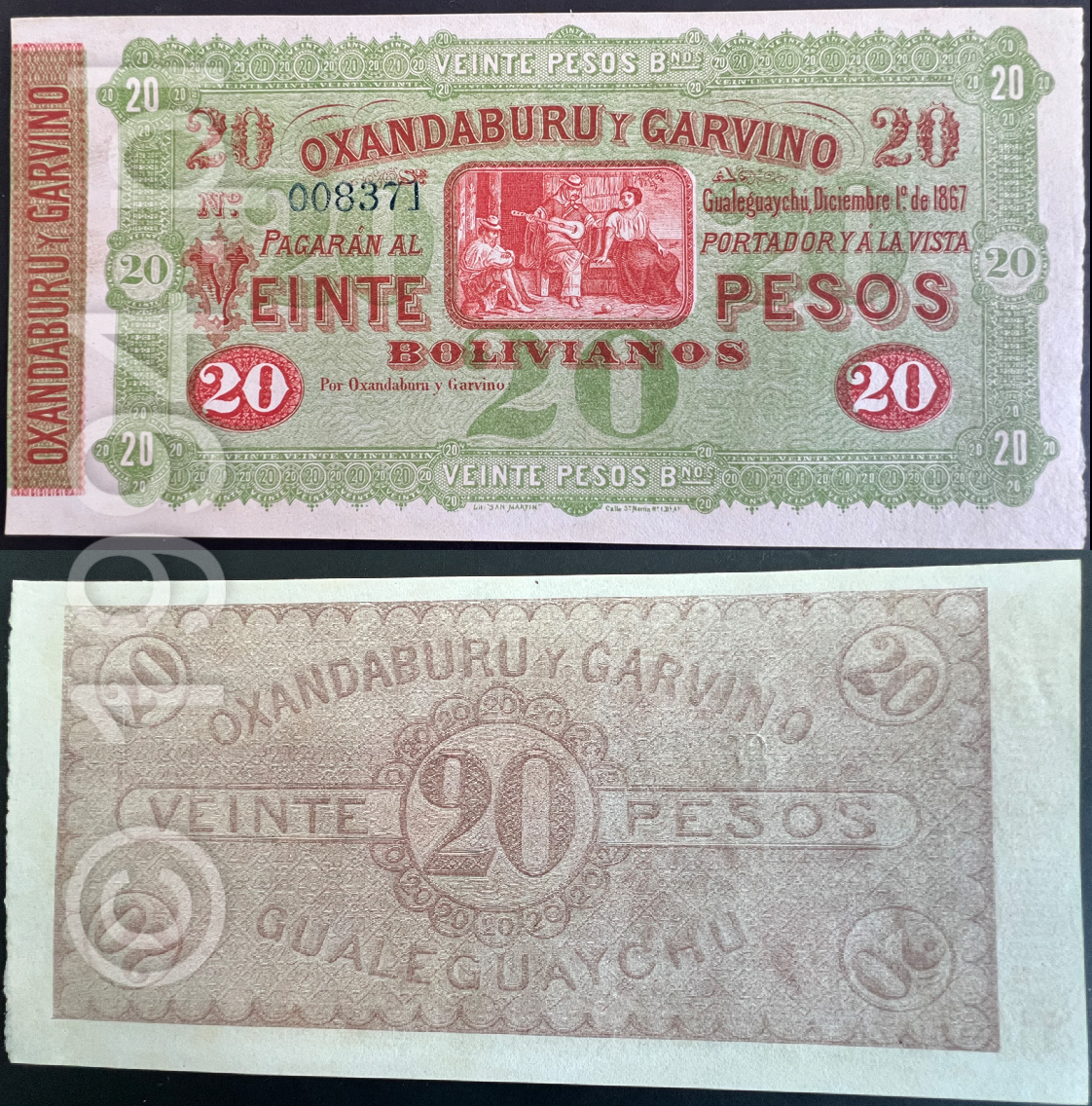
This 20 Pesos Bolivianos remainder was prepared in 1867 for Oxandaburu y Garvino of Gualeguaychu, Entre Rios, and preserves a substantially different design and printing program from the lower denominations of the same partnership issue. The note carries serial number 008371 and survives with its attached printer or accounting extension, complete multicolor face, and fully printed reverse.
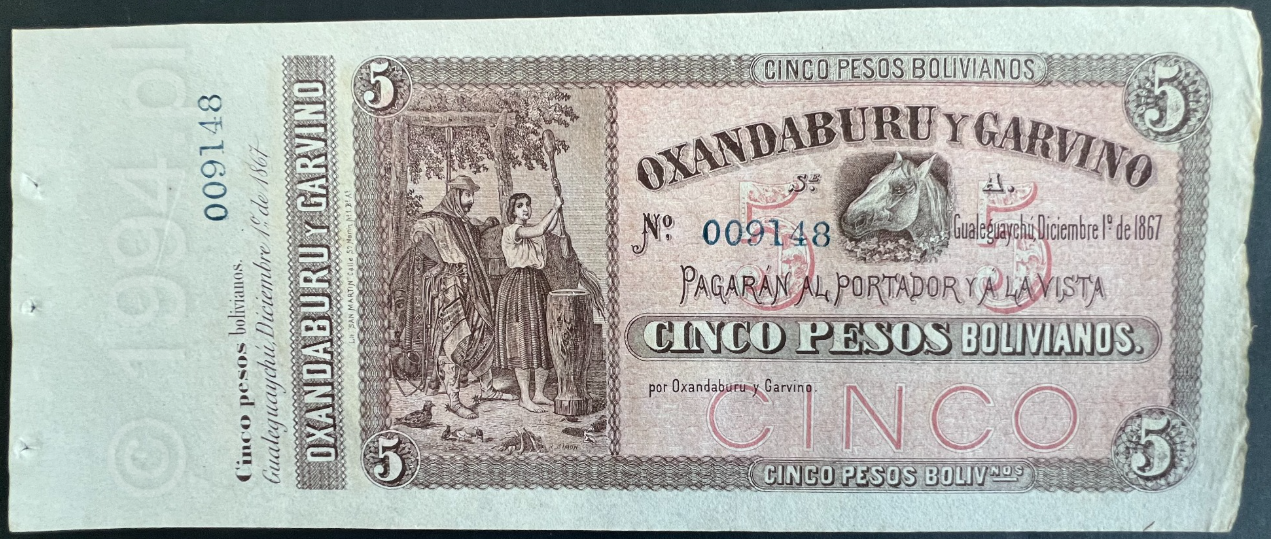
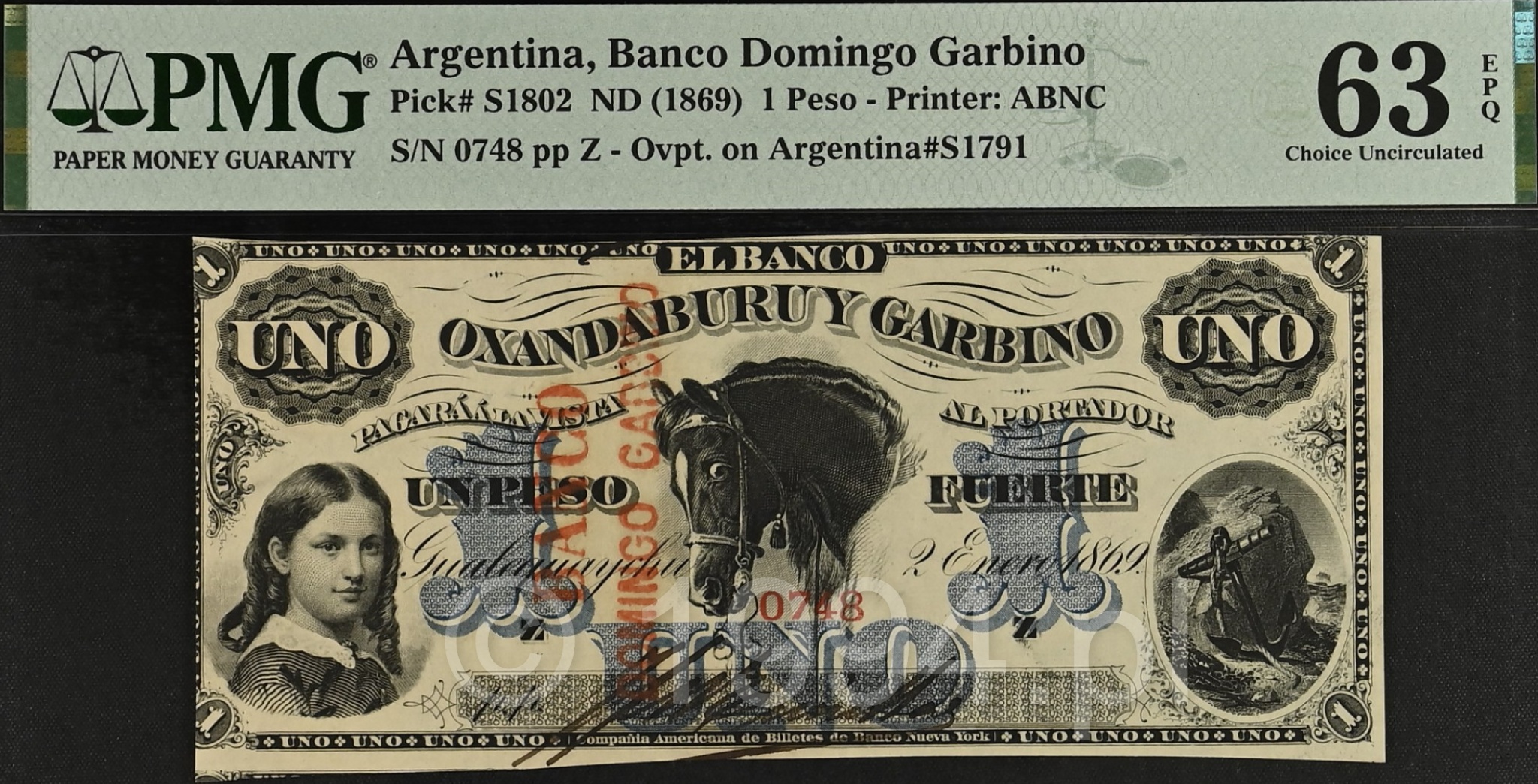
Across the face, the issuer appears prominently as OXANDABURU Y GARVINO. Historical records identify the partner as Domingo Luis Garbino, while the printed 1867 issue uses GARVINO with a V. This spelling is a defining feature of the 1867 partnership issue and provides a direct visual connection with the 5 Pesos Bolivianos remainder of the same year. The bank's 1869 series appears under the corrected GARBINO form, preserving a clear spelling progression between the two issues.
The principal monetary text states PAGARAN AL PORTADOR Y A LA VISTA and identifies the denomination as VEINTE PESOS BOLIVIANOS. Gualeguaychu, Diciembre 1 de 1867 appears at the right, while the blue serial number 008371 is positioned prominently within the central field. Large red 20 denomination devices are repeated throughout the design against an extensive green security framework.
The central vignette presents a detailed rural social scene showing two gaucho figures with a woman in an interior or working environment. The composition gives the denomination a strongly regional character and places Argentine rural life at the center of the note's visual identity. The red vignette is integrated into green geometric underprinting and surrounded by repeated numerical 20 devices, ornamental borders, denomination lettering, and fine security patterns.
The printing uses a vivid red-and-green palette. Red lettering, counters, denomination devices, and the central vignette sit over a broad green security field containing repeating geometric structures and micro-patterned ornament. This multicolor treatment gives the 20 Pesos its own visual identity within the 1867 partnership series and documents a distinct production approach for the denomination.
The note was printed by Litografia San Martin in Buenos Aires, whose imprint appears along the lower margin. Its production represents local Argentine security printing during a period when private issuers commissioned banknote work from both domestic lithographic establishments and major foreign security printers. The 20 Pesos records an important locally produced component of the Oxandaburu y Garvino issue.
The reverse is fully printed in a restrained brown tone. A large central 20 is enclosed by ornamental structures, with VEINTE PESOS extending horizontally through the middle and OXANDABURU Y GARVINO and GUALEGUAYCHU incorporated into the surrounding design. Additional 20 counters occupy the corners, creating a symmetrical denomination-focused reverse built from typography, numerical devices, ornamental framing, and fine patterned security work.
The denomination in Pesos Bolivianos reflects the monetary conditions of the Argentine interior during the 1860s, when Bolivian silver circulated extensively and served as an important standard in regional commerce. Expressing the bank's obligation directly in pesos bolivianos connected the paper instrument with a metallic monetary system already familiar to merchants and the public in Entre Rios and surrounding commercial networks.
The 1867 Oxandaburu y Garvino issue forms an early stage in the banking sequence represented by related material in this collection. The 1867 notes preserve GARVINO on the printed issue, while historical records identify the partner's surname as Garbino and the bank's 1869 series appears under the GARBINO spelling. Later material associated with Domingo Garbino continues the GARBINO form, allowing the surviving notes to document the changing institutional and printed identity across these closely related issues.
As a remainder, the note preserves the complete printed form before final execution for circulation. Its unsigned state, intact multicolor face, fully printed reverse, serial number 008371, and surviving attached format provide a direct record of the note as prepared for the bank.
Pick S1778r, this 1867 20 Pesos Bolivianos remainder documents the GARVINO-spelling phase of the Oxandaburu partnership through a locally printed two-sided note combining serial number 008371, red-and-green security printing, a gaucho social vignette, full denomination reverse, Gualeguaychu issue language, and Litografia San Martin production.