Collection PL

About 1994.pl
Results for “1800”
New Zealand 1916–1920 Bank of New Zealand £5 Red-Rose wartime specimen from the BNZ orange lineage, Pick S227s, serial prefix 7/180001–7/220000, PMG 65 EPQ Top Pop

New Zealand 1916-1920 - Bank of New Zealand £5 Red-Rose (Orange Lineage) with Serial Number Prefix Specimen (Pick S227s)

The specimen carries dual live serial prefixes (7/180001–7/220000), confirming its place within an active production range. The perforated CANCELLED across the signature panel prevented circulation, while the pencil annotation dated 29 September 1917 corresponds to the production record associated with the piece. PMG records this feature as Printer’s Annotation. Read more →

New ZealandSpecimen with Serial Number Prefix19165 PoundsPMG 65 EPQ Gem Uncirculated (Top Pop) Specimen5 PoundsRed-RoseBNZ Color LineageOrange LineageWith Serial PrefixPrinter AnnotationCANCELLED PerforationHigh DenominationBradbury WilkinsonBWCPick S227sBank of New ZealandPrivate Banknote EraPre-Reserve BankWartime IssueNew Zealand Banking HistoryMāori Portrait SeriesMaritime Economy NotesSecurity Printing HistoryNew Zealand191619201916–1920Top PopPMG 65 EPQMuseum GradeR8 Extremely RareAnnotationsHandwritten Annotations
Held
Austria 1800 Wiener Stadt Banco 1 Gulden issued note, Pick A29a, typographic Banco-Zettel design with value watermark in Arabic and Roman numerals

Austria 1800 - Wiener Stadt Banco 1 Gulden Issued Note (Pick A29a)

An issued 1 Gulden Banco-Zettel dated 1800 from the Wiener Stadt Banco, catalogued as Pick A29a. This denomination represents the foundation level of Austria’s first large-scale fiduciary paper money system, introduced in 1796 to stabilize state finances during prolonged military conflict and fiscal strain at the end of the eighteenth century. Read more →

AustriaIssued Note18001 GuldenPMG 63 Choice Uncirculated Issued NoteBanco-ZettelFiduciary Paper MoneyEarly State CurrencyTypographic BanknoteWiener Stadt BancoHabsburg Monetary SystemNapoleonic Era FinanceEveryday CirculationGaliciaZłoty ReńskiPolish Language TextAustrian Partition of PolandAustria1800PMG 63 Choice UncirculatedPick A29aMuseum Grade
Held
Austria 1800 Wiener Stadt Banco 5 Gulden issued note, Pick A33, featuring typographic design, blind embossed seals, and value watermark in Arabic and Roman numerals

Austria 1800 - Wiener Stadt Banco 5 Gulden Issued Note (Pick A33)

The 5 Gulden note of 1800, issued by the Wiener Stadt Banco, occupies a pivotal position within Austria’s early fiduciary paper money system known as Banco-Zettel. Introduced in 1796, this system marked the Habsburg Monarchy’s first sustained attempt to replace metallic circulation with state-backed paper currency, driven by the severe fiscal pressures of continuous warfare and structural budget deficits at the end of the eighteenth century. Read more →

AustriaIssued Note18005 GuldenIssued Note (PMG graded example) Issued Note5 GuldenWiener Stadt BancoBanco-ZettelEarly Fiduciary Paper MoneyAustrian Paper CurrencyHabsburg MonarchyAustrian EmpireState-Backed Paper MoneyPre-Industrial Security PrintingGaliciaZłoty ReńskiPolish Lands under Austrian RuleValue Watermark Arabic and Roman NumeralsBlind Embossed SealsTypographic Banknote DesignAustria1800Pick A33Museum Grade
Held
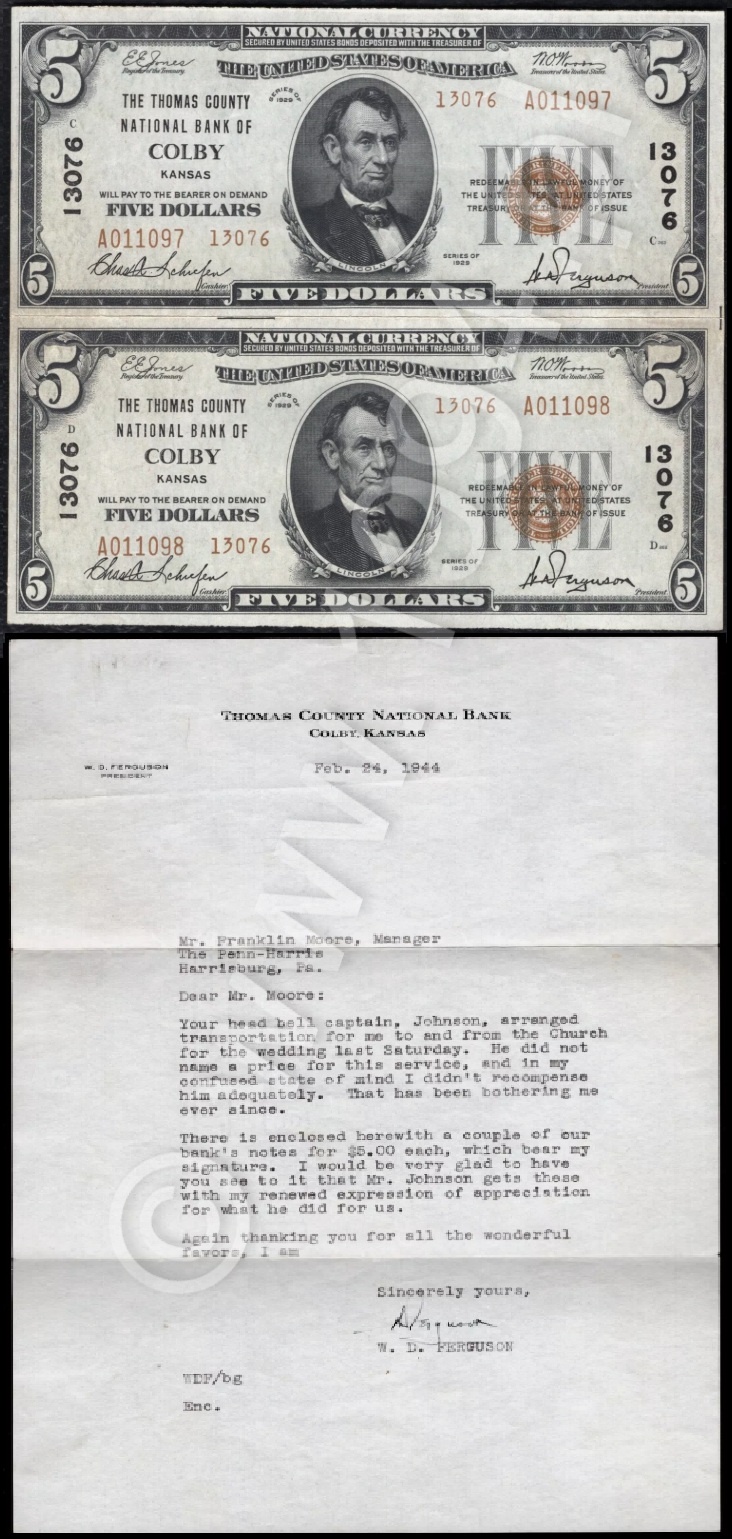
United States 1929 Type 2 uncut pair of 5 Dollars National Bank Notes from The Thomas County National Bank of Colby Kansas Charter 13076 with original 1944 W.D. Ferguson signed bank letter

United States 1929 - Uncut Pair of $5 Type 2 National Bank Notes with 1944 Bank Letter – The Thomas County National Bank of Colby, Kansas Charter 13076 W.D. Ferguson Provenance (Friedberg 1800-1)

Sets of this kind are virtually unknown. While individual Colby $5 notes appear occasionally in collections, none are recorded as uncut pairs with verified period letters. The Ferguson correspondence elevates this artifact from numismatic rarity to documentary history, capturing a moment when local banking, personal gratitude, and American currency art intersected on the same page. Read more →

United StatesNational Bank Note19295 Dollars (Uncut Pair)Uncirculated (Estimated Choice–Gem) 5 DollarsNational Bank NoteIssued NoteNational Bank Note Provenance SetType 2Uncut PairColbyKansasCharter 13076W.D. FergusonProvenance Letter1944 Correspondence1922Small Size NationalBank HistoryPick UnlistedMuseum GradeR9 Extremely RareUnique
Held
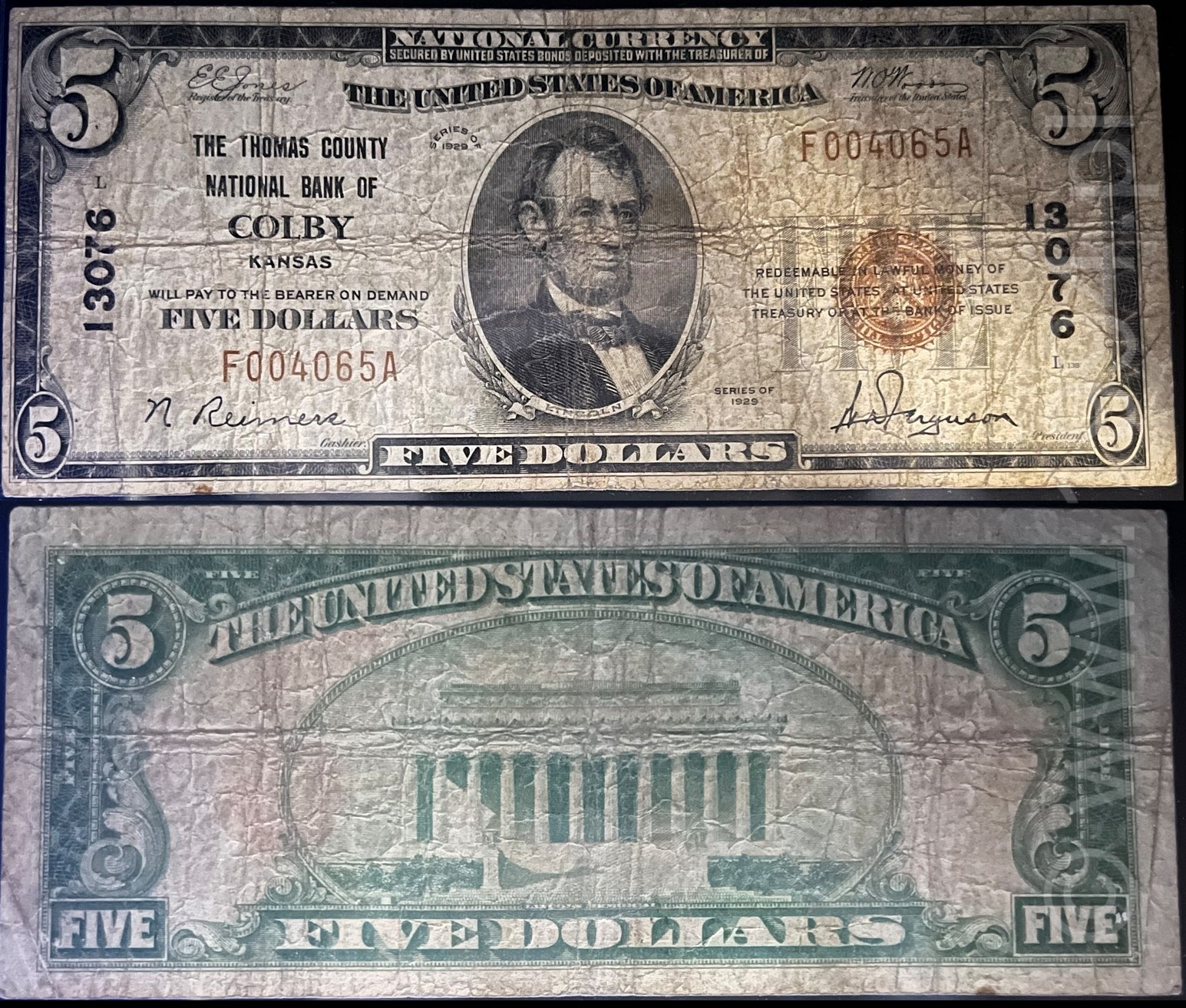
United States 1929 Type 1 - 5 Dollars National Bank Note The Thomas County National Bank of Colby Kansas Charter 13076 raw circulated example with signatures of N Reimers and W D Ferguson

United States 1929 - 5 Dollars Type 1 National Bank Note - The Thomas County National Bank of Colby, Kansas Charter 13076 (Friedberg 1800-1)

Circulated five-dollar note from The Thomas County National Bank of Colby, Kansas (Charter 13076), Series of 1929 Type 1. This example represents the true working currency of the Great Plains during the Depression years-money that passed through farms, shops, and local hands in northwest Kansas at a time when the nation’s economy was in flux. Read more →

United StatesNational Bank Note19295 DollarsRaw Circulated (Good–Very Good, estimated) 5 DollarsType 1National Bank NoteIssued NoteColbyKansasCharter 13076Lincoln1929Circulated ExampleGreat DepressionBanking History
Held
Edo-period Japanese 5 Momme Silver hansatsu printed by woodblock on handmade washi paper, showing vertical kanji inscriptions, circular and boxed validation seals, an oil merchant seal, and a reverse design with Daikokuten, rice bale symbolism, and ornamental wave-pattern security carving.

Japan 1800 - Edo Period 5 Momme Silver Hansatsu with Daikokuten Reverse and Oil Merchant Validation Seal Woodblock Printed on Handmade Washi Paper

The reverse gives the note its strongest visual identity. It features Daikokuten, the deity of wealth, grain, abundance, and good fortune. Daikokuten is traditionally associated with rice bales and the mallet of fortune, making the image perfectly suited to a currency instrument rooted in value, trust, and prosperity. On a hansatsu, this kind of imagery was not just religious ornament. It added moral and symbolic authority, presenting the note as a protected and fortunate object within the commercial life of the community. Read more →

JapanHansatsu18005 Momme SilverFine to Very Fine estimated JapanJapan 1800Year 1800Edo PeriodLate Edo PeriodTokugawa EraTokugawa ShogunatePre-Meiji JapanHansatsuFeudal Domain NoteDomain-Issued Local NoteRegional Paper MoneyLocal CurrencyFive Momme Silver5 Momme SilverSilver Five MommeGin Go MonmeMomme Weight StandardSilver CurrencyCommodity CurrencyOil Merchant SealOil Commodity SealMerchant ScripRegional Exchange HouseCommodity-Linked CurrencyMerchant ExchangeRice CurrencyEdo Monetary SystemWoodblock Printed NoteHandmade Washi PaperVermilion SealCircular SealBoxed Validation SealCalligraphic Security TextWave Pattern ReverseAnti-Counterfeiting Woodblock DesignDaikokutenDeity of WealthDeity of AbundanceRice Bale MotifMallet of FortuneReligious MotifProsperity SymbolismHistoric CurrencyAsian Paper MoneyEighteenth CenturyNineteenth CenturyPick UnlistedNot Listed in PickRarityMuseum GradeHistory
Held
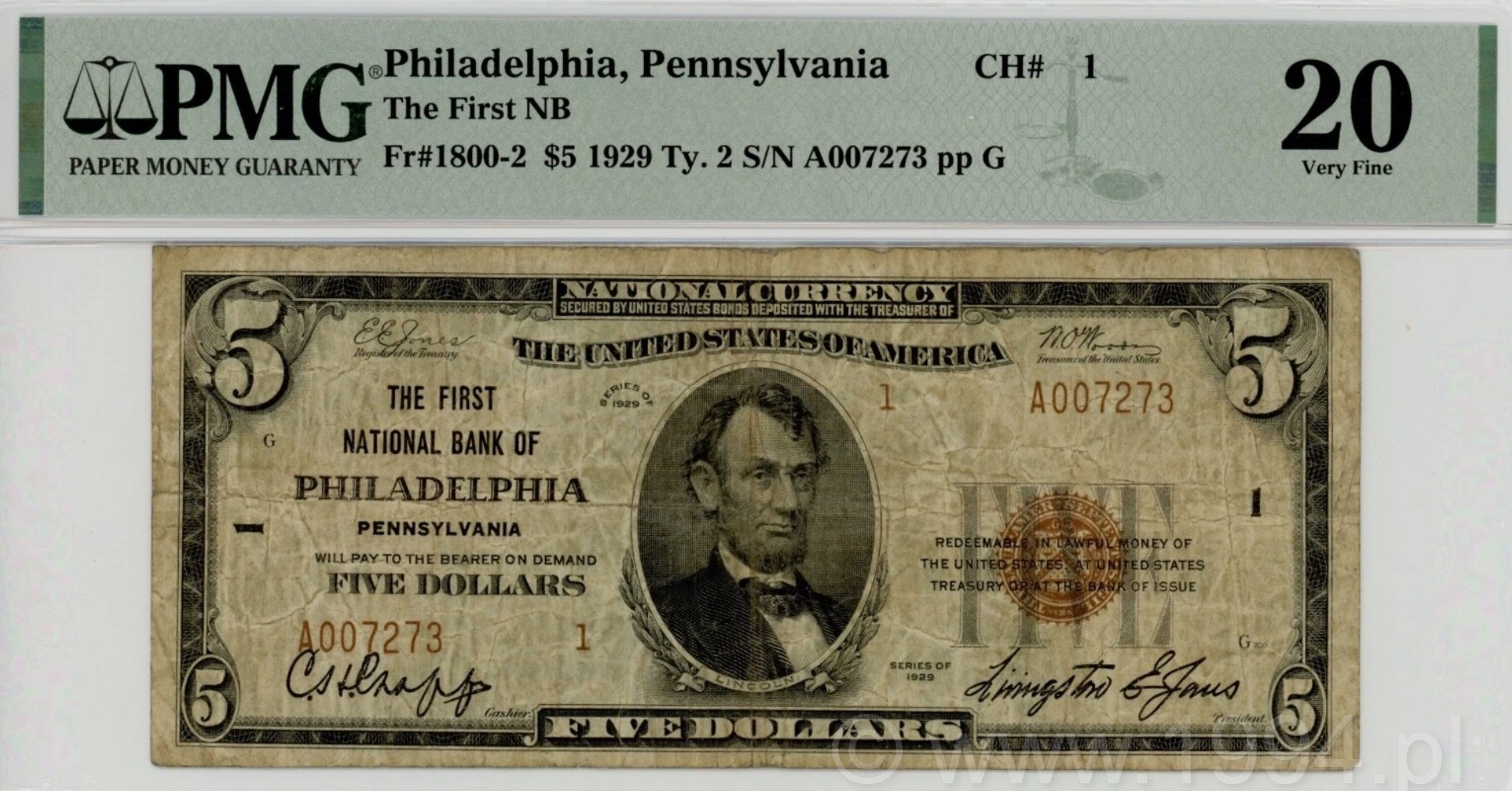
United States 1929 Type 2 - 5 Dollars National Bank Note The First National Bank of Philadelphia Pennsylvania Fr 1800-2 Charter 1 PMG 20 Very Fine

United States 1929 - 5 Dollars Type 2 National Bank Note - The First National Bank of Philadelphia, Pennsylvania Charter 1 (Fr. 1800-2)

This example is a Series of 1929 Type 2 five-dollar issue, distinguished from the earlier Type 1 by the addition of the bank’s charter number printed twice in brown ink within the Treasury seal and serial number fields. The central portrait of Abraham Lincoln and the black Treasury overprint tie the note’s aesthetic to the concurrent Federal Reserve designs while retaining the local bank title and signatures that define National Bank Notes. Friedberg designates this issue as 1800-2. Read more →

United StatesNational Bank Note19295 DollarsPMG 20 Very Fine 5 DollarsNational Bank NoteIssued NoteType 2PhiladelphiaPennsylvaniaCharter 1Low CharterLincoln1929PMG 20 VFFederal Banking History
Held
Portugal 1799 Real Erario 20000 reis apólice issued in Lisboa, serial number 37723 in red, blind embossed seal on the face, no red overprint present, with multiple official ink seals on the reverse

Portugal 1799 - Real Erario 20000 Reis Apólice, Original Issue, No Overprint, Lisboa No. 37723

The reverse is densely documented with multiple black ink official seals bearing heraldic devices and circular legends. Clearly legible dated impressions correspond to successive years of administrative handling: 1800, 1801, 1809, and 1811. Together, these seals demonstrate that the apolice remained in active fiscal recognition and was repeatedly validated by Treasury authorities for more than a decade following its original issue. The document therefore combines a clean original face with a substantial record of official administrative use preserved on the reverse. Read more →

PortugalPublic Debt Bond179920000 ReisVery Fine Public Debt BondApolice20000 ReisPayable to BearerBlind Embossed SealMultiple Reverse SealsNo OverprintOriginal IssuePre War of the BrothersReal ErarioLisboaPortuguese Treasury FinanceRoyal Era Fiscal PaperEighteenth Century State DebtAdministrative Validation SealsFiscal Control HistorySecurity Printing HistoryPortuguese Monetary HistoryPortugal17991811Museum GradeR9 Extremely RareTreasury BondShort-Term Treasury BondOne-Year MaturityInterest-Bearing DebtCirculating Treasury PaperFiduciary Paper MoneyEarly Portuguese Paper MoneyCirculating Public DebtGovernment Debt InstrumentPublic Loan InstrumentTreasury BillShort-Term Government DebtOne-Year Treasury InstrumentBearer Treasury NotePortuguese Paper MoneyEarly Paper CurrencyRoyal Treasury NoteInterest-Bearing Treasury NoteState Debt PaperCirculating Government DebtHistoric Treasury InstrumentGovernment BondSovereign DebtRoyal Treasury BondTreasury DebtBearer BondGovernment Paper MoneyCirculating BondPublic Debt InstrumentPortuguese Government DebtPortuguese Treasury BondPortuguese Treasury Bill18th Century Paper Money18th Century Government DebtEarly Government PaperHistoric Public DebtRoyal Erario BondReal Erario ApolicePortuguese Apolice1799 Portugal1799 Treasury Bond1799 Treasury Bill20000 Reis Apolice20000 Reis Treasury Bond20000 Reis Treasury Bill
Held
↑ Top