Collection PL

About 1994.pl
Results for “1870”
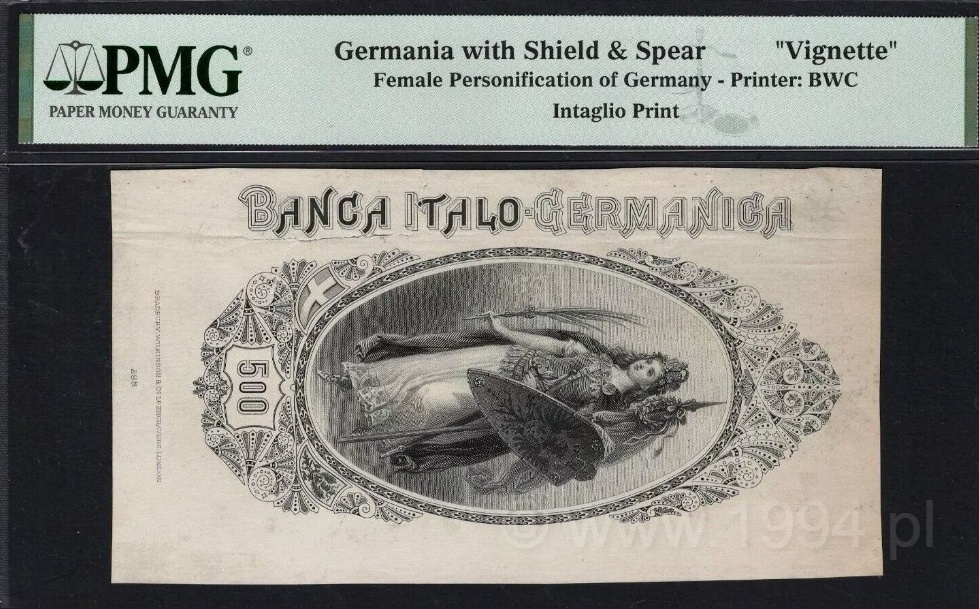
Italy 1871 Germania with shield and spear vignette die proof engraved by Bradbury Wilkinson for the Banca Italo-Germanica 500 Lire design

Italy 1871 - Germania with Shield and Spear Vignette Die Proof Used on 500 Lire (Pick PS977)

This engraved vignette proof depicting 'Germania with Shield and Spear' was produced by Bradbury, Wilkinson & Co. in London for the Banca Italo-Germanica during the early 1870s. The impression preserves the complete ornamental vignette prepared for the proposed 500 Lire banknote design, including the decorative frame and denomination tablet engraved for integration into the final banknote layout. Read more →

ItalyVignette1871-PMG Certified (Vignette Proof) VignetteVignette ProofIntaglio PrintSteel EngravingBanknote EngravingGermania AllegoryGermania with Shield and SpearFemale Personification of GermanyImperial Eagle ShieldBradbury WilkinsonBWCSecurity Printing19th Century EngravingEngraving Approval StageBanca Italo-GermanicaItalo-German Banking RelationsEuropean Banking HistoryGerman Unification EraItaly1871500 LirePS977Museum Grade
Held
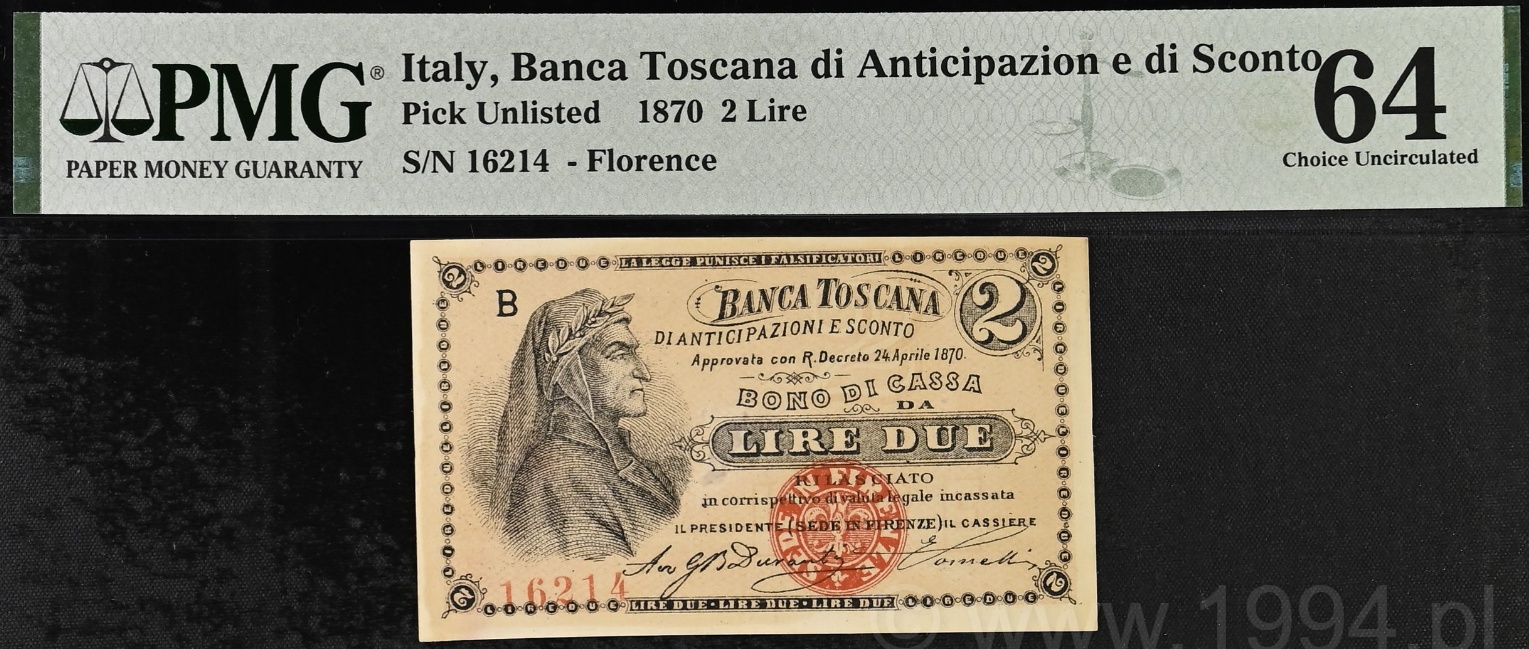
Italy 1870 Banca Toscana di Anticipazioni e di Sconto 2 Lire Pick Unlisted PMG 64 Choice Uncirculated

Italy 1870 - Banca Toscana di Anticipazioni e di Sconto 2 Lire (Pick Unlisted)

Florentine two‑lire "Bono di Cassa" authorized by Royal Decree of 24 April 1870 for the Banca Toscana di Anticipazioni e di Sconto. The face shows Dante Alighieri at left, a boldly engraved LIRE DUE tablet at center, and a red circular control seal of Florence-typical of Tuscan bank instruments immediately after unification. Read more →

ItalyPrivate Bank Cashier’s Note18702 LirePMG 64 Choice Uncirculated ItalyPick UnlistedBanca Toscana2 LirePrivate Bank NoteFlorence1870Cashier’s NoteUnlisted
Held
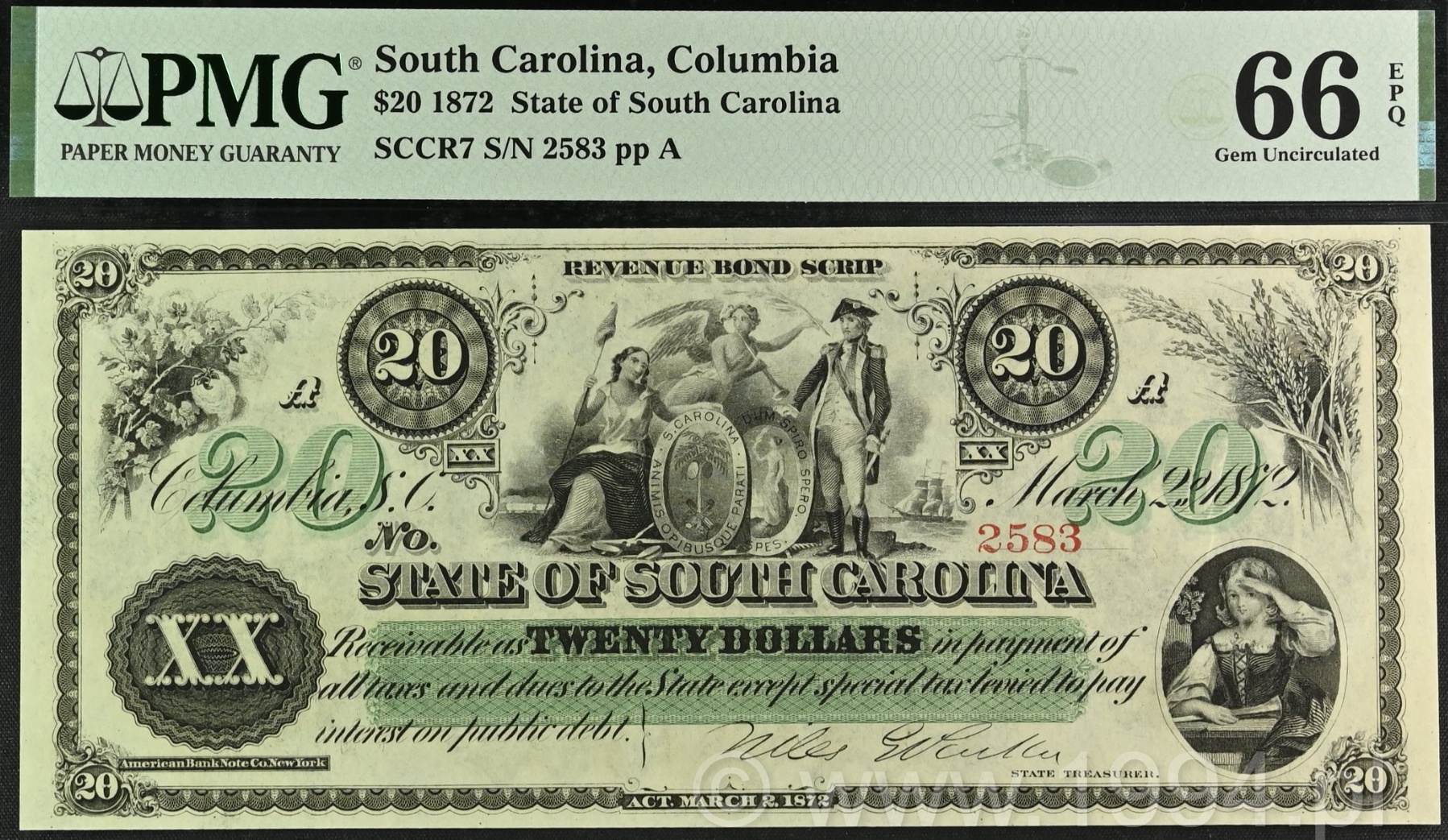
United States 1872 State of South Carolina 20 Dollars Revenue Bond Scrip Columbia Act March 2 1872 PMG 66 EPQ Gem Uncirculated

United States 1872 – State of South Carolina $20 Revenue Bond Scrip Act of March 2 1872 Columbia Issue

The $20 Revenue Bond Scrip of the State of South Carolina, dated March 2, 1872, represents one of the most ornate and historically revealing fiscal issues of the Reconstruction era. Authorized by the Act of March 2, 1872, these notes were used by the state government to pay outstanding obligations and to serve as tax receipts during a period of severe post–Civil War financial strain. Printed by the American Bank Note Company in New York, the scrip combined fine engraving, symbolic imagery, and the technical artistry characteristic of the firm’s early 1870s production. Read more →

United StatesState Issue187220 DollarsPMG 66 EPQ Gem Uncirculated United StatesSouth CarolinaColumbiaState IssueRevenue Bond Scrip1872ABNCAmerican Bank Note CompanyReconstruction EraPMG 66 EPQGem Uncirculated20 Dollars
Held
Edo-period Japanese 5 Momme Silver hansatsu printed by woodblock on handmade washi paper, showing vertical kanji inscriptions, circular and boxed validation seals, an oil merchant seal, and a reverse design with Daikokuten, rice bale symbolism, and ornamental wave-pattern security carving.

Japan 1800 - Edo Period 5 Momme Silver Hansatsu with Daikokuten Reverse and Oil Merchant Validation Seal Woodblock Printed on Handmade Washi Paper

This hansatsu belongs to the final pre-modern monetary landscape before the Meiji reforms of the nineteenth century. In the 1870s, Japan abolished the old domain currencies and moved toward a centralized national money system. Surviving notes like this preserve the older world that came before: a world where paper money could be a silver certificate, a merchant instrument, a religiously charged object, and a regional promise of value all at the same time. Read more →

JapanHansatsu18005 Momme SilverFine to Very Fine estimated JapanJapan 1800Year 1800Edo PeriodLate Edo PeriodTokugawa EraTokugawa ShogunatePre-Meiji JapanHansatsuFeudal Domain NoteDomain-Issued Local NoteRegional Paper MoneyLocal CurrencyFive Momme Silver5 Momme SilverSilver Five MommeGin Go MonmeMomme Weight StandardSilver CurrencyCommodity CurrencyOil Merchant SealOil Commodity SealMerchant ScripRegional Exchange HouseCommodity-Linked CurrencyMerchant ExchangeRice CurrencyEdo Monetary SystemWoodblock Printed NoteHandmade Washi PaperVermilion SealCircular SealBoxed Validation SealCalligraphic Security TextWave Pattern ReverseAnti-Counterfeiting Woodblock DesignDaikokutenDeity of WealthDeity of AbundanceRice Bale MotifMallet of FortuneReligious MotifProsperity SymbolismHistoric CurrencyAsian Paper MoneyEighteenth CenturyNineteenth CenturyPick UnlistedNot Listed in PickRarityMuseum GradeHistory
Held
Honduras 1873 5 Pesos Billete de Tesoreria Comayagua Unlisted

Honduras 1873 - 5 Pesos Treasury Note Billete de Tesoreria, Comayagua (Pick Unlisted)

Historical context: In the 1870s Honduras relied on treasury vales and billetes to finance operations before standardized banknote issues. These pieces circulated locally, were accepted for taxes, and were later exchanged for formal notes when funding allowed. Surviving signed and endorsed examples from 1873 are scarce, as most were redeemed and destroyed. This example retains clear date, city, and redemption annotations-an instructive artifact of early Central American public finance. Read more →

HondurasTreasury Note18735 PesosUncertified (Manuscript Signed, Endorsed/Converted) HondurasTreasury Note (Billete de Tesoreria)Billete de TesoreriaTreasury NoteFiscal NoteUnlistedPick Unlisted5 Pesos1873ComayaguaHandwrittenEndorsedConverted to BanknotesEarly Central AmericaNumismatic HistoryEducationalAnnotationsHandwritten Annotations
Held
1875 British Consulate Alexandria document with tied 5 Shillings Victoria Consular Service revenue stamp

1875 - 5 Shillings Victoria Consular Revenue Tied Diplomatic Document (British Consulate, Alexandria)

Because consular paperwork was treated as sensitive legal material, most documents remained in administrative files, were destroyed during routine clearances, or survived only as cut-down fragments saved for their stamps. Complete high-fee certificates from the 1870s-preserving full text, signatures, seals, and a tied 5/– adhesive-are exceptionally uncommon. Read more →

EgyptGovernment Document18755 Shillings Consular ServiceUncertified (Fine–VF, Complete Document) Legal DocumentGovernment DocumentConsular DocumentConsular Revenue5 ShillingsHigh-Value RevenueVictorian FiscalFiscal HistoryExtraterritorial JurisdictionCapitulations SystemBritish EmpireBritish ConsulateConsular CourtDiplomaticColonial Legal HistoryCross-Border AdministrationEgyptAlexandriaOttoman EgyptKhedivial Egypt1875Queen VictoriaMuseum GradeR6 Extremely RareAnnotationsHandwritten Annotations
Held
Issued Serie A No. 23322 Banco de Zaragoza 100 reales vellón, 1 May 1857, Pick S451b

Spain 1857 - Banco de Zaragoza 100 Reales Vellón Serie A Issued Note No. 23322 (Pick S451b)

Pick S451b denotes the fully signed circulation form of this emission. Nearly all issued notes from Banco de Zaragoza were redeemed and destroyed during the monetary reforms and centralisation of the 1870s, leaving an extremely small number of survivors. This note, with full signatures and strong detail, likely belongs to a group of fewer than five to ten existing issued examples. Read more →

SpainIssued Note1857100 Reales VellónExtremely Fine (Issued, Fully Signed) Issued NoteSerie ASerial 23322100 RealesPick S451bBanco de ZaragozaSpanish Provincial IssuePrivate BanknoteReales Vellon19th Century SpainCirculation IssueManuscript SignaturesRegional FinanceMonetary HistorySpain1857R8 Extremely RareMuseum Grade
Held
Martinique 1870 Banque de la Martinique 1 franc unissued cheque, Saint-Pierre issue, unused condition

Martinique 1870 - Banque de la Martinique 1 Franc Unissued Cheque (Pick P.5A)

The Banque de la Martinique was established as part of France’s overseas banking framework, created to stabilize currency supply and facilitate commercial credit in the Caribbean colonies. Unlike metropolitan France, where centralized banking instruments were already standardized, colonial institutions relied on a mixture of notes, cheques, receipts, and drafts adapted to local economic realities. This cheque format reflects that transitional monetary environment, bridging formal banking practices and localized colonial commerce. Read more →

MartiniqueUnissued Cheque18701 FrancUncirculated Unissued Cheque1 FrancBanque de la MartiniqueColonial Banking InstrumentFrench Colonial FinancePick P.5AColonial Banking HistoryFrench Overseas TerritoriesCaribbean Monetary History19th Century BankingDocumentary Financial InstrumentsSecurity Printing HistoryFrench Engraving TraditionMartinique1870Museum GradeR8 Extremely Rare
Held
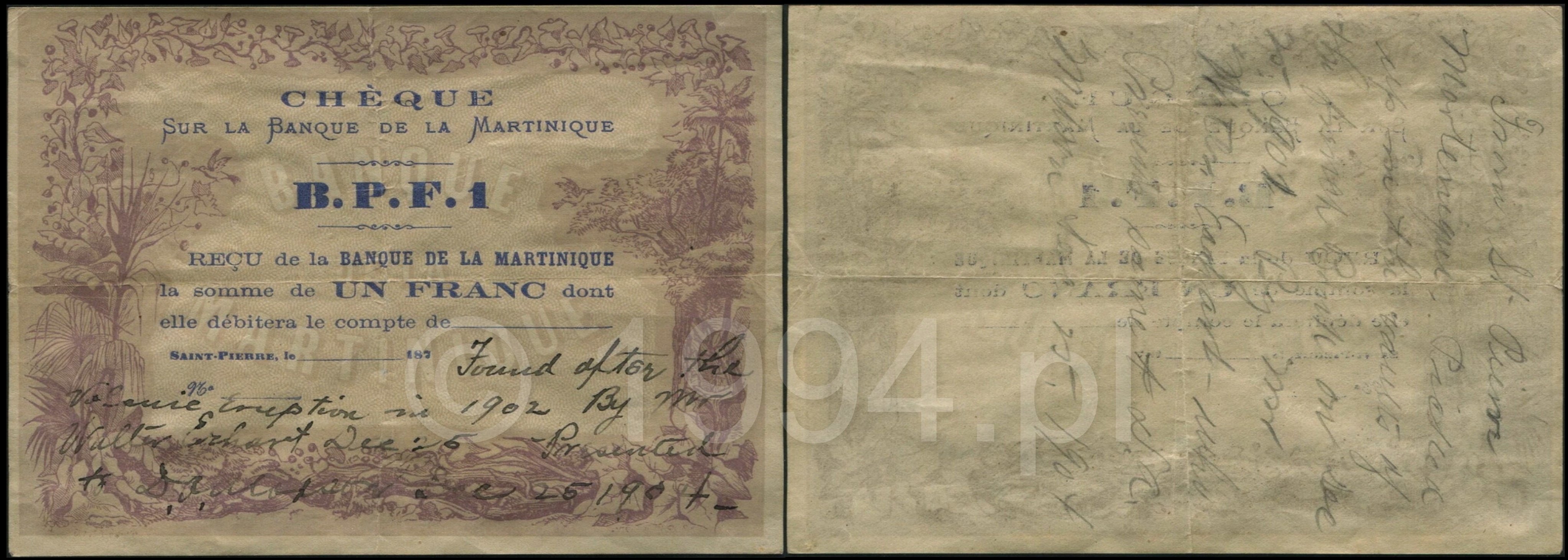
Martinique 1870 Banque de la Martinique 1 franc cheque recovered from the ruins of Saint-Pierre after the 1902 Mount Pelée eruption, with contemporary handwritten provenance notes

Martinique 1870 - Banque de la Martinique 1 Franc Cheque Recovered After the 1902 Mount Pelée Eruption (Pick P.5A)

Saint-Pierre, prior to its destruction, was the economic and administrative heart of Martinique and a central node in the island’s banking network. The annihilation of the city in 1902 resulted in the near-total loss of financial records, currency, and instruments held within its institutions. Paper banking artifacts that can be conclusively tied to the eruption are extraordinarily rare, and those bearing explicit contemporary inscriptions identifying their recovery context are rarer still. Read more →

MartiniqueDisaster Recovery Cheque18701 FrancVery Fine Disaster Recovery Cheque1 FrancBanque de la MartiniqueMount Pelee EruptionSaint Pierre DestructionColonial Bank RuinsPick P.5AColonial Banking HistoryFrench Overseas TerritoriesCaribbean Monetary HistoryNineteenth Century BankingDisaster Recovered ArtifactDocumentary Financial InstrumentsSecurity Printing HistoryFrench Engraving TraditionMartinique18701902Museum GradeR9 Extremely RareUniqueAnnotationsHandwritten Annotations
Held
Brazil Imperial Treasury ten mil réis contemporary counterfeit, Pick A231x, PMG 64 EPQ Choice Uncirculated, period forgery from the Dom Pedro II era

Brazil ca. 1852–1870 - Imperial Treasury of Brazil 10 Mil Réis Contemporary Counterfeit (Pick A231x)

According to current publicly available PMG population data, this is the only EPQ-designated example recorded for the Pick A231x contemporary counterfeit type. While multiple examples of this counterfeit are known and graded, none approach this level of preservation or paper quality. Its significance therefore lies not in type rarity alone, but in its status as a condition outlier preserving the physical characteristics of a circulating nineteenth-century forgery in near-original state. Read more →

BrazilContemporary Counterfeit185210 Mil RéisPMG 64 EPQ Choice Uncirculated Contemporary CounterfeitImperial Treasury of BrazilEmpire of Brazil10 Mil RéisPeriod ForgeryExceptional Paper QualityEPQTop PopNineteenth Century CurrencyBrazilian EmpireDom Pedro II EraMonetary Security HistoryCounterfeit StudiesBrazil18521870Pick A231xPMGPMG 64 EPQR7 RareCondition R8 Extremely RareMuseum Grade
Held
Uruguay 1870 El Banco Franco Platense 20 Pesos Dos Doblones with steamship vignette printed by American Bank Note Company

Uruguay 1870 - El Banco Franco Platense 20 Pesos Dos Doblones Issued Note (Pick S173a)

This 20 Pesos note was issued by El Banco Franco Platense in Montevideo and dated 1 de Agosto de 1870. The denomination is expressed both as Veinte Pesos and Dos Doblones, reflecting contemporary dual-value terminology within Uruguay's evolving monetary structure during the late nineteenth century. Read more →

UruguayIssued Note187020 Pesos Dos DoblonesChoice Uncirculated Issued Note20 PesosDos DoblonesSteamship VignetteAllegorical Female PortraitOrange Reverse GuillocheEl Banco Franco PlatenseABNCAmerican Bank Note CompanyCommercial Bank IssueLate 19th Century UruguayUruguay1870Pick S173aMuseum Grade
Held
Argentina 1869 Banco Domingo Garbino 5 Pesos Fuertes issued note, Pick S1803, overprint on Banco Oxandaburu y Garbino Pick S1792, red BANCO DOMINGO GARBINO overprint, PMG 58 Choice About Uncirculated

Argentina 1869 - Banco Domingo Garbino, 5 Pesos Fuertes Issued Note with Red Overprint (Pick S1803)

Historically, these notes belong to Argentina's fragmented late-1860s and early-1870s monetary environment, when private and provincial banking institutions issued paper obligations alongside multiple metallic currency standards. The transition from the 1867 Pesos Bolivianos partnership notes to the 1869 Pesos Fuertes series documents a change in monetary denomination, while the subsequent BANCO DOMINGO GARBINO overprint records the later institutional reuse of the earlier printed currency. Read more →

ArgentinaIssued Note18695 Pesos FuertesPMG 58 Choice About Uncirculated Issued NoteOverprint TypeRed OverprintBANCO DOMINGO GARBINO OverprintPick S1803Pick S17925 Pesos FuertesABNCAmerican Bank Note CompanyEngraved Security PrintingProvincial BanknoteRegional Convertibility19th Century BankingBanco Oxandaburu y GarbinoBanco Domingo GarbinoGarbinoGarbino Spelling1869 GARBINO IssueProvisional OverprintRemainder ConversionOverprint ValidationMonetary HistoryLatin American NumismaticsArgentina1869PMG 58R7 Very RareMuseum Grade
Held
↑ Top