Collection PL

About 1994.pl
Results for “1872”
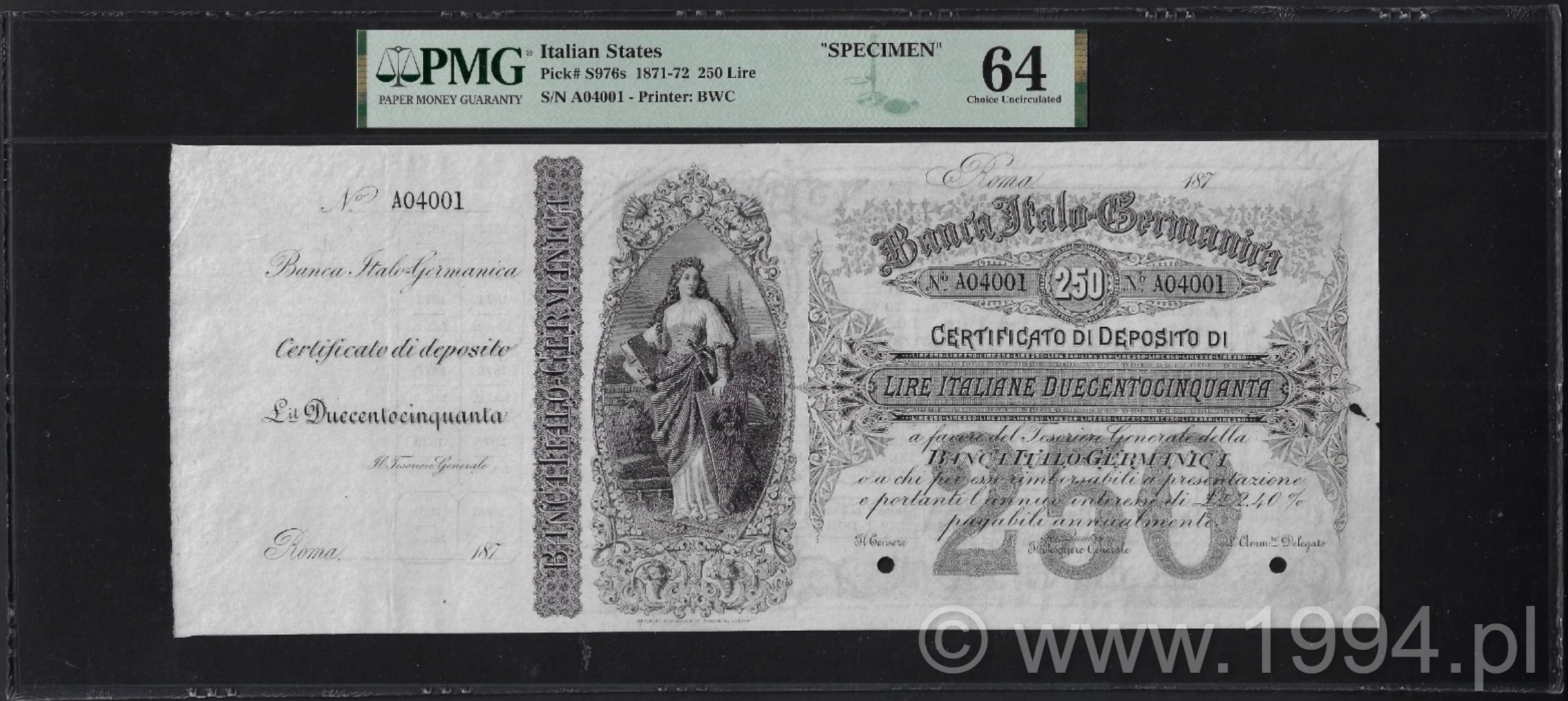
Italy 1871–1872 Banca Italo-Germanica 250 Lire specimen, Pick S976s, Bradbury Wilkinson & Co., PMG 64 Top Pop

Italy 1871–1872 - Banca Italo-Germanica 250 Lire Specimen (Pick S976s)

The note’s allegorical figure-Italia armed with shield and lance-embodies the nationalist mythmaking of the period, projecting unity, legitimacy, and sovereign stability at a time when the country’s financial systems were anything but stable. Its presence on a private banknote is historically significant: it illustrates how commercial institutions attempted to appropriate national symbols to bolster their credibility in a fragmented monetary ecosystem that lacked central authority. In this sense, the note functions both as a financial instrument and a cultural-political statement. Read more →

ItalySpecimen1871250 LirePMG 64 (Top Pop) Private BankOversizedSpecimenDouble Punch HolePunch Cancelled250 LireEngraved Security PaperProof and Archive PieceBradbury WilkinsonBWCPick S976sItalian StatesPost Unification ItalyItalian Banking HistoryFailed Banknote IssuesGerman Capital in Italy19th Century FinanceNational AllegorySecurity Printing HistoryRome Banking ExperimentsUnissued Banknote ProjectItaly1871PMG 64Top PopR9 Extremely RareUniqueMuseum Grade
Held
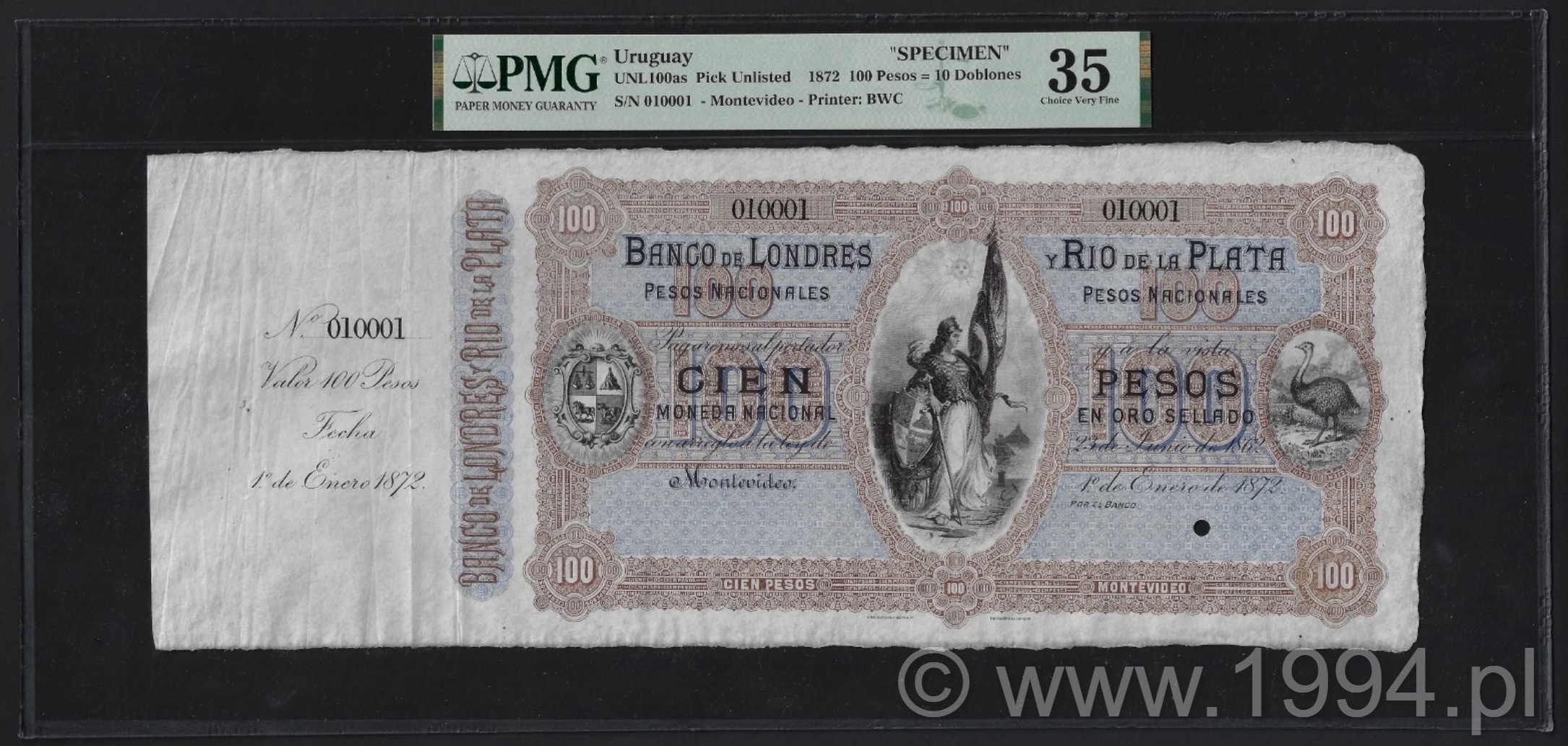
Uruguay 1872 100 Pesos equals 10 Doblones printer archival specimen, early serial number 010001, printed by Bradbury Wilkinson

Uruguay 1872 - Banco de Londres y Rio de la Plata 100 Pesos = 10 Doblones Specimen (Pick Unlisted)

A printer’s archival specimen of the 1872 issue of the Banco de Londres y Rio de la Plata, denominated 100 Pesos Nacionales with an explicit equivalence to 10 Doblones in gold. This dual-denomination construction represents one of the most ambitious monetary experiments undertaken in nineteenth-century Uruguay, attempting to anchor paper currency directly to a fixed gold value at a time of persistent instability and public distrust in fiduciary issues. Read more →

UruguaySpecimen1872100 Pesos = 10 DoblonesPMG 35 Choice Very Fine SpecimenPrinter Archival SpecimenDual DenominationGold EquivalenceEarly Pull Serial 010001Oversized FormatBradbury WilkinsonBWCLondon Security PrintingNineteenth Century EngravingArchival Reference NoteGold Standard ExperimentPeso Doblone ParityBanco de Londres y Rio de la PlataLatin American Monetary HistoryNineteenth Century State FinanceUruguayMontevideo1872Pick UnlistedMuseum GradeR9 Extremely RareUnique
Held
Argentina 1871 Banco de Londres y Rio de la Plata 10 Pesos Rosario control specimen, serial 000001, punch cancelled, with period pencil annotation dated February 1872

Argentina 1871 - Banco de Londres y Rio de la Plata 10 Pesos Rosario Specimen No. 000001 (Pick Unlisted)

A handwritten pencil annotation appears at the upper left margin, consistent with nineteenth century office handling and dating to February 1872. This notation post dates the printed issue date and reflects routine administrative processing rather than later collector intervention. Read more →

ArgentinaSpecimen187110 Pesos Moneda BolivianaUncirculated (Archival Control Specimen, Serial 000001) Specimen BanknotePick UnlistedSingle Instance Control SpecimenSerial Number 000001Punch CancelledArchival Control MaterialBanco de Londres y Rio de la PlataBritish Controlled BankingRosario BranchProvincial Private BankingMoneda BolivianaFragmented Monetary SystemNineteenth Century ArgentinaJose de San MartinNational IconographyEngraved Portrait VignetteBradbury WilkinsonBWCBritish Security PrintingExport Engraved NotesArgentinaRosario1871Handwritten Archival AnnotationMuseum GradeR9 Extremely RareUniqueAnnotationsHandwritten Annotations
Held
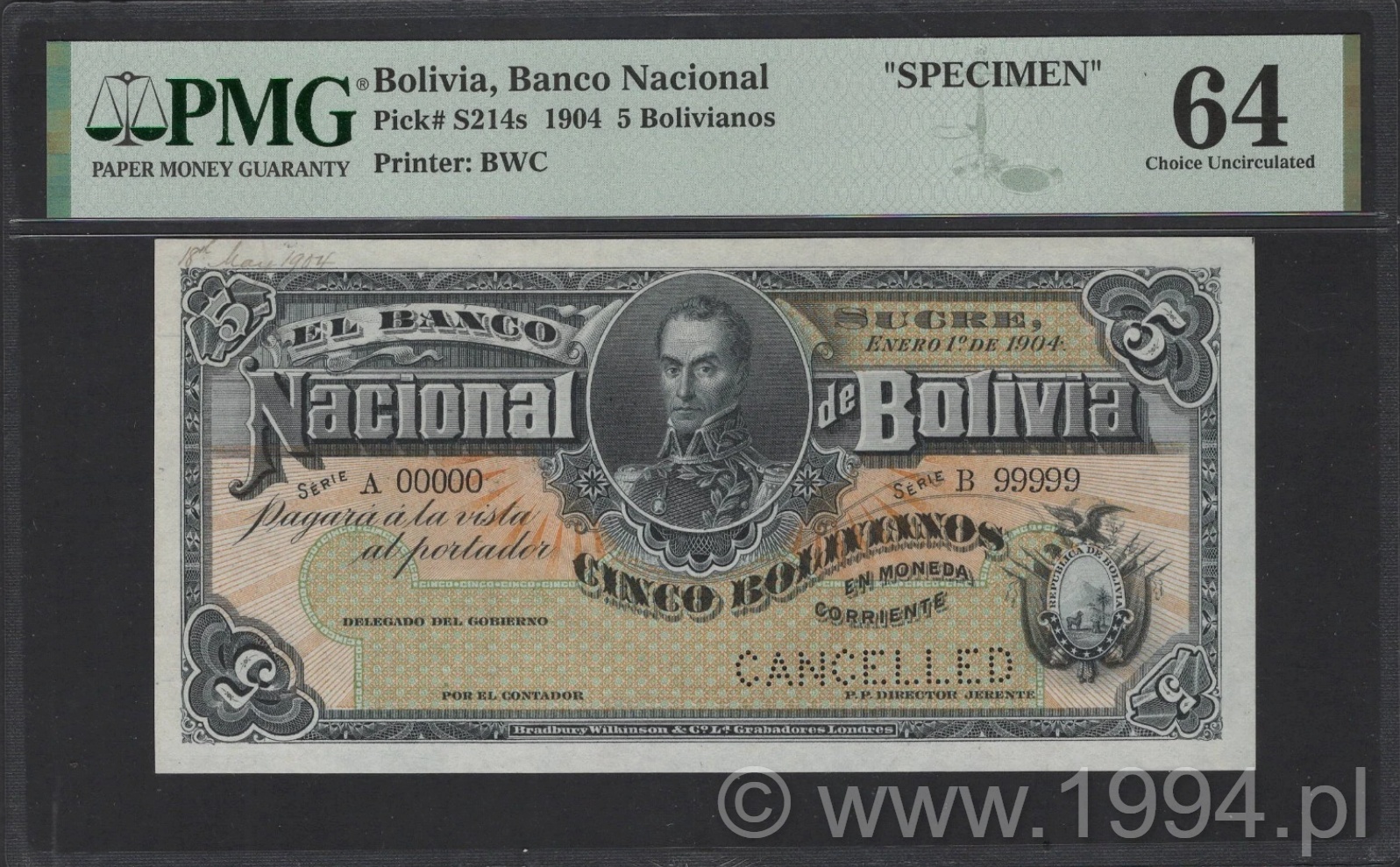
Bolivia 1904 Banco Nacional 5 Bolivianos specimen, PMG 64

Bolivia 1904 - Banco Nacional 5 Bolivianos (Specimen)

The Banco Nacional de Bolivia, founded in 1872, became the most important commercial bank in the country by the turn of the 20th century, serving as a de facto national issuing authority before Bolivia developed a centralized reserve structure. Its notes were critical to trade and daily transactions, yet most circulated examples suffered heavy attrition given the harsh climate, limited banking infrastructure, and chronic political instability. The Cerro Rico vignette carried particular symbolic weight: while it implied national prosperity and backed the promise of value, by 1904 the collapse of world silver prices had already undermined the very foundation of Bolivia’s fiscal stability. Read more →

BoliviaSpecimen19045 BolivianosPMG 64 (Top Pop) S214sTop PopBanco NacionalBradbury WilkinsonBWCBolivia 20th CenturyBolivia19045 BolivianosAnnotationsHandwritten Annotations
Held
Uruguay 1872 P. Valdez & Co. Tacuarembo 10 Centesimos unissued note with harvest scene, lith. Bauer, Rincon 72 Montevideo

Uruguay 1872 - P. Valdez & Co., Tacuarembo 10 Centesimos Unissued (Pick Unlisted)

Unissued 10 Centesimos note dated 1 July 1872 from P. Valdez & Co. of Tacuarembo (then San Fructuoso), printed by Lit. F. Bauer, Rincon 72, Montevideo. Pablo Valdez was a leading figure of 19th-century Tacuarembo: a stage-coach operator connecting San Fructuoso with Paso de los Toros, the town’s first agent of livestock brands and marks, and founder of the large soap works Jaboneria de Pablo Valdez near Arroyo Tranqueras. His firm issued these small bearer chits to replace missing fractional coinage during the post-conflict period following the Revolution of the Lances (1870-1872). Read more →

UruguayPrivate Scrip187210 CentesimosRaw (VF est.) UruguayPick UnlistedUnissued NotePrivate ScripEmergency MoneyTacuaremboP. Valdez & Co.F. Bauer LithographyUruguay 19th Century10 Centesimos1872Local Issue
Held
Uruguay 1872 P. Valdez & Co. Tacuarembo 20 Centesimos unissued note with classical vignette, lith. Bauer, Rincon 72 Montevideo

Uruguay 1872 - P. Valdez & Co., Tacuarembo 20 Centesimos Unissued (Pick Unlisted)

Unissued 20 Centesimos note dated 1 July 1872 from P. Valdez & Co. of Tacuarembo (then San Fructuoso), printed by Lit. F. Bauer, Rincon 72, Montevideo. This brown 20 Centesimos complemented the green 10 Centesimos and formed the upper value of Pablo Valdez’s private small-change series. Valdez, a transport entrepreneur and industrialist, operated stage-coach lines, managed livestock branding records, and owned the Jaboneria de Pablo Valdez soap factory near Arroyo Tranqueras. His enterprise issued these notes to supply everyday liquidity in the wake of the Revolution of the Lances (1870-1872) when coin was scarce. Read more →

UruguayPrivate Scrip187220 CentesimosRaw (VF est.) UruguayPick UnlistedUnissued NotePrivate ScripEmergency MoneyTacuaremboP. Valdez & Co.F. Bauer LithographyUruguay 19th Century20 Centesimos1872Local Issue
Held
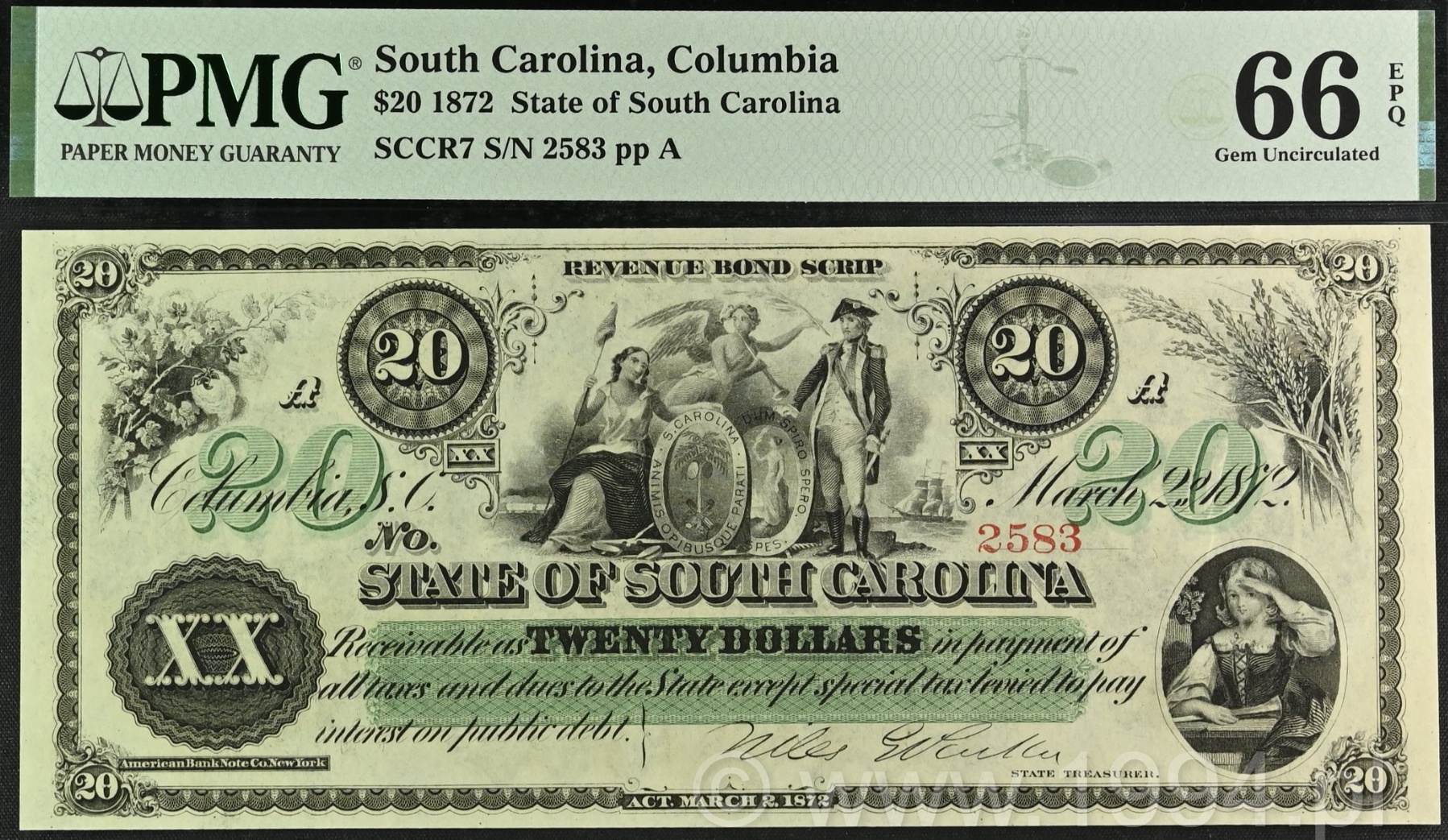
United States 1872 State of South Carolina 20 Dollars Revenue Bond Scrip Columbia Act March 2 1872 PMG 66 EPQ Gem Uncirculated

United States 1872 – State of South Carolina $20 Revenue Bond Scrip Act of March 2 1872 Columbia Issue

The $20 Revenue Bond Scrip of the State of South Carolina, dated March 2, 1872, represents one of the most ornate and historically revealing fiscal issues of the Reconstruction era. Authorized by the Act of March 2, 1872, these notes were used by the state government to pay outstanding obligations and to serve as tax receipts during a period of severe post–Civil War financial strain. Printed by the American Bank Note Company in New York, the scrip combined fine engraving, symbolic imagery, and the technical artistry characteristic of the firm’s early 1870s production. Read more →

United StatesState Issue187220 DollarsPMG 66 EPQ Gem Uncirculated United StatesSouth CarolinaColumbiaState IssueRevenue Bond Scrip1872ABNCAmerican Bank Note CompanyReconstruction EraPMG 66 EPQGem Uncirculated20 Dollars
Held
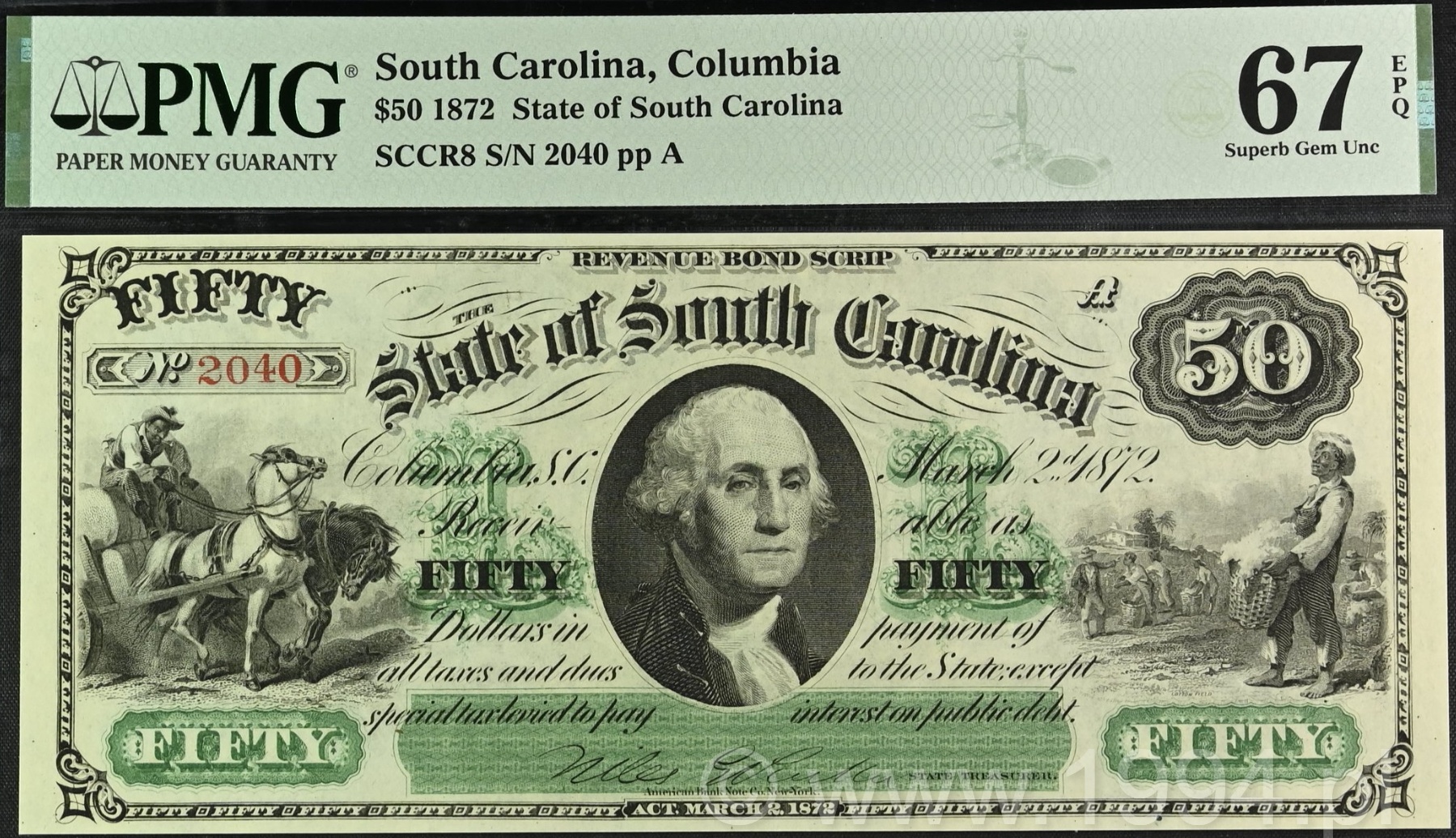
United States 1872 State of South Carolina 50 Dollars Revenue Bond Scrip Columbia Act March 2 1872 PMG 67 EPQ Superb Gem Uncirculated

United States 1872 – State of South Carolina $50 Revenue Bond Scrip Act of March 2 1872 Columbia Issue

The fifty-dollar Revenue Bond Scrip authorized by the Act of March 2, 1872, stands among the most elaborate and symbolically charged notes of Reconstruction-era South Carolina. Produced by the American Bank Note Company of New York, these notes were issued to pay state obligations and to function as tax receipts, serving as both a medium of exchange and an assertion of solvency during a turbulent postwar decade. Read more →

United StatesState Issue187250 DollarsPMG 67 EPQ Superb Gem Uncirculated United StatesSouth CarolinaColumbiaState IssueRevenue Bond Scrip1872ABNCAmerican Bank Note CompanyReconstruction EraPMG 67 EPQSuperb Gem Uncirculated50 Dollars
Held
↑ Top