Collection PL

About
155 results · Page 1 of 13
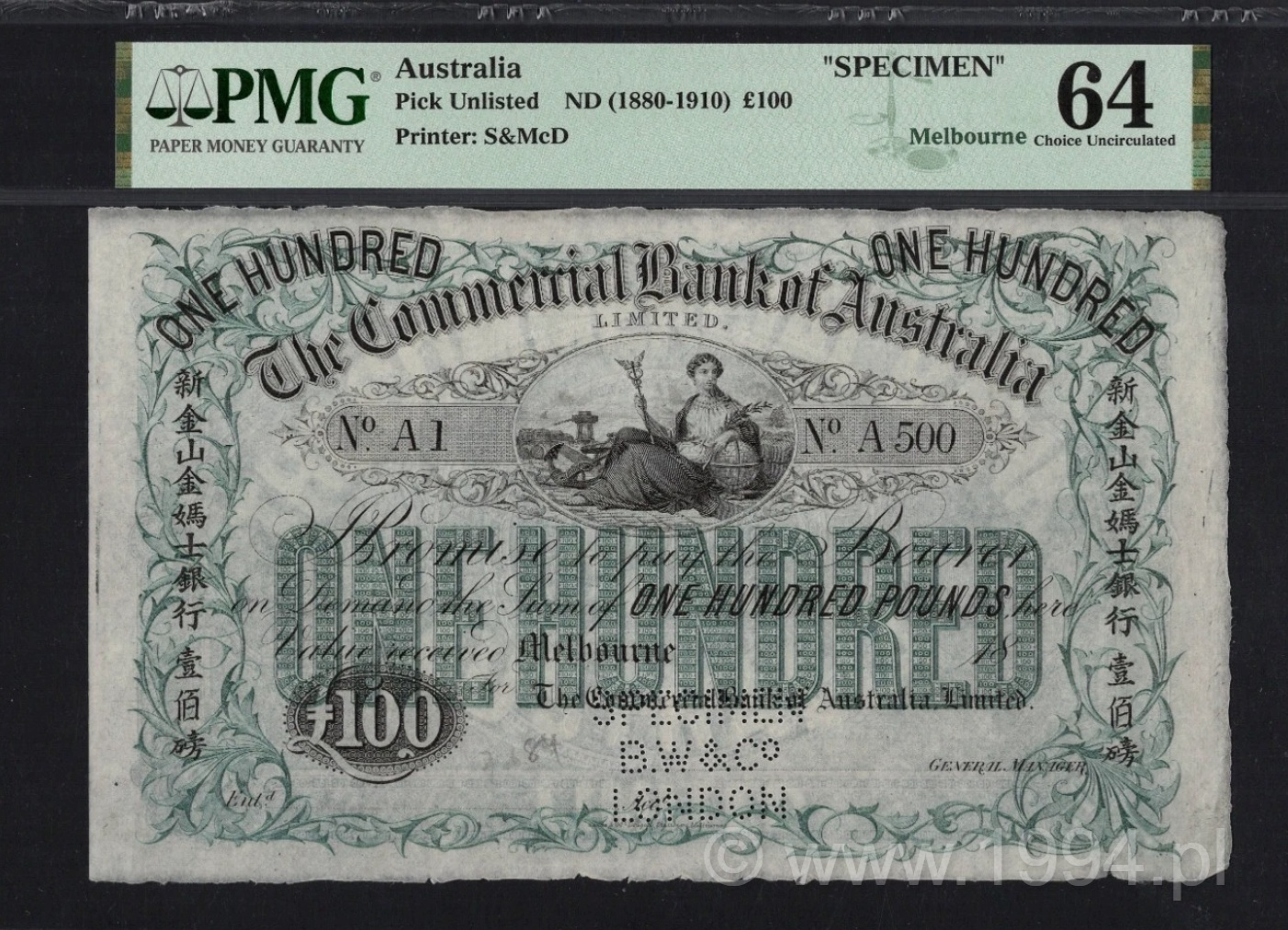
Australia 1880–1910 Commercial Bank of Australia £100 specimen, PMG 64 Choice Uncirculated

Australia 1880–1910 - Commercial Bank of Australia £100 Specimen (Pick Unlisted)

The historical context of this note is equally important. Before the 1910 Australian Notes Act, each major commercial bank operated as both a private deposit institution and a note-issuing authority, backed by gold reserves and subject to varying degrees of colonial regulation. The Commercial Bank of Australia was among the most prominent issuers, and its large denominations were used for interbank settlement, bullion transactions, and wholesale commercial payments. These notes circulated in an economy that was rapidly industrialising and integrating into global commodity markets through wool, gold, minerals, and agricultural exports. Read more →

AustraliaSpecimen1880100 PoundsPMG 64 Choice Uncirculated Specimen100 PoundsHigh DenominationCommercial Bank of AustraliaBradbury WilkinsonBWCSands & McDougallColonial SpecimenBilingualChinese-EnglishPick UnlistedColonial Banking HistoryAustralian Private BanknotesPre-Notes Act Era19th Century BankingMulticultural Trade NetworksSecurity Printing HistoryBritish Engraving InfluenceAustralian Monetary HistoryAustralia188019101880–1910PMG 64Museum GradeR9 Extremely RareUniqueAnnotationsHandwritten Annotations
Held
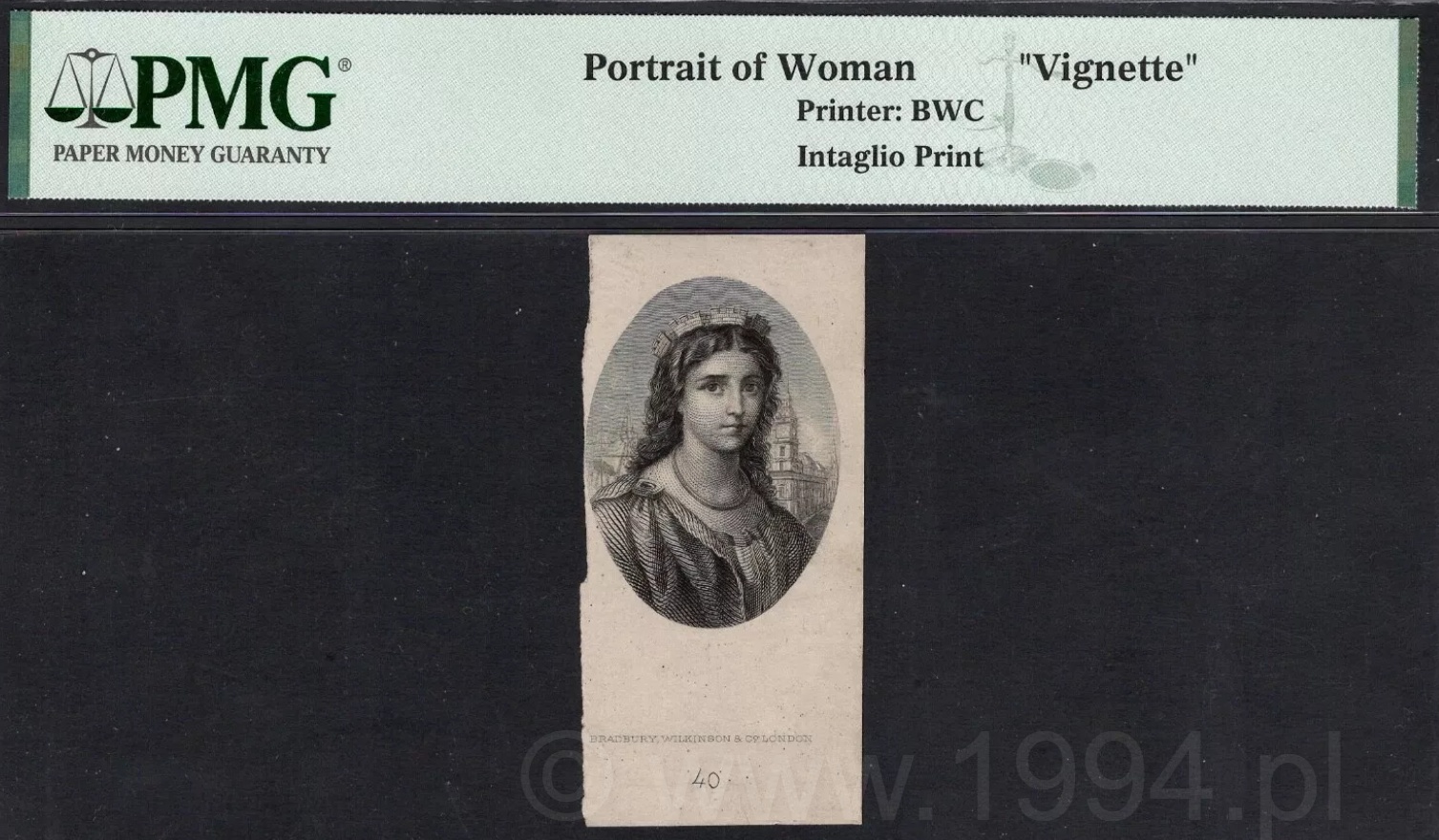
Bradbury, Wilkinson and Company 1877 Portrait of Woman intaglio vignette proof, printer's library design element associated with the City of Melbourne Bank Limited 20 Pounds colonial Australian banknote design

Australia 1877 - Bradbury, Wilkinson and Company Portrait of Woman Intaglio Vignette Proof for City of Melbourne Bank Limited 20 Pounds Design (Pick Unlisted)

The portrait is presented within a narrow oval composition and depicts a young woman in three-quarter view, wearing a decorative head ornament and draped garment, with architectural detail visible in the background. The engraving is built from fine intaglio linework, controlled cross-hatching and carefully graduated tonal transitions, with particular attention given to the face, hair, clothing and background. Read more →

AustraliaVignette Proof1877Reference VignetteArchival Intaglio Proof Vignette ProofIntaglio Vignette ProofPortrait VignettePortrait of WomanEngraved PortraitPrinter's Library ElementPrinter's Design ArchiveProduction Stage ArtifactStandalone VignetteReference VignetteCity of Melbourne Bank Limited Design Source20 Pounds Design SourceBradbury, Wilkinson and CompanyBradbury, Wilkinson and Company LondonLondon Security PrinterIntaglio PrintingIntaglio EngravingSecurity EngravingBanknote PrintingSecurity PrintingPrivate Banknote ProductionProofing and Plate ApprovalDesign Verification ArtifactPick UnlistedAustralian Banking HistoryAustralian Colonial BankingPre Federation AustraliaVictoria Banking HistoryCity of Melbourne BankCity of Melbourne Bank LimitedColonial VictoriaPrivate Banknote TraditionNineteenth Century Paper MoneyVictorian Era EngravingHistoryAustraliaVictoria1877R9 Extremely RareUniqueMuseum Grade
Held
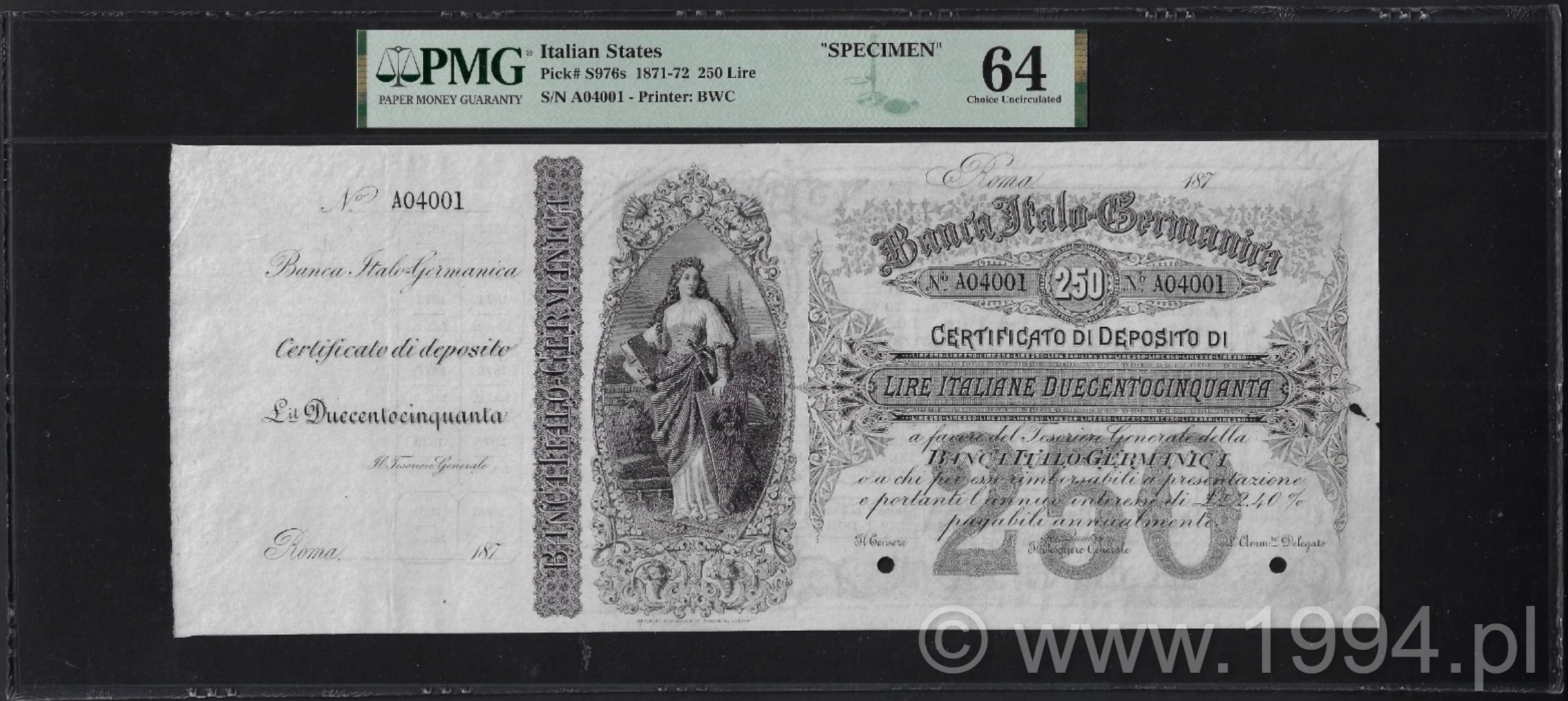
Italy 1871–1872 Banca Italo-Germanica 250 Lire specimen, Pick S976s, Bradbury Wilkinson & Co., PMG 64 Top Pop

Italy 1871–1872 - Banca Italo-Germanica 250 Lire Specimen (Pick S976s)

The Banca Italo-Germanica was founded amid the financial turbulence that followed Italy’s political unification (1861) and the annexation of Rome (1870). The new nation lacked a centralized note-issuing authority, and private, regional, and foreign-funded institutions vied for influence in a chaotic and rapidly shifting monetary landscape. German capital poured into Rome hoping to shape the financial future of the new kingdom, and several ventures attempted to position themselves as potential proto-central banks. The Banca Italo-Germanica was one such institution, backed by foreign investors and driven by optimism about Italy’s industrial and political ascent. Read more →

ItalySpecimen1871250 LirePMG 64 (Top Pop) Private BankOversizedSpecimenDouble Punch HolePunch Cancelled250 LireEngraved Security PaperProof and Archive PieceBradbury WilkinsonBWCPick S976sItalian StatesPost Unification ItalyItalian Banking HistoryFailed Banknote IssuesGerman Capital in Italy19th Century FinanceNational AllegorySecurity Printing HistoryRome Banking ExperimentsUnissued Banknote ProjectItaly1871PMG 64Top PopR9 Extremely RareUniqueMuseum Grade
Held
Italy 1871 Germania with shield and spear vignette die proof engraved by Bradbury Wilkinson for the Banca Italo-Germanica 250 Lire (Pick PS976)

Italy 1871 - Standing Italia Vignette Die Proof used on Banca Italo-Germanica 250 Lire

The composition depicts a standing female personification of Italia within an elaborate vertical frame. She holds a book or document in one hand and rests the other beside a heraldic shield bearing the Italian arms. Architectural forms rise in the background, while inscriptions and symbolic details are incorporated into the surrounding landscape and ornamental structure. The figure combines classical allegorical imagery with contemporary references to the newly unified Italian state. Read more →

ItalyVignette1871-Uncirculated Italia AllegoryDie ProofBanca Italo-Germanica250 LireItalian StatesBradbury WilkinsonBWCItaly1871
Held
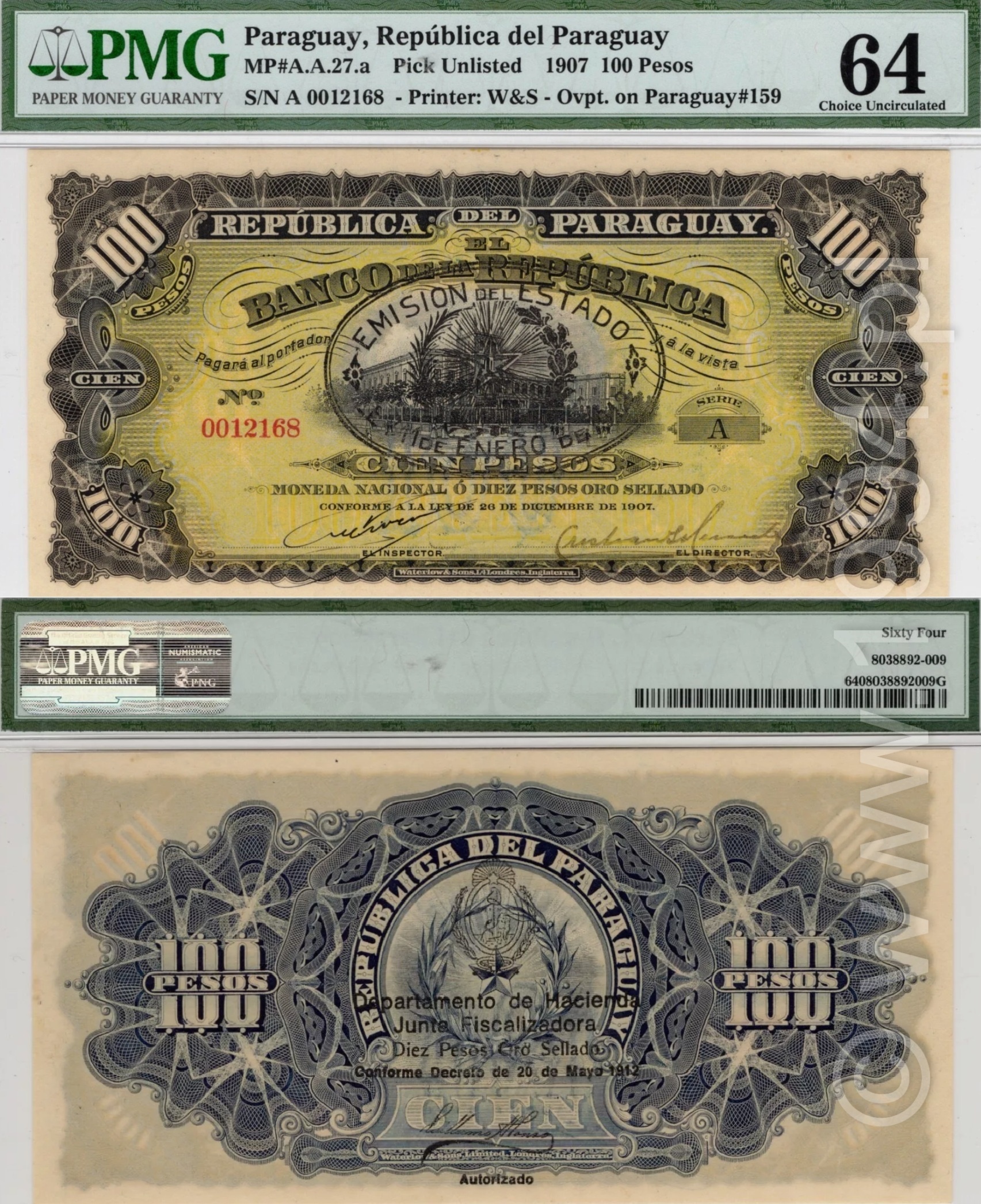
Paraguay 1907 100 Pesos Banco de la República specimen with 1912 dual-side state and treasury fiscal revalidation overprint, including Emisión del Estado on the face and Departamento de Hacienda Junta Fiscalizadora Diez Pesos Oro Sellado validation on the reverse, base Pick 159, Pick Unlisted, PMG 64 Choice Uncirculated

Paraguay 1907 - 100 Pesos with 1912 Dual-Side State and Treasury Revalidation Overprint Specimen (Pick Unlisted)

The design itself remains one of the finest Waterlow & Sons productions for Paraguay. The face combines a yellow-green tint field with dark intaglio borders, large corner denomination tablets, and the architectural vignette of the Banco de la República building. The engraved security work is dense and elegant, with layered guilloché patterns, scrollwork, and ornamental side panels framing the central promise-to-pay text. The reverse, with its large mirrored denomination panels and circular national emblem, becomes even more important on this variety because the Treasury overprint was placed directly across the center, turning the back from a purely decorative security design into an official fiscal record. Read more →

ParaguayOverprint Specimen1907100 PesosPMG 64 Choice Uncirculated Specimen100 PesosPick UnlistedPick 159OverprintState OverprintTreasury OverprintDual-Side OverprintDual-Signature OverprintProvisionalFiscal RevalidationTreasury RevalidationEmergency State IssueParaguayan Emergency Issues1912 ReformJanuary 11 1912 State EmissionMay 20 1912 DecreeBanco de la RepúblicaDepartamento de HaciendaJunta FiscalizadoraEmisión del EstadoDiez Pesos Oro SelladoGold-Value ReaffirmationWaterlow & SonsSouth American Monetary HistoryEarly 20th Century FinanceGovernment RevalidationOverprint VarietiesParaguay19071912PMG 64Choice UncirculatedMuseum GradeR9 Extremely RareUnique
Held
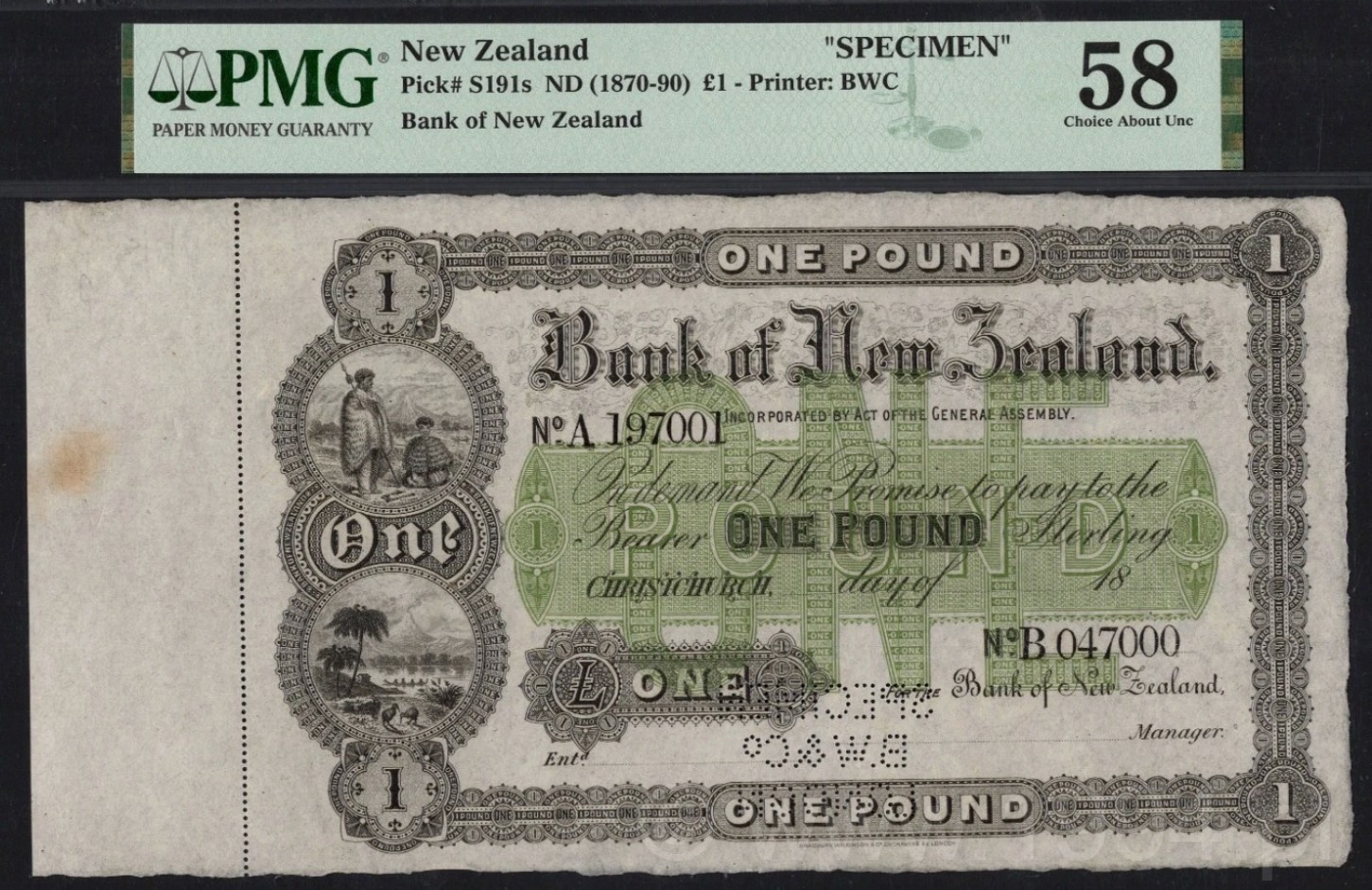
New Zealand 1870–1890 Bank of New Zealand 1 Pound Green Specimen Pick S191s, dual serial numbers A197001 and B047000, perforated CANCELLED, Bradbury Wilkinson printing, PMG 58 Choice About Uncirculated

New Zealand 1870–1890 - Bank of New Zealand £1 Green Specimen (Pick S191s)

This £1 Green specimen marks a pivotal stage in New Zealand’s monetary development. During the late nineteenth century, the Bank of New Zealand operated within a privately issued currency system, where commercial banks produced their own notes backed by reserves and governed under colonial legislation. Bradbury Wilkinson introduced high-security engraving standards to this system, embedding British technical precision into a developing colonial economy. Read more →

New ZealandSpecimen18701 PoundPMG 58 Choice About Uncirculated Specimen1 PoundBank of New ZealandBradbury WilkinsonBWCDual Serial NumbersA197001B047000Perforated CANCELLEDAudit MarginPrinter Control SystemColonial IssueVictorian DesignMāori Portrait SeriesEngraved Security PrintingNew Zealand Banking HistoryPrivate Banknote EraPre-Reserve BankBNZ Color LineageColor Lineage Origin19th Century OceaniaMaritime Economy NotesEarly Indigenous ImageryBritish Colonial FinanceHistoryNew Zealand187018901870–1890Pick S191sPMG 58Choice About UncirculatedMuseum GradeR7 Extremely Rare
Held
Argentina 1884 El Banco del Chaco 1 Peso Moneda Nacional Oro, Serial 05056, corner-missing example

Argentina 1884 - El Banco del Chaco 1 Peso Moneda Nacional Oro Serial 05056 (Pick S1566)

El Banco del Chaco operated within Argentina’s fragmented 1880s banking system, when provincial institutions issued gold-backed paper convertible on demand. Under this charter the Chaco branch financed frontier settlement and export agriculture, embodying the optimism of the northern provinces before the 1890 crash. Cataloged Pick S1566 / Bauman CHA-01a. Read more →

ArgentinaIssued Note18841 Peso Moneda Nacional OroFair–Good (missing corner) Fragment1 Peso OroEl Banco del ChacoBradbury WilkinsonBWCVilla OcampoPrivate BankSeries ISerial 05056Frontier CirculationNorthern ArgentinaChaco Region HistoryLey de Bancos GarantidosProvincial IssuerCirculated SurvivorAgriculture AllegoryFrontier BankingArgentina1884Museum GradeR8 Extremely Rare
Held
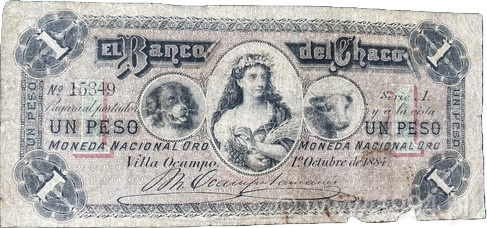
Argentina 1884 El Banco del Chaco 1 Peso Moneda Nacional Oro, Serial 15849

Argentina 1884 - El Banco del Chaco 1 Peso Moneda Nacional Oro Serial 15849 (Pick S1566)

Historically, the Chaco series represents Argentina’s experiment with provincial convertibility-private banks issuing gold-backed paper within a unified national framework. These notes circulated briefly across the northern frontier, a region opened by British-funded rail and river trade. Each surviving piece testifies to the reach of foreign engravers in shaping Argentina’s economic imagery. Read more →

ArgentinaIssued Note18841 Peso Moneda Nacional OroFine–Very Fine (est.) 1 Peso OroIssued NoteEl Banco del ChacoBradbury WilkinsonBWCVilla OcampoPrivate BankSerial 15849Frontier CirculationLey de Bancos GarantidosProvincial BankingNorthern ArgentinaChaco Region HistoryAgriculture AllegoryBritish Influence19th Century ArgentinaCirculated SurvivorArgentina1884Museum GradeR8 Extremely Rare
Held
Uruguay 1867 Banco Oriental 10 Pesos equals 1 Doblón de Oro Sellado issued banknote, American Bank Note Company, single handwritten right-side circulation signature, serial number 55818, Pick S385a, PMG 15 Choice Fine, plate position pp B

Uruguay 1867 - Banco Oriental 10 Pesos = 1 Doblón de Oro Sellado Issued Note, Handwritten Right-Side Signature, Serial 55818 (Pick S385a)

The obverse design follows the classic American Bank Note Company international style of the mid-nineteenth century. At left, two allegorical female figures personify Commerce and Abundance, rendered in finely engraved classical style. At right, the national coat of arms of Uruguay appears above crossed flags and laurel branches, emphasizing state authority and political legitimacy. A bold central orange guilloche surrounds the inscription “UN DOBLÓN DE ORO SELLADO,” explicitly referencing gold-backed value and convertibility, an essential confidence mechanism in Uruguay’s developing monetary system. Read more →

UruguayIssued Note186710 Pesos = 1 Doblón de Oro SelladoPMG 15 Choice Fine Issued BanknoteHandwritten SignatureRight Side Signature PlacementPlate Position BGold Convertible DenominationABNCAmerican Bank Note CompanyNineteenth Century Security PrintingEngraved Allegorical DesignGuilloche Security PatternBanco OrientalUruguay1867MontevideoPick S385aHistoryMuseum GradeAnnotationsHandwritten Annotations
Held
Uruguay 1867 Banco Oriental 10 Pesos equals 1 Doblón de Oro Sellado issued banknote, centered handwritten circulation signature, serial number 35345, Pick S385a, plate position pp A

Uruguay 1867 - Banco Oriental 10 Pesos = 1 Doblón de Oro Sellado Issued Note, Centered Handwritten Signature, Serial 35345 (Pick S385a)

The centered handwritten signature represents a short-lived transitional solution within Banco Oriental’s authorization practice. After briefly requiring two manual signatures and then abandoning that requirement, the bank consolidated authority back to a single signer while temporarily repositioning the signature to rebalance the visual composition of the note. This configuration was subsequently abandoned in favor of restoring the original right-side placement when facsimile signatures were introduced. Read more →

UruguayIssued Note186710 Pesos = 1 Doblón de Oro SelladoVery Fine (estimated) Issued BanknoteHandwritten SignatureCentered Signature PlacementPlate Position AGold Convertible DenominationABNCAmerican Bank Note CompanyNineteenth Century Security PrintingAuthorization TransitionAdministrative AdjustmentBanco OrientalUruguay1867MontevideoPick S385aHistoryMuseum GradeAnnotationsHandwritten Annotations
Held
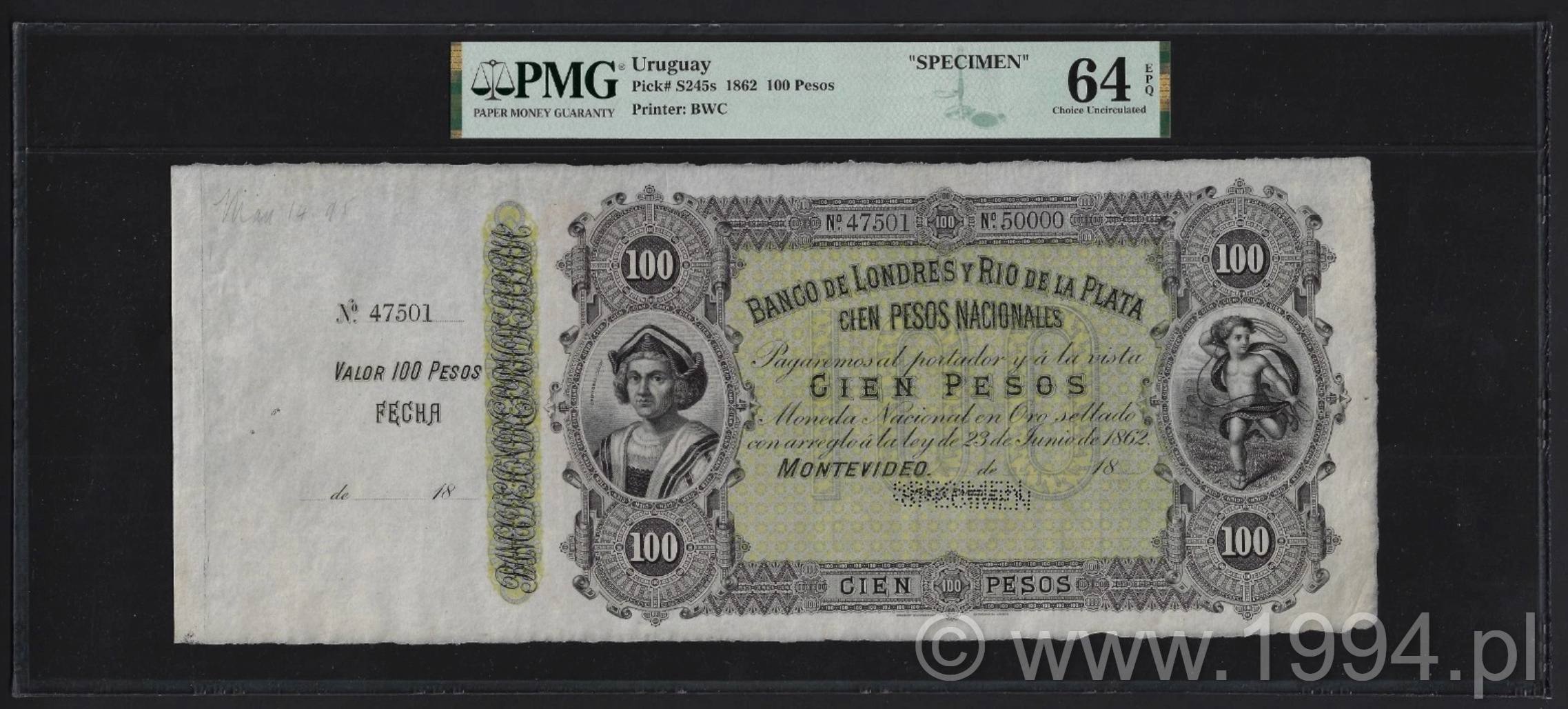
Uruguay 1862 Banco de Londres y Rio de la Plata 100 Pesos Pick S245s specimen, perforated SPECIMEN, engraved by Bradbury Wilkinson & Co., graded PMG 64 EPQ

Uruguay 1862 - Banco de Londres y Rio de la Plata 100 Pesos Specimen (Pick S245s)

Issued shortly after Uruguay’s 1862 banking law authorized private note issuance backed by metallic reserves, the design stands at the intersection of foreign capital and national development. Each surviving example bears the diagonal SPECIMEN perforation-Bradbury Wilkinson’s control format for archival presentation pieces, never intended for circulation. Read more →

UruguaySpecimen1862100 PesosPMG 64 EPQ Pick S245sPick S245SpecimenBanco de Londres y Rio de la PlataBradbury WilkinsonBWCUruguay 19th Century100 PesosUruguay1862
Held
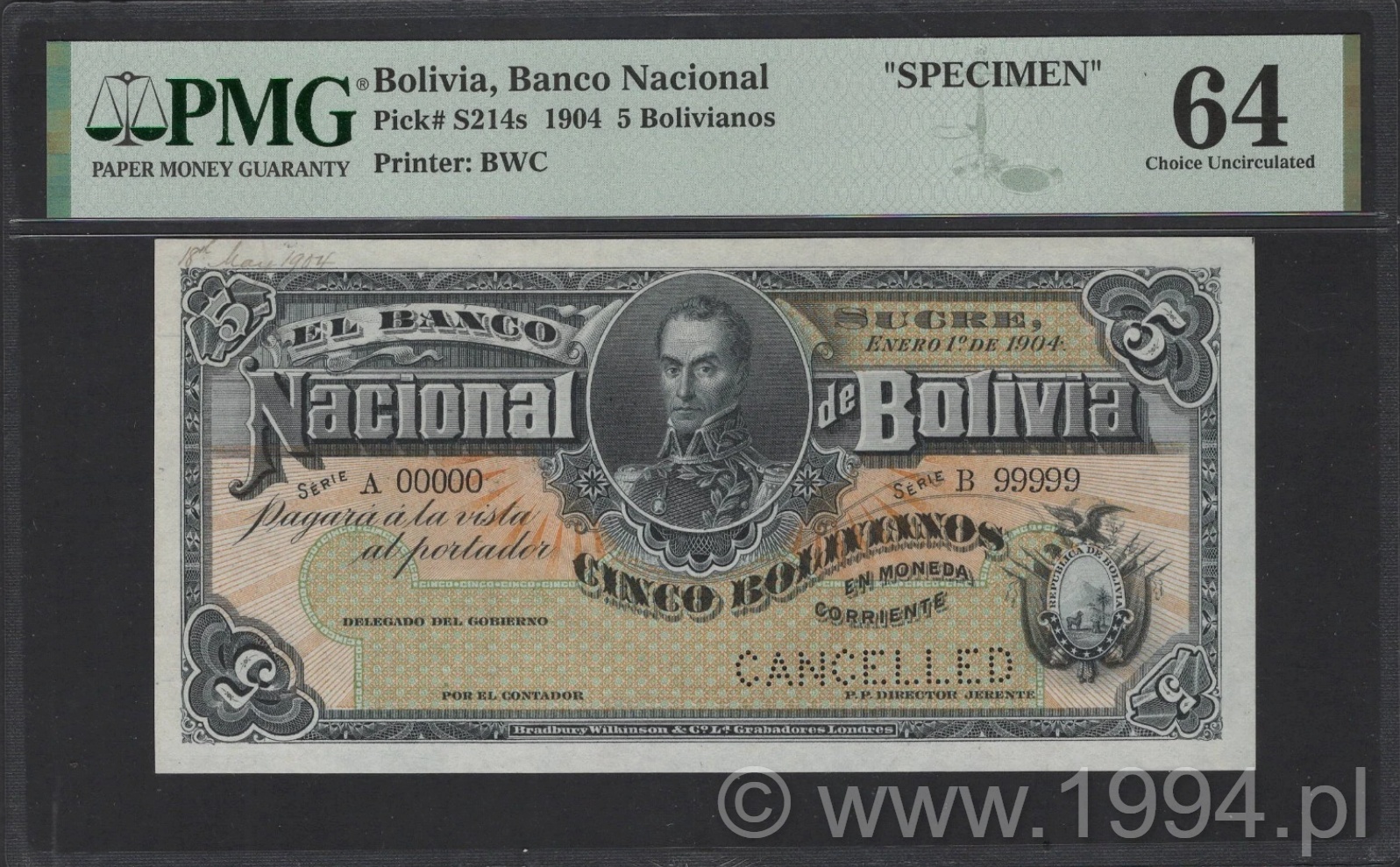
Bolivia 1904 Banco Nacional 5 Bolivianos specimen, PMG 64

Bolivia 1904 - Banco Nacional 5 Bolivianos (Specimen)

Specimen of the 1904 Banco Nacional de Bolivia 5 Bolivianos, engraved and printed by Bradbury, Wilkinson & Co. (BWC) in London. The note bears the date SUCRE, 1 de Enero de 1904, and features the portrait of Simón Bolívar at center-an enduring symbol of republican legitimacy. The engraving itself traces back to a mid-19th-century French lithograph of Bolívar that was reused and refined by BWC for several Latin American issues, earning it the nickname 'the export Bolívar.' Surrounding design elements include elaborate guilloché frames, floral counters, and a small vignette of Potosí’s Cerro Rico, underscoring the country’s reliance on silver mining wealth. Read more →

BoliviaSpecimen19045 BolivianosPMG 64 (Top Pop) S214sTop PopBanco NacionalBradbury WilkinsonBWCBolivia 20th CenturyBolivia19045 Bolivianos
Held
↑ Top