Collection PL

About 1994.pl
Results for “banknot”
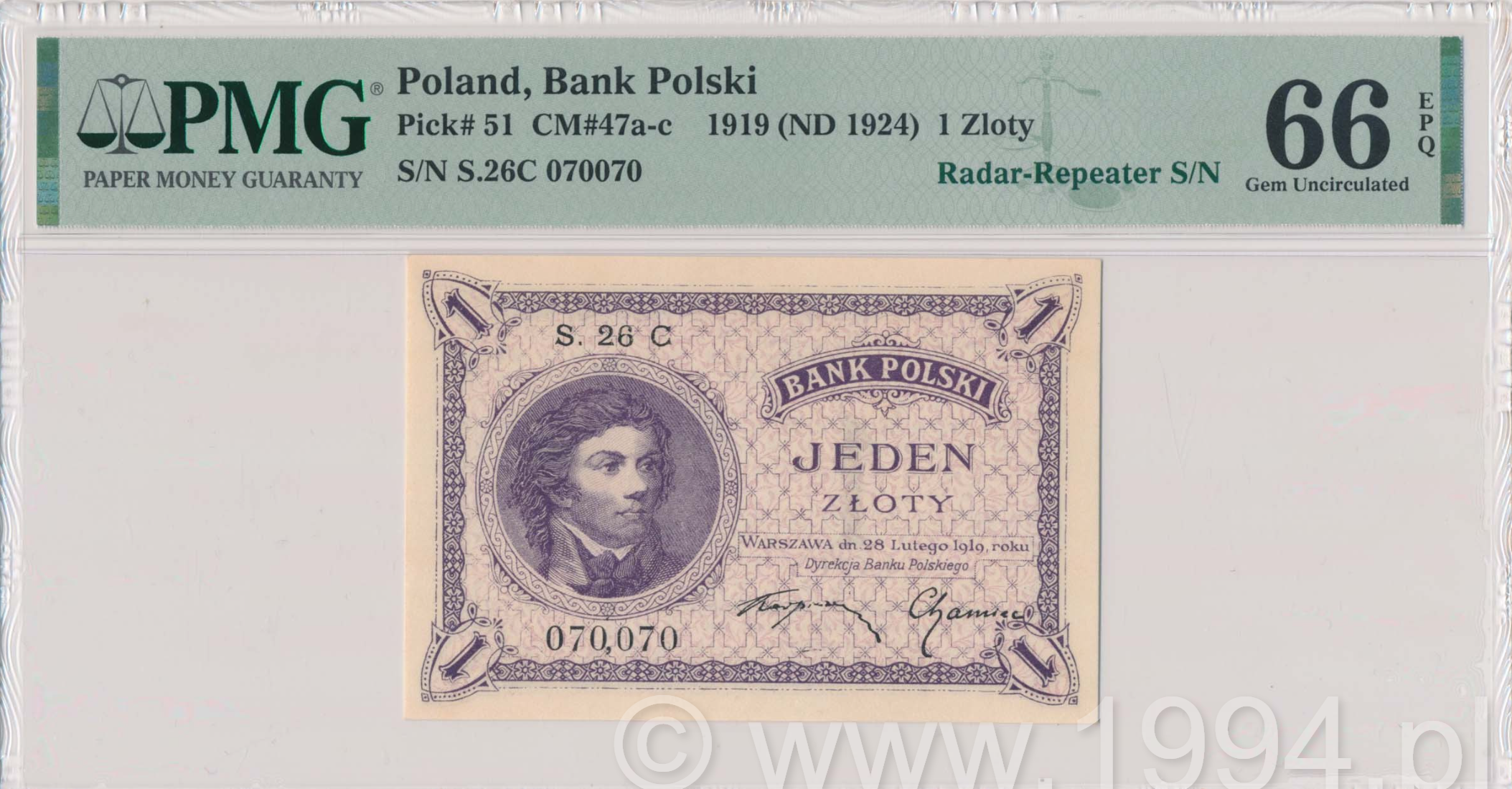
Poland 1919 Bank Polski 1 Zloty issued note, series S.26C and radar-repeater serial 070070, featuring Tadeusz Kosciuszko and printed by Imprimerie Benoit Arnaud in Lyon, France.

Poland 1919 - Bank Polski 1 Zloty Issued Note S.26C 070070 (Pick 51)

The note was printed by Imprimerie Benoit Arnaud in Lyon, France. Its engraved portraiture, fine-line borders, layered underprinting, and compact security design document the contribution of French security printing to the first paper-money series prepared for independent Poland. Read more →

PolandIssued Note19191 ZlotyPMG 66 EPQ Gem Uncirculated Issued NoteBank Polski1 ZlotySeries S.26CSerial 070070Radar-Repeater SerialRadar SerialFirst Zloty IssueTadeusz KosciuszkoKosciuszko PortraitGrabski Currency ReformPolish Monetary ReformRestoration of the ZlotyPost-Independence CurrencyImprimerie Benoit ArnaudIMP BenoitBenoit ArnaudLyon PrintingFrench Security PrintingSecurity Printing HistoryEngraved BanknoteGuilloche DesignPolandPoland 1919Second Polish RepublicSecond Polish Republic Currency19191924Pick 51Milczak 47a-cPMG 66 EPQTop PopGem UncirculatedMuseum Grade
Held
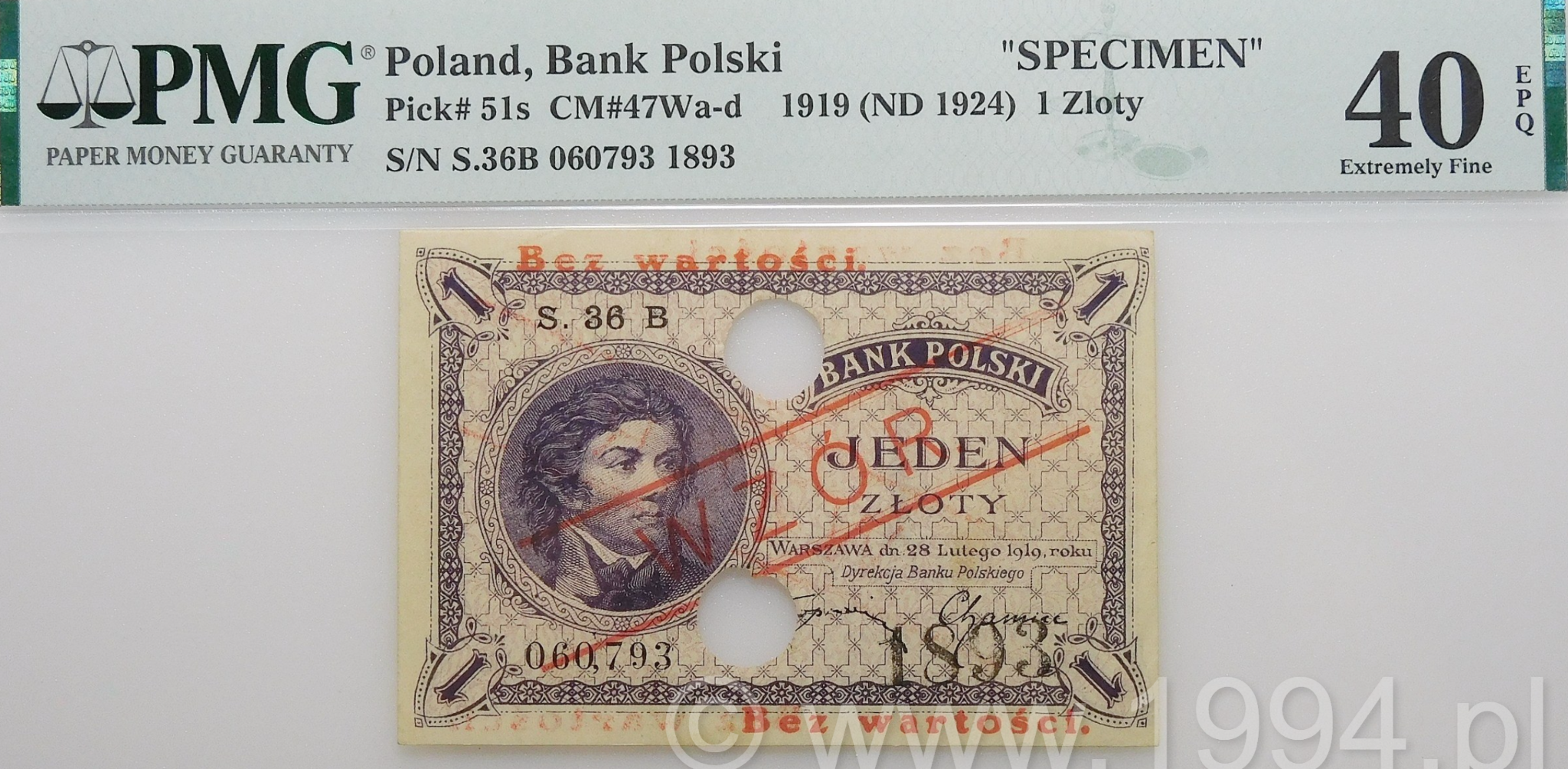
Poland 1919 Bank Polski 1 Zloty specimen, series S.36B, serial 060793 and specimen control number 1893, with red WZÓR and BEZ WARTOŚCI overprints and two vertically arranged circular perforations.

Poland 1919 - Bank Polski 1 Zloty Specimen S.36B 060793 with WZÓR and BEZ WARTOŚCI Overprints (Pick 51s)

The note was printed in France by Imprimerie Benoit Arnaud in Lyon at a time when Poland's domestic security-printing capacity was still being rebuilt after independence. Its refined engraving, fine-line ornament, and layered pastel underprinting reflect the strong influence of early twentieth-century French banknote design. Read more →

PolandSpecimen19191 ZlotyPMG 40 EPQ Extremely Fine SpecimenBank Polski1 ZlotySeries S.36BSerial 060793Specimen Control Number 1893First Zloty IssueWZOR OverprintWZOR Overprint with PeriodBEZ WARTOSCI OverprintRed WZOR Overprint on Both SidesBilateral Specimen Overprint7 mm WZOR LetteringTwo Circular PerforationsVertical Perforation ArrangementPunch-Cancelled SpecimenSpecimen Control SystemTadeusz KosciuszkoKosciuszko PortraitGrabski Currency ReformPolish Monetary ReformRestoration of the ZlotyPost-Independence CurrencyImprimerie Benoit ArnaudIMP BenoitBenoit ArnaudLyon PrintingFrench Security PrintingSecurity Printing HistoryEngraved BanknoteGuilloche DesignPolandPoland 1919Second Polish RepublicSecond Polish Republic Currency19191924Pick 51sMilczak 47WcPMG 40 EPQMuseum Grade
Held
Poland 1919 1000 Złotych, Unissued, PMG 63 EPQ

Poland 1919 - 1000 Zlotych Unissued Note (Pick 59a)

The note’s design is a tour de force of neobaroque ornamentation: elaborate guilloches, scrolling acanthus motifs, and a commanding layout that conveyed prestige. Like the smaller denominations, it features Tadeusz Kosciuszko on the obverse, reinforcing his role as the symbolic figurehead of the 1919 series. Measuring 181 × 111 mm, it impresses with both scale and detail, and its watermark also carries Kosciuszko’s likeness as a security device. Read more →

PolandUnissued Note19191000 ZłotychPMG 63 EPQ EPQPolandSecond RepublicBanknoteMilczakZlotyUnissued NoteUnissued IssueBank PolskiWaterlowKosciuszkoTadeusz KosciuszkoKosciuszko PortraitTadeusz Kosciuszko WatermarkPortrait WatermarkWaterlow & SonsInterwar PeriodPMG 63 EPQChoice UncirculatedPick 59a1000 ZlotychUncirculated1919
Held
Poland 1940 10 Złotych Printing Remnants, forgery workshop underprint, PMG descriptive holder

Poland 1940 - 10 Zlotych Printing Remnants Forgery Workshop Underprint (Miłczak 94)

Fascinating semi-finished product from a wartime forgery workshop, connected with the 10 złotych 1940 issue (Miłczak 94). The piece is printed only with the underprint of the obverse design - background guilloches and the female allegorical portrait at left - without the main face value, overprints, or full intaglio elements. Trimmed to the correct banknote format, it represents an intermediate stage in the counterfeiting process. Read more →

PolandContemporary Counterfeit194010 złotychPMG Holdered (Descriptive, no numeric grade) Poland194010 ZlotychPick 94Milczak 94MilczakBank Emisyjny w PolsceEmission BankGeneral GovernmentGerman OccupationOccupationOccupation IssueWorld War IIWWIIWartimeCounterfeitContemporary CounterfeitForgeryWartime ForgeryForgery WorkshopCounterfeit WorkshopPrinting RemnantsWorkshop RemnantProduction RemnantSemi Finished PrintIntermediate PrintIncomplete PrintUnderprintObverse UnderprintGuillocheWatermarkBanknotePMG
Held
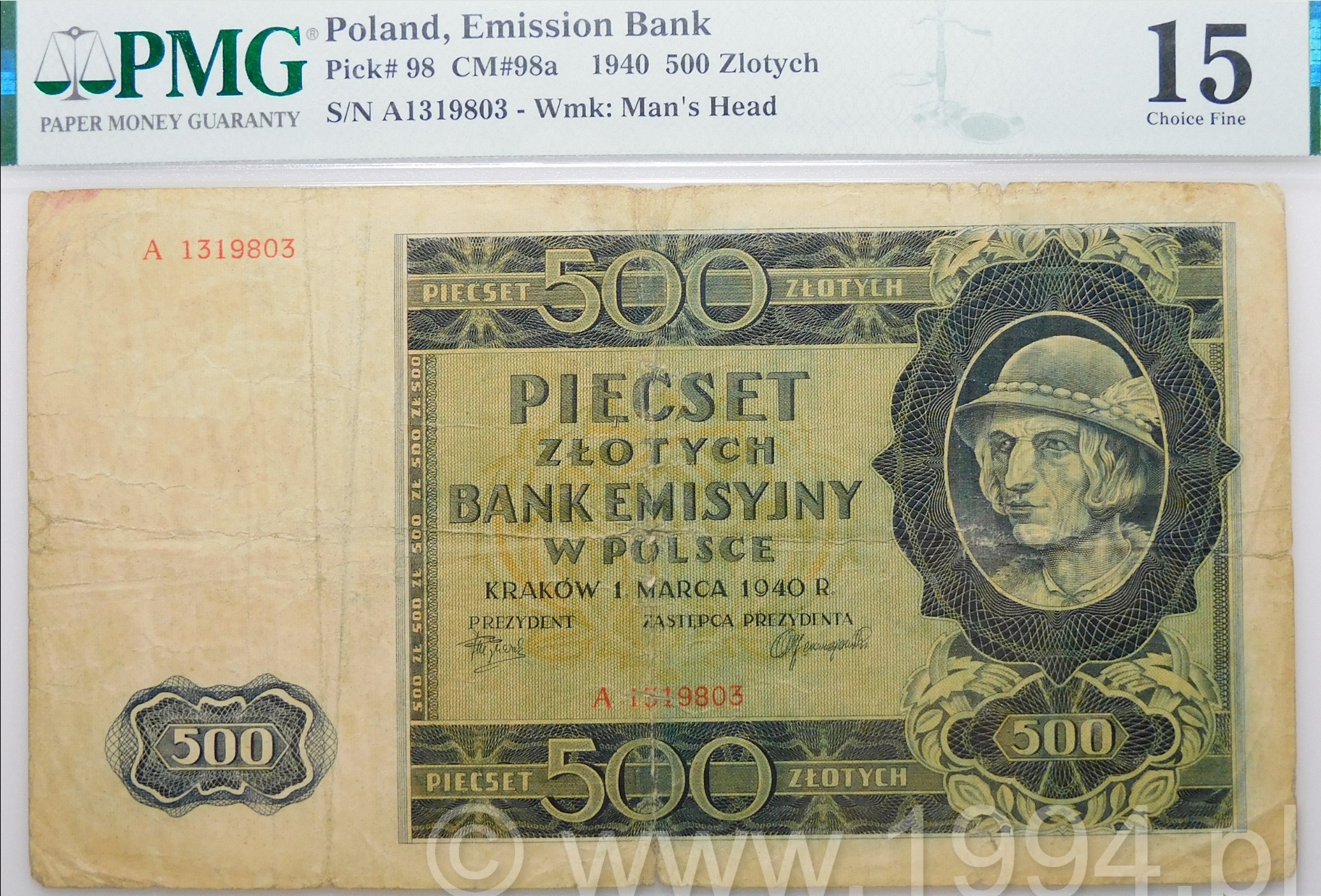
Poland 1940 500 Złotych Series A with counterfeit numbering link, PMG 15

Poland 1940 - 500 Zlotych, Series A with Counterfeit Numbering (Pick 98a)

Original 500 złotych note of 1 March 1940 issued by the Bank Emisyjny w Polsce, Series A, serial A 1319803. Although the banknote itself is genuine, its serial falls within the 13xxxxx numbering range later associated with diversionary forgeries of the 500 złotych denomination. Together with the 12xxxxx sequence, these numbers became compromised by the appearance of counterfeit notes, making A 1319803 an extremely rare surviving original from a range subsequently targeted for withdrawal. Read more →

PolandIssued Note with Counterfeit Link1940500 ZłotychPMG 15 Choice Fine Poland1940500 ZlotychBank Emisyjny w PolsceGeneral GovernmentGerman OccupationWorld War IIWWIISeries APick 98aMilczak 98aOccupation IssueCounterfeit NumberingDiversionary ForgeryContemporary CounterfeitLondon CounterfeitPolish ResistanceWartime CounterfeitingCounterfeit WithdrawalPMG 15
Held
Poland 1933 - 25 Złotych Investment Fund Voucher, Series I, PMG 55 EPQ

Poland 1933 - 25 Zlotych Investment Fund Voucher, Series I Bon Funduszu Inwestycyjnego (Lucow 732)

The vouchers (bony funduszu inwestycyjnego) functioned as state debt instruments, essentially IOUs of the Treasury. They were non-interest bearing, but widely accepted for the payment of taxes, customs duties, and official fees owed to the state. To encourage their use, the government held weekly drawings in which selected bond numbers were repurchased at four times face value, meaning that a 25 zł voucher could be redeemed for 100 zł if chosen. This combination of fiscal utility and lottery incentive gave the notes a dual role as both practical and speculative instruments in the interwar economy. Read more →

PolandInvestment Fund Voucher193325 ZłotychPMG 55 EPQ About Uncirculated Bon Funduszu InwestycyjnegoLucow 732Bank PolskiSecond RepublicbanknotPolskaPolandMilczakBykowski 25zlotymiedzywojniezlotychII RPMazur E.33Moczydlowski B63Investment Voucher1933
Held
Poland 1940 500 Złotych Series B, unfinished print fragment with partial obverse and full reverse, PMG holdered

Poland 1940 - 500 Zlotych Series B Unfinished Print Fragment (Pick 98)

PMG encapsulated the piece under the descriptive designation "Printing Remnants" without assigning a numerical grade. Its importance lies in the production evidence retained within a single unfinished note: the established obverse underprint, the absence of the principal obverse design, a substantially developed reverse, the B 2048322 serial number and the original watermarked paper. Together, these features preserve several normally integrated elements of banknote manufacture in an unfinished state. Read more →

PolandPrinting Remnant1940500 ZłotychPMG Holdered (Descriptive, no numeric grade) Printing RemnantPrinting RemnantsUnfinished PrintIncomplete PrintUnfinished BanknoteProduction MaterialProduction StagePrinting ProcessBanknote ProductionPrinter's SheetPrinter's Sheet FragmentSheet FragmentProduction Sheet500 Zlotych500 Zlotych 1940Bank Emisyjny w PolsceEmission BankEmission Bank in PolandPolandPolish BanknotePolish CurrencyGerman OccupationGerman Occupied PolandGeneral GovernmentGeneralgouvernementWorld War IIWWIIWartime CurrencyOccupation Currency19401 March 1940Pick 98Milczak 98MilczakSeries BB 2048322B2048322Serial B 2048322Serial B2048322Serial NumberSerial Number AnomalyUnrecorded Serial NumberUnrecorded Serial Range20xxxxx Serial RangeSeries B Serial NumberSeries B 20xxxxxAborted ProductionInterrupted ProductionIncomplete ProductionProduction AnomalyUnderprintObverse UnderprintGreen UnderprintMissing Main DesignMissing Obverse DesignMissing PortraitIncomplete ObverseReverse DesignMorskie OkoTatra MountainsTatrasWatermarkMan's HeadMan's Head WatermarkHighlanderHighlander PortraitHighlander WatermarkGoralGoral PortraitGoral WatermarkPortrait WatermarkObverse PortraitWatermarked PaperPMGPMG Printing RemnantsDescriptive HolderNo Numeric GradeZlotyZlotych
Held
Austria 1800 Wiener Stadt Banco 1 Gulden issued note, Pick A29a, typographic Banco-Zettel design with value watermark in Arabic and Roman numerals

Austria 1800 - Wiener Stadt Banco 1 Gulden Issued Note (Pick A29a)

Additional security elements include embossed dry stamps, hand-applied serial numbers, and official signatures, all characteristic of early Austrian paper money production. These features reflect a transitional phase in banknote design, positioned between handwritten fiscal instruments and later industrial security printing. Read more →

AustriaIssued Note18001 GuldenPMG 63 Choice Uncirculated Issued NoteBanco-ZettelFiduciary Paper MoneyEarly State CurrencyTypographic BanknoteWiener Stadt BancoHabsburg Monetary SystemNapoleonic Era FinanceEveryday CirculationGaliciaZłoty ReńskiPolish Language TextAustrian Partition of PolandAustria1800PMG 63 Choice UncirculatedPick A29aMuseum Grade
Held
Austria 1800 Wiener Stadt Banco 5 Gulden issued note, Pick A33, featuring typographic design, blind embossed seals, and value watermark in Arabic and Roman numerals

Austria 1800 - Wiener Stadt Banco 5 Gulden Issued Note (Pick A33)

Within the denomination hierarchy, 5 Gulden functioned as a true intermediary value. It was sufficiently substantial to serve for tax payments, rents, wholesale trade, and administrative settlements, yet not so high as to be confined exclusively to institutional or elite use. This made the denomination central to the functioning of the paper-money system, bridging the everyday transactional role of the 1 Gulden and the more capital-oriented function of higher denominations such as the 10 Gulden. Read more →

AustriaIssued Note18005 GuldenIssued Note (PMG graded example) Issued Note5 GuldenWiener Stadt BancoBanco-ZettelEarly Fiduciary Paper MoneyAustrian Paper CurrencyHabsburg MonarchyAustrian EmpireState-Backed Paper MoneyPre-Industrial Security PrintingGaliciaZłoty ReńskiPolish Lands under Austrian RuleValue Watermark Arabic and Roman NumeralsBlind Embossed SealsTypographic Banknote DesignAustria1800Pick A33Museum Grade
Held
Austria 1806 Wiener Stadt Banco 10 Gulden issued note, Pick A39a, typographic design with multilingual denomination and value watermark in Arabic and Roman numerals

Austria 1806 - Wiener Stadt Banco 10 Gulden Issued Note (Pick A39a)

Within the denomination structure, 10 Gulden functioned primarily as a high-value transactional instrument. While still legally equivalent to lower Banco-Zettel, notes of this value were more commonly used for wholesale trade, larger commercial settlements, tax remittances, and administrative payments rather than everyday retail exchange. This positioned the 10 Gulden at the boundary between circulating paper money and early forms of paper-based capital storage. Read more →

AustriaIssued Note180610 GuldenPMG 40 Extremely Fine Issued NoteBanco-ZettelFiduciary Paper MoneyEarly State CurrencyTypographic BanknoteWiener Stadt BancoHabsburg Monetary SystemNapoleonic Wars FinanceMultilingual DenominationImperial AustriaGaliciaZłoty ReńskiPolish Language TextAustrian Partition of PolandAustria1806PMG 40 Extremely FinePick A39aMuseum Grade
Held
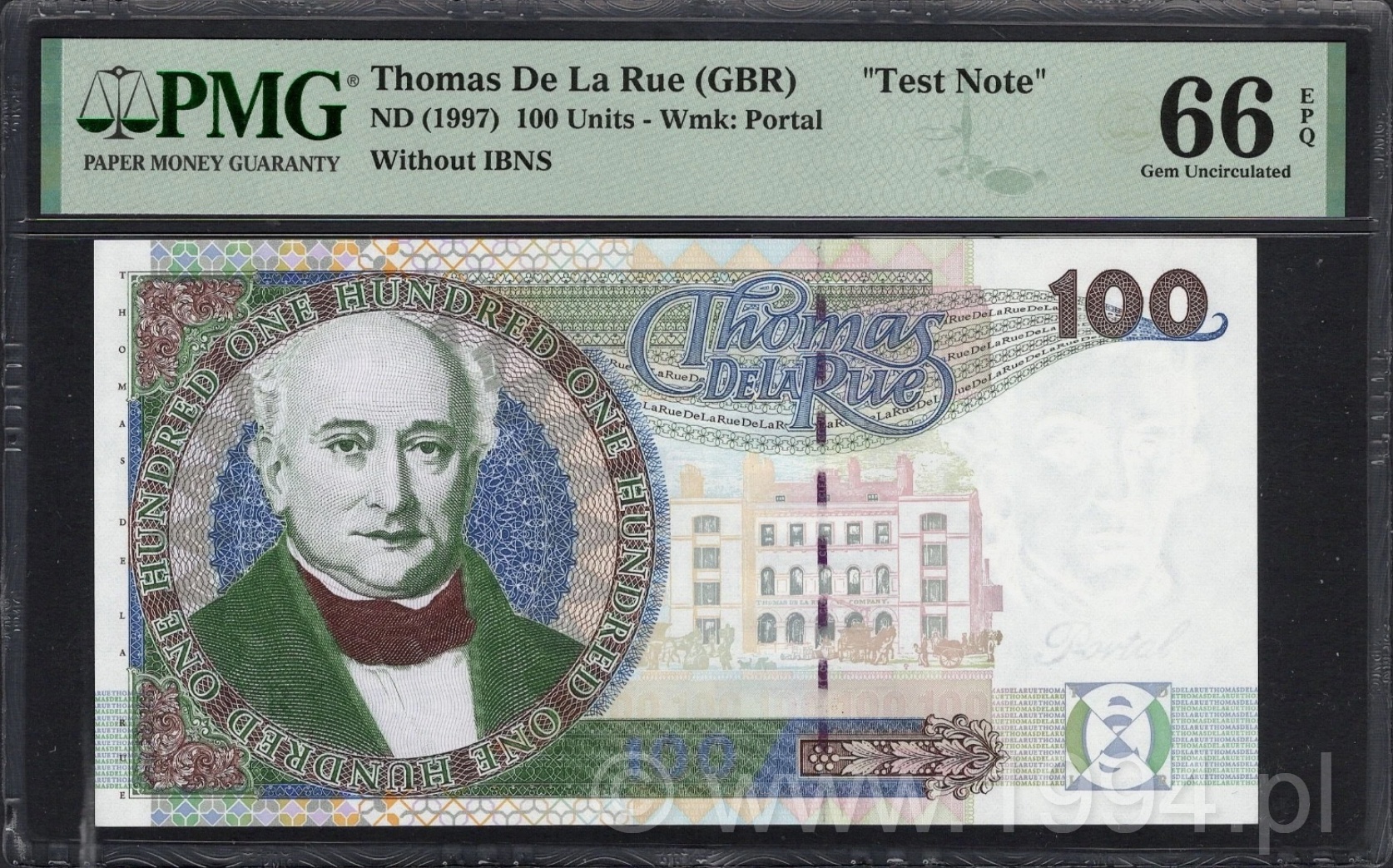
Great Britain 1997 Thomas De La Rue 100 Units Test Note, PMG 66 EPQ Gem Uncirculated

Great Britain 1997 - Thomas De La Rue 100 Units Test Note Portal Watermark

A rare Thomas De La Rue test note, issued as a demonstration piece rather than circulating currency. Dated ND (1997), this 100 Units note was printed to showcase De La Rue’s advanced banknote security design, incorporating microtext, guilloche patterns, and the portal watermark. The obverse features a portrait of Thomas De La Rue with multicolor lathework and the company’s headquarters vignette. Test notes like this were produced for presentations, sales demonstrations, and security trials, not for public issue, and remain highly sought after by collectors. Read more →

Great BritainTest Note1997100 UnitsPMG 66 EPQ Gem Uncirculated Great Britain1997Thomas De La RueTDLRTest NotePMG 66 EPQBanknote PrintingSecurity PrintingPortal Watermark
Held
Uruguay 1862 Banco de Londres y Rio de la Plata 100 Pesos Pick S245r remainder, unissued and unsigned, engraved by Bradbury Wilkinson & Co., PMG 63 Choice Uncirculated

Uruguay 1862 - Banco de Londres y Rio de la Plata 100 Pesos Remainder (Pick S245r)

Few notes capture the working side of 19th-century banknote production like this 1862 100 Pesos remainder. Printed by Bradbury, Wilkinson & Co. for the Banco de Londres y Rio de la Plata but never signed or issued, it remains an untouched example of Uruguay’s first major British-engraved currency design. No cancellations, no serials-just the raw presswork as it left London more than 160 years ago. Read more →

UruguayRemainder1862100 PesosPMG 63 Choice Uncirculated Pick S245rPick S245RemainderBanco de Londres y Rio de la PlataBradbury WilkinsonBWCUruguay 19th Century100 PesosUruguay1862
Held
↑ Top