Collection PL

About 1994.pl
Results for “british colonial finance”
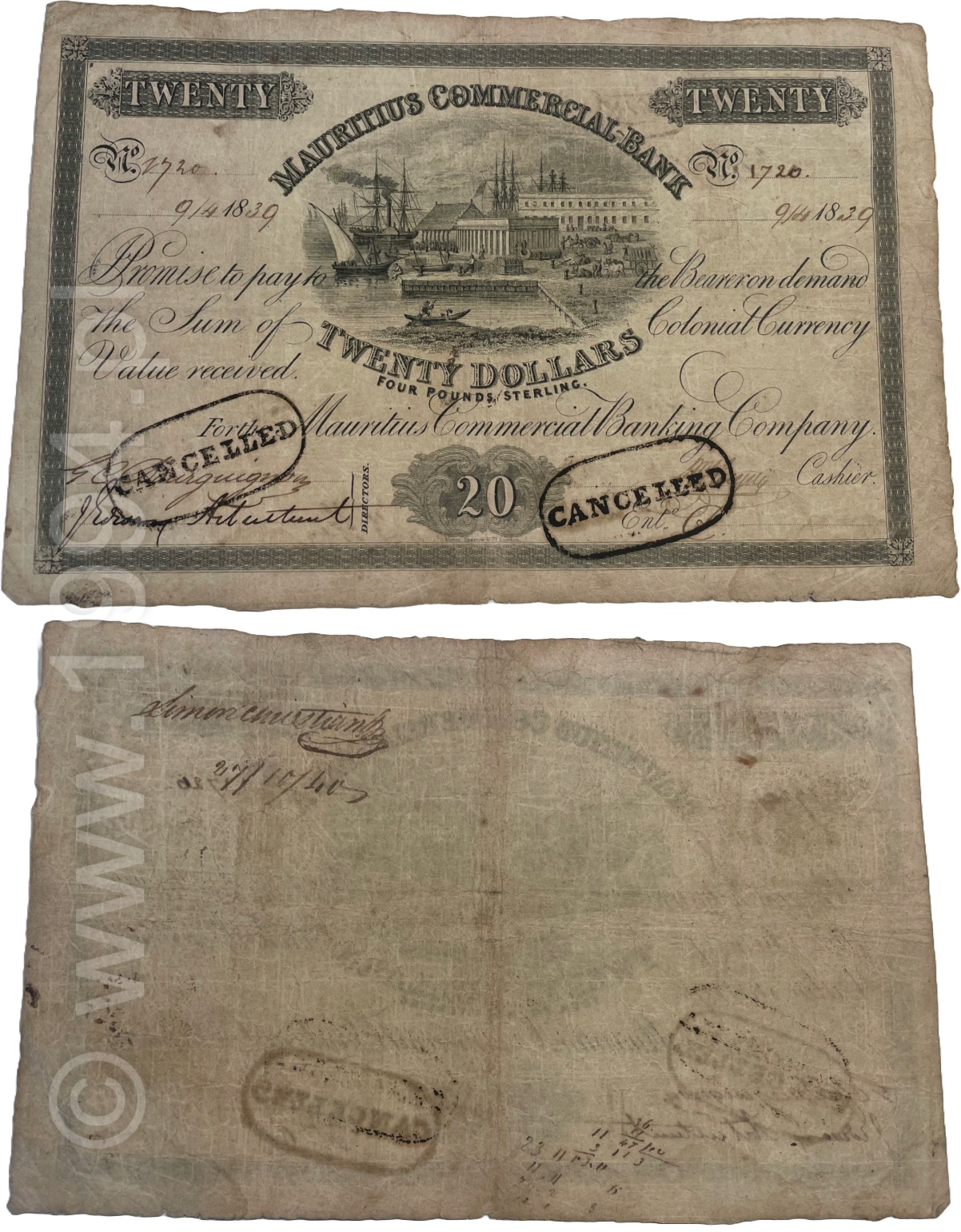
Mauritius 1839 Mauritius Commercial Bank 20 Dollars / 4 Pounds Sterling Issued & Cancelled

Mauritius 1839 - Mauritius Commercial Bank 20 Dollars / 4 Pounds Sterling Issued & Cancelled Note (Pick S125)

Rarity is severe. PMG census lists only 15 total graded examples for Pick S125 across all grades and subtypes. Surviving raw pieces in private hands and institutions likely number only a handful more. Combining these yields an estimated total population of approximately <10 extant issued-and-cancelled examples in all conditions, placing the type squarely in the R8 range of rarity. As an intact, fully issued, pre-1840 Mauritius note from the formative period of the island’s banking history, this piece stands as a museum-grade cornerstone for early Indian Ocean finance and colonial economic studies. Read more →

MauritiusIssued & Cancelled Note183920 Dollars / 4 Pounds SterlingFine–Very Fine (Issued & Cancelled) Issued NoteCancelled20 Dollars4 PoundsColonial CurrencyDual-CurrencyMyers Frs & CoEngraved Security PrintingMauritius Commercial BankEarly Mauritius BankingColonial Banking HistoryPrivate Banknote EraPort Louis Harbor VignetteBritish Colonial Finance19th Century BanknotesRedemption and Cancellation NotesMauritiusPort Louis1839Museum GradeR8 Extremely Rare
Held
New Zealand 1895–1915 Bank of New Zealand 5 Pounds Orange Specimen Pick S192s with dual serial numbers A000001 and A020000, perforated CANCELLED marking, left audit margin, and dated top margin printer annotations, printed by Bradbury Wilkinson & Company, Limited, London, PMG 55 About Uncirculated.

New Zealand 1895–1915 - Bank of New Zealand £5 Orange Specimen (Pick S192s)

The high-denomination anchor of the Bank of New Zealand color series, this five pounds orange specimen (Pick S192s) represents one of the most structurally complex and production-informative notes of New Zealand’s private banking era. Printed by Bradbury, Wilkinson & Company, Limited, London, it embodies the transition from richly ornamental Victorian engraving toward the more controlled and symmetrical Edwardian framework that followed. The composition preserves the defining elements of the earlier series-paired Māori figures within oval medallions at left, a lower maritime vignette reflecting colonial trade identity, and a dense guilloche lattice enclosing the denomination-while introducing a more disciplined spatial hierarchy across the central obligation panel. Read more →

New ZealandSpecimen18955 PoundsPMG 55 About Uncirculated Specimen5 PoundsBank of New ZealandBradbury WilkinsonBWCA Prefix SpecimenA000001A020000Dual Serial NumbersPrinter Control NumberingPerforated CANCELLEDAudit Margin LeftPrinter AnnotationsTop Margin AnnotationDated Annotation 1915Printer Ledger MarkingsColonial IssueHigh DenominationEdwardian DesignMāori Portrait SeriesEngraved Security PrintingNew Zealand Banking HistoryPrivate Banknote EraPre-Reserve BankBNZ Color LineageVictorian to Edwardian TransitionMaritime Economy NotesBritish Colonial FinanceSecurity Printing HistoryOceania NumismaticsHistoryNew Zealand189519151895-1915Pick S192sPMG 55Museum GradeR7 Extremely RareAnnotationsHandwritten Annotations
Held
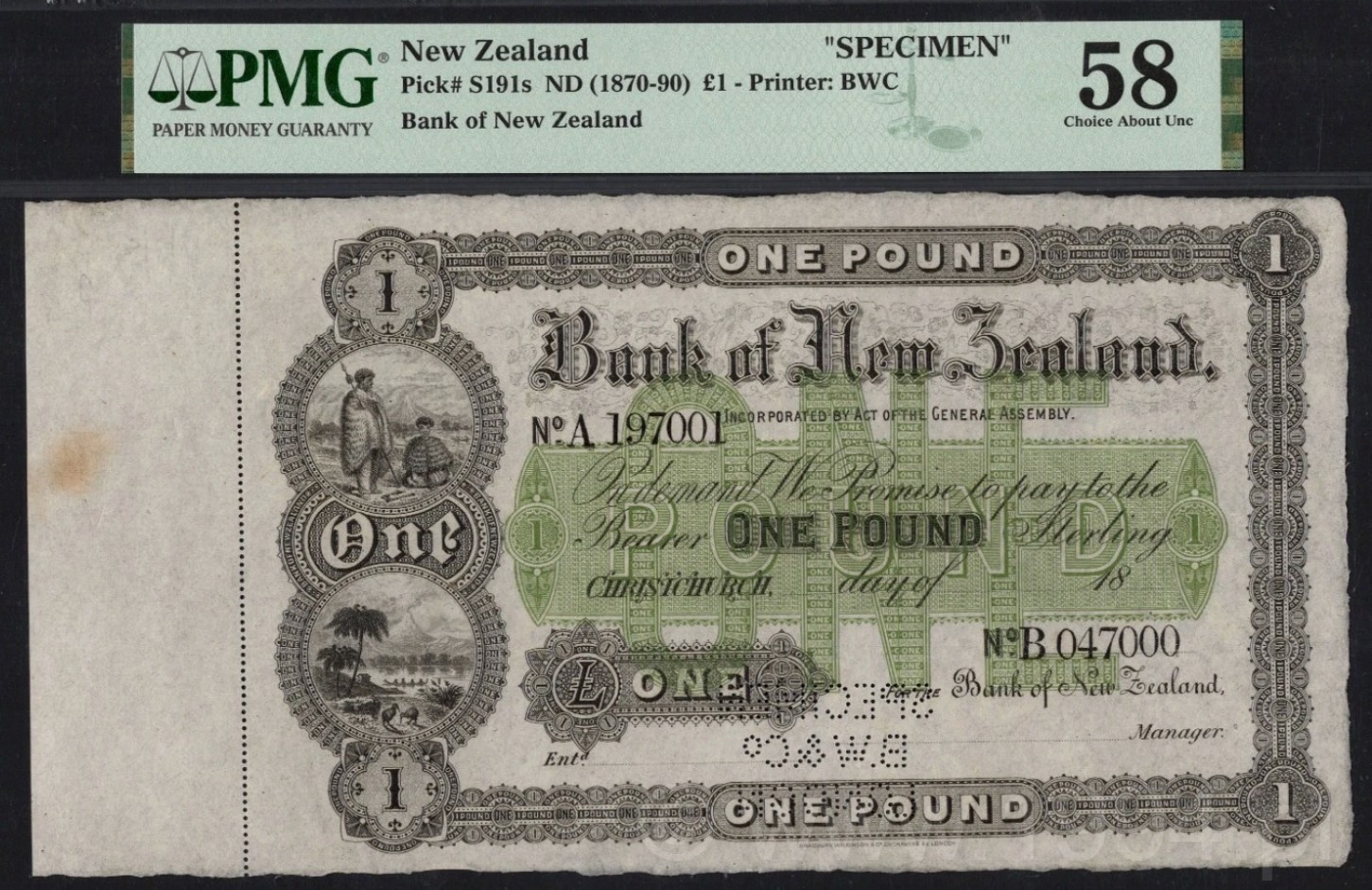
New Zealand 1870–1890 Bank of New Zealand 1 Pound Green Specimen Pick S191s, dual serial numbers A197001 and B047000, perforated CANCELLED, Bradbury Wilkinson printing, PMG 58 Choice About Uncirculated

New Zealand 1870–1890 - Bank of New Zealand £1 Green Specimen (Pick S191s)

This £1 Green specimen marks a pivotal stage in New Zealand’s monetary development. During the late nineteenth century, the Bank of New Zealand operated within a privately issued currency system, where commercial banks produced their own notes backed by reserves and governed under colonial legislation. Bradbury Wilkinson introduced high-security engraving standards to this system, embedding British technical precision into a developing colonial economy. Read more →

New ZealandSpecimen18701 PoundPMG 58 Choice About Uncirculated Specimen1 PoundBank of New ZealandBradbury WilkinsonBWCDual Serial NumbersA197001B047000Perforated CANCELLEDAudit MarginPrinter Control SystemColonial IssueVictorian DesignMāori Portrait SeriesEngraved Security PrintingNew Zealand Banking HistoryPrivate Banknote EraPre-Reserve BankBNZ Color LineageColor Lineage Origin19th Century OceaniaMaritime Economy NotesEarly Indigenous ImageryBritish Colonial FinanceHistoryNew Zealand187018901870–1890Pick S191sPMG 58Choice About UncirculatedMuseum GradeR7 Extremely Rare
Held
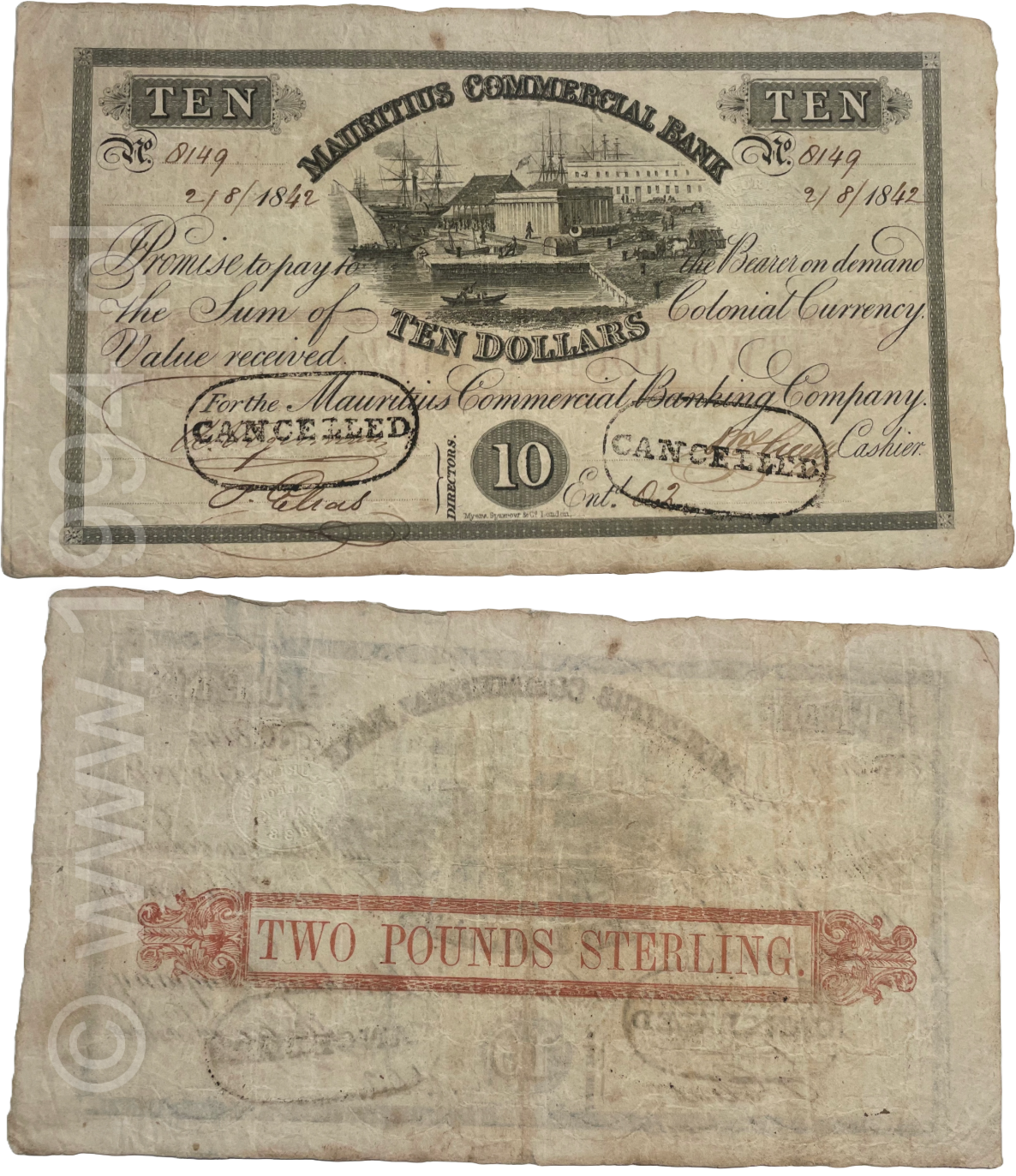
Mauritius 1842 Mauritius Commercial Bank 10 Dollars / 2 Pounds Sterling Issued & Cancelled

Mauritius 1842 - Mauritius Commercial Bank 10 Dollars / 2 Pounds Sterling Issued & Cancelled (Pick S122a)

Each note was printed on watermarked paper, completed by hand, and countersigned by bank officials. Surviving examples such as this are among the earliest tangible records of Mauritius’s entry into formal banking and British colonial monetary structure. Read more →

MauritiusIssued & Cancelled Note184210 Dollars / 2 Pounds SterlingFine–Very Fine (Issued & Cancelled) Issued NoteCancelled10 Dollars2 PoundsDual-CurrencyColonial CurrencyMyers Frs & CoEngraved Security PrintingMauritius Commercial BankEarly Mauritius BankingColonial Banking HistoryPrivate Banknote EraPort Louis Harbor VignetteBritish Colonial Finance19th Century BanknotesRedemption and Cancellation NotesMauritiusPort Louis1842Museum GradeR6 Extremely Rare
Held
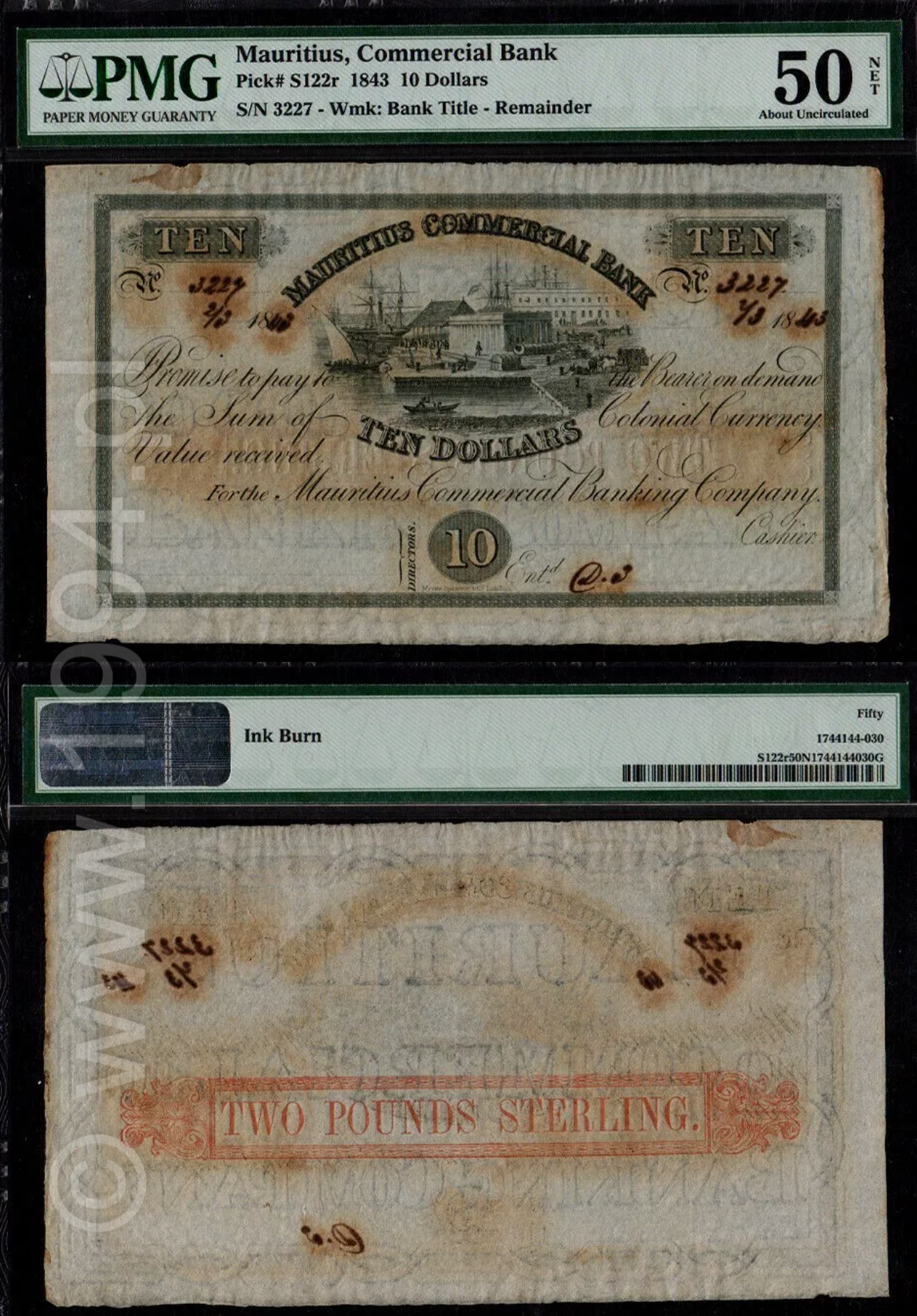
Mauritius 1843 Mauritius Commercial Bank 10 Dollars / 2 Pounds Sterling Remainder, PMG 50 NET

Mauritius 1843 - Mauritius Commercial Bank 10 Dollars / 2 Pounds Sterling Remainder (Pick S122r)

Graded PMG 50 NET About Uncirculated for ink burn alone - rather than circulation wear - the note retains exceptional embossing, paper strength, and plate clarity. As a high-denomination Ten Dollar / Two Pounds Sterling remainder from the earliest functional period of Mauritian banking under British administration, it stands as a museum-grade artifact documenting the origins of the island’s formal monetary structure, its dependence on sterling, and the technical evolution of one of the British Empire’s rarest early colonial paper-money systems. Read more →

MauritiusRemainder184310 Dollars / 2 Pounds SterlingPMG 50 NET (Ink Burn) Remainder10 Dollars2 PoundsDual-CurrencyColonial CurrencyMyers Frs & CoEngraved Security PrintingInk BurnMauritius Commercial BankEarly Mauritius BankingColonial Banking HistoryPrivate Banknote EraPort Louis Harbor VignetteBritish Colonial Finance1840s Currency Reform19th Century BanknotesMauritiusPort Louis1843PMG 50Museum GradeR6 Extremely RareAnnotationsHandwritten Annotations
Held
South Africa 1828 Cape of Good Hope Bank five shillings pre issue sample note, engraved border and ships vignette, Smithsonian class institutional artifact

South Africa 1828 - Cape of Good Hope Bank 5 Shillings Pre-Issue Sample (Pick S171p)

The obverse design reflects the visual language of early nineteenth-century British colonial banking. An ornate engraved border encloses a central vignette depicting ships anchored off the Cape with mountainous terrain in the background, a deliberate reference to maritime trade, provisioning, and the strategic role of the Cape as a commercial waypoint within the British imperial system. The textual promise to pay the bearer on demand is fully articulated, while the date and issuance fields remain incomplete, consistent with pre-authorization sample status. The reverse is blank, as expected for early colonial banking samples produced prior to standardized two-sided note formats. Read more →

South AfricaPre-Issue Sample1828Five Shillings SterlingUncirculated Pre Issue Sample5 Shillings SterlingSample NoteApproval Stage CurrencyCape of Good Hope BankPrivate Colonial BankingEarly Nineteenth Century CurrencyCape Colony Monetary HistoryBritish Colonial FinanceInstitutional ProvenanceSouth Africa1828Pick S171pR9 Extremely RareMuseum GradeSmithsonian Held Class
Held
↑ Top