Collection PL

About 1994.pl
Results for “colonial banking”
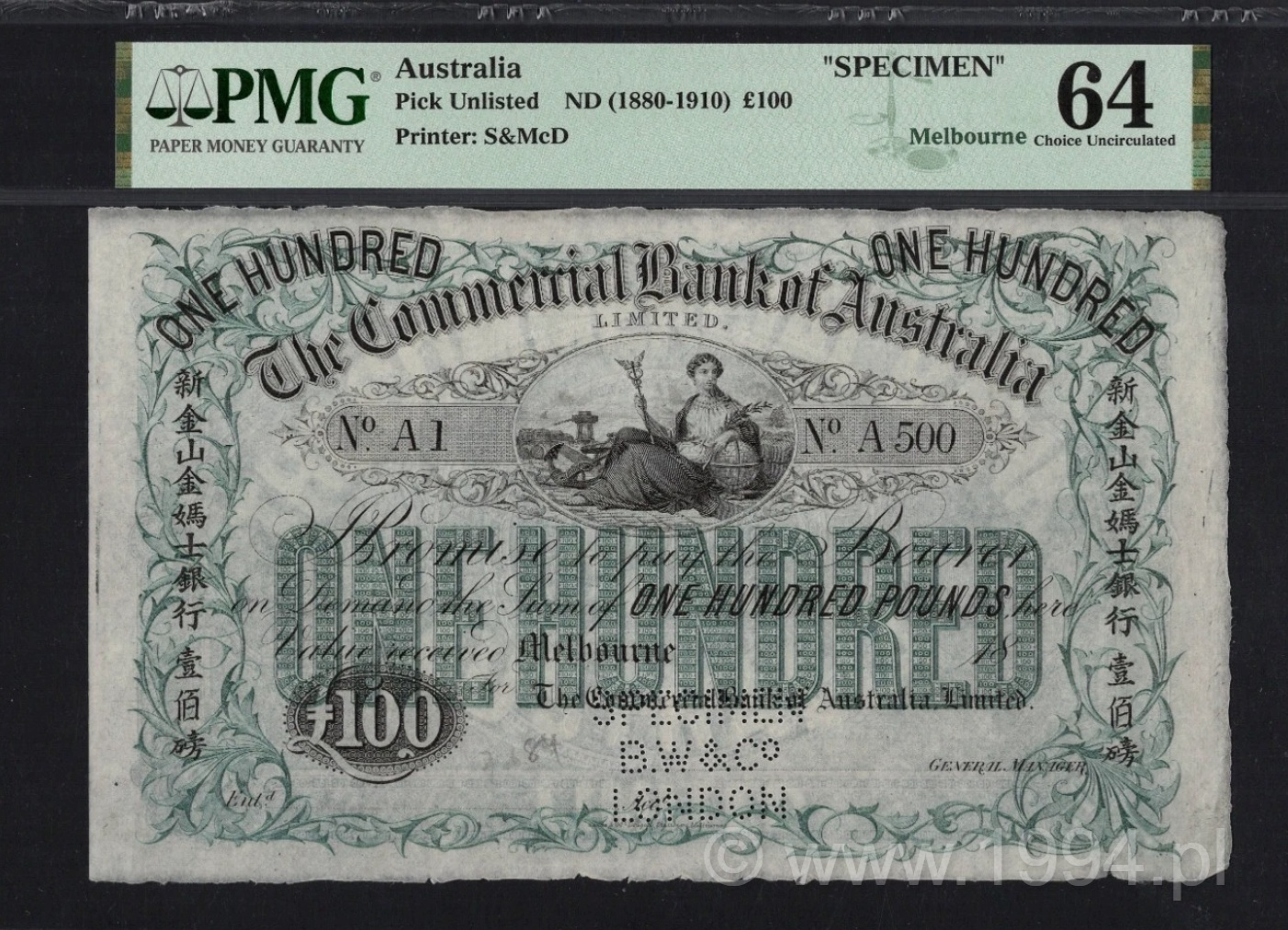
Australia 1880–1910 Commercial Bank of Australia £100 specimen, PMG 64 Choice Uncirculated

Australia 1880–1910 - Commercial Bank of Australia £100 Specimen (Pick Unlisted)

A monumental survivor from Australia’s private banking era, this £100 specimen ranks among the most important colonial-era notes known. Printed circa 1880–1910 for the Commercial Bank of Australia Limited, it represents the uppermost denomination produced under the private-issue system that existed before the Commonwealth took full control of note issuance in 1910. No issued examples of this £100 are believed to have survived, making specimens the only remaining documentation of the type. Read more →

AustraliaSpecimen1880100 PoundsPMG 64 Choice Uncirculated Specimen100 PoundsHigh DenominationCommercial Bank of AustraliaBradbury WilkinsonBWCSands & McDougallColonial SpecimenBilingualChinese-EnglishPick UnlistedColonial Banking HistoryAustralian Private BanknotesPre-Notes Act Era19th Century BankingMulticultural Trade NetworksSecurity Printing HistoryBritish Engraving InfluenceAustralian Monetary HistoryAustralia188019101880–1910PMG 64Museum GradeR9 Extremely RareUniqueAnnotationsHandwritten Annotations
Held
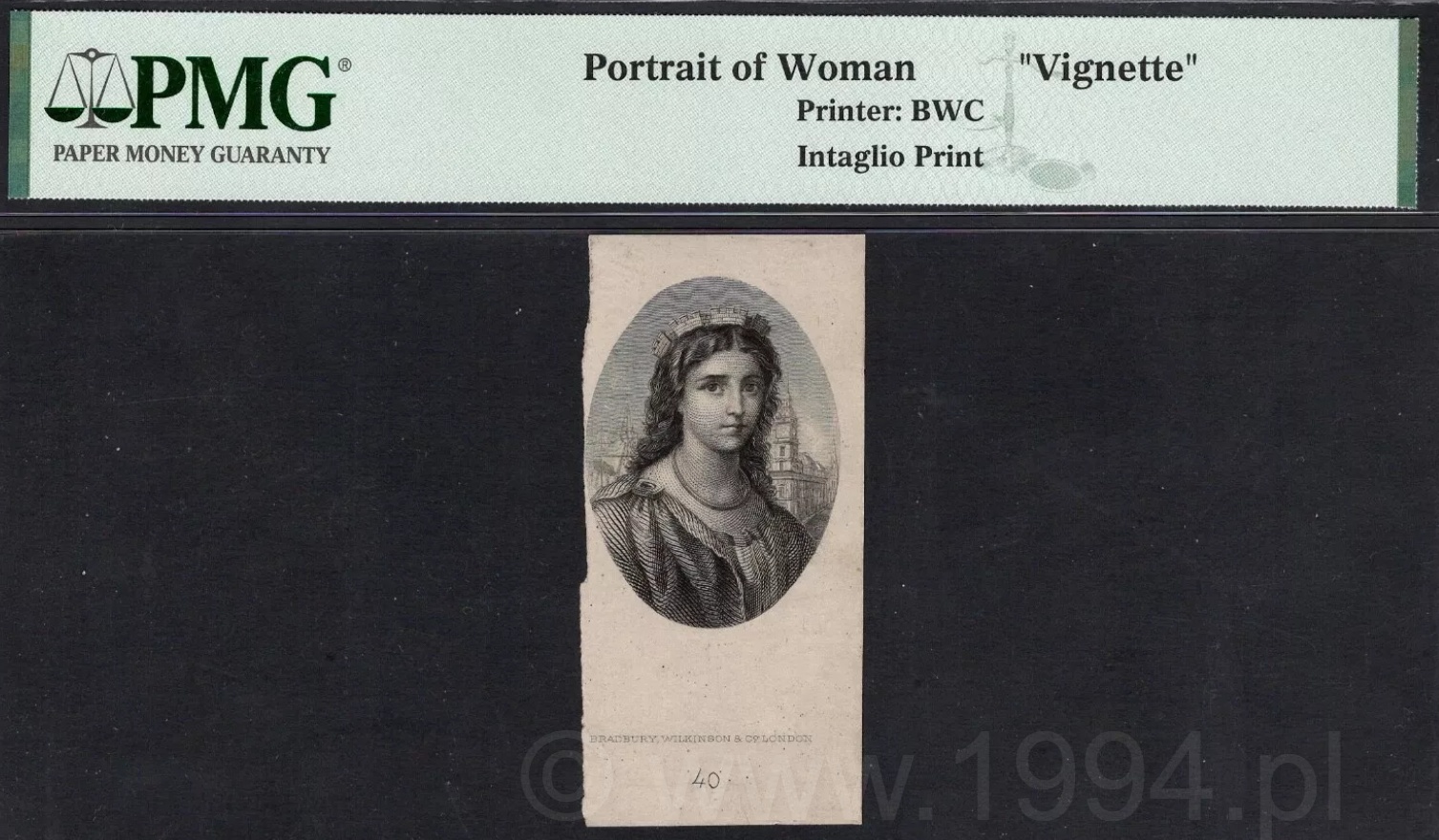
Bradbury, Wilkinson and Company 1877 Portrait of Woman intaglio vignette proof, printer's library design element associated with the City of Melbourne Bank Limited 20 Pounds colonial Australian banknote design

Australia 1877 - Bradbury, Wilkinson and Company Portrait of Woman Intaglio Vignette Proof for City of Melbourne Bank Limited 20 Pounds Design (Pick Unlisted)

The lower margin carries the Bradbury, Wilkinson & Co. London imprint together with the number 40. Preserved independently from borders, denomination devices, issuer lettering and other elements of the completed note, the vignette allows the engraved portrait to be examined as an individual production component. Read more →

AustraliaVignette Proof1877Reference VignetteArchival Intaglio Proof Vignette ProofIntaglio Vignette ProofPortrait VignettePortrait of WomanEngraved PortraitPrinter's Library ElementPrinter's Design ArchiveProduction Stage ArtifactStandalone VignetteReference VignetteCity of Melbourne Bank Limited Design Source20 Pounds Design SourceBradbury, Wilkinson and CompanyBradbury, Wilkinson and Company LondonLondon Security PrinterIntaglio PrintingIntaglio EngravingSecurity EngravingBanknote PrintingSecurity PrintingPrivate Banknote ProductionProofing and Plate ApprovalDesign Verification ArtifactPick UnlistedAustralian Banking HistoryAustralian Colonial BankingPre Federation AustraliaVictoria Banking HistoryCity of Melbourne BankCity of Melbourne Bank LimitedColonial VictoriaPrivate Banknote TraditionNineteenth Century Paper MoneyVictorian Era EngravingHistoryAustraliaVictoria1877R9 Extremely RareUniqueMuseum Grade
Held
New Zealand Bank of Australasia £50 Christchurch proof note dated 1896, Victorian engraved colonial banknote printed by Perkins Bacon, PMG 55 proof

New Zealand 1896 - Bank of Australasia £50 Christchurch Proof (Pick Unlisted)

Surviving proof material from the Bank of Australasia New Zealand operations is exceptionally scarce. The combination of high denomination, branch specificity, and proof status positions this example as a primary documentary artifact of British colonial banking mechanics, engraving practice, and monetary authority in late nineteenth century New Zealand. Read more →

New ZealandProof189650 PoundsPMG 55 About Uncirculated Proof Banknote50 PoundsPre Issue ProofNon Circulating ProofInstitutional Presentation NoteBank of AustralasiaBritish Chartered BanksColonial Banking in New ZealandColonial FinanceBritish Security PrintingVictorian EngravingExport Engraved NotesNew ZealandChristchurch188819211896Pick UnlistedMuseum GradeR9 Extremely RareUnique
Held
Australia 1877 Mercantile Bank of Sydney £1 specimen with red ONE overprint, Pick Unlisted, printed by Bradbury Wilkinson & Co., graded PMG 66 EPQ Gem Uncirculated Pop 1, only known example

Australia 1877 - Mercantile Bank of Sydney £1 Specimen (Pick Unlisted)

A superb Bradbury, Wilkinson & Co. specimen from the early colonial banking era, this £1 note for the Mercantile Bank of Sydney survives today as the only documented example of its type. Certified PMG 66 EPQ Gem Uncirculated and recorded as Pop 1, it represents a unique surviving specimen of a private Australian bank whose issues rarely appear in any form. The same piece is known to have appeared once in a past Christie’s sale prior to encapsulation, making this the sole confirmed survivor based on all available auction, census, and institutional research. Read more →

AustraliaSpecimen18771 PoundPMG 66 EPQ Gem Uncirculated (Pop 1) Specimen1 PoundPick UnlistedRed OverprintColonial Private BankBradbury WilkinsonBWCMercantile Bank of SydneyNew South Wales Banking History19th Century FinanceAustralian Private IssuesSecurity Printing HistoryColonial PeriodAustralia1877Only Known ExampleR9 Extremely RareUniquePop 1Top PopPMG 66 EPQGem UncirculatedMuseum Grade
Held
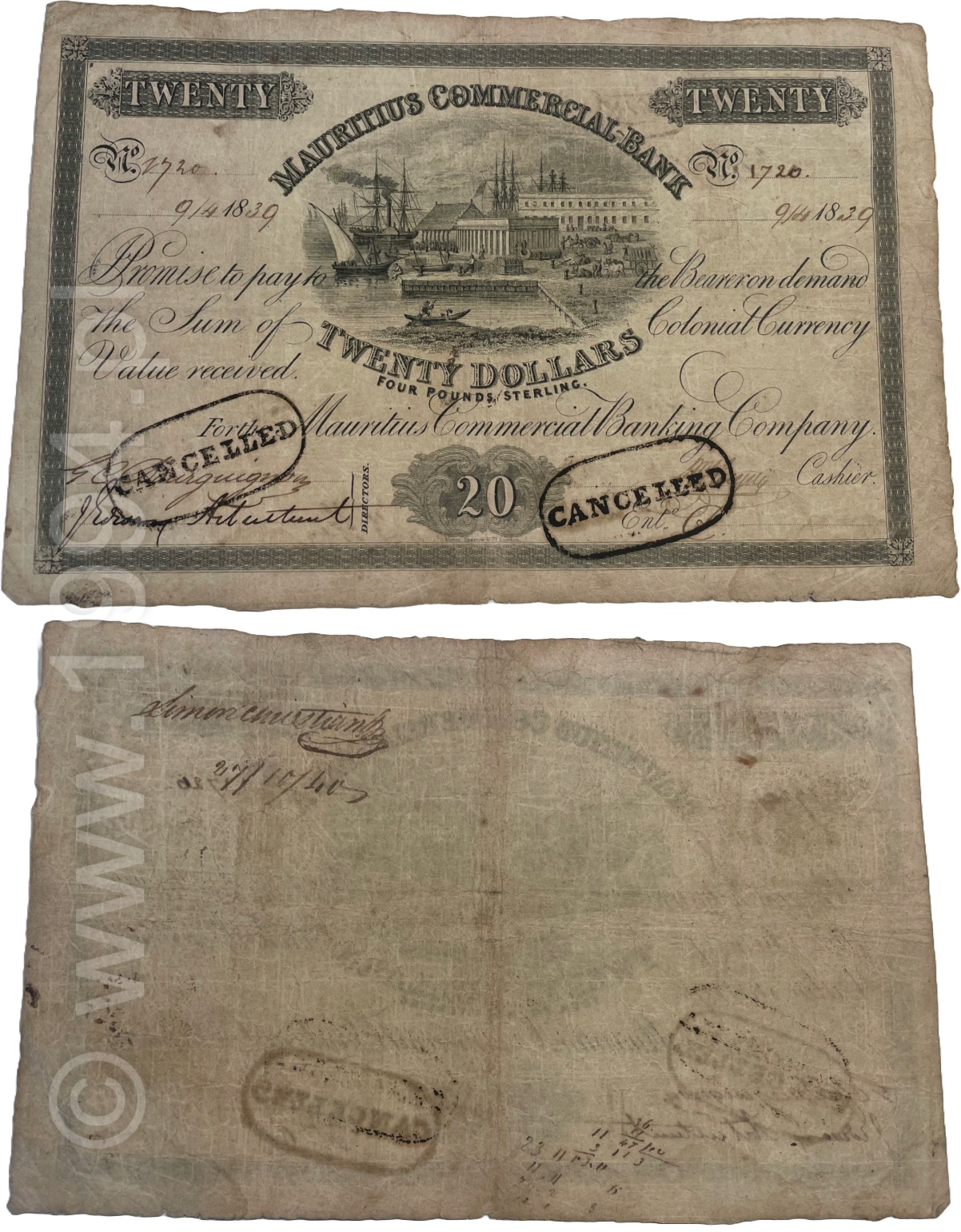
Mauritius 1839 Mauritius Commercial Bank 20 Dollars / 4 Pounds Sterling Issued & Cancelled

Mauritius 1839 - Mauritius Commercial Bank 20 Dollars / 4 Pounds Sterling Issued & Cancelled Note (Pick S125)

One of the earliest surviving issued notes of the Mauritius Commercial Bank-the oldest banking institution in the Indian Ocean-this 1839 Twenty Dollar / Four Pounds Sterling note is a foundational artifact of Mauritian monetary history. Issued only one year after the bank’s founding in 1838, it belongs to the first generation of fully functional colonial paper money used on the island. These early issues circulated at a time when coin shortages were severe, and private banknotes became the primary medium of exchange for merchants, plantation owners, and shipping houses. Read more →

MauritiusIssued & Cancelled Note183920 Dollars / 4 Pounds SterlingFine–Very Fine (Issued & Cancelled) Issued NoteCancelled20 Dollars4 PoundsColonial CurrencyDual-CurrencyMyers Frs & CoEngraved Security PrintingMauritius Commercial BankEarly Mauritius BankingColonial Banking HistoryPrivate Banknote EraPort Louis Harbor VignetteBritish Colonial Finance19th Century BanknotesRedemption and Cancellation NotesMauritiusPort Louis1839Museum GradeR8 Extremely Rare
Held
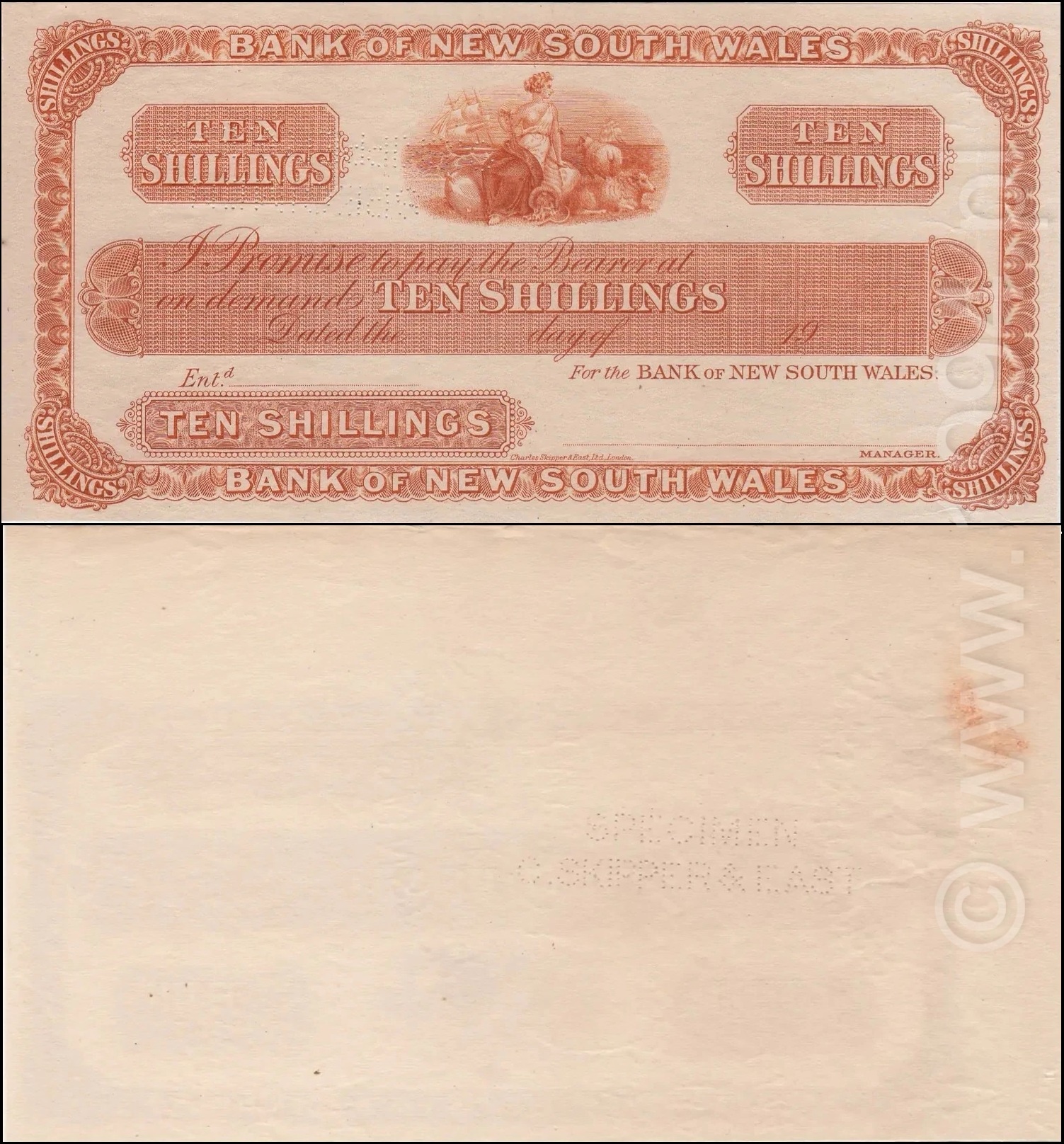
New Zealand ND 1924-1933 Bank of New South Wales ten shillings proof printed by Charles Skipper and East, perforated SPECIMEN control marking, single sided with blank reverse

New Zealand ND (1924-1933) - Bank of New South Wales Ten Shillings Proof, Perforated SPECIMEN (Pick S161s)

As a museum grade research artifact, this proof embodies several converging narratives. It illustrates London based contract engraving for colonial and dominion banks, the trans Tasman operational identity of the Bank of New South Wales, and the use of perforated control markings as an internal security and archival mechanism within early twentieth century banknote production. Rather than serving as a monetary instrument, this piece functions as documentary evidence of how colonial banking institutions planned, approved, and archived designs that in some cases never reached the public. Read more →

New ZealandProof192410 ShillingsChoice Uncirculated Proof Banknote10 ShillingsPrinter ProofPerforated SPECIMENPrinter Control MarkingNon Circulating ProofBank of New South WalesColonial BankingAustralasian BankingCharles Skipper and EastLondon Security PrintingGuilloche EngravingMicroletteringBlank ReverseNew ZealandND 1924-193319241933Pick S161sPick S161Museum GradeR8 Extremely Rare
Held
New Zealand ND 1924-1933 Bank of New South Wales ten shillings oversized proof printed by Charles Skipper and East, perforated SPECIMEN control marking, untrimmed margins, blank reverse

New Zealand ND (1924-1933) - Bank of New South Wales Ten Shillings Oversized Proof, Perforated SPECIMEN (Pick S161s)

Although cataloged under New Zealand, the design belongs to the broader Australasian operating structure of the Bank of New South Wales, a trans Tasman institution active in both Australia and New Zealand. As with other interwar colonial banking issues, engraving and printing were executed in London, where firms such as Skipper and East supplied unified design languages for banks operating across multiple jurisdictions. Read more →

New ZealandProof192410 ShillingsChoice Uncirculated Proof Banknote10 ShillingsOversized ProofPrinter Archive ProofPerforated SPECIMENPrinter Control MarkingNon Circulating ProofUntrimmed MarginsBlank ReverseBank of New South WalesColonial BankingAustralasian BankingCharles Skipper and EastLondon Security PrintingGuilloche EngravingMicroletteringNew ZealandND 1924-193319241933Pick S161sMuseum GradeR9 Extremely RareUnique
Held
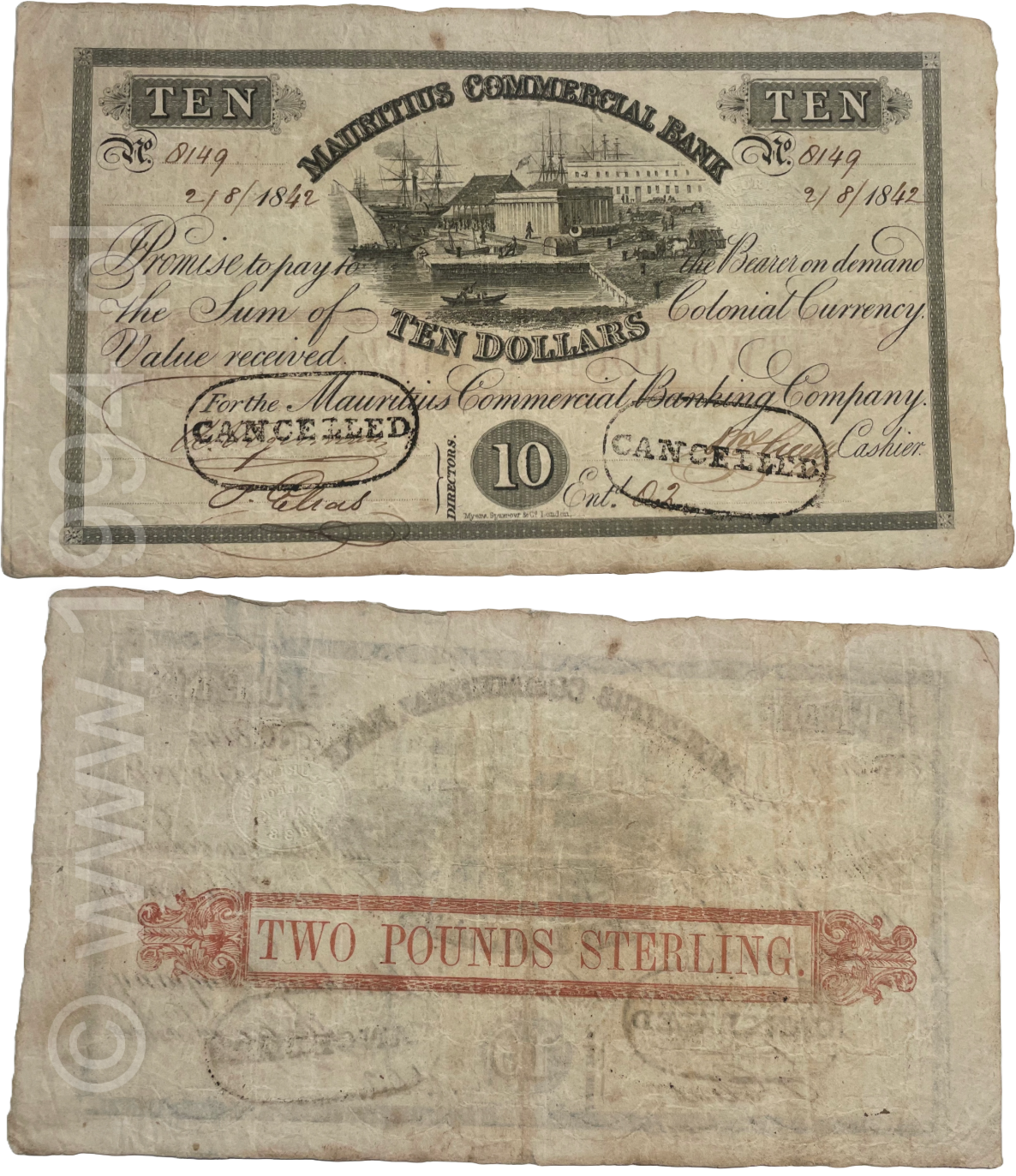
Mauritius 1842 Mauritius Commercial Bank 10 Dollars / 2 Pounds Sterling Issued & Cancelled

Mauritius 1842 - Mauritius Commercial Bank 10 Dollars / 2 Pounds Sterling Issued & Cancelled (Pick S122a)

Each note was printed on watermarked paper, completed by hand, and countersigned by bank officials. Surviving examples such as this are among the earliest tangible records of Mauritius’s entry into formal banking and British colonial monetary structure. Read more →

MauritiusIssued & Cancelled Note184210 Dollars / 2 Pounds SterlingFine–Very Fine (Issued & Cancelled) Issued NoteCancelled10 Dollars2 PoundsDual-CurrencyColonial CurrencyMyers Frs & CoEngraved Security PrintingMauritius Commercial BankEarly Mauritius BankingColonial Banking HistoryPrivate Banknote EraPort Louis Harbor VignetteBritish Colonial Finance19th Century BanknotesRedemption and Cancellation NotesMauritiusPort Louis1842Museum GradeR6 Extremely Rare
Held
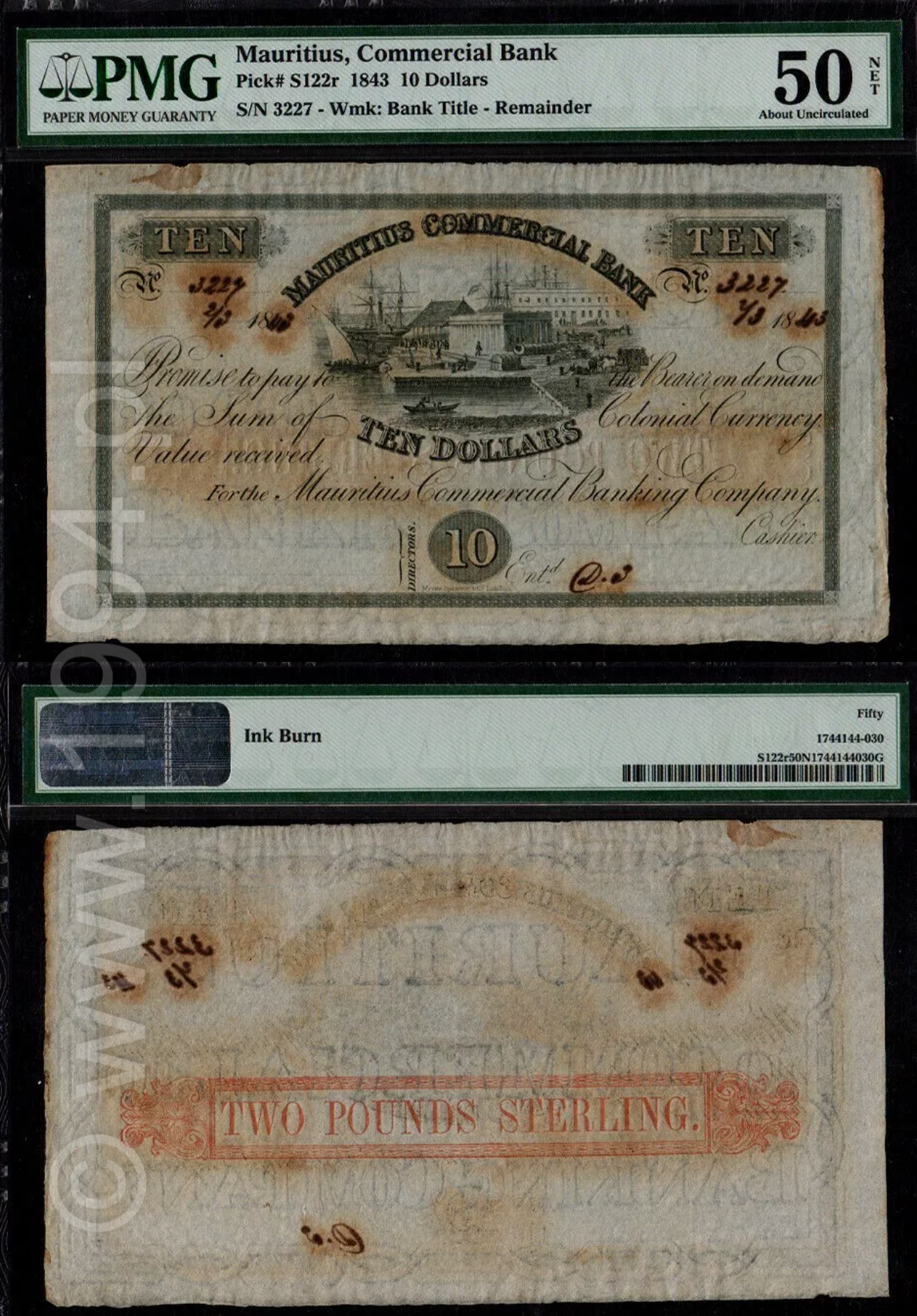
Mauritius 1843 Mauritius Commercial Bank 10 Dollars / 2 Pounds Sterling Remainder, PMG 50 NET

Mauritius 1843 - Mauritius Commercial Bank 10 Dollars / 2 Pounds Sterling Remainder (Pick S122r)

Graded PMG 50 NET About Uncirculated for ink burn alone - rather than circulation wear - the note retains exceptional embossing, paper strength, and plate clarity. As a high-denomination Ten Dollar / Two Pounds Sterling remainder from the earliest functional period of Mauritian banking under British administration, it stands as a museum-grade artifact documenting the origins of the island’s formal monetary structure, its dependence on sterling, and the technical evolution of one of the British Empire’s rarest early colonial paper-money systems. Read more →

MauritiusRemainder184310 Dollars / 2 Pounds SterlingPMG 50 NET (Ink Burn) Remainder10 Dollars2 PoundsDual-CurrencyColonial CurrencyMyers Frs & CoEngraved Security PrintingInk BurnMauritius Commercial BankEarly Mauritius BankingColonial Banking HistoryPrivate Banknote EraPort Louis Harbor VignetteBritish Colonial Finance1840s Currency Reform19th Century BanknotesMauritiusPort Louis1843PMG 50Museum GradeR6 Extremely RareAnnotationsHandwritten Annotations
Held
Martinique 1870 Banque de la Martinique 1 franc unissued cheque, Saint-Pierre issue, unused condition

Martinique 1870 - Banque de la Martinique 1 Franc Unissued Cheque (Pick P.5A)

An unissued cheque for one franc prepared for the Banque de la Martinique and intended for use at Saint-Pierre, dating from the early period of organized colonial banking on the island. Classified as Pick P.5A, this form represents a non-circulating banking instrument rather than a circulating banknote, designed for internal settlement, account debiting, and controlled monetary transfers within the colonial financial system. Read more →

MartiniqueUnissued Cheque18701 FrancUncirculated Unissued Cheque1 FrancBanque de la MartiniqueColonial Banking InstrumentFrench Colonial FinancePick P.5AColonial Banking HistoryFrench Overseas TerritoriesCaribbean Monetary History19th Century BankingDocumentary Financial InstrumentsSecurity Printing HistoryFrench Engraving TraditionMartinique1870Museum GradeR8 Extremely Rare
Held
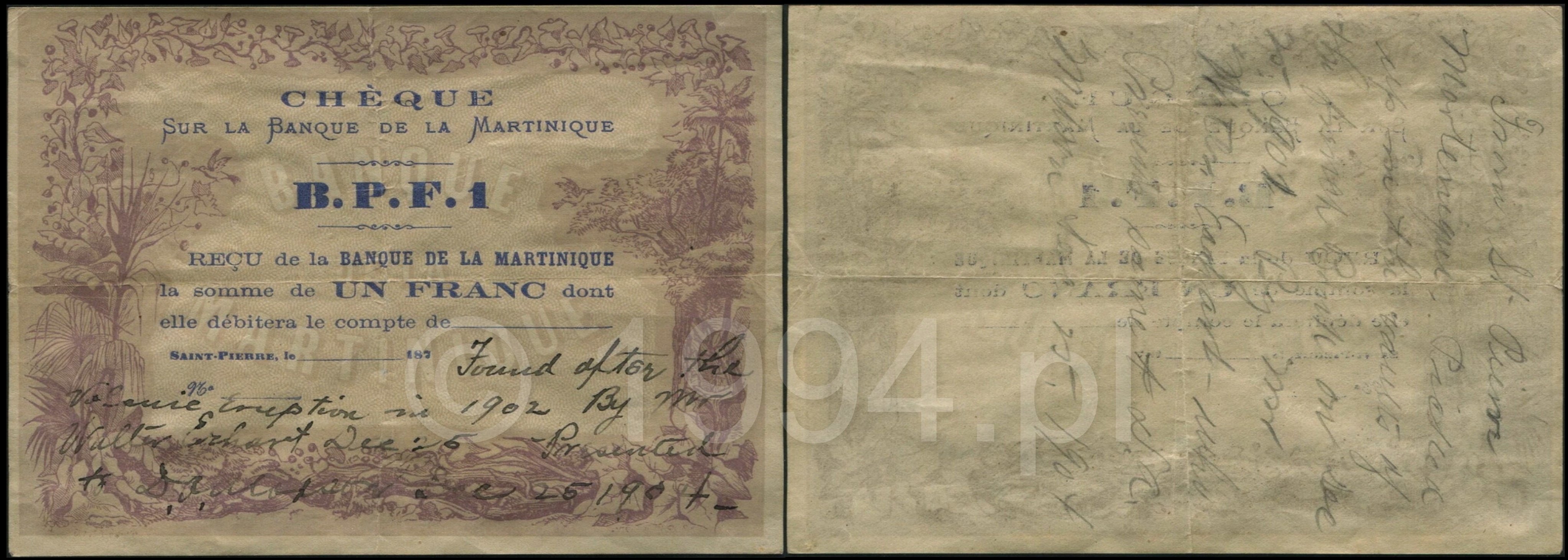
Martinique 1870 Banque de la Martinique 1 franc cheque recovered from the ruins of Saint-Pierre after the 1902 Mount Pelée eruption, with contemporary handwritten provenance notes

Martinique 1870 - Banque de la Martinique 1 Franc Cheque Recovered After the 1902 Mount Pelée Eruption (Pick P.5A)

The reverse carries a clearer and more explicit inscription reading “Souvenir of St. Pierre” and “Found in the wreck of the Colonial Bank,” followed by a specific date: May 13, 1902. This date falls only five days after the eruption, during the brief window when access to the ruins was still possible and before systematic clearing or restriction of the site. The reference to the Colonial Bank situates the recovery location within the destroyed banking district of Saint-Pierre, an area completely annihilated by pyroclastic flows and fires. Read more →

MartiniqueDisaster Recovery Cheque18701 FrancVery Fine Disaster Recovery Cheque1 FrancBanque de la MartiniqueMount Pelee EruptionSaint Pierre DestructionColonial Bank RuinsPick P.5AColonial Banking HistoryFrench Overseas TerritoriesCaribbean Monetary HistoryNineteenth Century BankingDisaster Recovered ArtifactDocumentary Financial InstrumentsSecurity Printing HistoryFrench Engraving TraditionMartinique18701902Museum GradeR9 Extremely RareUniqueAnnotationsHandwritten Annotations
Held
South Africa 1828 Cape of Good Hope Bank five shillings pre issue sample note, engraved border and ships vignette, Smithsonian class institutional artifact

South Africa 1828 - Cape of Good Hope Bank 5 Shillings Pre-Issue Sample (Pick S171p)

The Cape of Good Hope Bank occupies a unique position in South African monetary history. While earlier banking activity existed under Dutch East India Company administration, including the state-controlled Lombard Bank established in 1793, the Cape of Good Hope Bank was the first true private commercial bank in southern Africa. Its eventual opening in 1837 marked a decisive transition from state-issued colonial notes toward privately organized banking and credit formation within the Cape economy. Read more →

South AfricaPre-Issue Sample1828Five Shillings SterlingUncirculated Pre Issue Sample5 Shillings SterlingSample NoteApproval Stage CurrencyCape of Good Hope BankPrivate Colonial BankingEarly Nineteenth Century CurrencyCape Colony Monetary HistoryBritish Colonial FinanceInstitutional ProvenanceSouth Africa1828Pick S171pR9 Extremely RareMuseum GradeSmithsonian Held Class
Held
↑ Top