Results for “eighteenth century”
Complete nine-note Stockholm Spinnhus pollett monetary system from circa 1785, including all denominations from one half öre to one daler, preserved in unissued condition and classified as R10 extremely rare.

Sweden 1785 - Stockholm Spinnhus Pollett System – Complete Nine-Denomination Institutional Currency Set:One Half Öre to One Daler (Pick Unlisted)

This complete nine-note ensemble represents the entire internal monetary system of Stockholm’s Spinnhus, the women’s correctional institution and workhouse operating on Långholmen Island during the late eighteenth century. Produced circa 1785, these engraved pollett notes functioned as closed-economy institutional currency, issued exclusively for use within the prison environment. They served as a controlled medium of exchange through which inmates were compensated for labor, particularly the spinning and processing of flax and wool. Internally, the notes operated as proto-fiat currency, enabling regulated transactions, discipline, and subsistence within a self-contained penal micro-economy. Read more →

eighteenth century
SwedenInstitutional Paper Currency Set1785Complete nine-note system: one half öre, one öre, two öre, five öre, six öre, seven öre, sixteen öre, twenty-four öre, one dalerUncirculated PollettInstitutional paper currencyEngraved copperplate noteEighteenth century rag paperAnopisthographic printingUnissuedUncirculatedStockholm engravingSwedish copperplate productionPre-industrial note manufactureStockholm SpinnhusLångholmen prison economyPenal labor currencyClosed economy tenderProto-fiat institutional moneyInternal monetary systemSweden1785One half öreOne öreTwo öreFive öreSix öreSeven öreSixteen öreTwenty-four öreOne dalerFull denomination setPick UnlistedR10 UniqueR10UniqueUnique Known ExampleUnique Set
Held
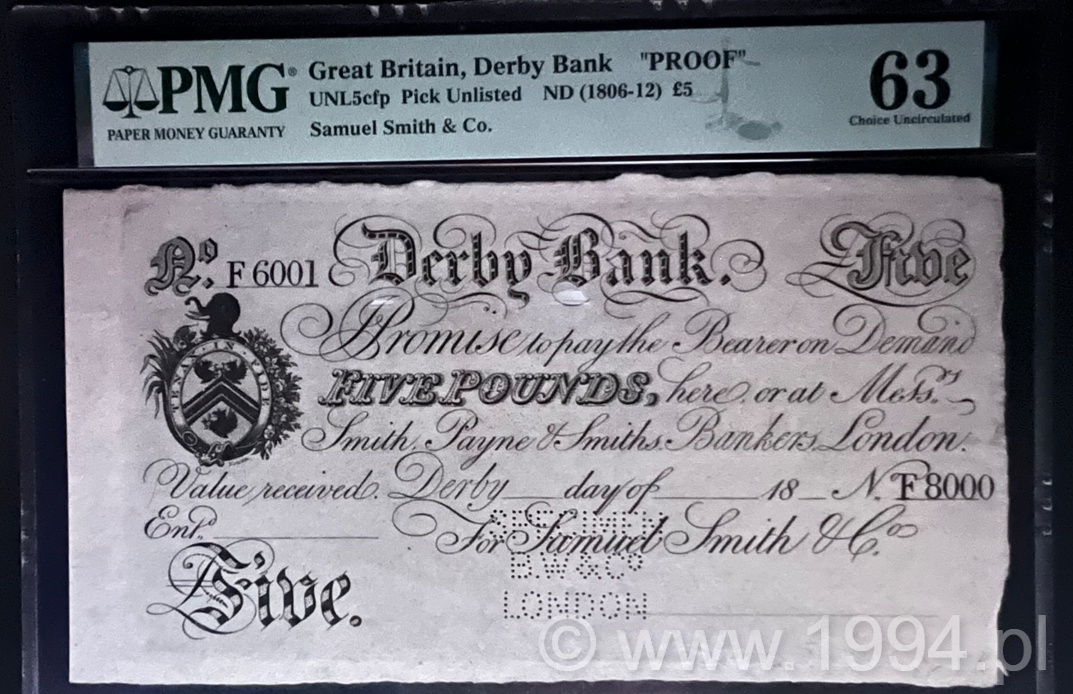
Great Britain Derby Bank £5 proof, circa 1806–1812, engraved private bank issue payable via Samuel Smith & Co., PMG 63 Choice Uncirculated

Great Britain c.1806–1812 - Derby Bank £5 Proof (Pick Unlisted)

A printer’s proof of a £5 note prepared for the Derby Bank during the formative years of British provincial banking, dating to circa 1806–1812. This piece belongs to the critical transitional period between eighteenth-century handwritten credit instruments and the fully industrialized, security-driven banknote production that would dominate the nineteenth century. Read more →

eighteenth-century
Great BritainProof18065 PoundsPMG 63 Choice Uncirculated Proof5 PoundsPrivate Bank IssueProvincial BankingEarly British BanknotesNapoleonic War EraBank Restriction PeriodSecurity EngravingCalligraphic DesignPre Standardization CurrencyLondon Correspondent BankingGreat BritainDerby18061806–1812Pick UnlistedMuseum GradeR9 Extremely RareUnique
Held
Austria 1800 Wiener Stadt Banco 1 Gulden issued note, Pick A29a, typographic Banco-Zettel design with value watermark in Arabic and Roman numerals

Austria 1800 - Wiener Stadt Banco 1 Gulden Issued Note (Pick A29a)

An issued 1 Gulden Banco-Zettel dated 1800 from the Wiener Stadt Banco, catalogued as Pick A29a. This denomination represents the foundation level of Austria’s first large-scale fiduciary paper money system, introduced in 1796 to stabilize state finances during prolonged military conflict and fiscal strain at the end of the eighteenth century. Read more →

eighteenth century
AustriaIssued Note18001 GuldenPMG 63 Choice Uncirculated Issued NoteBanco-ZettelFiduciary Paper MoneyEarly State CurrencyTypographic BanknoteWiener Stadt BancoHabsburg Monetary SystemNapoleonic Era FinanceEveryday CirculationGaliciaZłoty ReńskiPolish Language TextAustrian Partition of PolandAustria1800PMG 63 Choice UncirculatedPick A29aMuseum Grade
Held
Austria 1800 Wiener Stadt Banco 5 Gulden issued note, Pick A33, featuring typographic design, blind embossed seals, and value watermark in Arabic and Roman numerals

Austria 1800 - Wiener Stadt Banco 5 Gulden Issued Note (Pick A33)

The 5 Gulden note of 1800, issued by the Wiener Stadt Banco, occupies a pivotal position within Austria’s early fiduciary paper money system known as Banco-Zettel. Introduced in 1796, this system marked the Habsburg Monarchy’s first sustained attempt to replace metallic circulation with state-backed paper currency, driven by the severe fiscal pressures of continuous warfare and structural budget deficits at the end of the eighteenth century. Read more →

eighteenth century
AustriaIssued Note18005 GuldenIssued Note (PMG graded example) Issued Note5 GuldenWiener Stadt BancoBanco-ZettelEarly Fiduciary Paper MoneyAustrian Paper CurrencyHabsburg MonarchyAustrian EmpireState-Backed Paper MoneyPre-Industrial Security PrintingGaliciaZłoty ReńskiPolish Lands under Austrian RuleValue Watermark Arabic and Roman NumeralsBlind Embossed SealsTypographic Banknote DesignAustria1800Pick A33Museum Grade
Held
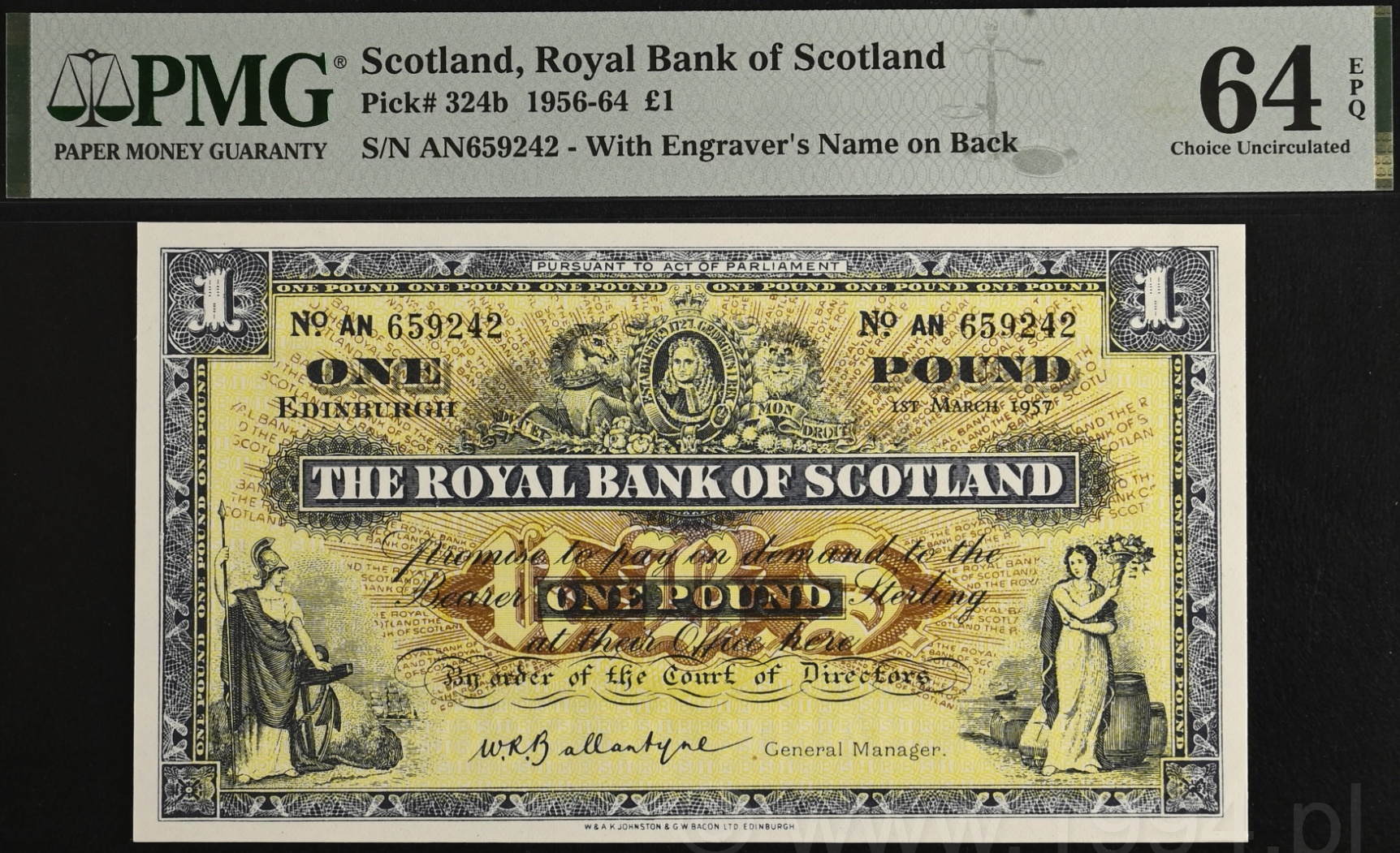
Scotland 1956–64 Royal Bank of Scotland £1, Pick 324b, PMG 64 EPQ

Scotland 1956 - The Royal Bank of Scotland £1 With Engraver's Name on Back (Pick 324b)

Royal Bank of Scotland One Pound of the 1956–64 series, variety with the engraver's imprint on back as cited by PMG. The face carries the bank's crowned arms and the long‑standing central medallion portrait associated with the institution since the eighteenth century, surrounded by a dense field of micro‑lettered Royal Bank of Scotland repeats. Read more →

eighteenth century
ScotlandIssued Note19561 PoundPMG 64 EPQ Choice Uncirculated ScotlandRoyal Bank of Scotland£11 Pound19561964Pick 324bEngraver's Name on BackJohnston and BaconSterlingIssued
Held
Edo-period Japanese 5 Momme Silver hansatsu printed by woodblock on handmade washi paper, showing vertical kanji inscriptions, circular and boxed validation seals, an oil merchant seal, and a reverse design with Daikokuten, rice bale symbolism, and ornamental wave-pattern security carving.

Japan 1800 - Edo Period 5 Momme Silver Hansatsu with Daikokuten Reverse and Oil Merchant Validation Seal Woodblock Printed on Handmade Washi Paper

This hansatsu belongs to the final pre-modern monetary landscape before the Meiji reforms of the nineteenth century. In the 1870s, Japan abolished the old domain currencies and moved toward a centralized national money system. Surviving notes like this preserve the older world that came before: a world where paper money could be a silver certificate, a merchant instrument, a religiously charged object, and a regional promise of value all at the same time. Read more →

JapanHansatsu18005 Momme SilverFine to Very Fine estimated JapanJapan 1800Year 1800Edo PeriodLate Edo PeriodTokugawa EraTokugawa ShogunatePre-Meiji JapanHansatsuFeudal Domain NoteDomain-Issued Local NoteRegional Paper MoneyLocal CurrencyFive Momme Silver5 Momme SilverSilver Five MommeGin Go MonmeMomme Weight StandardSilver CurrencyCommodity CurrencyOil Merchant SealOil Commodity SealMerchant ScripRegional Exchange HouseCommodity-Linked CurrencyMerchant ExchangeRice CurrencyEdo Monetary SystemWoodblock Printed NoteHandmade Washi PaperVermilion SealCircular SealBoxed Validation SealCalligraphic Security TextWave Pattern ReverseAnti-Counterfeiting Woodblock DesignDaikokutenDeity of WealthDeity of AbundanceRice Bale MotifMallet of FortuneReligious MotifProsperity SymbolismHistoric CurrencyAsian Paper MoneyEighteenth CenturyNineteenth CenturyPick UnlistedNot Listed in PickRarityMuseum GradeHistory
Held
Portugal 1799 Real Erario 20000 reis apólice issued in Lisboa, serial number 37723 in red, blind embossed seal on the face, no red overprint present, with multiple official ink seals on the reverse

Portugal 1799 - Real Erario 20000 Reis Apólice, Original Issue, No Overprint, Lisboa No. 37723

Issued in Lisboa in 1799 under the authority of the Real Erario, this 20,000-reis apolice is a Portuguese royal-era public debt instrument payable to bearer. It represents state-backed debt from a period of administrative continuity in late eighteenth-century Portugal, before the political and fiscal disruptions of the nineteenth century. Read more →

eighteenth-century
PortugalPublic Debt Bond179920000 ReisVery Fine Public Debt BondApolice20000 ReisPayable to BearerBlind Embossed SealMultiple Reverse SealsNo OverprintOriginal IssuePre War of the BrothersReal ErarioLisboaPortuguese Treasury FinanceRoyal Era Fiscal PaperEighteenth Century State DebtAdministrative Validation SealsFiscal Control HistorySecurity Printing HistoryPortuguese Monetary HistoryPortugal17991811Museum GradeR9 Extremely RareTreasury BondShort-Term Treasury BondOne-Year MaturityInterest-Bearing DebtCirculating Treasury PaperFiduciary Paper MoneyEarly Portuguese Paper MoneyCirculating Public DebtGovernment Debt InstrumentPublic Loan InstrumentTreasury BillShort-Term Government DebtOne-Year Treasury InstrumentBearer Treasury NotePortuguese Paper MoneyEarly Paper CurrencyRoyal Treasury NoteInterest-Bearing Treasury NoteState Debt PaperCirculating Government DebtHistoric Treasury InstrumentGovernment BondSovereign DebtRoyal Treasury BondTreasury DebtBearer BondGovernment Paper MoneyCirculating BondPublic Debt InstrumentPortuguese Government DebtPortuguese Treasury BondPortuguese Treasury Bill18th Century Paper Money18th Century Government DebtEarly Government PaperHistoric Public DebtRoyal Erario BondReal Erario ApolicePortuguese Apolice1799 Portugal1799 Treasury Bond1799 Treasury Bill20000 Reis Apolice20000 Reis Treasury Bond20000 Reis Treasury Bill
Held
Italy 1781 Regie Finanze di Torino five scudi front proof sheet with two impressions from plate 1 and plate 2, visible plate numbers, deep intaglio bite, unique surviving proof sheet

Italy 1781 - Regie Finanze di Torino 5 Scudi Front Proof Sheet (Pick Unlisted)

The Regie Finanze di Torino served as the central fiscal authority of the Savoyard state, overseeing taxation, state credit, and the issuance of paper instruments during the late eighteenth century. The introduction of paper money during this period marked a decisive institutional development, reflecting the state’s effort to formalize credit issuance beyond reliance on metallic reserves. Read more →

eighteenth century
ItalyProof17815 ScudiUncirculated ProofFront ProofProof Sheet5 ScudiRegie Finanze di TorinoPlate NumberedPlate 1Plate 2Kingdom of SardiniaSavoyard State FinanceEighteenth Century CurrencyItalian State Paper MoneyPre Central Bank EraSecurity Printing HistoryItaly1781Pick UnlistedMuseum GradeR9 Extremely RareUniqueUnique Proof Sheet
Held
Italy Regie Finanze di Torino 100 lire back proof sheet in pre-date control state from plate 2, full margins, undated control framework

Italy 1745 - Regie Finanze di Torino - 100 Lire Back Proof, Pre-Date Control State (Pick Unlisted)

The engraved design is concentrated in the upper portion of the sheet. A double denomination cartouche marked 100 appears near the upper border. Below it, the central device consists of a Savoyard cross within a wreath-like enclosure, engraved with dense linear detail and surrounded by scrollwork that integrates into the lower border. At the right, a stacked calligraphic authority block is fully engraved, reading Maestro Auditore, Maestro Auditore, Tesoriere generale, and Controllore della Tesoreria, aligned vertically within the frame. Read more →

ItalyBack Proof1745100 LireUncirculated ProofBack ProofPre-Date Control State100 LireRegie Finanze di TorinoPlate 2Control FrameworkKingdom of SardiniaSavoyard State FinanceEighteenth Century CurrencyItalian State Paper MoneyPre Central Bank EraSecurity Printing HistoryItaly1745Museum GradeR9 Extremely RareUniquePick Unlisted
Held
Italy Regie Finanze di Torino 100 lire back proof sheet dated 1746 from plate 2, showing crowned Savoyard shield, laurel wreath, denomination cartouches, full legal text, and complete ornamental frame

Italy 1746 - Regie Finanze di Torino - 100 Lire Back Proof, Fixed-Date Control State (Pick Unlisted)

The engraving exhibits consistent line depth and sharply articulated lettering throughout, with fully populated ornamental borders, scrolls, and text fields in this state. The presence of the engraved date and complete legal text distinguishes this control state from earlier undated framework impressions. Read more →

ItalyBack Proof1746100 LireUncirculated ProofBack ProofFixed-Date Control State100 LireRegie Finanze di TorinoPlate 2Control FrameworkKingdom of SardiniaSavoyard State FinanceEighteenth Century CurrencyItalian State Paper MoneyPre Central Bank EraSecurity Printing HistoryItaly1746Pick UnlistedMuseum GradeR9 Extremely Rare
Held
Italy Regie Finanze di Torino 100 lire front proof sheet from plate 2 dated 1765 showing landscape vignette with Savoyard shield, obligation text panels, denomination inscriptions, and full ornamental frame

Italy 1765 - Regie Finanze di Torino - 100 Lire Front Proof, Final Face State (Pick Unlisted)

The upper text field carries the denomination and obligation wording beginning with Per il Capitale di lire cento, followed by the dated line Torino il p. Gen. 1765. Beneath this appear engraved signature titles arranged in vertical alignment, including Maestro Auditore, Maestro Auditore, Tesoriere generale, and Controllore della Tesoreria, with ruled signature lines left blank. Read more →

ItalyProof1765100 LireUncirculated ProofFront ProofFinal Face State100 LireRegie Finanze di TorinoPlate 2Kingdom of SardiniaSavoyard State FinanceEighteenth Century CurrencyItalian State Paper MoneyPre Central Bank EraSecurity Printing HistoryItaly1765Pick UnlistedMuseum GradeR9 Extremely Rare
Held
↑ Top