Collection PL

About 1994.pl
Results for “monetary history”
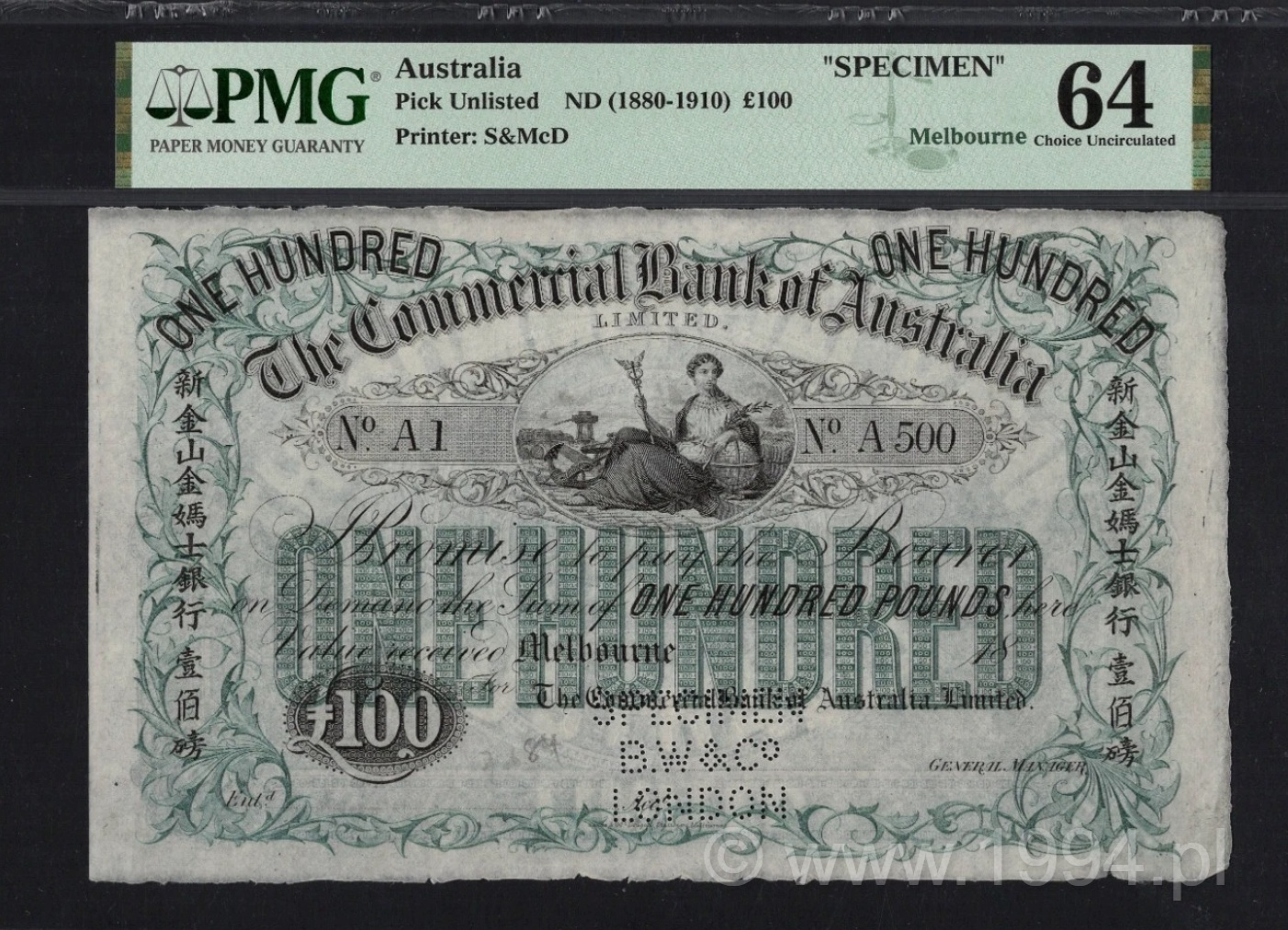
Australia 1880–1910 Commercial Bank of Australia £100 specimen, PMG 64 Choice Uncirculated

Australia 1880–1910 - Commercial Bank of Australia £100 Specimen (Pick Unlisted)

Pick Unlisted and absent from major catalogues, this note represents the intersection of rarity, artistry, cultural history, and financial significance. As a design artifact, a Chinese-Australian commercial document, a surviving record of deliberate 19th-century financial localization, and a financial relic from the end of Australia’s private-banknote era, this piece is an educational cornerstone for advanced Commonwealth collections and a critical reference in the study of pre-federation monetary history. Read more →

AustraliaSpecimen1880100 PoundsPMG 64 Choice Uncirculated Specimen100 PoundsHigh DenominationCommercial Bank of AustraliaBradbury WilkinsonBWCSands & McDougallColonial SpecimenBilingualChinese-EnglishPick UnlistedColonial Banking HistoryAustralian Private BanknotesPre-Notes Act Era19th Century BankingMulticultural Trade NetworksSecurity Printing HistoryBritish Engraving InfluenceAustralian Monetary HistoryAustralia188019101880–1910PMG 64Museum GradeR9 Extremely RareUniqueAnnotationsHandwritten Annotations
Held
New Zealand 1907–1926 Bank of New Zealand £20 Blue audit-range serial-prefix specimen with dual control numbers, Bradbury Wilkinson & Co., PMG 55 AU, Pop 1/1, R9 Extremely Rare

New Zealand 1907–1926 - Bank of New Zealand £20 Blue Serial-Prefix Audit Specimen (Pick S194s)

The PMG 55 About Uncirculated grade is exceptionally high for a large-format, soft-paper audit specimen. With Pop 1/1 status and no evidence of any additional audit-range examples in institutional or private holdings, this piece stands as the definitive reference for the BNZ £20 issue and a cornerstone artifact of New Zealand’s pre–Reserve Bank monetary history. Read more →

New ZealandSpecimen190720 PoundsPMG 55 About Uncirculated (Pop 1/1) Specimen20 PoundsBlueBNZ Color LineageHigh Denomination Color TierHigh DenominationAudit-Range SpecimenSerial PrefixDual Serial NumbersPerforated SpecimenBradbury WilkinsonBWCPick S194sBank of New ZealandPrivate Banknote EraPre-Reserve BankNew Zealand Banking HistoryBritish Engraved NotesMāori Portrait VignettesSecurity Printing HistoryHigh-Value NotesAudit Control SheetNew Zealand190719261907–1926PMG 58Pop 1Top PopMuseum GradeR9 Extremely RareUnique
Held
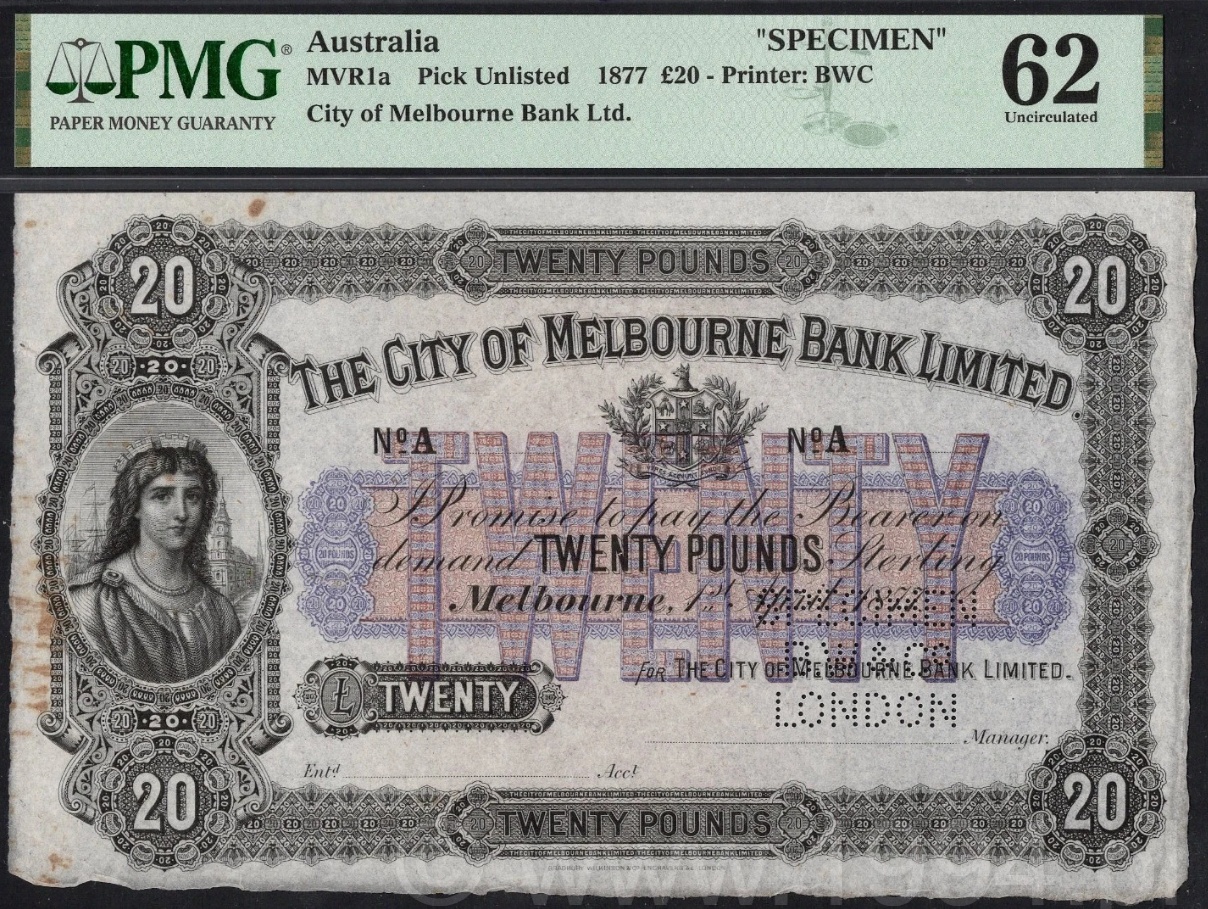
Australia 1877 City of Melbourne Bank Limited £20 specimen engraved by Bradbury Wilkinson, PMG 62 Uncirculated, unique surviving example

Australia 1877 - City of Melbourne Bank Limited £20 Specimen (Pick Unlisted)

This specimen preserves the full engraved layout exactly as produced, without circulation wear, providing an intact reference for typography, guilloché geometry, and denomination treatment that is otherwise lost to history. Its survival illustrates the hybrid production model of the era, in which London engravers supplied master plates while colonial banks adopted imagery reflecting local identity and economic ambition. Read more →

AustraliaSpecimen187720 PoundsPMG 62 Uncirculated Specimen20 PoundsCity of Melbourne Bank LimitedBradbury WilkinsonBWCPick UnlistedColonial SpecimenEngraved Security PrintingAustralian Private BanknotesVictoria Banking HistoryPre-Federation FinanceGold Rush Era BankingSecurity Printing History19th Century BankingAustralian Monetary HistoryAustraliaVictoria1877PMG 62Museum GradeR9 Extremely RareUnique
Held
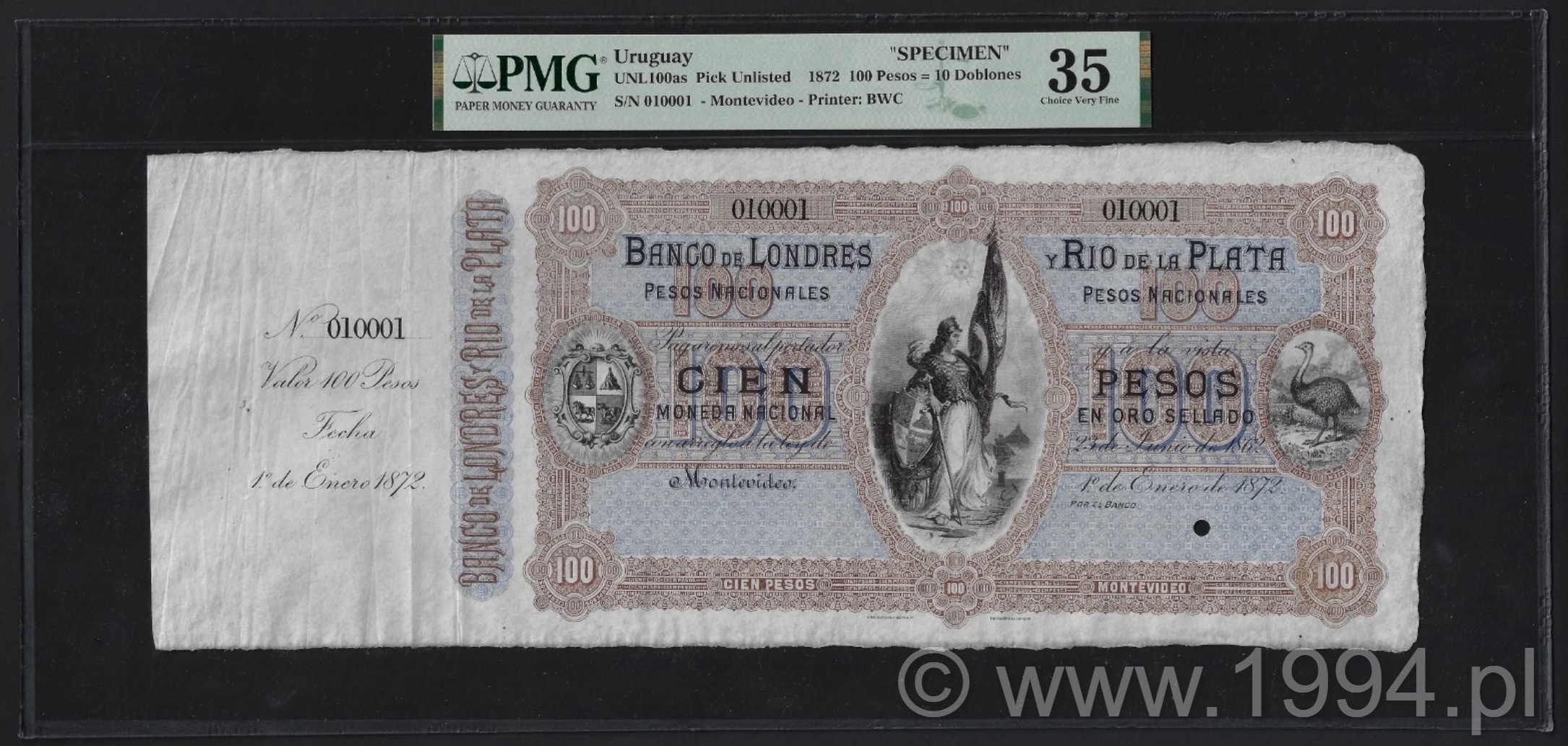
Uruguay 1872 100 Pesos equals 10 Doblones printer archival specimen, early serial number 010001, printed by Bradbury Wilkinson

Uruguay 1872 - Banco de Londres y Rio de la Plata 100 Pesos = 10 Doblones Specimen (Pick Unlisted)

A printer’s archival specimen of the 1872 issue of the Banco de Londres y Rio de la Plata, denominated 100 Pesos Nacionales with an explicit equivalence to 10 Doblones in gold. This dual-denomination construction represents one of the most ambitious monetary experiments undertaken in nineteenth-century Uruguay, attempting to anchor paper currency directly to a fixed gold value at a time of persistent instability and public distrust in fiduciary issues. Read more →

UruguaySpecimen1872100 Pesos = 10 DoblonesPMG 35 Choice Very Fine SpecimenPrinter Archival SpecimenDual DenominationGold EquivalenceEarly Pull Serial 010001Oversized FormatBradbury WilkinsonBWCLondon Security PrintingNineteenth Century EngravingArchival Reference NoteGold Standard ExperimentPeso Doblone ParityBanco de Londres y Rio de la PlataLatin American Monetary HistoryNineteenth Century State FinanceUruguayMontevideo1872Pick UnlistedMuseum GradeR9 Extremely RareUnique
Held
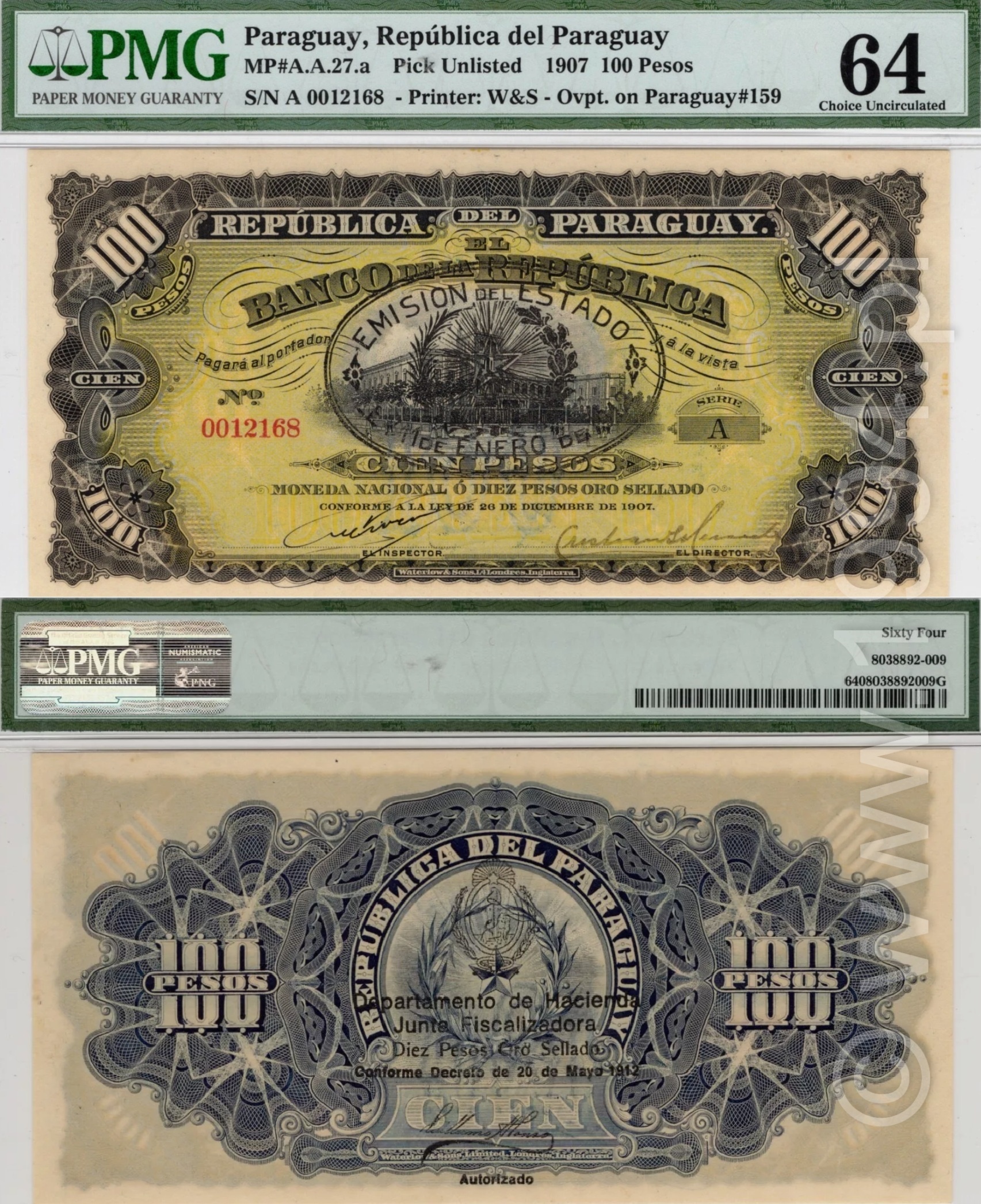
Paraguay 1907 100 Pesos Banco de la República specimen with 1912 dual-side state and treasury fiscal revalidation overprint, including Emisión del Estado on the face and Departamento de Hacienda Junta Fiscalizadora Diez Pesos Oro Sellado validation on the reverse, base Pick 159, Pick Unlisted, PMG 64 Choice Uncirculated

Paraguay 1907 - 100 Pesos with 1912 Dual-Side State and Treasury Revalidation Overprint Specimen (Pick Unlisted)

The significance of the reverse overprint is especially important. The original 1907 note already carried the monetary clause “Moneda Nacional ó Diez Pesos Oro Sellado,” meaning that the 100 Pesos paper denomination was legally associated with a value formula of ten sealed gold pesos. During the monetary and political emergency of 1912, this wording became more than decorative text. The state needed a way to distinguish selected, officially reviewed notes from the unstable mass of paper circulating in a damaged economy. The second, reverse overprint did exactly that: it reaffirmed the gold-denominated language of the base note and placed the note under the authority of the Treasury’s fiscal inspection board. Read more →

ParaguayOverprint Specimen1907100 PesosPMG 64 Choice Uncirculated Specimen100 PesosPick UnlistedPick 159OverprintState OverprintTreasury OverprintDual-Side OverprintDual-Signature OverprintProvisionalFiscal RevalidationTreasury RevalidationEmergency State IssueParaguayan Emergency Issues1912 ReformJanuary 11 1912 State EmissionMay 20 1912 DecreeBanco de la RepúblicaDepartamento de HaciendaJunta FiscalizadoraEmisión del EstadoDiez Pesos Oro SelladoGold-Value ReaffirmationWaterlow & SonsSouth American Monetary HistoryEarly 20th Century FinanceGovernment RevalidationOverprint VarietiesParaguay19071912PMG 64Choice UncirculatedMuseum GradeR9 Extremely RareUnique
Held
China 1924 Dihua Official Coin Bureau 40 wen textile emergency banknote printed on red cotton with Chinese and Uyghur inscriptions

China 1924 - Dihua Official Coin Bureau 40 Wen Textile Emergency Issue (Pick Unlisted)

Textile currency in Xinjiang was not a folk improvisation but an official response to fiscal isolation. Cloth provided a locally available, resilient medium that could be authenticated through familiar visual conventions and regional authority rather than reliance on metropolitan paper supply. In this context, durability and recognizability outweighed refinement, and the resulting notes occupy a distinct category within Chinese monetary history. Read more →

ChinaTextile Banknote192440 WenCirculated (Textile Issue) Textile BanknoteTextile Emergency CurrencyCloth CurrencyEmergency Issue40 WenWoodblock PrintingDihua Official Coin BureauXinjiangRepublican ChinaRegional Monetary SystemMultilingual CurrencyProvisional FinanceChina1924R8 Extremely RareMuseum GradePick Unlisted
Held
Specimen full sheet Serie A No. 23327 Banco de Zaragoza 100 reales vellón with header and talón, Pick S451s, 1 May 1857

Spain 1857 - Banco de Zaragoza 100 Reales Vellón Serie A Specimen Full Sheet with Header and Talón No. 23327 (Pick S451s)

Founded in 1857 under the banking reforms introduced by the Law of January 28, 1856, the Banco de Zaragoza was one of several short-lived provincial issuing banks authorized to produce their own currency. The bank adopted a strict denomination-to-series structure: Serie A = 100 reales, Serie B = 200 reales, Serie C = 500 reales, Serie D = 1000 reales, Serie E = 2000 reales, Serie F = 4000 reales. Operating only until its absorption into the Banco de España in 1874, the bank issued comparatively small volumes, and most circulating notes were redeemed and destroyed during the centralisation of Spanish monetary issuance. Read more →

SpainSpecimen Full Sheet with Talon1857100 Reales VellónUncirculated (Specimen Full Sheet) SpecimenPick S451sFull SheetHeader PanelTalonUnissuedSerie ASerial 23327100 RealesBanco de ZaragozaSpanish Provincial IssuePrivate Banknote19th Century SpainReales VellonMadrid EngravingMonetary HistorySecurity PrintingSpain1857R8 Extremely RareMuseum Grade
Held
Specimen full sheet Banco de Zaragoza 200 reales vellón, Serie B No. 07887, with header and talón, Pick S452s, 14 May 1857

Spain 1857 - Banco de Zaragoza 200 Reales Vellón Serie B Specimen Full Sheet with Header and Talón No. 07887 (Pick S452s)

This specimen forms a matched typological pair with the standard specimen Serie B, No. 07958 (Pick S452s) also in the collection, together documenting both the production-sheet format and the standard specimen format of the 200 reales vellón emission. Read more →

SpainSpecimen Full Sheet with Talon1857200 Reales VellónUncirculated (Specimen Full Sheet) SpecimenPick S452sFull SheetHeader PanelTalonUnissuedSerie BSerial 07887200 RealesBanco de ZaragozaSpanish Provincial IssuePrivate Banknote19th Century SpainReales VellonMadrid EngravingSecurity PrintingMonetary HistorySpain1857R8 Extremely RareMuseum Grade
Held
Specimen full sheet Banco de Zaragoza 500 reales vellón, Serie C No. 08703, with header and talón, Pick S453s, 14 May 1857

Spain 1857 - Banco de Zaragoza 500 Reales Vellón Serie C Specimen Full Sheet with Header and Talón No. 08703 (Pick S453s)

Rarity is extreme. PMG census entries for the broader Pick S453 family combine notes from multiple unrelated banks and do not represent Banco de Zaragoza. No full-sheet S453s specimens from Zaragoza are recorded in PMG archives or in the catalog history of major Spanish auctions (Aureo & Calicó, Cayón, Soler y Llach, Vico). This complete production sheet, preserving header, talón, and banknote together, qualifies as R8+ and may be unique. Read more →

SpainSpecimen Full Sheet with Talon1857500 Reales VellónUncirculated (Specimen Full Sheet) SpecimenPick S453sFull SheetHeader PanelTalonUnissuedSerie CSerial 08703500 RealesBanco de ZaragozaSpanish Provincial IssuePrivate Banknote19th Century SpainReales VellonMadrid EngravingSecurity PrintingMonetary HistorySpain1857R8 Extremely RareMuseum Grade
Held
New Zealand 1916–1920 Bank of New Zealand £5 Red-Rose wartime specimen from the BNZ orange lineage, Pick S227s, serial prefix 7/180001–7/220000, PMG 65 EPQ Top Pop

New Zealand 1916–1920 - Bank of New Zealand £5 Red-Rose (Orange Lineage) Specimen with Serial Number Prefix (Pick S227s)

This specimen is a reference-grade artifact of New Zealand monetary history, combining wartime production context, live serial numbering, internal control markings, and documented survival from the Bank of New Zealand’s private-issue period. Certified PMG 65 EPQ Gem Uncirculated, it is the sole PMG-certified example at this grade and Top Pop. R8 rarity. Read more →

New ZealandSpecimen with Serial Number Prefix19165 PoundsPMG 65 EPQ Gem Uncirculated (Top Pop) Specimen5 PoundsRed-RoseBNZ Color LineageOrange LineageWith Serial PrefixPrinter AnnotationCANCELLED PerforationHigh DenominationBradbury WilkinsonBWCPick S227sBank of New ZealandPrivate Banknote EraPre-Reserve BankWartime IssueNew Zealand Banking HistoryMāori Portrait SeriesMaritime Economy NotesSecurity Printing HistoryNew Zealand191619201916–1920Top PopPMG 65 EPQMuseum GradeR8 Extremely RareAnnotationsHandwritten Annotations
Held
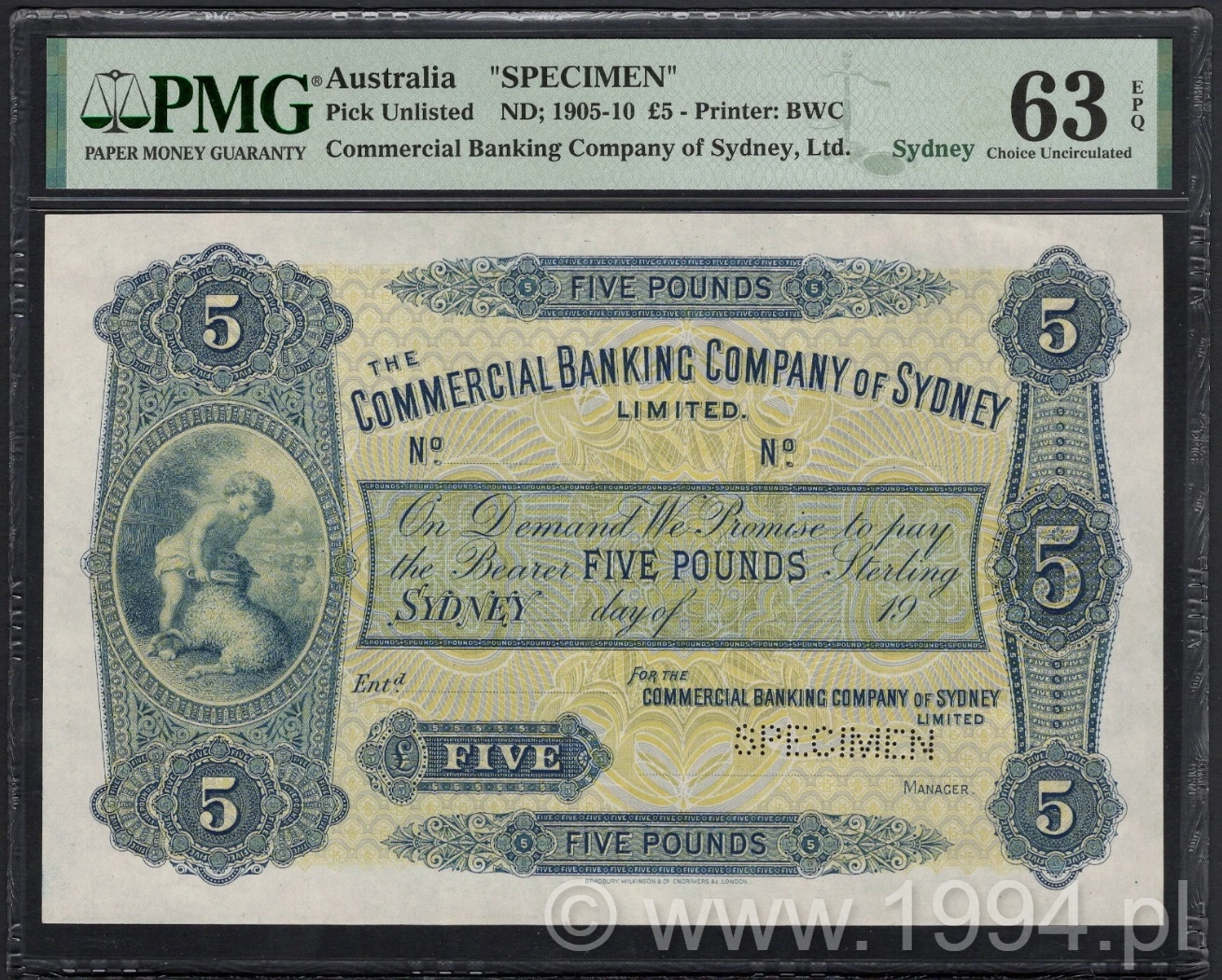
Commercial Banking Company of Sydney LIMITED £5 proof, circa 1905–1910, PMG 63 EPQ

Australia 1905–1910 - Commercial Banking Company of Sydney LIMITED £5 Specimen Proof (Pick Unlisted)

As a proof with cancelled perforations, broad margins, and fully preserved plate detail, this example stands among the finest surviving artifacts of early-twentieth-century Australian paper money. Its PMG 63 EPQ Top Pop status further elevates it as a benchmark for scholars and advanced collectors studying the final private-bank issues of the Australian continent. Read more →

AustraliaSpecimen Proof19055 PoundsPMG 63 EPQ (Top Pop) Specimen5 PoundsSpecimen ProofProofPick UnlistedCommercial Banking Company of Sydney LimitedBradbury WilkinsonBWCLarge SizePre-FederationColonial SpecimenEngraved Security PrintingAustralian Private BanknotesSydney Banking HistorySecurity Printing HistoryEdwardian DesignBritish Engraving InfluenceTransition to Commonwealth CurrencyEarly 20th Century BankingAustralian Monetary HistoryAustraliaSydney190519101905–1910PMG 63 EPQTop PopMuseum GradeR8 Extremely Rare
Held
Australia 1889 Commercial Banking Company of Sydney Limited £5 specimen with serial number prefix, perforated SPECIMEN, printer annotation dated 1 March 1890

Australia 1880–1889 - Commercial Banking Company of Sydney Limited £5 SPECIMEN with Serial Prefix (Pick Unlisted, MVR4a)

The Commercial Banking Company of Sydney, founded in 1834, was among Australia’s most influential private banks during the colonial period. High-denomination notes such as this £5 played a central role in interbank settlement and wholesale finance, making specimen material a critical part of the bank’s operational infrastructure. Read more →

AustraliaSpecimen with Serial Number Prefix18895 PoundsUncirculated SpecimenSpecimen with Serial Number Prefix5 PoundsCommercial Banking Company of Sydney LimitedBradbury WilkinsonBWCPick UnlistedColonial SpecimenEngraved Security PrintingAustralian Private BanknotesNew South Wales Banking HistoryPre-Federation Finance19th Century BankingSecurity Printing HistoryAustralian Monetary HistoryAustraliaSydney1889Museum GradeR8 Extremely RareAnnotationsHandwritten Annotations
Held
↑ Top