Collection PL

About 1994.pl
Results for “national currency”
North Macedonia 1996 5000 Denari issued banknote EA5464675 featuring the Maened vignette, graded PMG 66 EPQ

North Macedonia 1996 - 5000 Denari Issued Note EA5464675 Maened (Pick 19a)

The 5000 Denari note issued in 1996 forms part of the first complete banknote series of the Republic of Macedonia following independence from Yugoslavia in 1991. Introduced by the National Bank of the Republic of Macedonia as part of the country’s early monetary stabilization program, the series marked the establishment of a distinct national currency identity separate from the Yugoslav dinar system. Production of the notes was contracted to Thomas De La Rue and Company Limited in London, one of the world’s leading security printers, whose technical standards shaped the visual and structural character of the entire issue. Read more →

North MacedoniaIssued Note19965000 DenariPMG 66 EPQ Issued NoteMaenedMaened WatermarkDe La RueSecurity PrintingIntaglio EngravingMicrotextSecurity ThreadSee-Through RegisterNorth Macedonia19965000 DenariPick 19aPMG 66 EPQGem UncirculatedMuseum Grade
Held
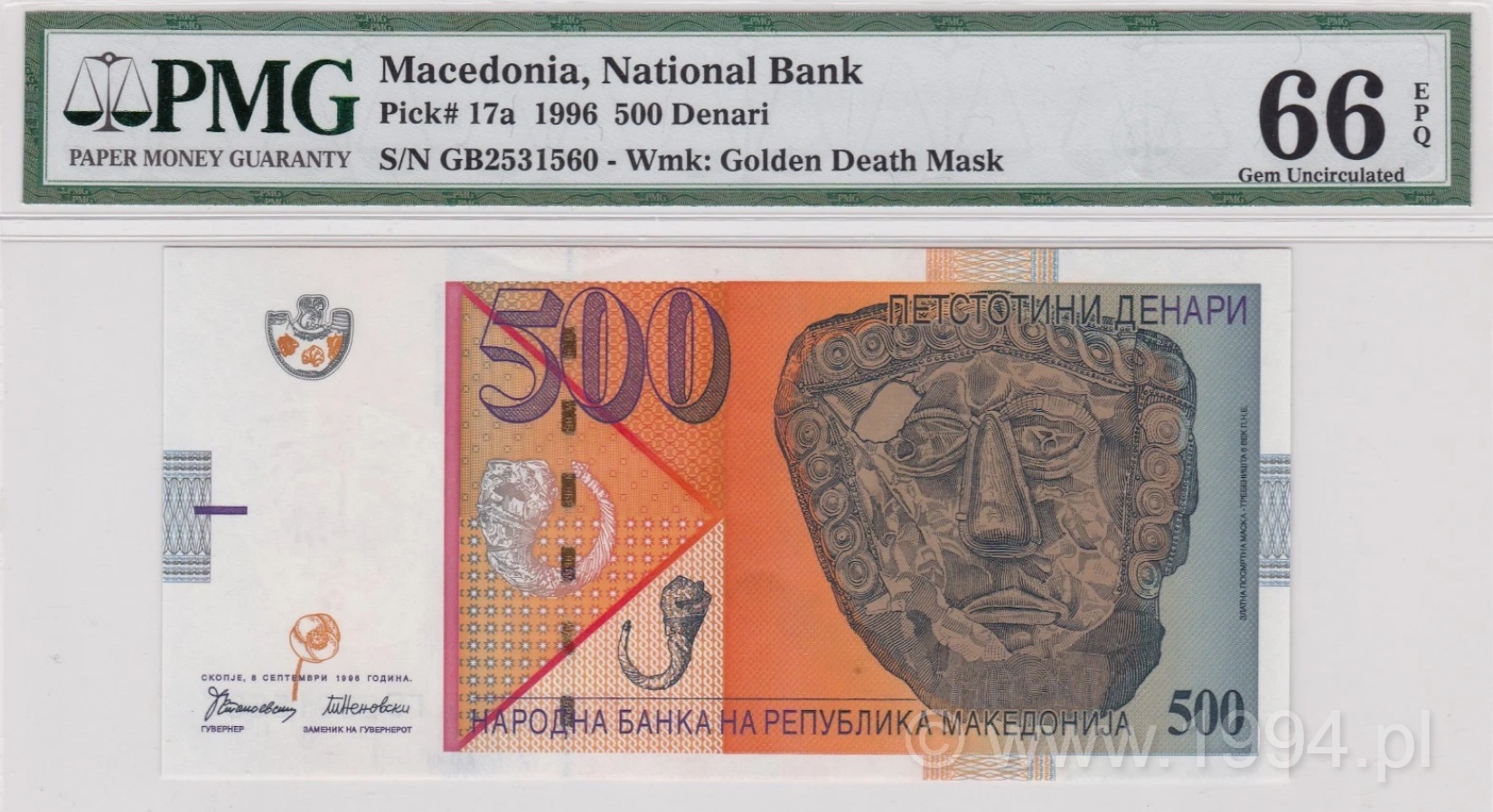
1996 North Macedonia 500 Denari issued banknote GB2531560 featuring the Golden Death Mask motif, graded PMG 66 EPQ

North Macedonia 1996 - 500 Denari Issued Note GB2531560 Golden Death Mask (Pick 17a)

The 500 Denari banknote issued in 1996 forms part of the first modern currency series of the Republic of Macedonia following independence in 1991. Introduced by the National Bank of the Republic of Macedonia as part of the country’s early monetary stabilization program, the series established the visual identity and security standards of the newly independent state’s paper currency. Production was entrusted to Thomas De La Rue & Company Limited in London, whose security printing expertise shaped both the artistic and technical structure of the notes. Read more →

North MacedoniaIssued Note1996500 DenariPMG 66 EPQ Issued NoteGolden Death MaskGolden Mask of TrebenishtaArchaeological HeritageBanknote EngravingDe La RueSecurity PrintingIntaglio EngravingOffset PrintingSecurity ThreadMicrotextSee-Through RegisterGuilloche PatternsWatermarkNorth Macedonia1996500 DenariPick 17aPMG 66 EPQGem UncirculatedMuseum Grade
Held
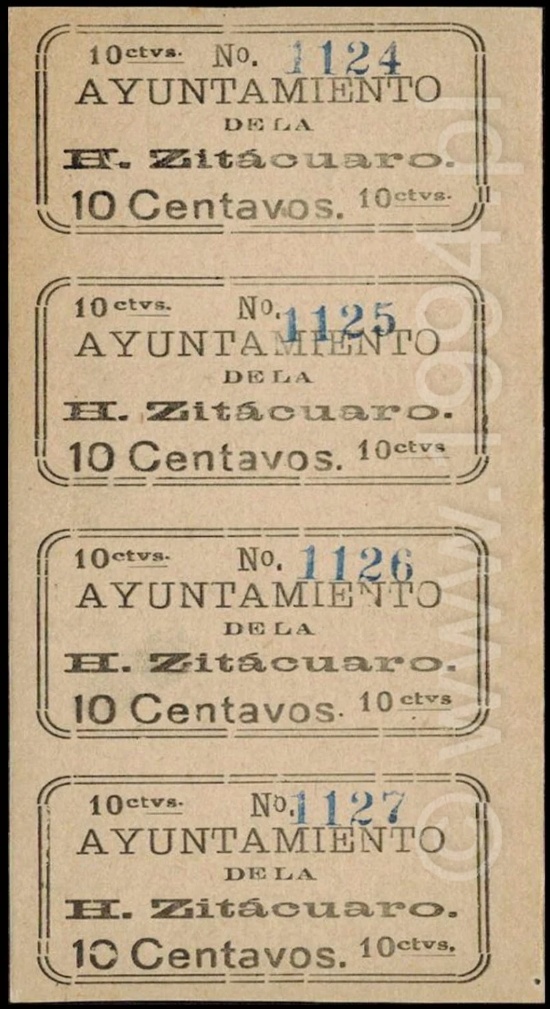
Mexico 1915 Ayuntamiento de Zitácuaro 10 Centavos uncut sheet of four notes numbered 1124 to 1127, revolutionary municipal currency from Michoacán

Mexico 1915 - Ayuntamiento de Zitácuaro 10 Centavos Uncut Sheet of Four M2952c (Pick Unlisted)

As an artifact, the sheet illustrates how local authorities temporarily replaced national currency systems with municipal credit instruments backed by civic authority and local trust. It stands as a rare surviving witness to the decentralized monetary practices that emerged across Mexico during the upheaval of the revolution. Read more →

MexicoRevolutionary Issue191510 CentavosUncut Sheet Revolutionary IssuePick UnlistedMunicipal CurrencyEmergency MoneyBilimbiquesUncut Sheet10 CentavosAyuntamientoHonorable AyuntamientoMunicipal Government IssueLocal PrintingMexican Revolution CurrencyRevolutionary Monetary CrisisFractional Municipal MoneyEconomic HistoryMexicoMichoacánZitácuaro1915M2952cMuseum Grade
Held
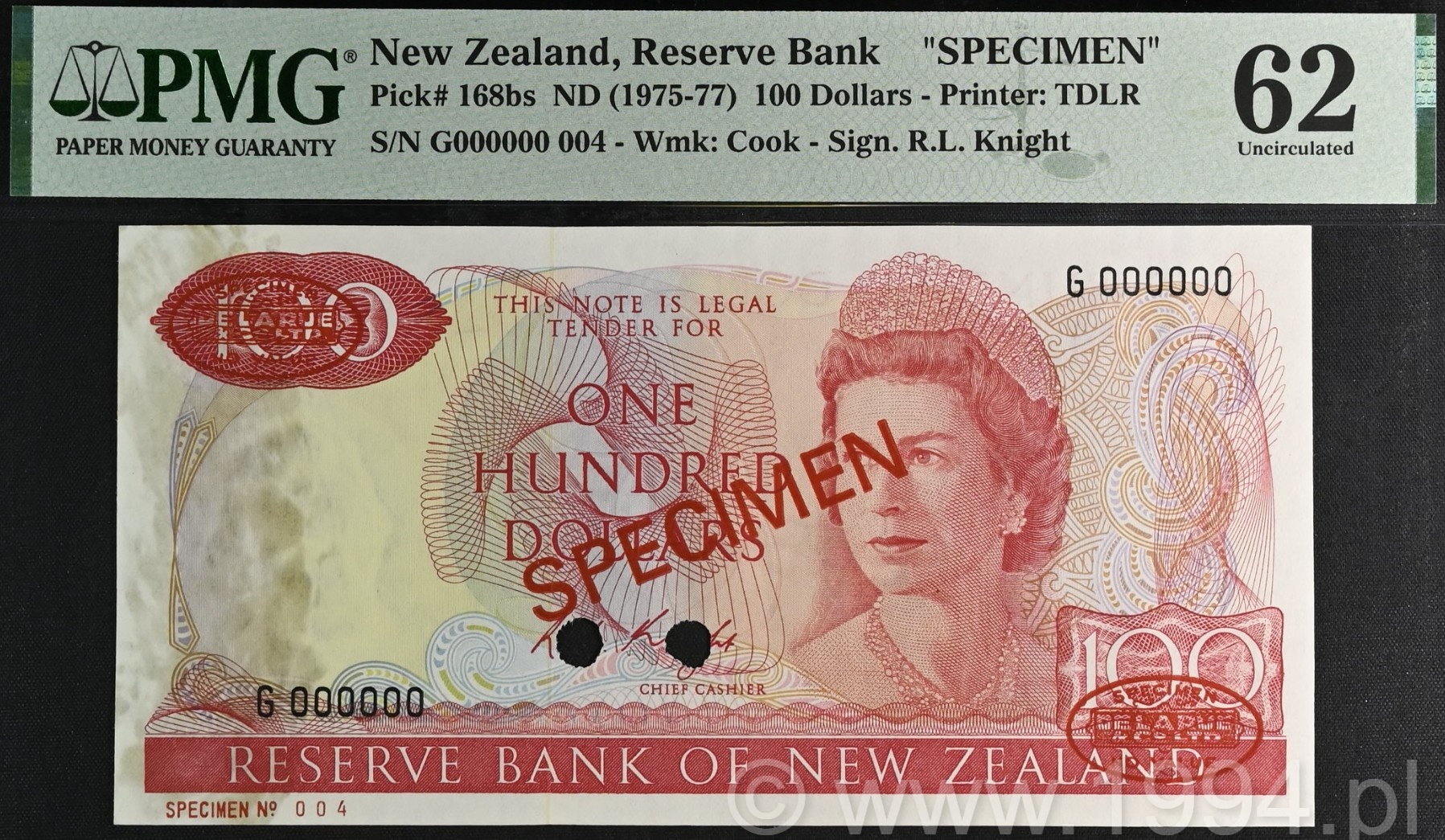
New Zealand 1975 100 Dollars R.L. Knight Signature TDLR Overprint Specimen No. 004, Serial G000000004 with diagonal red overprint, oval stamp, and double punch holes (Pick 168bs)

New Zealand 1975 - 100 Dollars R.L. Knight Signature TDLR Overprint Specimen No. 004 Serial G000000004 (Pick 168bs)

The 1975 one hundred dollars specimen represents the highest denomination of New Zealand’s decimal currency series during the tenure of R.L. Knight as Chief Cashier, issued within the ND (1975–1977) period. Knight’s signature defines the third phase of the decimal era, following the Fleming and Wilks periods, and reflects a stage in which the system had transitioned from initial introduction into a fully established national currency structure. Read more →

New ZealandSpecimen with Red Overprint and Oval Stamp1975100 DollarsPMG 62 Uncirculated SpecimenRed OverprintTDLR OverprintDiagonal SPECIMEN overprintOval StampSingle Oval StampDouble Punch HolePunch Cancelled100 DollarsQueen Elizabeth II portraitCaptain James Cook watermarkThomas De La RueTDLRKnight SignatureR.L. KnightSpecimen distribution formatDecimal SeriesReserve Bank of New ZealandHigh denomination noteNew Zealand currency evolutionHistoryNew Zealand197519771975-1977Specimen No. 004G000000004Pick 168bsPick 168bPMG 62UncirculatedMuseum Grade
Held
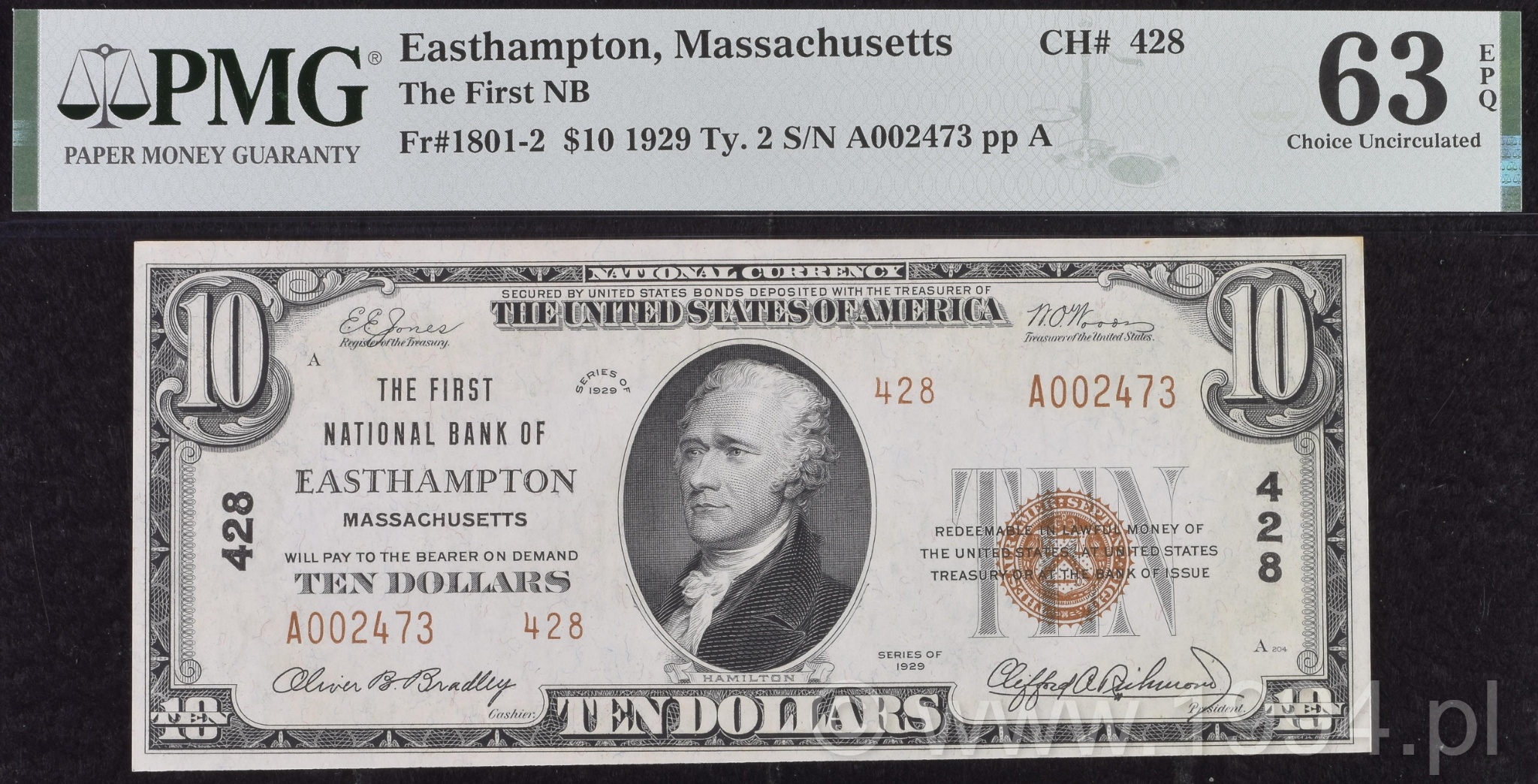
United States 1929 Type 2 - 10 Dollars National Bank Note The First National Bank of Easthampton Massachusetts Fr 1801-2 Chapter 428 PMG 63 EPQ

United States 1929 Type 2 - 10 Dollars National Bank Note - The First National Bank of Easthampton, Massachusetts Charter 428 (Fr. 1801-2)

Certified PMG 63 EPQ Choice Uncirculated, this piece exemplifies original color and paper quality seldom preserved in small-town issues. It represents not just Easthampton’s banking history but the closing chapter of a uniquely American experiment that tied national currency directly to local enterprise. Read more →

United StatesNational Bank Note192910 DollarsPMG 63 EPQ Choice Uncirculated 10 DollarsNational Bank NoteIssued NoteType 2EasthamptonMassachusettsCharter 428Hamilton1929PMG 63 EPQLocal Banking History
Held
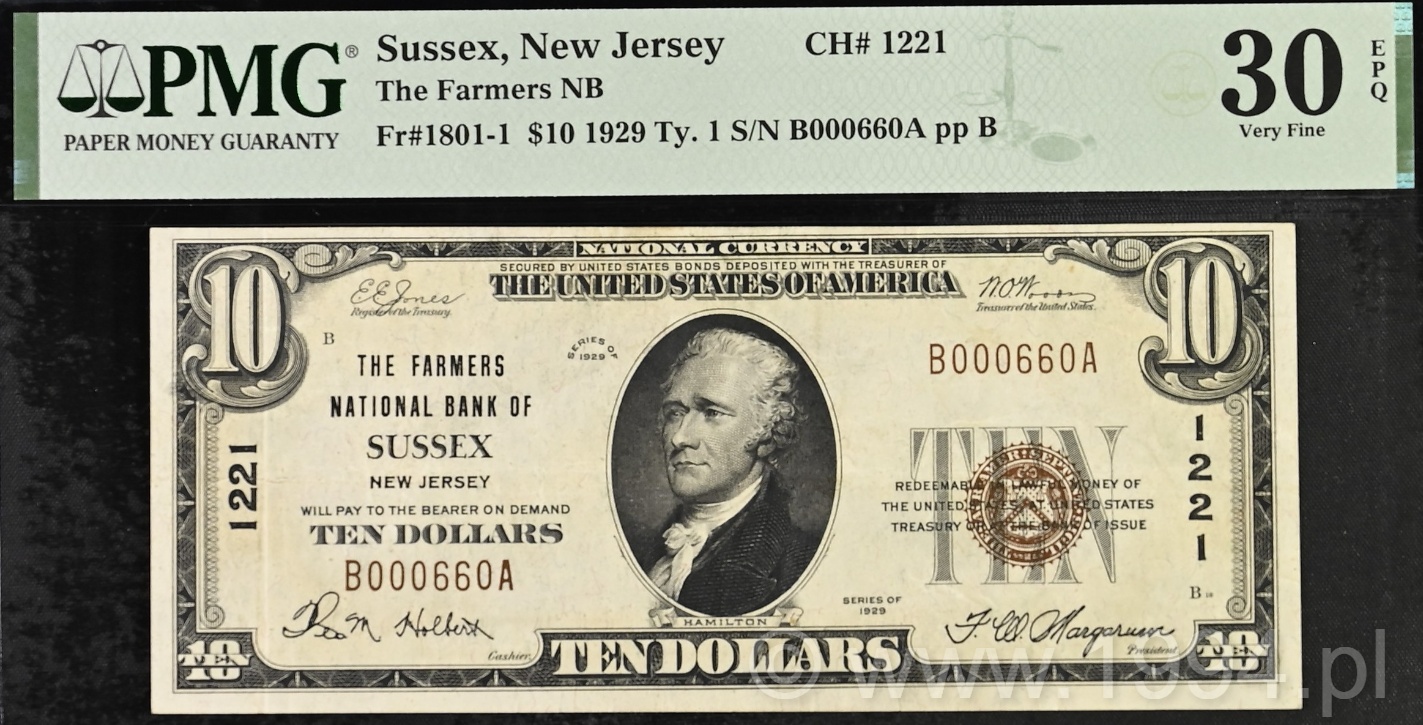
United States 1929 Type 1 - 10 Dollars National Bank Note The Farmers National Bank of Sussex New Jersey Fr 1801-1 CH 1221 PMG 30 EPQ

United States 1929 Type 1 - 10 Dollars National Bank Note - The Farmers National Bank of Sussex, New Jersey Charter 1221 (Fr. 1801-1)

This note is a Series of 1929 Type 1 ten-dollar issue, carrying the vertical charter numbers 1221 at both margins and the red-brown Treasury seal at right. Type 1s were the first of the small-size nationals introduced that year, still bearing the ornate "National Currency" title and traditional layout derived from earlier large-size designs. It features the Jones–Woods federal signature pair and printed local officer names, continuing the national-local dual structure established by the 1863 Act. Read more →

United StatesNational Bank Note192910 DollarsPMG 30 EPQ Very Fine 10 DollarsNational Bank NoteIssued NoteType 1SussexNew JerseyCharter 1221Hamilton1929PMG 30 EPQLocal Banking History
Held
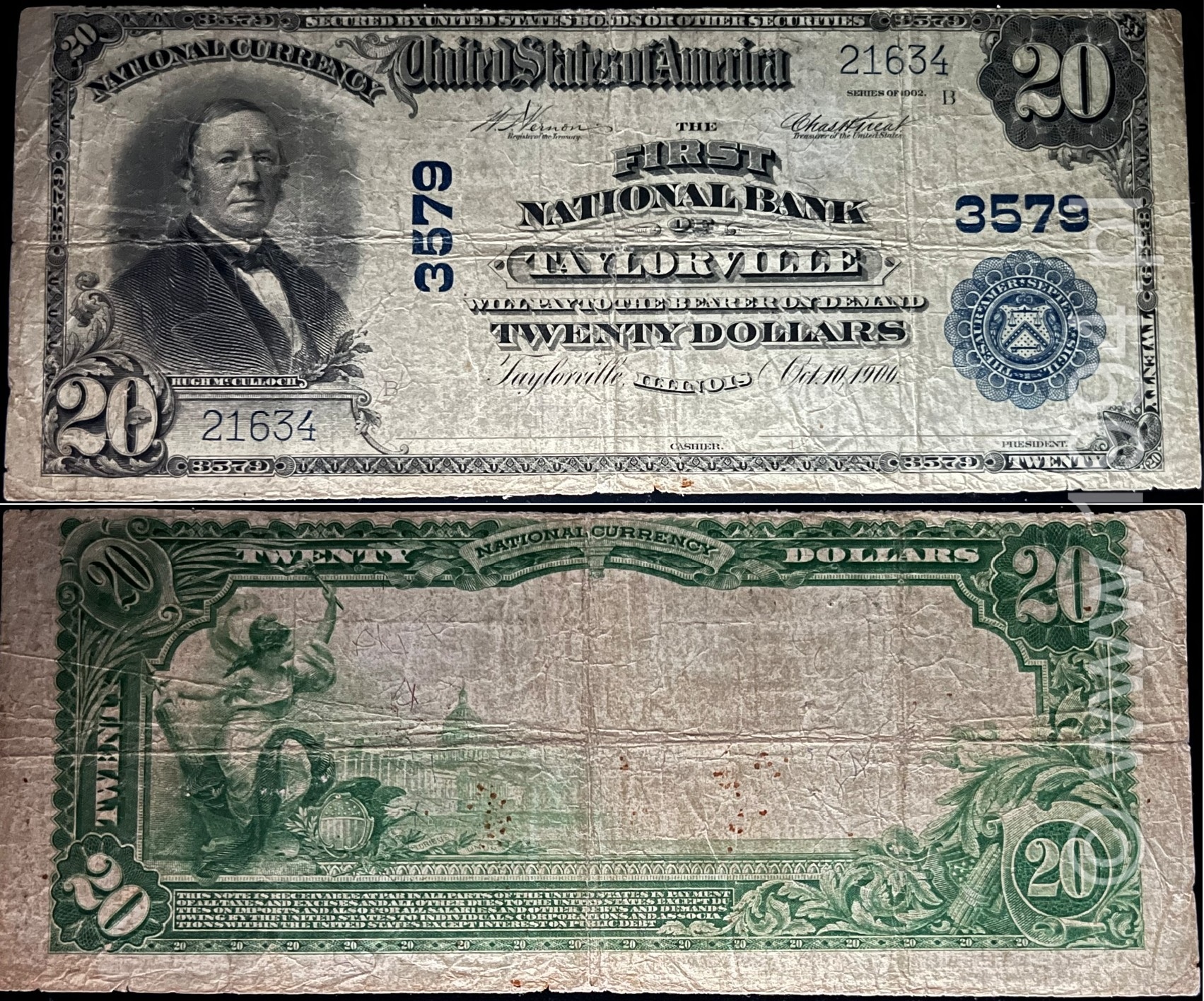
United States 1902 20 Dollars National Bank Note First National Bank of Taylorville Illinois CH 3579 large size plain back blue seal serial 21634

United States 1902 – 20 Dollars Large Size Plain Back National Bank Note – The First National Bank of Taylorville, Illinois Charter 3579 (Fr.650-652)

Large-size 1902 Plain Back twenty from The First National Bank of Taylorville, Illinois, Charter 3579, a seldom-seen issuer that entered receivership on October 18, 1929 at the very start of the small-size era. Organized and chartered in October 1886, the bank operated for more than four decades, but its total national-currency output was modest for an Illinois institution and survivorship today is extremely thin. Read more →

United StatesNational Bank Note190220 DollarsRaw Very Good (estimated) 20 DollarsNational Bank NoteIssued NotePlain BackTaylorvilleIllinoisCharter 3579Hugh McCullochLarge Size1902Banking History
Held
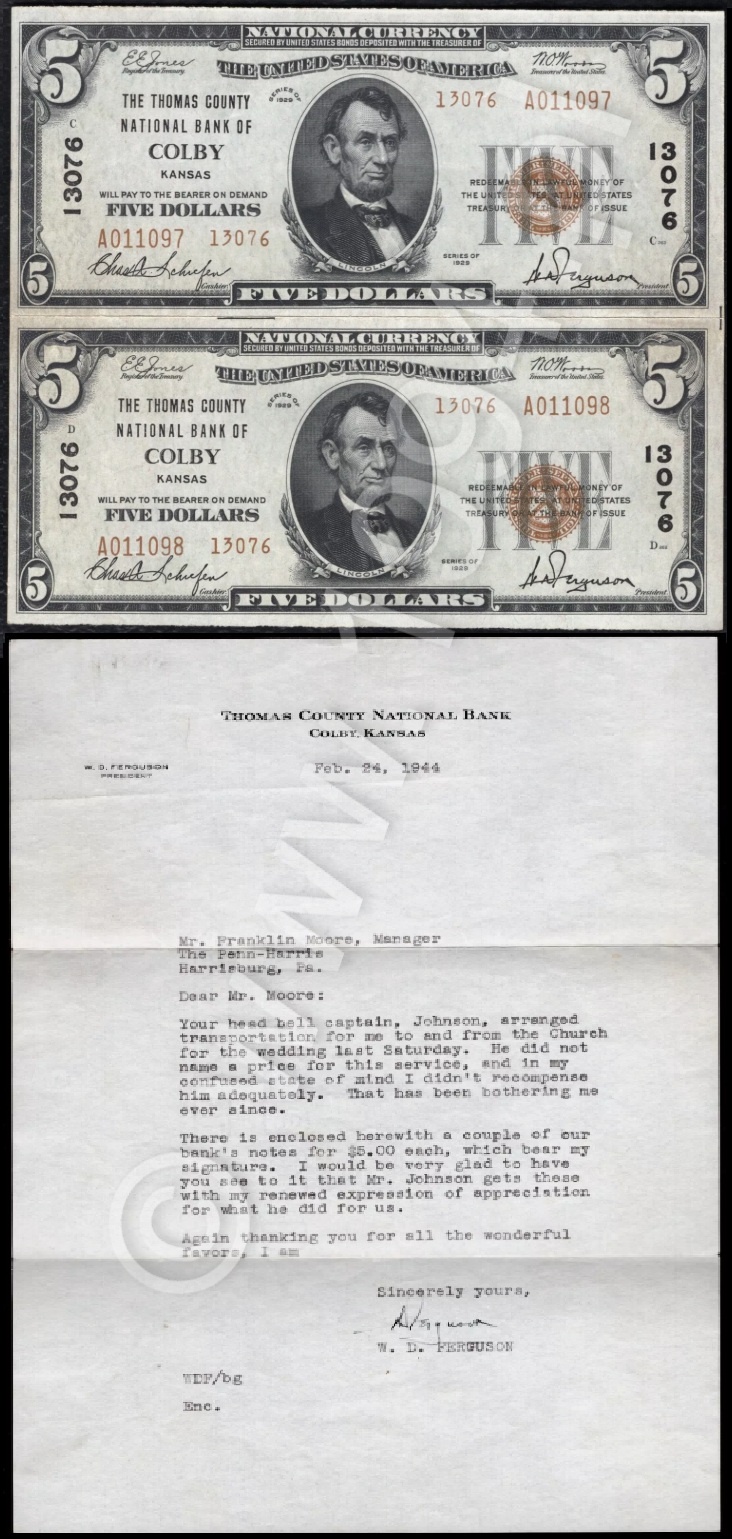
United States 1929 Type 2 uncut pair of 5 Dollars National Bank Notes from The Thomas County National Bank of Colby Kansas Charter 13076 with original 1944 W.D. Ferguson signed bank letter

United States 1929 - Uncut Pair of $5 Type 2 National Bank Notes with 1944 Bank Letter – The Thomas County National Bank of Colby, Kansas Charter 13076 W.D. Ferguson Provenance (Friedberg 1800-1)

The enclosed letter, dated February 24 1944, is printed on official Thomas County National Bank stationery and signed in ink by W. D. Ferguson. Addressed to Franklin Moore in Harrisburg, Pennsylvania, it explains that Ferguson is enclosing 'a couple of our bank’s notes for $5.00 each, which bear my signature,' to express appreciation for assistance received at a wedding. This direct reference to the enclosed notes establishes verified provenance linking these specific examples to the issuing bank’s executive-a form of authenticity documentation almost never encountered with National Currency. Read more →

United StatesNational Bank Note19295 Dollars (Uncut Pair)Uncirculated (Estimated Choice–Gem) 5 DollarsNational Bank NoteIssued NoteNational Bank Note Provenance SetType 2Uncut PairColbyKansasCharter 13076W.D. FergusonProvenance Letter1944 Correspondence1922Small Size NationalBank HistoryPick UnlistedMuseum GradeR9 Extremely RareUnique
Held
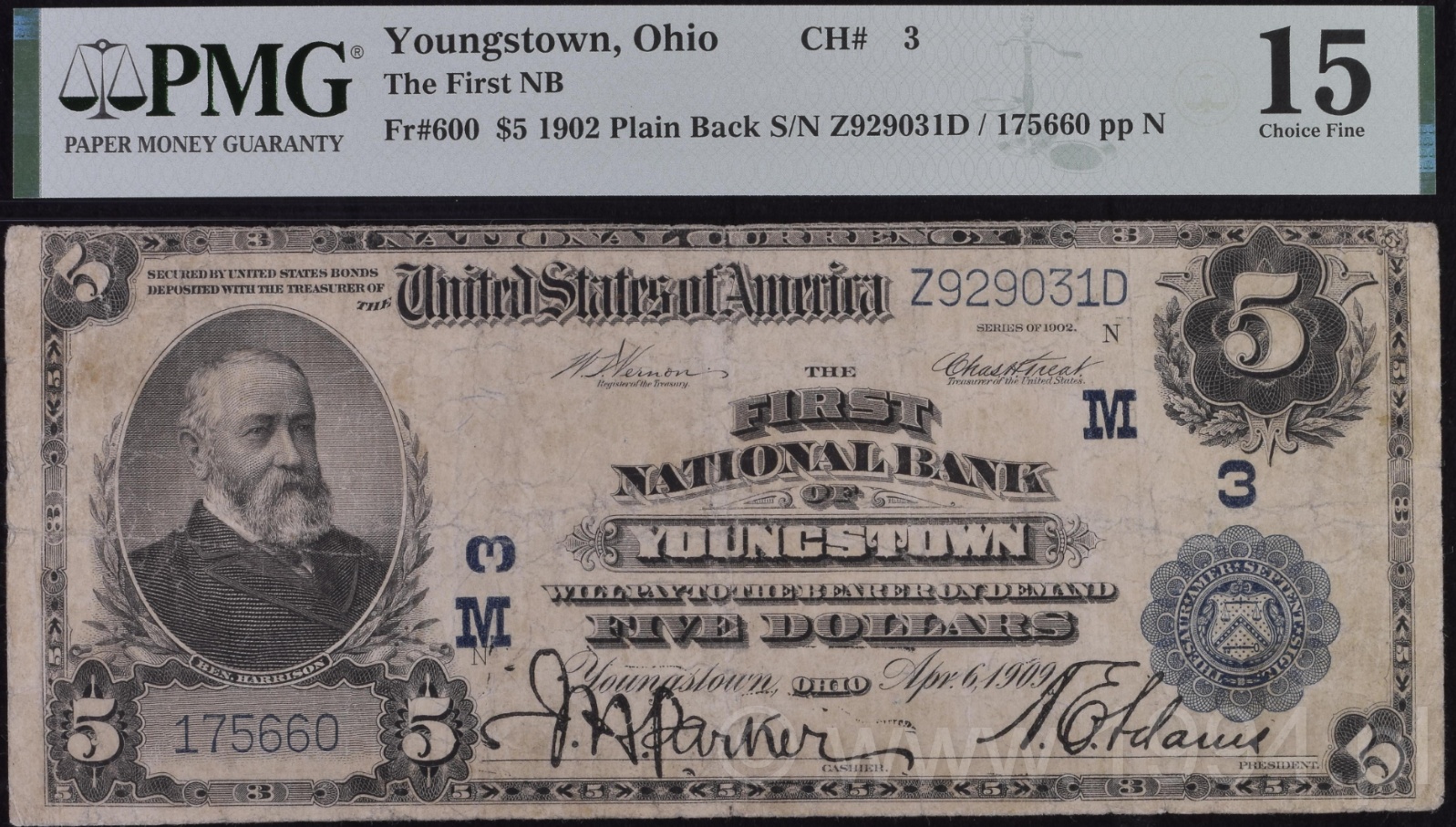
United States 1902 5 Dollars National Bank Note, The First National Bank of Youngstown, Ohio, Blue Seal Plain Back, Friedberg 600, Charter 3, PMG 15 Choice Fine, serial Z929031D with bank serial 175660

United States 1902 - 5 Dollars Blue Seal Plain Back National Bank Note - The First National Bank of Youngstown, Ohio Charter 3 (Friedberg 600)

Large‑size National Currency from a single‑digit charter. The First National Bank of Youngstown carried Charter 3, issued at the very start of the National Banking era. Low charter numbers stayed with an institution across redesigns, so CH 3 on a 1902 large‑size note directly links back to the earliest adopters of the 1863 system. Read more →

United StatesNational Bank Note19095 DollarsPMG 15 Choice Fine National Bank NoteIssued NoteLarge SizeBlue SealPlain BackBenjamin HarrisonYoungstownOhioCharter 3Low CharterFriedberg 6001902 Series1902Bureau of Engraving and Printing
Held
Edo-period Japanese 5 Momme Silver hansatsu printed by woodblock on handmade washi paper, showing vertical kanji inscriptions, circular and boxed validation seals, an oil merchant seal, and a reverse design with Daikokuten, rice bale symbolism, and ornamental wave-pattern security carving.

Japan 1800 - Edo Period 5 Momme Silver Hansatsu with Daikokuten Reverse and Oil Merchant Validation Seal Woodblock Printed on Handmade Washi Paper

This Edo-period hansatsu is a striking survivor from the decentralized monetary world of Tokugawa Japan, when paper currency was not yet a national system but a local instrument of trust, exchange, and authority. Printed by hand-carved woodblock on handmade washi paper, the note belongs to the long, narrow format associated with feudal domain and regional exchange issues. These notes circulated within local commercial systems, where value was understood through seals, inscriptions, redemption practice, and the reputation of the issuing authority rather than through modern banknote conventions. Read more →

JapanHansatsu18005 Momme SilverFine to Very Fine estimated JapanJapan 1800Year 1800Edo PeriodLate Edo PeriodTokugawa EraTokugawa ShogunatePre-Meiji JapanHansatsuFeudal Domain NoteDomain-Issued Local NoteRegional Paper MoneyLocal CurrencyFive Momme Silver5 Momme SilverSilver Five MommeGin Go MonmeMomme Weight StandardSilver CurrencyCommodity CurrencyOil Merchant SealOil Commodity SealMerchant ScripRegional Exchange HouseCommodity-Linked CurrencyMerchant ExchangeRice CurrencyEdo Monetary SystemWoodblock Printed NoteHandmade Washi PaperVermilion SealCircular SealBoxed Validation SealCalligraphic Security TextWave Pattern ReverseAnti-Counterfeiting Woodblock DesignDaikokutenDeity of WealthDeity of AbundanceRice Bale MotifMallet of FortuneReligious MotifProsperity SymbolismHistoric CurrencyAsian Paper MoneyEighteenth CenturyNineteenth CenturyPick UnlistedNot Listed in PickRarityMuseum GradeHistory
Held
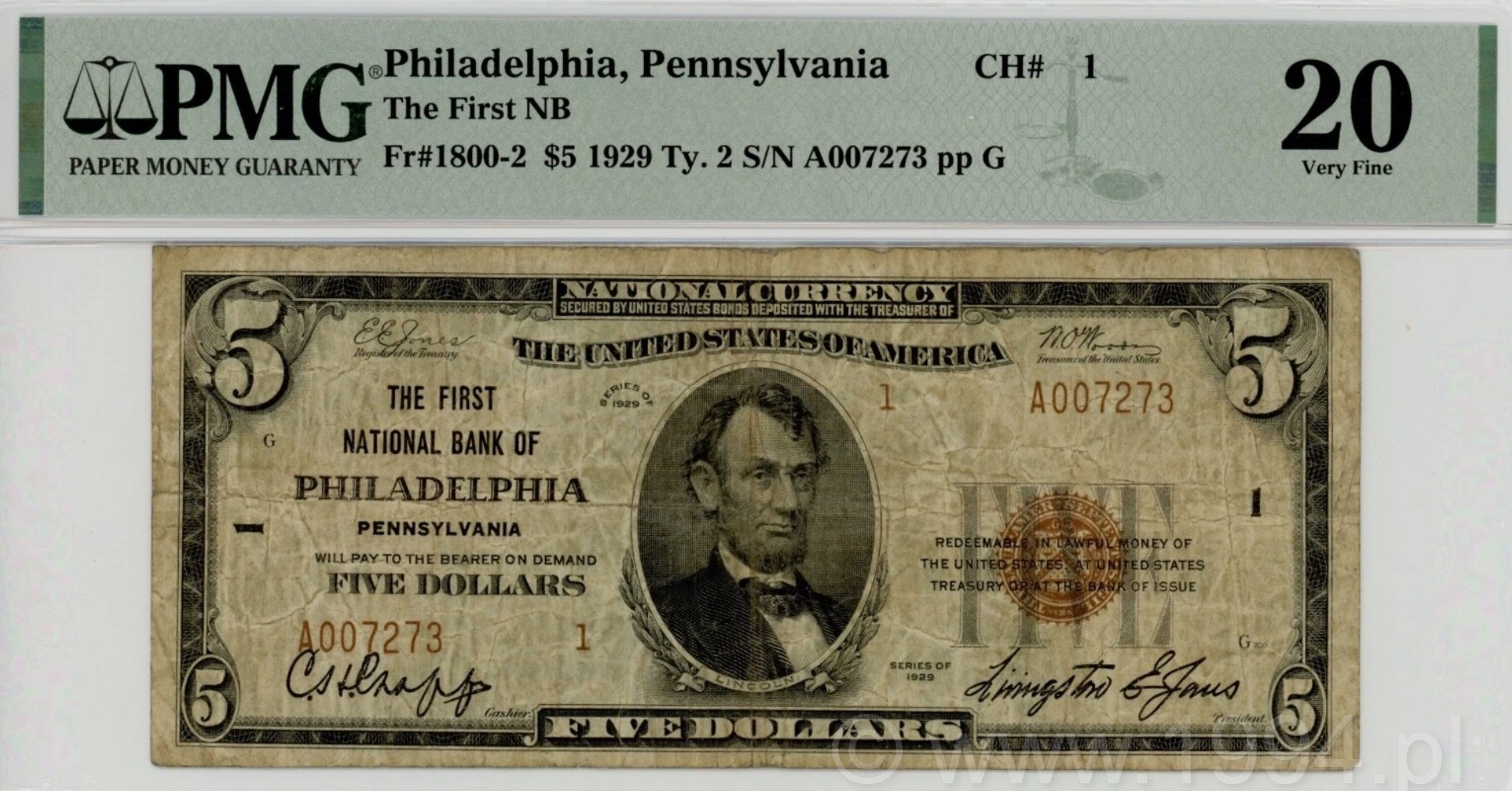
United States 1929 Type 2 - 5 Dollars National Bank Note The First National Bank of Philadelphia Pennsylvania Fr 1800-2 Charter 1 PMG 20 Very Fine

United States 1929 - 5 Dollars Type 2 National Bank Note - The First National Bank of Philadelphia, Pennsylvania Charter 1 (Fr. 1800-2)

Issued by The First National Bank of Philadelphia under Charter 1 - the very first federal national bank charter granted following the National Banking Act of 1863 - this five-dollar note represents the closing generation of National Currency printed before the system ended in the 1930s. Read more →

United StatesNational Bank Note19295 DollarsPMG 20 Very Fine 5 DollarsNational Bank NoteIssued NoteType 2PhiladelphiaPennsylvaniaCharter 1Low CharterLincoln1929PMG 20 VFFederal Banking History
Held
Argentina 1876 Banco de San Juan 5 Pesos Fuertes archival specimen printed by Bradbury Wilkinson, provincial private banknote, PMG 64 EPQ

Argentina 1876 - Banco de San Juan 5 Pesos Fuertes Specimen (S1881s)

The Banco de San Juan operated within Argentina’s interior Andean province during a period when provincial banks exercised near-sovereign authority over local credit and currency issuance. Under the Ley de Bancos Garantidos framework, these institutions were permitted to issue convertible paper backed by metallic reserves, supporting regional economies centered on mining, viticulture, mule transport, and inter-provincial trade. This decentralized system preceded the later consolidation of monetary authority in Buenos Aires and the emergence of national currency. Read more →

ArgentinaSpecimen18765 Pesos FuertesPMG 64 Choice Uncirculated Exceptional Paper Quality (Top Population) Specimen BanknotePick S1880sSingle Instance Control SpecimenArchival Approval NoteProvincial Private Bank IssuePunch Cancelled SpecimenBanco de San JuanArgentine Provincial BanksRegional Monetary AutonomyLey de Bancos GarantidosFrontier Province FinanceAllegorical VignetteProvincial Coat of ArmsNative Fauna IconographyEngraved Security PrintingBradbury WilkinsonBWCBritish Security PrintingExport Engraved NotesArgentinaSan Juan1876Exceptional Paper QualityTop PopMuseum GradeR9 Extremely RareUnique
Held
↑ Top