Results for “nineteenth century”
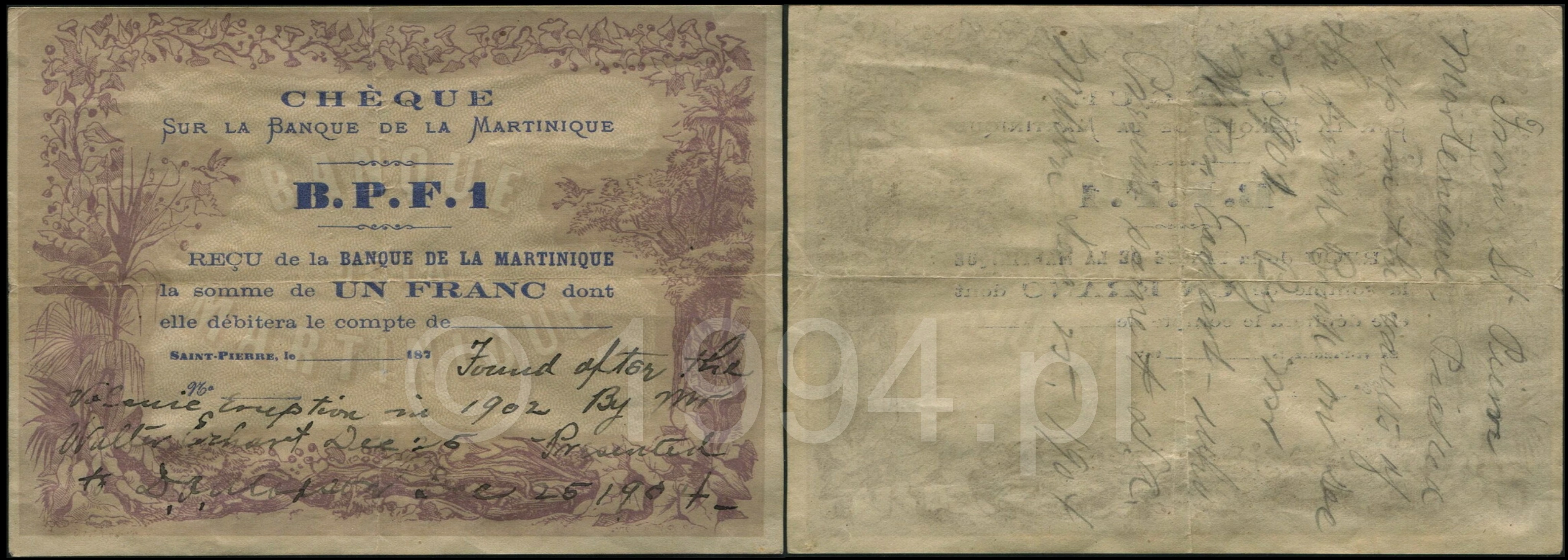
Martinique 1870 Banque de la Martinique 1 franc cheque recovered from the ruins of Saint-Pierre after the 1902 Mount Pelée eruption, with contemporary handwritten provenance notes

Martinique 1870 - Banque de la Martinique 1 Franc Cheque Recovered After the 1902 Mount Pelée Eruption (Pick P.5A)

A Banque de la Martinique one franc cheque form, Pick P.5A, originally printed for use at Saint-Pierre during the late nineteenth century and later recovered from the ruins of the city following the catastrophic eruption of Mount Pelée on 8 May 1902. Although printed decades earlier as part of the bank’s standardized cheque issue, this surviving example was never negotiated as a financial instrument and instead entered history as a disaster-recovery relic, explicitly identified as such by contemporary handwritten annotations. Read more →

nineteenth century
MartiniqueDisaster Recovery Cheque18701 FrancVery Fine Disaster Recovery Cheque1 FrancBanque de la MartiniqueMount Pelee EruptionSaint Pierre DestructionColonial Bank RuinsPick P.5AColonial Banking HistoryFrench Overseas TerritoriesCaribbean Monetary HistoryNineteenth Century BankingDisaster Recovered ArtifactDocumentary Financial InstrumentsSecurity Printing HistoryFrench Engraving TraditionMartinique18701902Museum GradeR9 Extremely RareUniqueAnnotationsHandwritten Annotations
Held
Portugal 1799 Real Erario 20000 reis apólice issued in Lisboa, serial number 37723 in red, blind embossed seal on the face, no red overprint present, with multiple official ink seals on the reverse

Portugal 1799 - Real Erario 20000 Reis Apólice, Original Issue, No Overprint, Lisboa No. 37723

Issued in Lisboa in 1799 under the authority of the Real Erario, this 20,000-reis apolice is a Portuguese royal-era public debt instrument payable to bearer. It represents state-backed debt from a period of administrative continuity in late eighteenth-century Portugal, before the political and fiscal disruptions of the nineteenth century. Read more →

nineteenth century
PortugalPublic Debt Bond179920000 ReisVery Fine Public Debt BondApolice20000 ReisPayable to BearerBlind Embossed SealMultiple Reverse SealsNo OverprintOriginal IssuePre War of the BrothersReal ErarioLisboaPortuguese Treasury FinanceRoyal Era Fiscal PaperEighteenth Century State DebtAdministrative Validation SealsFiscal Control HistorySecurity Printing HistoryPortuguese Monetary HistoryPortugal17991811Museum GradeR9 Extremely RareTreasury BondShort-Term Treasury BondOne-Year MaturityInterest-Bearing DebtCirculating Treasury PaperFiduciary Paper MoneyEarly Portuguese Paper MoneyCirculating Public DebtGovernment Debt InstrumentPublic Loan InstrumentTreasury BillShort-Term Government DebtOne-Year Treasury InstrumentBearer Treasury NotePortuguese Paper MoneyEarly Paper CurrencyRoyal Treasury NoteInterest-Bearing Treasury NoteState Debt PaperCirculating Government DebtHistoric Treasury InstrumentGovernment BondSovereign DebtRoyal Treasury BondTreasury DebtBearer BondGovernment Paper MoneyCirculating BondPublic Debt InstrumentPortuguese Government DebtPortuguese Treasury BondPortuguese Treasury Bill18th Century Paper Money18th Century Government DebtEarly Government PaperHistoric Public DebtRoyal Erario BondReal Erario ApolicePortuguese Apolice1799 Portugal1799 Treasury Bond1799 Treasury Bill20000 Reis Apolice20000 Reis Treasury Bond20000 Reis Treasury Bill
Held
Brazil Imperial Treasury ten mil réis contemporary counterfeit, Pick A231x, PMG 64 EPQ Choice Uncirculated, period forgery from the Dom Pedro II era

Brazil ca. 1852–1870 - Imperial Treasury of Brazil 10 Mil Réis Contemporary Counterfeit (Pick A231x)

This note represents a contemporary counterfeit of the Imperial Treasury of Brazil ten mil réis issue, produced during the active circulation period of the official banknote and intended to pass as legal tender in everyday commerce. Classified in standard references as Pick A231x, it is a period forgery rather than a later reproduction or fantasy piece, created using materials, engraving methods, and paper consistent with mid-nineteenth-century Brazilian monetary circulation. Read more →

nineteenth-century
BrazilContemporary Counterfeit185210 Mil RéisPMG 64 EPQ Choice Uncirculated Contemporary CounterfeitImperial Treasury of BrazilEmpire of Brazil10 Mil RéisPeriod ForgeryExceptional Paper QualityEPQTop PopNineteenth Century CurrencyBrazilian EmpireDom Pedro II EraMonetary Security HistoryCounterfeit StudiesBrazil18521870Pick A231xPMGPMG 64 EPQR7 RareCondition R8 Extremely RareMuseum Grade
Held
Uruguay 1871 Banco de Londres y Rio de la Plata 10 Pesos face proof, obverse-only engraving proof, PCGS 61 New

Uruguay 1871 - Banco de Londres y Rio de la Plata 10 Pesos Face Proof (Pick S239p)

Face proofs occupied a distinct place within nineteenth-century banknote production. They were technical production artifacts used to evaluate and approve the engraved face before full note manufacture proceeded. This example therefore records the design at a critical production stage, preserving the approved plate work and original control layout associated with the 10 Pesos issue. Read more →

nineteenth-century
UruguayFace Proof187110 PesosPCGS 61 New Face ProofObverse OnlyEngraving Approval ProofPrinter Reference ProofBanco de Londres y Rio de la PlataNineteenth Century Security PrintingLatin American Banknote ProductionPlate Development ProcessPre Issue Production ArtifactUruguay1871MontevideoPick S239pMuseum GradeR9 Extremely RareUnique
Held
United States 1844 four dollars state bank note issued by the Bank of Florida in Tallahassee during its final revival, engraved by Rawdon Wright Hatch and Edson, New York payable, bearing official crosscut cancellation, graded PCGS 58 Choice About Uncirculated

United States 1844 - Bank of Florida - Tallahassee 4 Dollars, State Bank Note, Final Revival Issue, FL-65-G26

Engraving for this issue is attributable to Rawdon, Wright, Hatch and Edson, the predecessor firm to the American Bank Note Company. This attribution is supported by later archival material and aligns stylistically with mid-nineteenth-century American banknote engraving conventions. The face design employs classical allegorical figures and commercial imagery intended to project continuity, legitimacy, and economic order at a moment when the issuing institution itself was financially unstable. Read more →

nineteenth-century
United StatesState Bank Note18444 DollarsPCGS Banknote 58 Choice About Uncirculated 4 DollarsState Bank NoteBank of FloridaTallahasseeFlorida TerritoryFinal Revival IssueNew York PayableCrosscut CancelledRedeemed BanknoteAntebellum BankingState Chartered BankingFlorida Banking HistoryAmerican Engraved BanknotesUnited StatesFlorida1844PCGS BanknotePCGS 58Haxby Florida FL-65-G26Museum Grade
Held
Lower Canada 1837 Champlain and St. Lawrence Railroad full uncut sheet showing six notes with 15 Sous, Quarter Dollar, and Half Dollar denominations in A and B series paired layout

Lower Canada 1837 - Champlain and St. Lawrence Railroad - 15 Sous, Quarter Dollar, Half Dollar (Full Uncut Dual Series Sheet)

The denominations themselves correspond to multiple monetary systems in concurrent use. Fifteen sous aligns with fifteen pence, the quarter dollar corresponds to seven pence half penny, and the half dollar reflects a higher transactional unit. The simultaneous presence of British sterling, French-derived sou denominations, and dollar-based values illustrates the fragmented and hybrid monetary environment of Lower Canada in the 1830s. Read more →

Lower CanadaRailroad Scrip Uncut Sheet183715 Sous, Quarter Dollar, Half DollarUncut Sheet, ungraded Railroad ScripUncut SheetFull SheetDual Series LayoutA SeriesB SeriesPaired Denomination FormatTwo of Each DenominationSix Note SheetChamplain and St. Lawrence RailroadLower CanadaPrivate CurrencyTransportation CurrencyLocomotive VignettesIndustrial Engraving15 SousQuarter DollarHalf DollarFifteen PenceSeven Pence Half PennyThirty SousThree FrancsPre Confederation CanadaLower Canada Rebellion EraCanadian Railroad HistoryNineteenth Century FinanceHistory1837August 1 1837350mm x 220mmUngradedR8 Extremely RareMuseum Grade
Held
Spain 1875 Banco de España 50 pesetas contemporary counterfeit, Pick 7x, with large circular hole punches and FALSO stamp, one of only two graded examples, graded PMG 25 Very Fine

Spain 1875 - Banco de España 50 Pesetas Contemporary Counterfeit (Pick 7x)

This note represents a contemporary counterfeit of the Banco de España fifty pesetas issue of 1875, produced during the active circulation period of the official banknote and intended to pass as legal tender in everyday commerce. Classified in standard references as Pick 7x, it is a period forgery rather than a later reproduction or fantasy piece, created using materials and printing methods consistent with nineteenth-century Spanish monetary circulation. Read more →

nineteenth-century
SpainContemporary Counterfeit187550 PesetasPMG 25 Very Fine Contemporary CounterfeitBanco de España50 PesetasPeriod ForgeryCirculating CounterfeitFALSO StampHole Punch CancelledNineteenth Century CurrencySpanish Monetary HistoryPaper Money SecurityCounterfeit StudiesSpain1875Pick 7xPMG 25R8 Extremely RareMuseum Grade
Held
Spain 1876 Banco de España one hundred pesetas contemporary counterfeit, Pick 11x, with large circular hole punches and FALSO stamp, Top Pop graded PMG 40 Extremely Fine

Spain 1876 - Banco de España 100 Pesetas Contemporary Counterfeit (Pick 11x)

This note represents a contemporary counterfeit of the Banco de España one hundred pesetas issue of 1876, produced during the active circulation period of the official banknote and intended to pass as legal tender in everyday commerce. Classified in standard references as Pick 11x, it is a period forgery rather than a later reproduction or fantasy piece, created using materials and printing methods consistent with late nineteenth-century Spanish monetary circulation. Read more →

nineteenth-century
SpainContemporary Counterfeit1876100 PesetasPMG 40 Extremely Fine Contemporary CounterfeitBanco de España100 PesetasPeriod ForgeryCirculating CounterfeitFALSO StampHole Punch CancelledNineteenth Century CurrencySpanish Monetary HistoryPaper Money SecurityCounterfeit StudiesSpain1876Pick 11xPMGPMG 40Top PopR8 Extremely RareMuseum Grade
Held
South Africa 1828 Cape of Good Hope Bank five shillings pre issue sample note, engraved border and ships vignette, Smithsonian class institutional artifact

South Africa 1828 - Cape of Good Hope Bank 5 Shillings Pre-Issue Sample (Pick S171p)

The obverse design reflects the visual language of early nineteenth-century British colonial banking. An ornate engraved border encloses a central vignette depicting ships anchored off the Cape with mountainous terrain in the background, a deliberate reference to maritime trade, provisioning, and the strategic role of the Cape as a commercial waypoint within the British imperial system. The textual promise to pay the bearer on demand is fully articulated, while the date and issuance fields remain incomplete, consistent with pre-authorization sample status. The reverse is blank, as expected for early colonial banking samples produced prior to standardized two-sided note formats. Read more →

nineteenth-century
South AfricaPre-Issue Sample1828Five Shillings SterlingUncirculated Pre Issue Sample5 Shillings SterlingSample NoteApproval Stage CurrencyCape of Good Hope BankPrivate Colonial BankingEarly Nineteenth Century CurrencyCape Colony Monetary HistoryBritish Colonial FinanceInstitutional ProvenanceSouth Africa1828Pick S171pR9 Extremely RareMuseum GradeSmithsonian Held Class
Held
South Africa 1861 Montagu Bank five pounds remainder, large format steel plate engraved private banknote with green counterfeit protector

South Africa 1861 - Montagu Bank 5 Pounds Remainder (Pick S231r)

The Montagu Bank was established in 1861 at a time when local banking was widely regarded as essential to trade and economic development within the Cape Colony. Contemporary accounts note that by the late nineteenth century more than thirty such local banks operated across the colony, each issuing its own paper currency. Montagu was among the smaller but more ambitious of these institutions, notable not only for issuing its own banknotes but for embedding itself physically and socially within the town’s commercial core. Read more →

nineteenth century
South AfricaRemainder18615 Pounds SterlingUncirculated Remainder5 PoundsUnissued CurrencyMontagu BankPrivate BanknoteSteel Plate EngravingMid Nineteenth Century CurrencyCape Colony BankingCounterfeit ProtectorColonial Monetary HistorySouth Africa1861Pick S231rR7 Very RareMuseum Grade
Held
United States 1854 Empire City Bank 100 Dollars proof note, Collins Line steamship vignette, blank reverse with American Bank Note Company archival stamp, PMG Uncirculated 62 EPQ

United States 1854 - Empire City Bank 100 Dollars Proof (Pick NY1585G16P)

Archival records further support this classification. Six examples of this proof type were recorded in the American Bank Note Company Archives sale of 1990, indicating a very small surviving population derived directly from institutional holdings. Proofs of this nature were produced in extremely limited numbers and were often destroyed once designs were finalized or banks ceased operation, making surviving examples highly significant as primary evidence of nineteenth century American banknote production practices. Read more →

nineteenth century
United StatesProof1854100 DollarsPMG Uncirculated 62 EPQ ProofProof Banknote100 DollarsHigh DenominationEmpire City BankABNCAmerican Bank Note CompanyArchival ProofPunch of CancellationAmerican Private BankingPre Civil War CurrencyNew York Banking HistoryNineteenth Century BankingSecurity Printing HistoryCollins Line Steamer VignetteUnited States1854Pick NY1585G16PPMG 62Museum GradeR8 Extremely Rare
Held
United States 1838 Olney Alabama uncut remainder sheet with 25 cents, 50 cents, and 1 dollar notes printed by Manly and Orr, deckled bottom margin, PCGS Banknote Very Fine 25

United States 1838 - Olney, Alabama 25 Cents, 50 Cents, 1 Dollar Uncut Sheet Remainder

The notes were printed from stock designs produced by Manly and Orr of Philadelphia, a major nineteenth century security printing firm that supplied generic engraved templates to a wide range of customers across the United States during the 1830s. These designs were marketed for rapid adoption by banks, merchants, and local issuers seeking to introduce paper money without the expense of commissioning custom engravings. As a result, identical or closely related layouts appear across numerous state and local issues of the period. Read more →

nineteenth century
United StatesRemainder183825 Cents, 50 Cents, 1 DollarPCGS Banknote Very Fine 25 RemainderUncut Sheet25 Cents50 Cents1 DollarFractional CurrencyStock EngravingManly and OrrDeckled EdgeAntebellum CurrencyPanic of 1837 EraLocal ScripUnofficial IssuerAlabama Monetary HistoryEarly American PrintingUnited StatesAlabamaOlney1838Gunther and Derby AO-386PCGS 25Museum GradeR8 Extremely Rare
Held
↑ Top