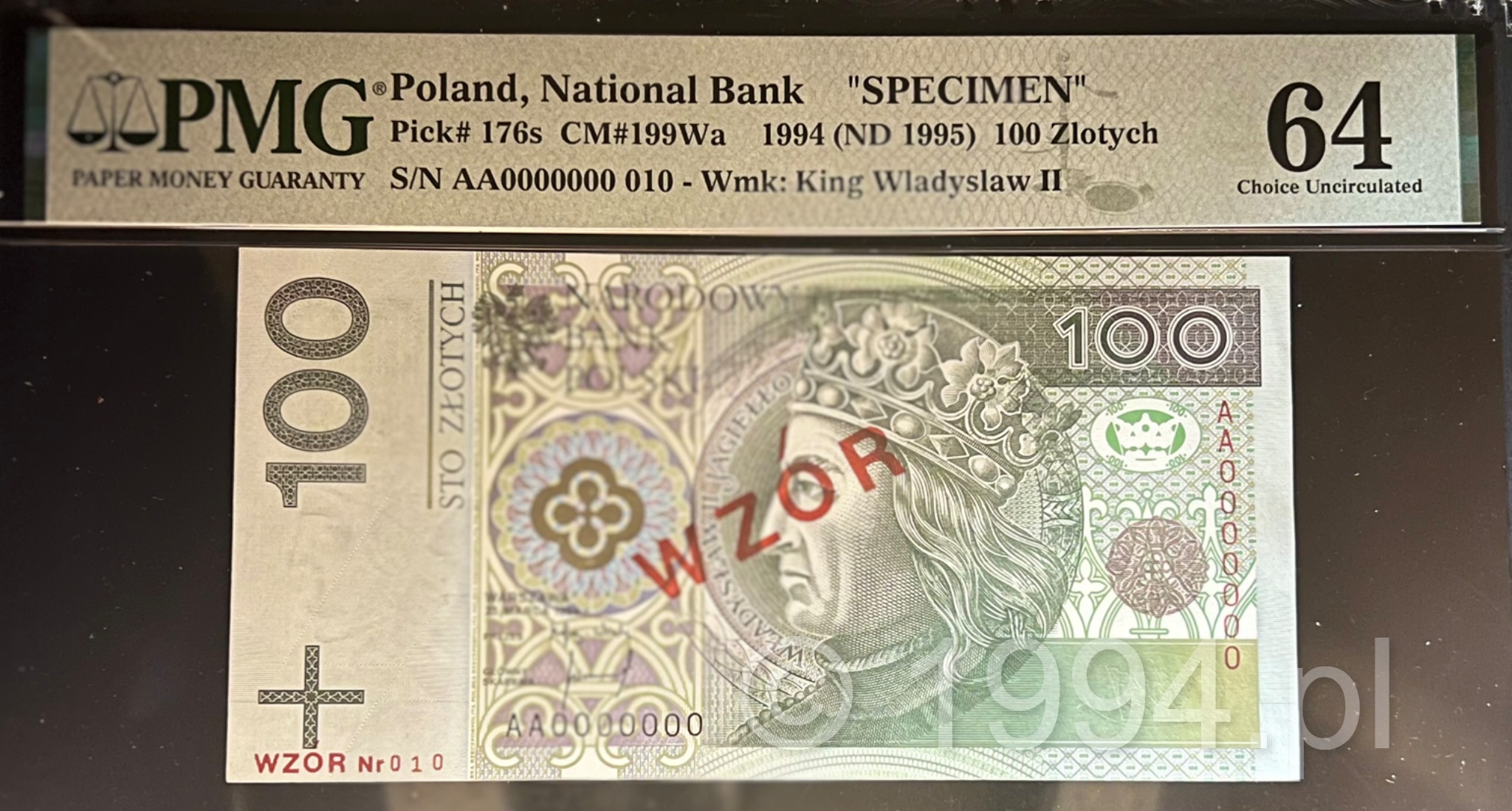
Poland 1994 - 100 Zlotych, Narodowy Bank Polski WZÓR Specimen Number 010 (Pick 176s)
This AA0000000, WZÓR No. 010 example represents the 100 Zlotych component of the complete matching-number WZÓR 010 set preserved in this collection. Read more →
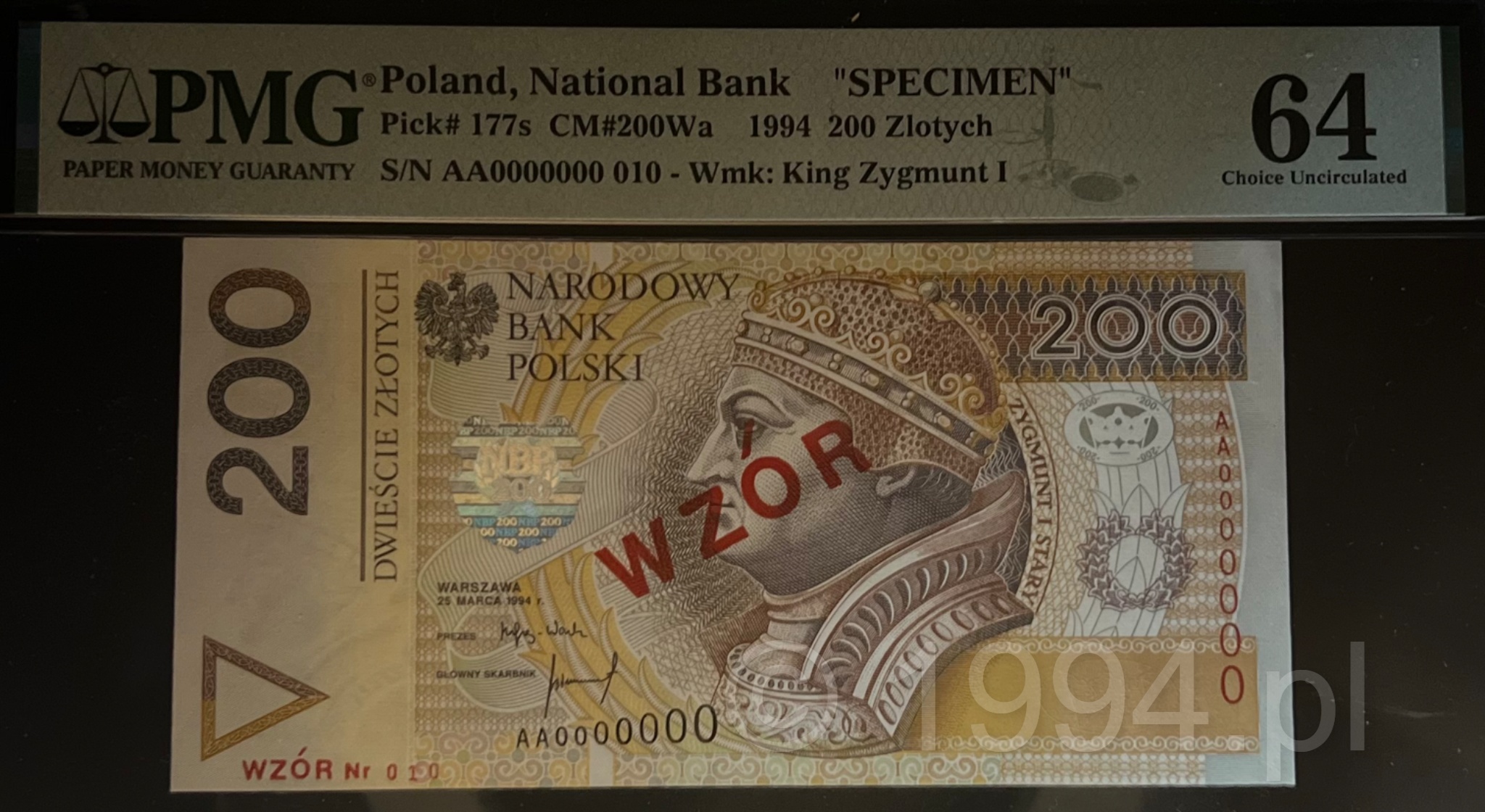
The reverse features the Sigismund Chapel at Wawel in Krakow, directly connecting the denomination with the reign and cultural legacy of Sigismund I the Old. The note preserves the complete design and security structure of the 200 Zlotych issue, including guilloche work, denomination fields, ornamental security elements, and the Sigismund I watermark. Read more →
According to current publicly available PMG population data, this is the only EPQ-designated example recorded for the Pick A231x contemporary counterfeit type. While multiple examples of this counterfeit are known and graded, none approach this level of preservation or paper quality. Its significance therefore lies not in type rarity alone, but in its status as a condition outlier preserving the physical characteristics of a circulating nineteenth-century forgery in near-original state. Read more →
The reverse displays the complete allegorical equestrian scene associated with the one thousand pesos type, executed at the same engraving standard as circulation notes. The absence of cancellation on the reverse reinforces the interpretation of this piece as a formal institutional reference specimen rather than a presentation or display example. Read more →
The perforated CANCELLED inscription is the defining production feature of this example. Formed by a sequence of small openings through the sheet, it cannot be removed or altered without materially damaging the note. At the same time, the perforation leaves the underlying typography, engraving, and color structure visible, making the note suitable for technical comparison and institutional recordkeeping. Its restrained appearance distinguishes it from the visually heavier red-overprint specimens prepared under other control protocols. Read more →
Certified PMG 64, this specimen documents the De La Rue control-stamp specimen format used for Cayman Islands Currency Board notes. Its significance lies in recording a distinct specimen handling stage associated with the Jefferson-signed phase of the one dollar series, positioned between classic presentation specimens and terminal perforated archival control examples. Read more →
Certified PMG 64, this specimen documents the perforated archival control format applied to Cayman Islands Currency Board notes during the Jefferson-signed phase of the one dollar series. Its significance lies in preserving direct evidence of late twentieth-century specimen invalidation practice, illustrating how fully authorized designs were deliberately withdrawn from monetary function for institutional recordkeeping. Read more →
The specimen state is defined by a layered De La Rue control protocol. A bold red diagonal SPECIMEN overprint spans the face, and two red oval control stamps reading “SPECIMEN / DE LA RUE / NO VALUE” are applied in the classic De La Rue format used to mark specimen material that had to remain visually legible while being permanently non-monetary. A further physical voiding measure is present as a single punch cancellation in the signature area, an additional safeguard that disables monetary function without obscuring the engraved design. Read more →
As an archival specimen, this piece is documentary evidence of process. It shows how a fully authorized five dollar design was preserved in a permanently voided state and how De La Rue differentiated otherwise comparable specimens through explicit job coding and written handling instructions. That internal differentiation is exactly what makes this A2-marked specimen a distinct catalog object rather than a redundant duplicate. Read more →
This forty dollars specimen of the Cayman Islands Currency Board belongs to the 1974 design series authorized under the Cayman Islands Currency Law of 1974 and produced by Thomas De La Rue and Company Limited as controlled reference material. It preserves the complete engraved production design of the denomination while being permanently invalidated for non-monetary use. Read more →
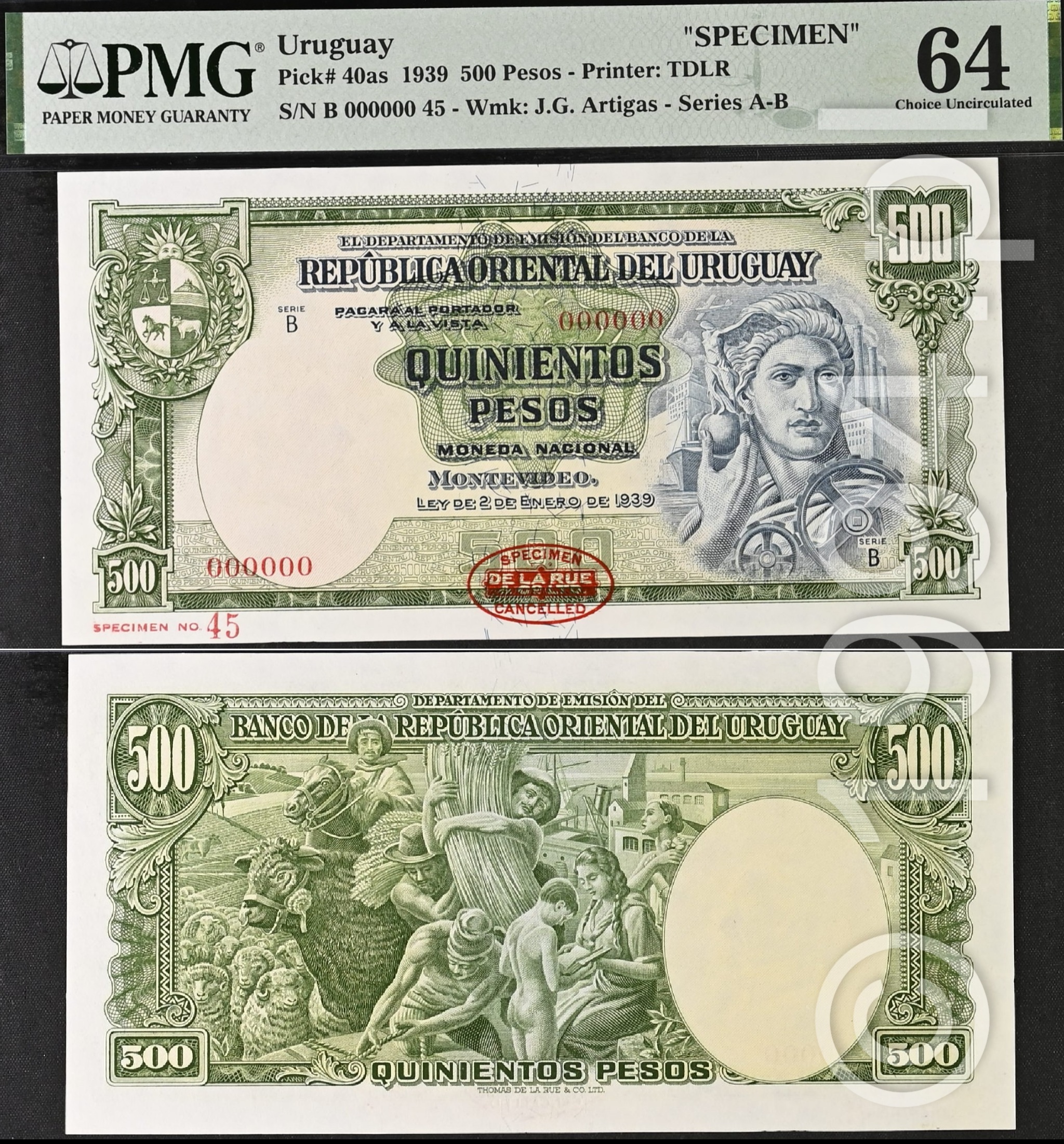
Certified Paper Money Guaranty 64, this Specimen No. 45 preserves the sharp engraving and composed visual structure needed to study the Serie B design at production standard. Its localized cancellation, numbered identity, and unmarked reverse make it a particularly clear record of one of the specimen-handling formats used by Thomas De La Rue and Company Limited for Uruguay's 1939 five hundred pesos issue. Read more →
This Serie D one hundred pesos specimen of the Banco de la Republica Oriental del Uruguay is identified as Specimen No. 2 and represents the red-marked member of an exceptional matched specimen-control pair. Its companion carries the same Pick 39cs classification, the same Serie D designation, the same all-zero serial format, the same Specimen No. 2 assignment, and the same completed banknote design, but was prepared with black specimen markings. Together, the two notes preserve parallel printer-controlled presentations of the same reference position. Read more →