Results for “r9 extremely rare”
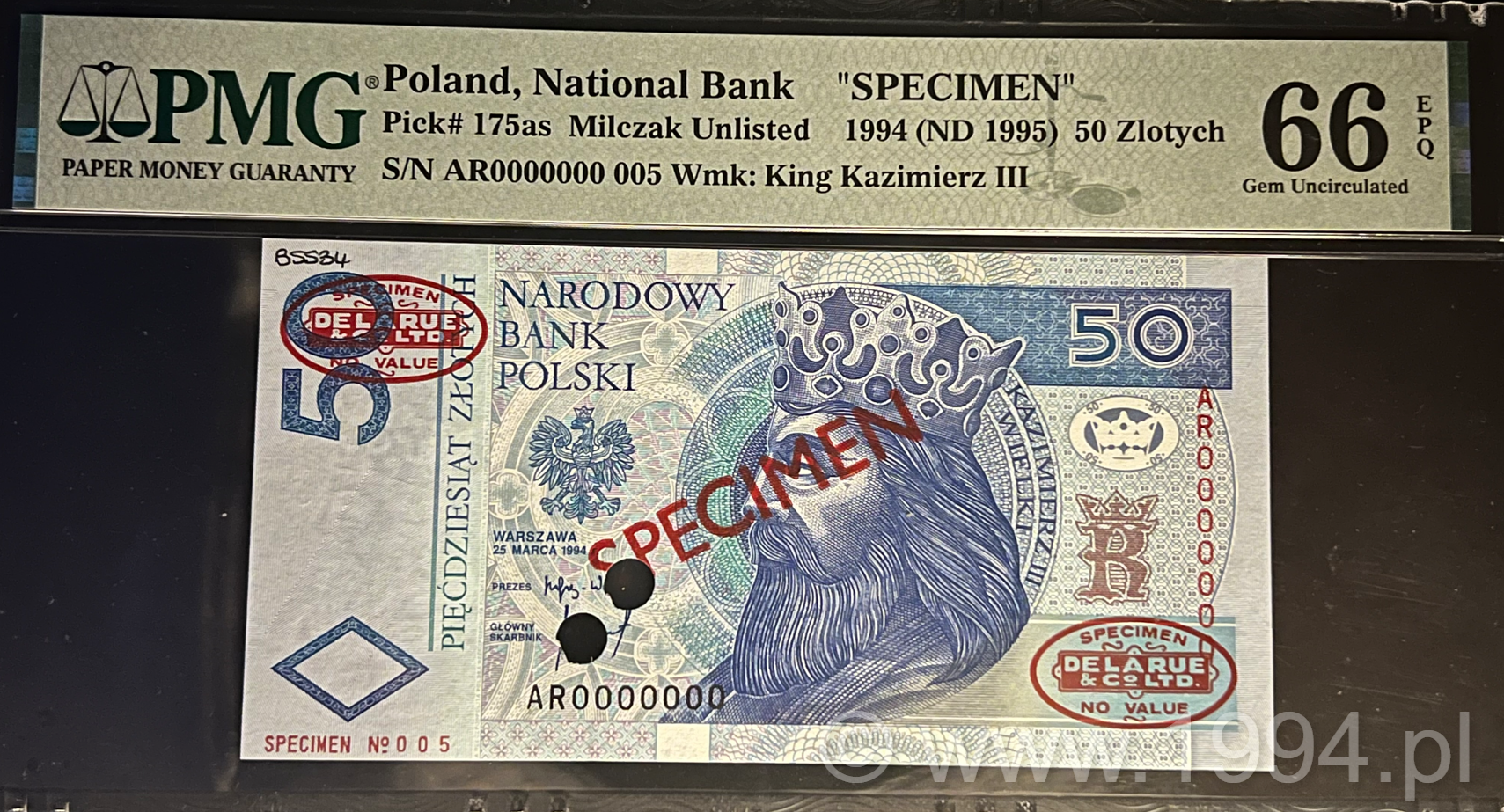
Poland 1994 50 Zlotych discovery AR prefix specimen with red SPECIMEN overprint, red oval NO VALUE stamps, punch cancellations, serial AR0000000, De La Rue specimen-control number 005, and Thomas De La Rue specimen tracking panel.

Poland 1994 - 50 Zlotych Discovery AR Prefix with Red Overprint and Oval Stamp Specimen (Pick Unlisted)

Serial AR0000000 is the principal prefix diagnostic. The all-zero numbering identifies the note as specimen material, while the AR prefix places it within a previously undocumented control group for the 1994 50 Zlotych issue. The red specimen markings and punch cancellations establish its controlled non-circulating status while preserving the complete production design. Read more →

PolandSpecimen with Red Overprint and Oval Stamp199450 ZlotychPMG 66 EPQ Gem Uncirculated SpecimenDiscovery AR PrefixDiscovery PrefixDiscovery MaterialProduction-Stage DiscoveryRed OverprintRed SPECIMEN OverprintOval NO VALUE StampPunch CancelledSpecimen Tracking PanelDe La Rue Specimen Control Number 005Specimen Control Number 005Control Number 005Unique Specimen Control NumberAR PrefixSerial AR0000000Zero Serial NumberThomas De La RueTDLRMilczak UnlistedPick UnlistedMilczak Unlisted AR PrefixPreviously Undocumented AR PrefixAR Prefix Specimen EvidencePhysical Specimen Control FormPoland Currency Redesign 1994National Bank of PolandNarodowy Bank PolskiModern Polish BanknotesSecurity Printing HistorySpecimen Control ProceduresPre Issue Control NotePrinter Control MaterialFinal Issued-Style DesignKing Casimir III the GreatKazimierz WielkiAndrzej HeidrichHanna Gronkiewicz-WaltzWieslaw BiernatowiczPolandPoland 1994199450 ZlotychPMG 66 EPQMuseum GradeR9 Extremely RareUnique
Held
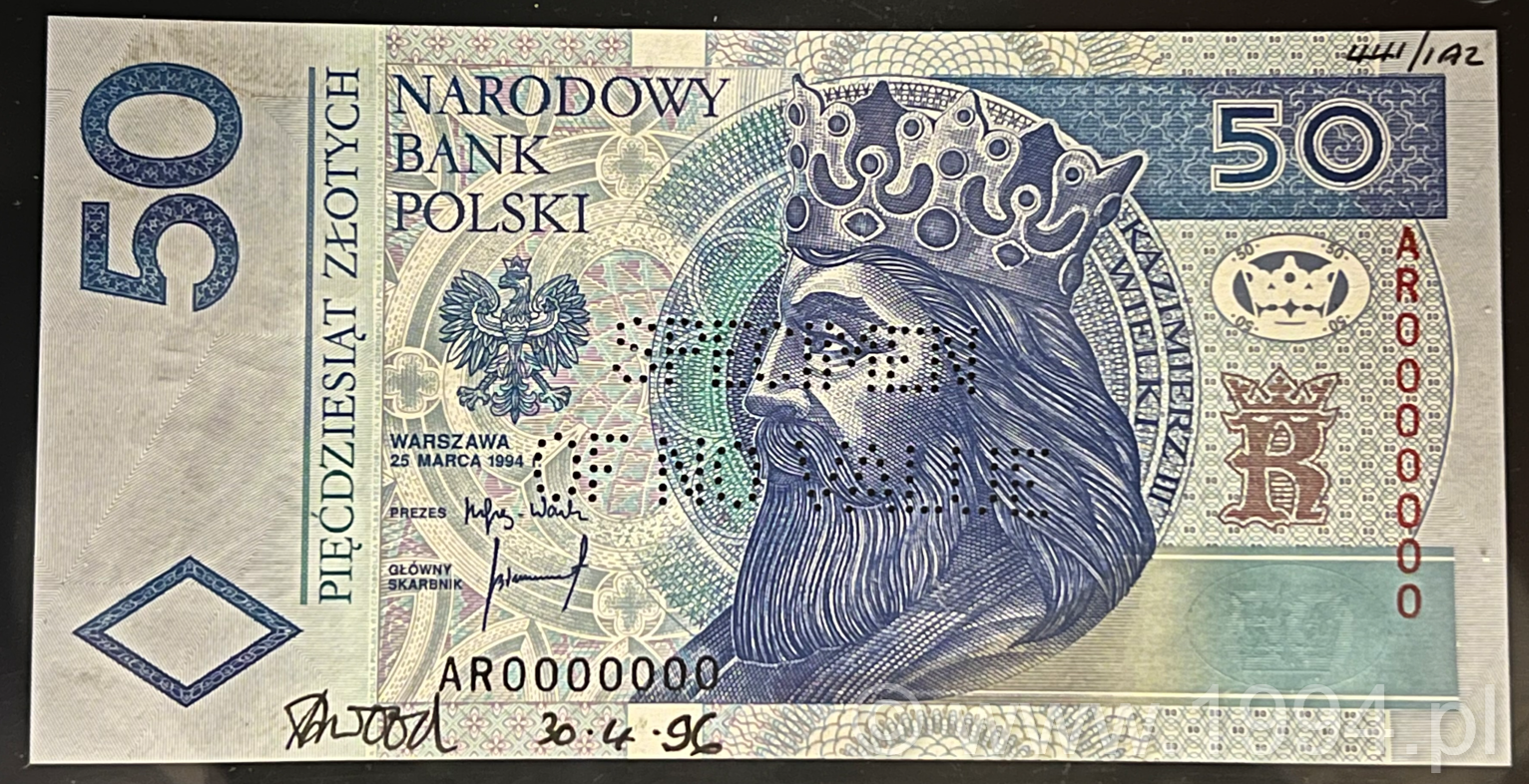
Poland 1994 50 Zlotych discovery AR prefix specimen perforated SPECIMEN OF NO VALUE, serial AR0000000, with handwritten archive date 30.4.96, printer annotations, and Thomas De La Rue production origin.

Poland 1994 - 50 Zlotych Discovery AR Prefix Perforated SPECIMEN OF NO VALUE Specimen (Pick Unlisted)

The face preserves the complete 50 Zlotych design prepared for the National Bank of Poland, with the portrait of King Casimir III the Great, the Polish eagle, the denomination PIĘĆDZIESIĄT ZŁOTYCH, the large 50 value device at left, the National Bank of Poland title, the Warsaw date of 25 March 1994, and the printed signatures of Hanna Gronkiewicz-Waltz and Wieslaw Biernatowicz. Read more →

PolandDiscovery AR Prefix Specimen Perforated SPECIMEN OF NO VALUE199450 ZlotychUncirculated SpecimenDiscovery AR PrefixDiscovery PrefixDiscovery MaterialProduction-Stage DiscoveryPerforated SpecimenPerforated SPECIMEN OF NO VALUESpecimen of No ValuePrinter AnnotationsHandwritten Archive Date30.4.96AR PrefixSerial AR0000000Zero Serial NumberThomas De La RueTDLRMilczak UnlistedPick UnlistedMilczak Unlisted AR PrefixPreviously Undocumented AR PrefixAR Prefix Specimen EvidencePhysical Specimen Control FormDe La Rue Archival ControlPoland Currency Redesign 1994National Bank of PolandNarodowy Bank PolskiModern Polish BanknotesSecurity Printing HistorySpecimen Control ProceduresPre Issue Control NotePrinter Control MaterialFinal Issued-Style DesignKing Casimir III the GreatKazimierz WielkiAndrzej HeidrichHanna Gronkiewicz-WaltzWieslaw BiernatowiczPolandPoland 1994199450 ZlotychMuseum GradeR9 Extremely RareUniqueAnnotationsHandwritten Annotations
Held
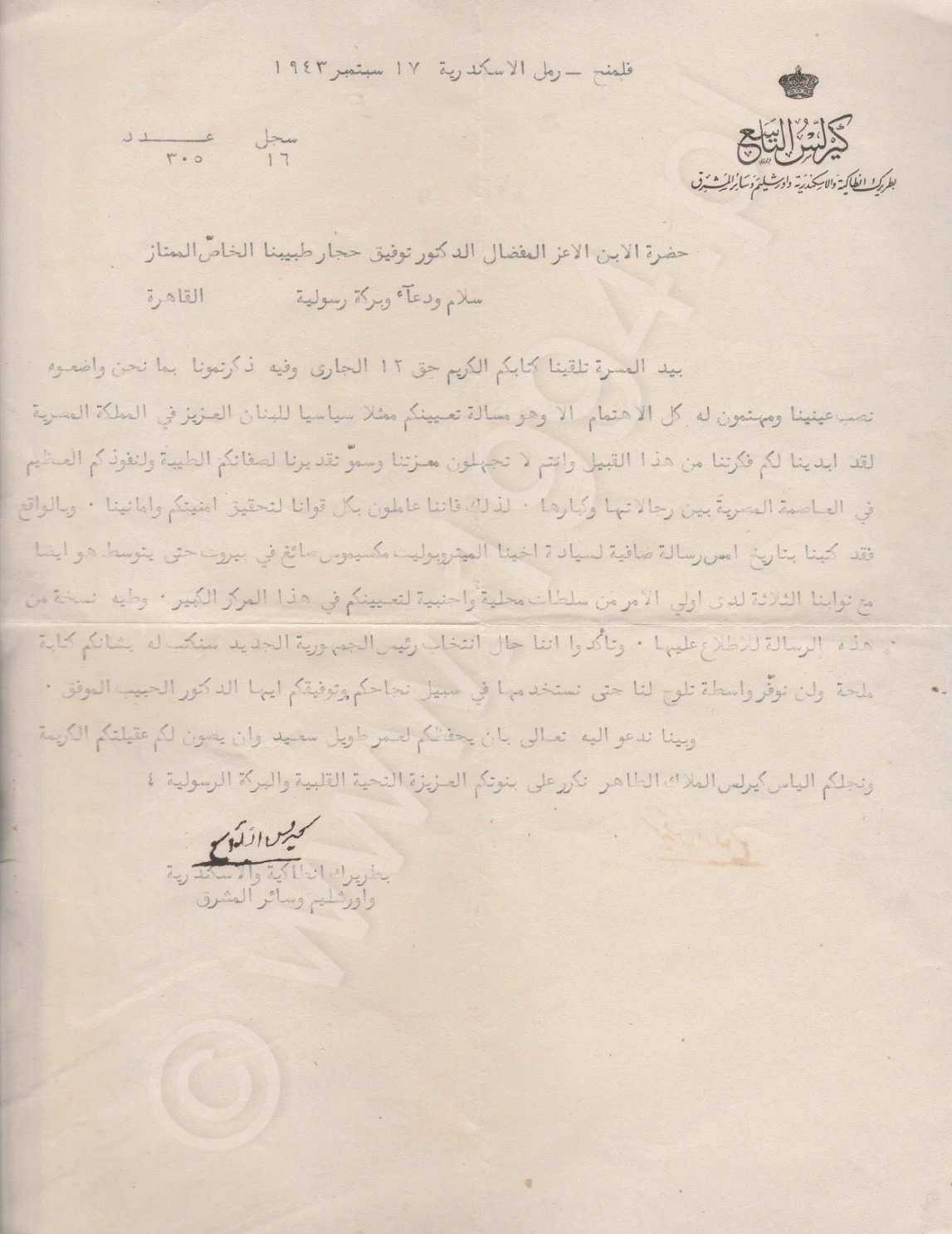
1943 Patriarchal letter signed by Cyril IX Moghabghab, Melkite Greek Catholic Patriarch, issued in Alexandria

Egypt 1943 - Cyril IX Moghabghab, Melkite Greek Catholic Patriarch (Signed Patriarchal Letter, Alexandria)

Addressed to Dr. Tawfiq Hajjar in Cairo, the letter opens with the formal Melkite invocation of peace and apostolic blessing. However, its content is explicitly political, offering a rare glimpse into the diplomatic and intercessory functions of the Patriarchate during the final months of World War II and immediately before the proclamation of Lebanese independence (November 1943). Hajjar had requested patriarchal support for his appointment as a Lebanese political representative in the Egyptian kingdom. Cyril IX acknowledges this request and commends Hajjar’s standing among Cairo’s senior figures, noting that his reputation strengthens the legitimacy of the proposed appointment. Read more →

EgyptEcclesiastical Document1943N/A (Patriarchal Correspondence)Uncertified (VF, Strong Signature, Full Text Intact) Ecclesiastical DocumentPolitical CorrespondenceMelkite Greek Catholic ChurchPatriarch of Antioch Alexandria JerusalemCyril IX MoghabghabSigned LetterPatriarchal ChanceryReligious LeadershipChristian EgyptLevantine ChristianityMiddle Eastern ChristianityLebanese RepresentationChurch and StateWWII EgyptClerical InfluenceEgyptAlexandria1943Museum GradeR9 Extremely RareUnique
Held
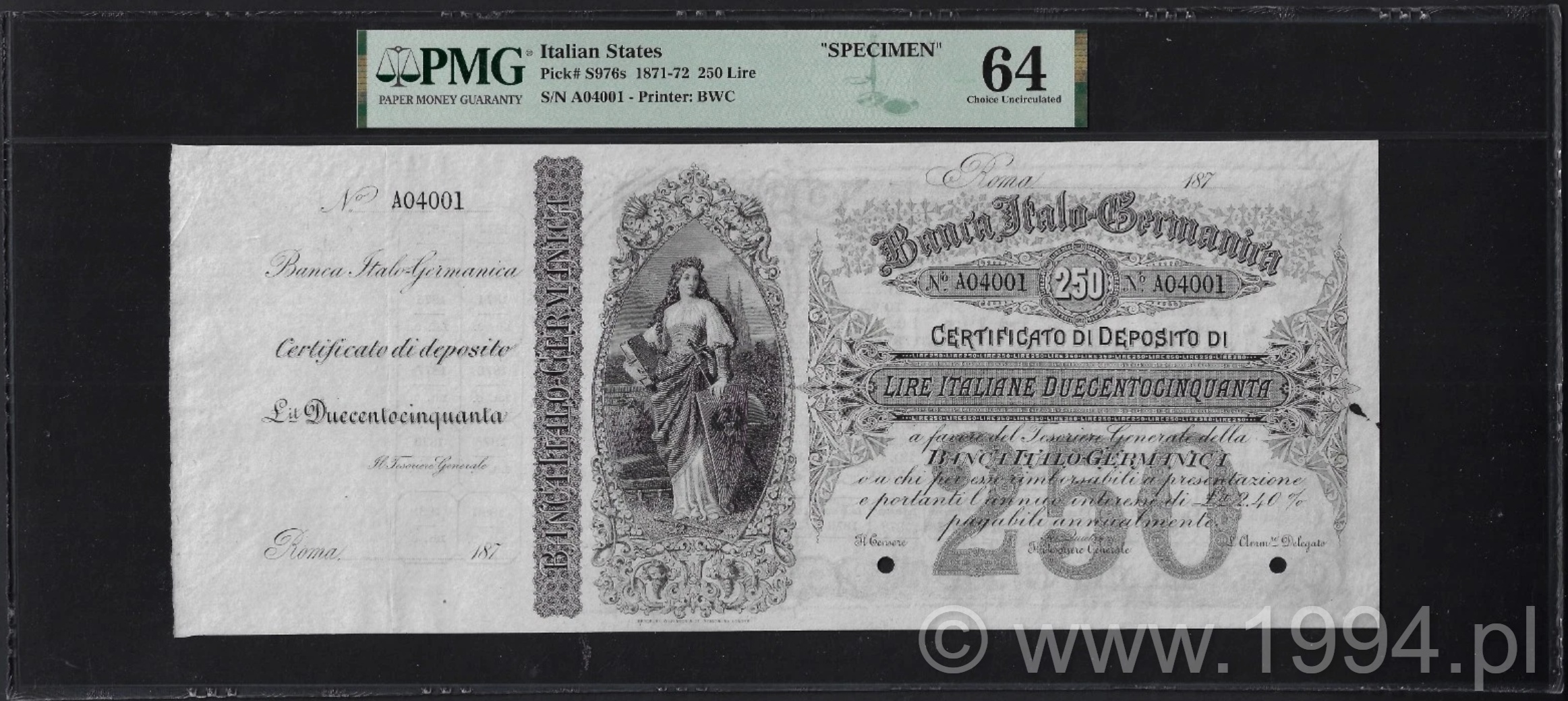
Italy 1871–1872 Banca Italo-Germanica 250 Lire specimen, Pick S976s, Bradbury Wilkinson & Co., PMG 64 Top Pop

Italy 1871–1872 - Banca Italo-Germanica 250 Lire Specimen (Pick S976s)

An exceptional and academically important survival from the experimental phase of Italy’s early post-unification banking era, this 250 Lire specimen from the short-lived Banca Italo-Germanica, cataloged as Pick S976s, represents one of the rarest and most ambitious private note-issuing projects attempted in Rome during the 1870s. No issued examples of this type are known to exist, and all scholarship indicates that the bank’s banknote program collapsed before any notes entered circulation, leaving only a microscopic number of presentation pulls, proofs, or internal printer’s archive sheets. This PMG 64 Choice Uncirculated example is the sole graded specimen in the PMG census, making it both Top Pop and Only Pop. Read more →

ItalySpecimen1871250 LirePMG 64 (Top Pop) Private BankOversizedSpecimenDouble Punch HolePunch Cancelled250 LireEngraved Security PaperProof and Archive PieceBradbury WilkinsonBWCPick S976sItalian StatesPost Unification ItalyItalian Banking HistoryFailed Banknote IssuesGerman Capital in Italy19th Century FinanceNational AllegorySecurity Printing HistoryRome Banking ExperimentsUnissued Banknote ProjectItaly1871PMG 64Top PopR9 Extremely RareUniqueMuseum Grade
Held
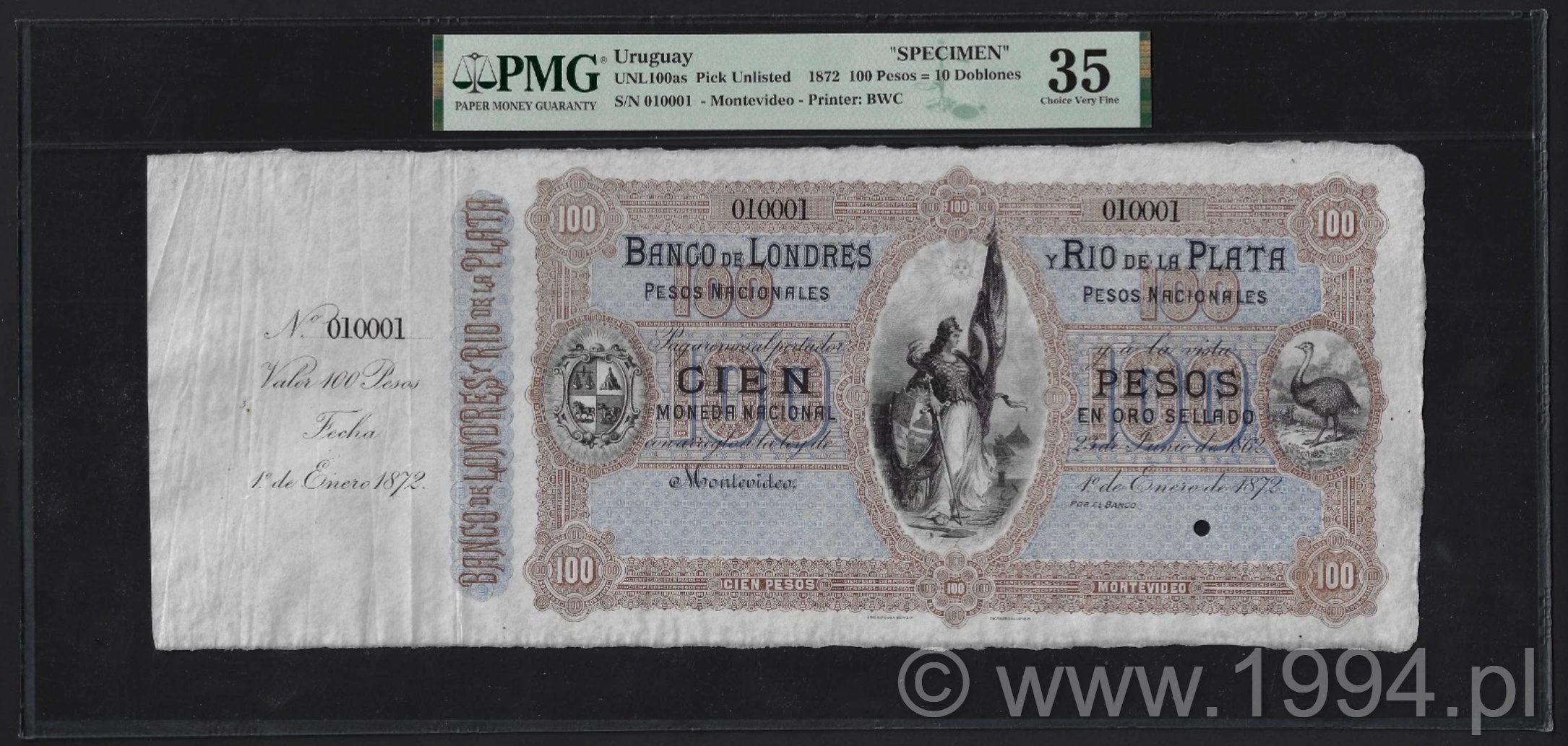
Uruguay 1872 100 Pesos equals 10 Doblones printer archival specimen, early serial number 010001, printed by Bradbury Wilkinson

Uruguay 1872 - Banco de Londres y Rio de la Plata 100 Pesos = 10 Doblones Specimen (Pick Unlisted)

This specimen was never intended for circulation. Its preservation without signs of handling, together with specimen markings and the absence of circulation wear, confirms its role as a controlled archival reference. While issued examples of this type are historically documented, no confirmed issued survivors are presently traceable, and none approach the clarity, completeness, or condition of this specimen. Read more →

UruguaySpecimen1872100 Pesos = 10 DoblonesPMG 35 Choice Very Fine SpecimenPrinter Archival SpecimenDual DenominationGold EquivalenceEarly Pull Serial 010001Oversized FormatBradbury WilkinsonBWCLondon Security PrintingNineteenth Century EngravingArchival Reference NoteGold Standard ExperimentPeso Doblone ParityBanco de Londres y Rio de la PlataLatin American Monetary HistoryNineteenth Century State FinanceUruguayMontevideo1872Pick UnlistedMuseum GradeR9 Extremely RareUnique
Held
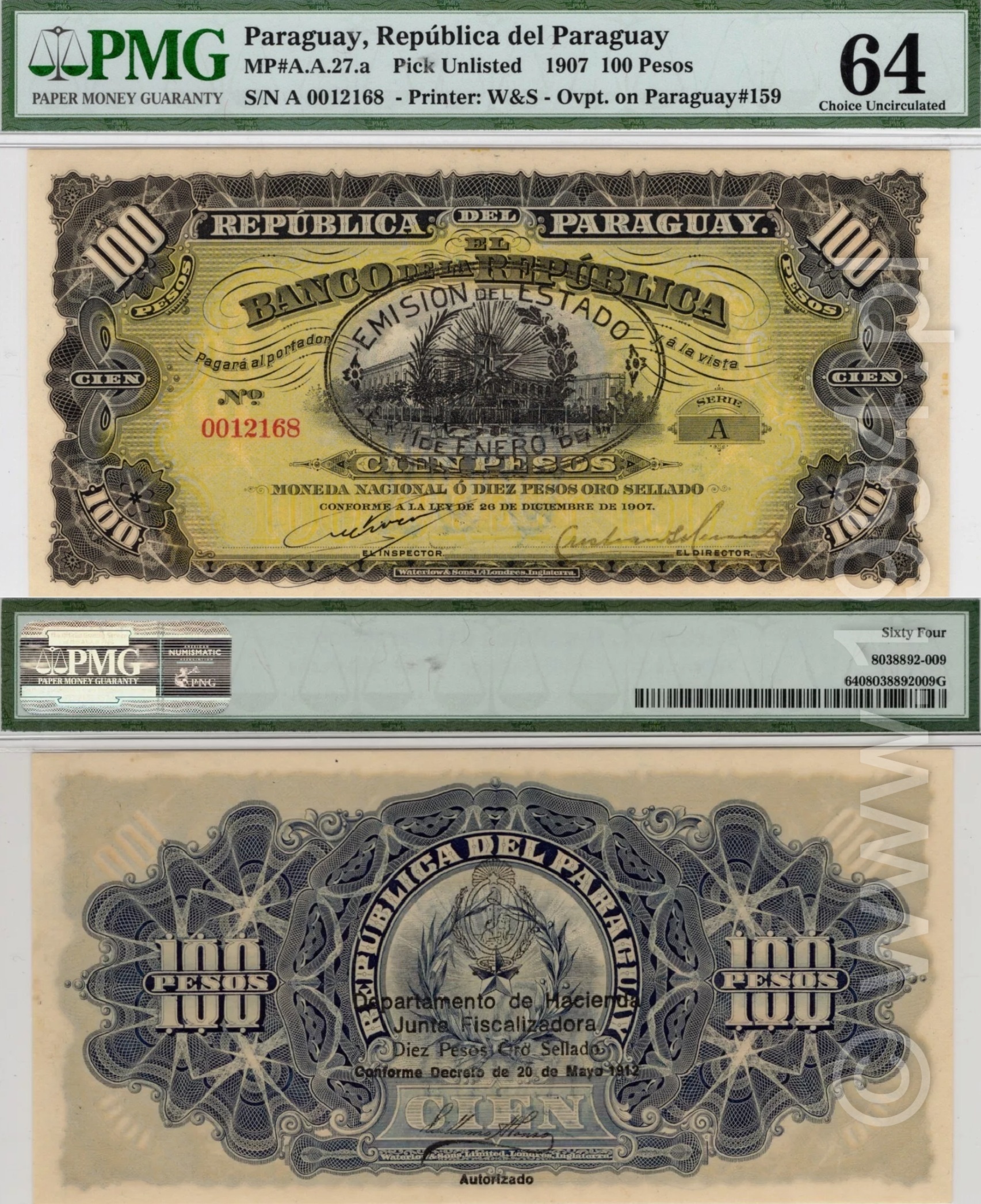
Paraguay 1907 100 Pesos Banco de la República specimen with 1912 dual-side state and treasury fiscal revalidation overprint, including Emisión del Estado on the face and Departamento de Hacienda Junta Fiscalizadora Diez Pesos Oro Sellado validation on the reverse, base Pick 159, Pick Unlisted, PMG 64 Choice Uncirculated

Paraguay 1907 - 100 Pesos with 1912 Dual-Side State and Treasury Revalidation Overprint Specimen (Pick Unlisted)

Among recorded Paraguayan emergency issues, the dual-side state and treasury revalidation format is virtually in a class of its own. It is not simply another overprint variety. It is a surviving document of how Paraguay attempted to defend official monetary credibility at a moment when ordinary paper value, legal value, and gold-referenced value were no longer the same thing in practice. The second overprint is therefore the key historical feature: it confirms that this note was not only reissued, but reviewed, fiscalized, and tied back to the higher official “Diez Pesos Oro Sellado” standard. As a Pick-unlisted specimen, base Pick 159, and R9 Extremely Rare survivor, it stands as a museum-grade crown piece of Paraguayan emergency paper money. Read more →

R9 Extremely Rare
ParaguayOverprint Specimen1907100 PesosPMG 64 Choice Uncirculated Specimen100 PesosPick UnlistedPick 159OverprintState OverprintTreasury OverprintDual-Side OverprintDual-Signature OverprintProvisionalFiscal RevalidationTreasury RevalidationEmergency State IssueParaguayan Emergency Issues1912 ReformJanuary 11 1912 State EmissionMay 20 1912 DecreeBanco de la RepúblicaDepartamento de HaciendaJunta FiscalizadoraEmisión del EstadoDiez Pesos Oro SelladoGold-Value ReaffirmationWaterlow & SonsSouth American Monetary HistoryEarly 20th Century FinanceGovernment RevalidationOverprint VarietiesParaguay19071912PMG 64Choice UncirculatedMuseum GradeR9 Extremely RareUnique
Held
Late Qing Sinkiang textile emergency currency printed on red-dyed cloth using hand-carved woodblocks, circa 1880

China 1880 - Sinkiang Textile Emergency Currency Cloth Note (Pick Unlisted)

Cloth emergency currencies of this type have an exceptionally low survival rate. Their organic material, combined with heavy circulation and lack of archival preservation, resulted in widespread loss. Documented institutional examples are extremely limited, and confirmed private holdings are few. At present, only a single verifiable example of this specific type is known. Read more →

ChinaTextile Emergency Currency1880Unknown Local DenominationFine (Textile Issue) Textile BanknoteTextile Emergency CurrencyCloth BanknoteCloth NoteHand-Carved Woodblock PrintingLate Qing Frontier IssueWoodblock PrintingSinkiangChina1880R9 Extremely RareUniqueMuseum GradePick Unlisted
Held
China 1915 South Sinkiang Border Defence Headquarters 1 tael textile emergency banknote printed on woven cloth with red overprint and bilingual inscriptions

China 1915 - South Sinkiang Border Defence Headquarters 1 Tael Textile Emergency Issue (Pick Unlisted)

At present, only one example of this specific 1 tael textile issue is documented. There are no confirmed specimens recorded in the holdings of the British Museum, the American Numismatic Society, the Smithsonian Institution, or major Chinese public collections. No repeat auction appearances or archival groupings are known. On the basis of observable, verifiable evidence alone, the issue qualifies as R9 - unique. Read more →

ChinaTextile Banknote19151 TaelFine (Textile Issue) Textile BanknoteTextile Emergency CurrencyCloth CurrencyMilitary Emergency Issue1 TaelWoodblock PrintingRed OverprintSouth Sinkiang Border Defence HeadquartersFrontier Military AdministrationRegional Monetary SystemUyghur-Chinese Bilingual IssueCentral Asian Frontier FinanceSecurity Printing HistoryChinaSinkiangSouth Sinkiang1915R9 Extremely RareUniqueMuseum GradePick Unlisted
Held
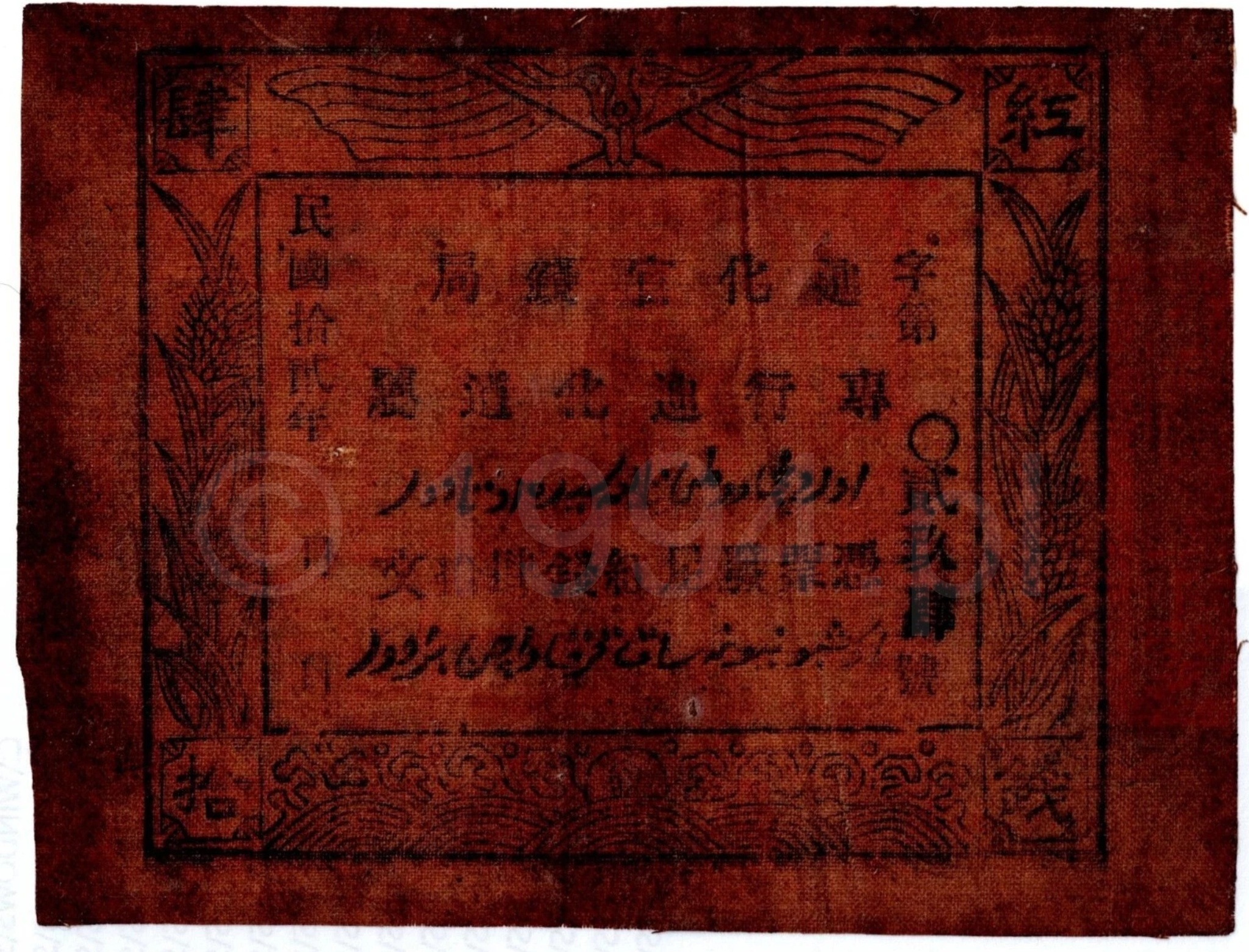
China 1918 Xinjiang textile emergency currency printed on red cloth by woodblock, with framed inscription panel, vegetal side borders, winged emblem, and wave-pattern lower band

China 1918 - Xinjiang Textile Emergency Currency Printed on Red Cloth, Local Authority Issue (Pick Unlisted)

Textile emergency currency of this type was issued as functional money for everyday transactions, provisioning, and local settlement in environments where paper currency was unavailable or impractical. Once monetary conditions stabilized, such notes were typically withdrawn and destroyed, accounting for their extremely low survival rate. Read more →

ChinaTextile Emergency Currency1918UnspecifiedIssued (Textile Emergency Currency) Textile BanknoteTextile Emergency CurrencyCloth BanknoteIssued Emergency MoneyWoodblock PrintingFrontier CurrencyXinjiangSinkiangLocal Authority IssueEarly Republican PeriodRegional Monetary SystemChina1918Museum GradeR9 Extremely RareUniquePick Unlisted
Held
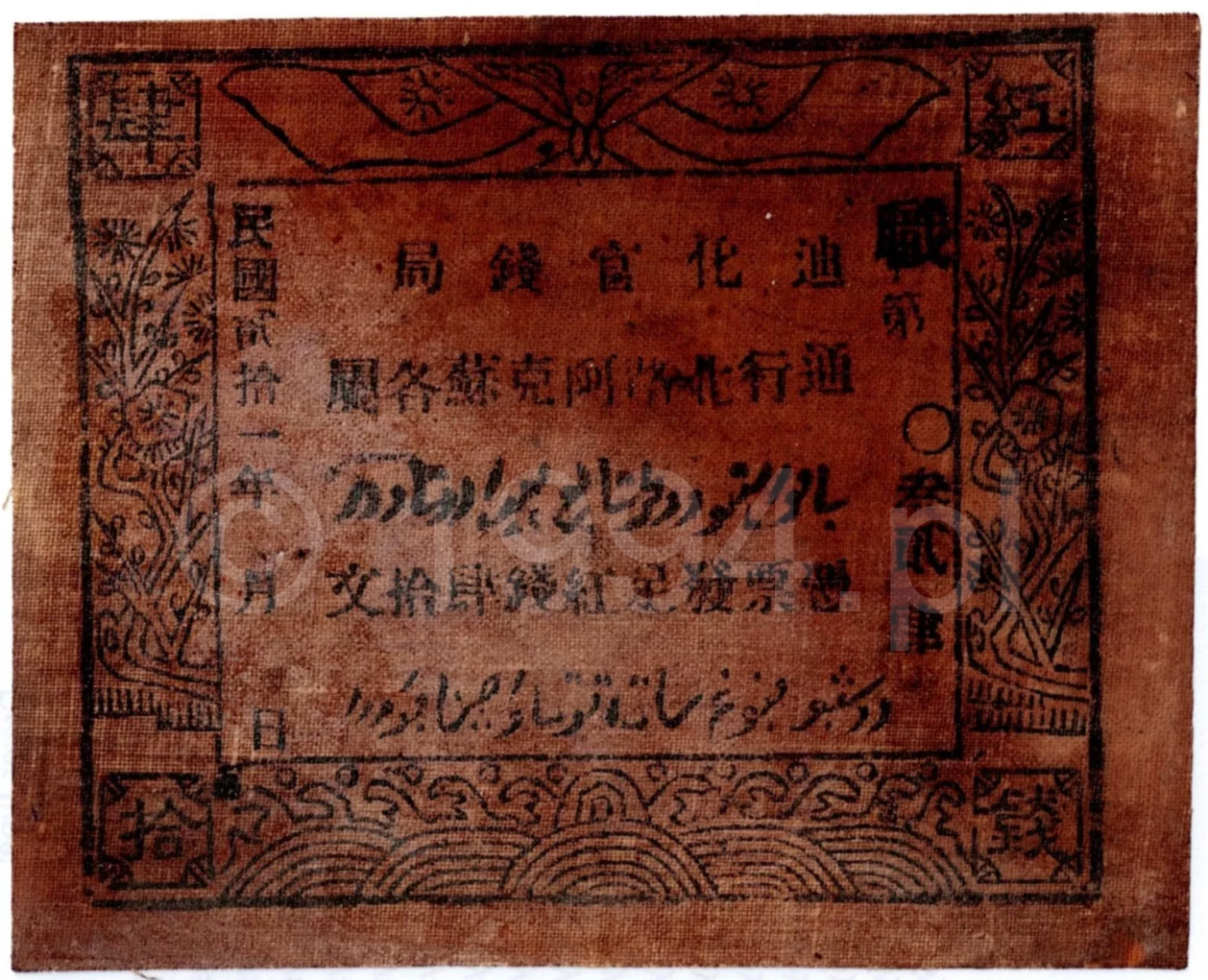
China 1920 Xinjiang textile emergency currency printed on red cloth by woodblock, showing framed inscription panel and ornamental borders

China 1920 - Xinjiang Textile Emergency Currency Printed on Red Cloth, Local Authority Issue (Pick Unlisted)

The note was issued as functional money, not as symbolic or ceremonial material. Textile currency of this type was intended for everyday transactions, provisioning, and local settlement in environments where paper currency was unavailable or impractical. Once monetary conditions stabilized, such notes were typically withdrawn and destroyed, resulting in extremely low survival rates. Read more →

ChinaTextile Emergency Currency1920UnspecifiedIssued (Textile Emergency Currency) Textile BanknoteTextile Emergency CurrencyCloth BanknoteIssued Emergency MoneyWoodblock PrintingFrontier CurrencyXinjiangSinkiangLocal Authority IssueEarly Republican PeriodRegional Monetary SystemChina1920Museum GradeR9 Extremely RareUniquePick Unlisted
Held
China 1921 Xinjiang textile emergency currency printed on red cloth by woodblock, featuring a winged emblem with sun motif and framed inscription panel

China 1921 - Xinjiang Textile Emergency Currency Printed on Red Cloth with Sun Emblem (Pick Unlisted)

Textile emergency currency of this type was issued as functional money for everyday transactions, provisioning, and local settlement in environments where conventional paper currency was unavailable or impractical. Once monetary conditions stabilized and centralized systems expanded, such cloth notes were withdrawn and destroyed, resulting in extremely low survival rates. Read more →

ChinaTextile Emergency Currency1921UnspecifiedIssued (Textile Emergency Currency) Textile BanknoteTextile Emergency CurrencyCloth BanknoteIssued Emergency MoneyWoodblock PrintingFrontier CurrencyXinjiangSinkiangLocal Authority IssueEarly Republican PeriodSun EmblemChina1921Museum GradeR9 Extremely RareUniquePick Unlisted
Held
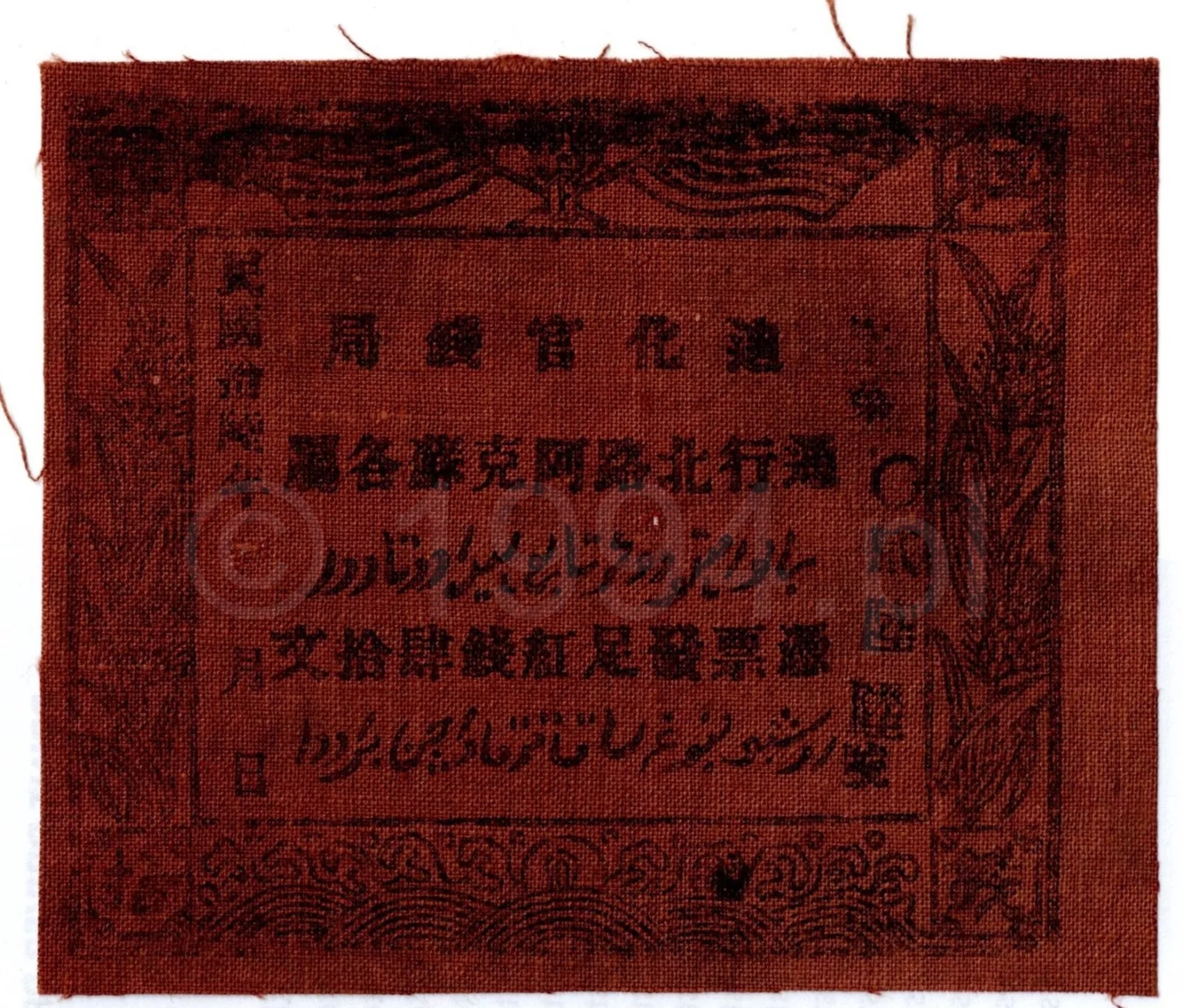
China 1922 Xinjiang textile emergency currency printed on red cloth by woodblock, with framed inscription panel, vegetal borders, and wave-pattern lower band

China 1922 - Xinjiang Textile Emergency Currency Printed on Red Cloth, Local Authority Issue (Pick Unlisted)

No catalog listing, institutional reference, or documented parallel example corresponding to this specific textile type is known. Under the collection’s evidence-based classification system, this note is treated as a single known example at present and classified as R9. Read more →

ChinaTextile Emergency Currency1922UnspecifiedIssued (Textile Emergency Currency) Textile BanknoteTextile Emergency CurrencyCloth BanknoteIssued Emergency MoneyWoodblock PrintingFrontier CurrencyXinjiangSinkiangLocal Authority IssueEarly Republican PeriodRegional Monetary SystemChina1922Museum GradeR9 Extremely RareUniquePick Unlisted
Held
↑ Top