Collection PL

About 1994.pl
Results for “unique”
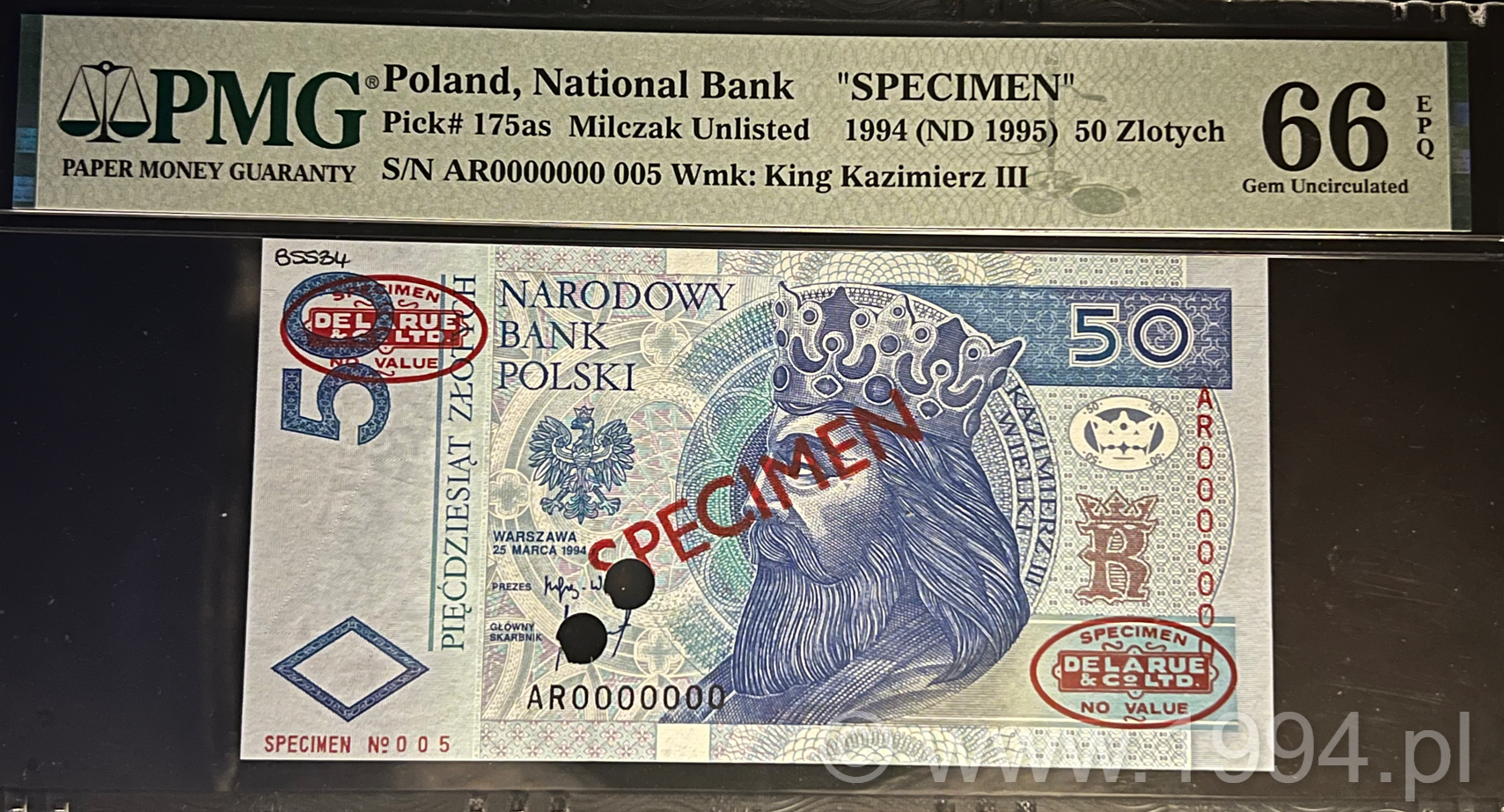
Poland 1994 50 Zlotych discovery AR prefix specimen with red SPECIMEN overprint, red oval NO VALUE stamps, punch cancellations, serial AR0000000, De La Rue specimen-control number 005, and Thomas De La Rue specimen tracking panel.

Poland 1994 - 50 Zlotych Discovery AR Prefix Specimen with Red Overprint and Oval Stamp (Pick Unlisted)

This AR-prefix red-overprint specimen is a direct production artifact from the creation of Poland's 1994 banknote issue. Its importance lies in documenting a previously unrecorded specimen form through a complete surviving note with identifiable prefix, control number, printer markings, and final production design. Read more →

PolandSpecimen with Red Overprint and Oval Stamp199450 ZlotychPMG 66 EPQ Gem Uncirculated SpecimenDiscovery AR PrefixDiscovery PrefixDiscovery MaterialProduction-Stage DiscoveryRed OverprintRed SPECIMEN OverprintOval NO VALUE StampPunch CancelledSpecimen Tracking PanelDe La Rue Specimen Control Number 005Specimen Control Number 005Control Number 005Unique Specimen Control NumberAR PrefixSerial AR0000000Zero Serial NumberThomas De La RueTDLRMilczak UnlistedPick UnlistedMilczak Unlisted AR PrefixPreviously Undocumented AR PrefixAR Prefix Specimen EvidencePhysical Specimen Control FormPoland Currency Redesign 1994National Bank of PolandNarodowy Bank PolskiModern Polish BanknotesSecurity Printing HistorySpecimen Control ProceduresPre Issue Control NotePrinter Control MaterialFinal Issued-Style DesignKing Casimir III the GreatKazimierz WielkiAndrzej HeidrichHanna Gronkiewicz-WaltzWieslaw BiernatowiczPolandPoland 1994199450 ZlotychPMG 66 EPQMuseum GradeR9 Extremely RareUnique
Held
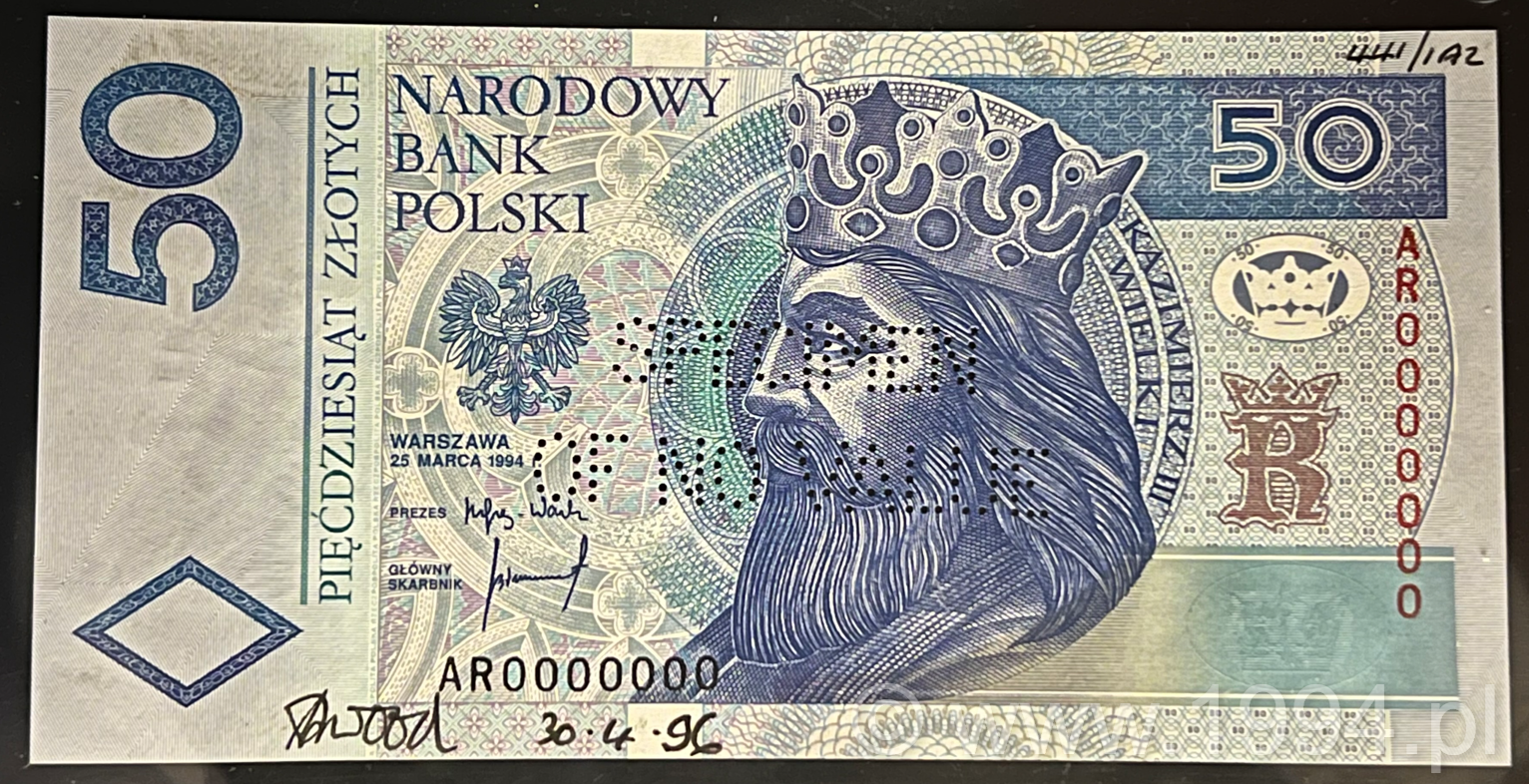
Poland 1994 50 Zlotych discovery AR prefix specimen perforated SPECIMEN OF NO VALUE, serial AR0000000, with handwritten archive date 30.4.96, printer annotations, and Thomas De La Rue production origin.

Poland 1994 - 50 Zlotych Discovery AR Prefix Specimen Perforated SPECIMEN OF NO VALUE (Pick Unlisted)

The face preserves the complete 50 Zlotych design prepared for the National Bank of Poland, with the portrait of King Casimir III the Great, the Polish eagle, the denomination PIĘĆDZIESIĄT ZŁOTYCH, the large 50 value device at left, the National Bank of Poland title, the Warsaw date of 25 March 1994, and the printed signatures of Hanna Gronkiewicz-Waltz and Wieslaw Biernatowicz. Read more →

PolandDiscovery AR Prefix Specimen Perforated SPECIMEN OF NO VALUE199450 ZlotychUncirculated SpecimenDiscovery AR PrefixDiscovery PrefixDiscovery MaterialProduction-Stage DiscoveryPerforated SpecimenPerforated SPECIMEN OF NO VALUESpecimen of No ValuePrinter AnnotationsHandwritten Archive Date30.4.96AR PrefixSerial AR0000000Zero Serial NumberThomas De La RueTDLRMilczak UnlistedPick UnlistedMilczak Unlisted AR PrefixPreviously Undocumented AR PrefixAR Prefix Specimen EvidencePhysical Specimen Control FormDe La Rue Archival ControlPoland Currency Redesign 1994National Bank of PolandNarodowy Bank PolskiModern Polish BanknotesSecurity Printing HistorySpecimen Control ProceduresPre Issue Control NotePrinter Control MaterialFinal Issued-Style DesignKing Casimir III the GreatKazimierz WielkiAndrzej HeidrichHanna Gronkiewicz-WaltzWieslaw BiernatowiczPolandPoland 1994199450 ZlotychMuseum GradeR9 Extremely RareUniqueAnnotationsHandwritten Annotations
Held
Complete nine-note Stockholm Spinnhus pollett monetary system from circa 1785, including all denominations from one half öre to one daler, preserved in unissued condition and classified as R10 extremely rare.

Sweden 1785 - Stockholm Spinnhus Pollett System – Complete Nine-Denomination Institutional Currency Set (One Half Öre to One Daler)

No Swedish institutional archive is known to hold a complete original set. Existing examples, when found, appear singly and often in lesser condition or as later restrikes. This privately assembled nine-note system, accumulated over nearly half a century, is believed to be the only surviving complete original series. Individually these notes measure at the highest rarity levels (R9+). As a unified and intact monetary system, the set attains R10 rarity, representing a uniquely preserved eighteenth-century institutional currency structure of profound historical and academic significance. Read more →

SwedenInstitutional Paper Currency Set1785Complete nine-note system: one half öre, one öre, two öre, five öre, six öre, seven öre, sixteen öre, twenty-four öre, one dalerUncirculated PollettInstitutional paper currencyEngraved copperplate noteEighteenth century rag paperAnopisthographic printingUnissuedUncirculatedStockholm engravingSwedish copperplate productionPre-industrial note manufactureStockholm SpinnhusLångholmen prison economyPenal labor currencyClosed economy tenderProto-fiat institutional moneyInternal monetary systemSweden1785One half öreOne öreTwo öreFive öreSix öreSeven öreSixteen öreTwenty-four öreOne dalerFull denomination setPick UnlistedR10 UniqueR10UniqueUnique Known ExampleUnique Set
Held
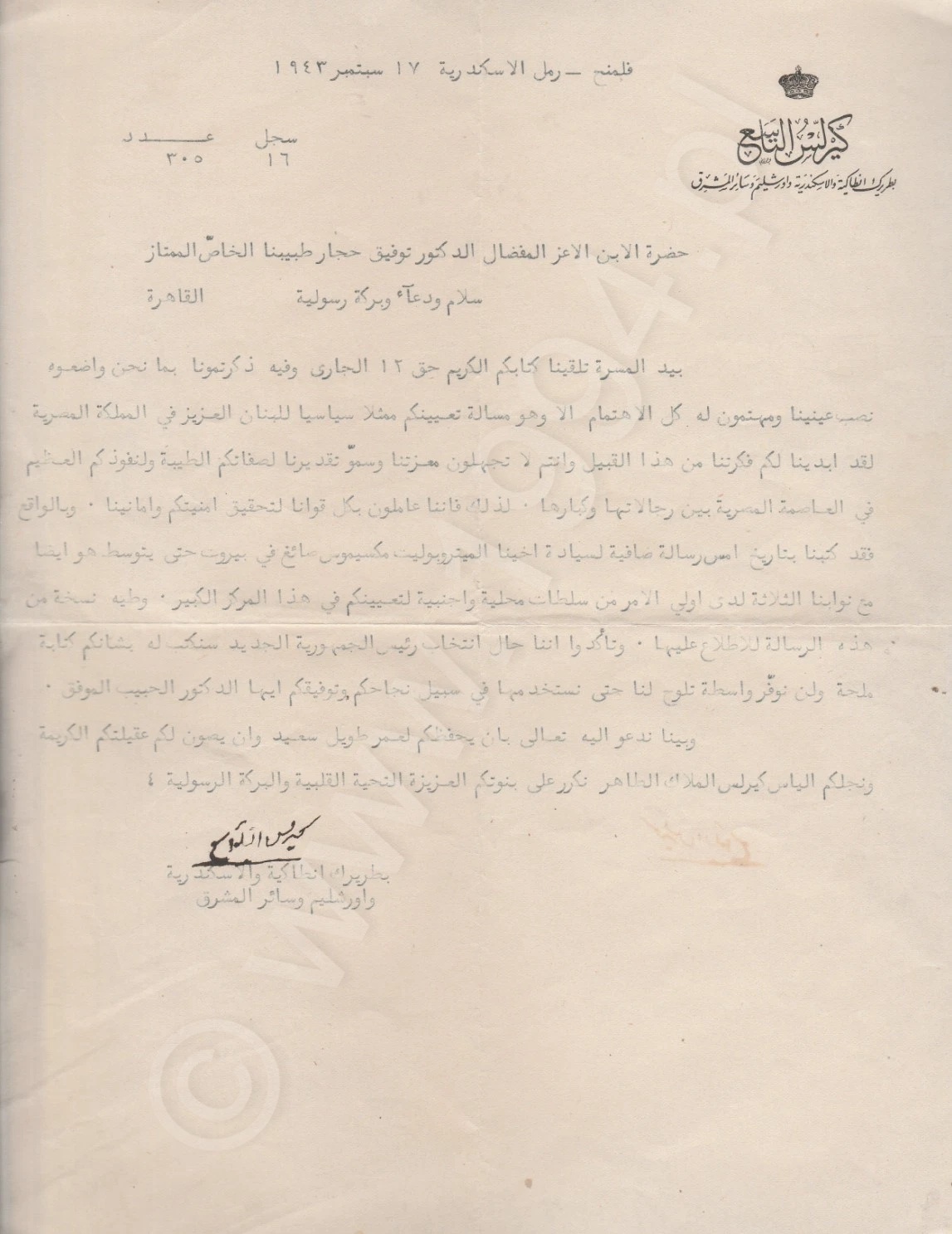
1943 Patriarchal letter signed by Cyril IX Moghabghab, Melkite Greek Catholic Patriarch, issued in Alexandria

Egypt 1943 - Cyril IX Moghabghab, Melkite Greek Catholic Patriarch (Signed Patriarchal Letter, Alexandria)

This mixture of pastoral tone and high-level political engagement reflects the unique position the Melkite Patriarchate occupied in the 1940s. Alexandria and Cairo served as geopolitical hubs linking the Levant, British authorities, and emerging Arab-nationalist leadership circles. Patriarchal letters explicitly engaging in political intercession-particularly those naming individuals, bishops, and concrete diplomatic instructions-are almost never found outside church archives. Read more →

EgyptEcclesiastical Document1943N/A (Patriarchal Correspondence)Uncertified (VF, Strong Signature, Full Text Intact) Ecclesiastical DocumentPolitical CorrespondenceMelkite Greek Catholic ChurchPatriarch of Antioch Alexandria JerusalemCyril IX MoghabghabSigned LetterPatriarchal ChanceryReligious LeadershipChristian EgyptLevantine ChristianityMiddle Eastern ChristianityLebanese RepresentationChurch and StateWWII EgyptClerical InfluenceEgyptAlexandria1943Museum GradeR9 Extremely RareUnique
Held
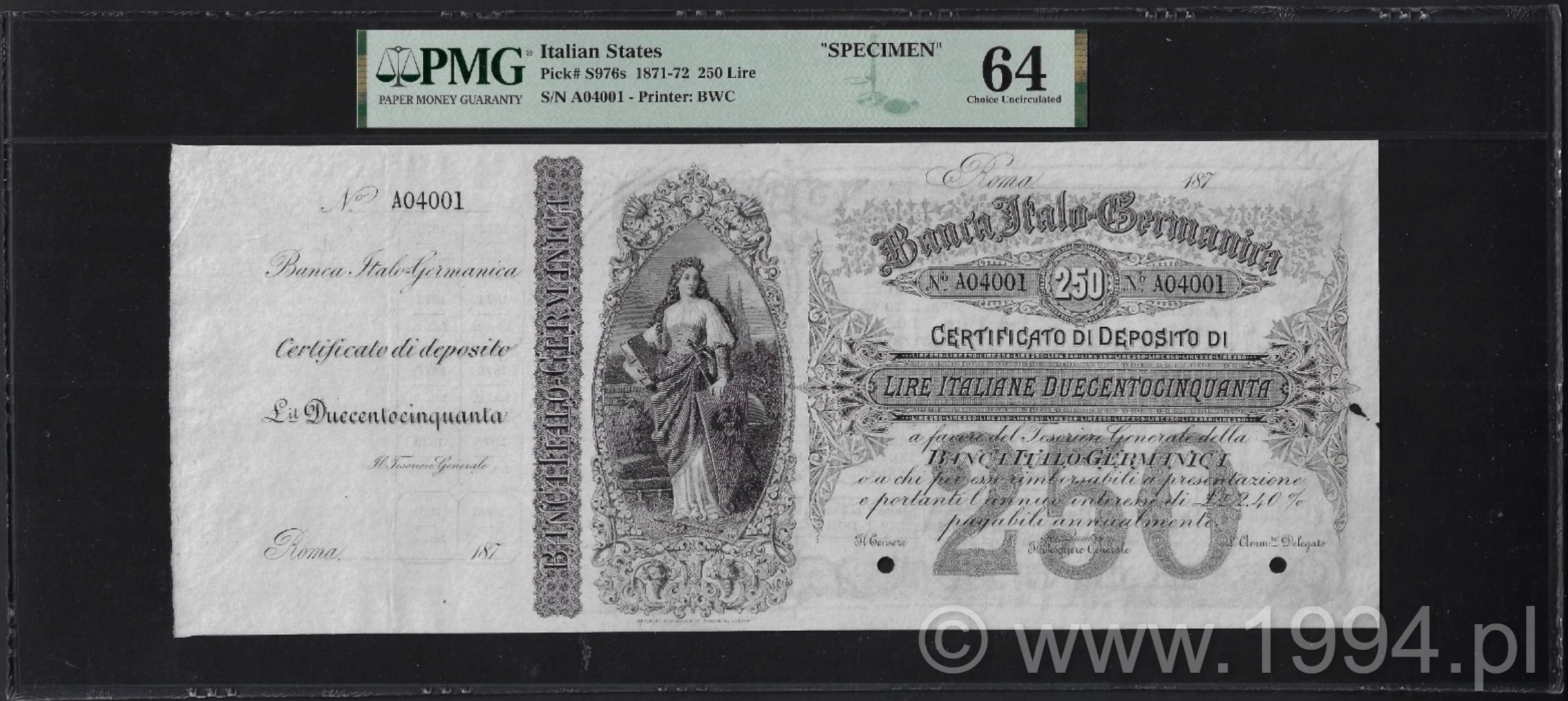
Italy 1871–1872 Banca Italo-Germanica 250 Lire specimen, Pick S976s, Bradbury Wilkinson & Co., PMG 64 Top Pop

Italy 1871–1872 - Banca Italo-Germanica 250 Lire Specimen (Pick S976s)

Rarity research places this specimen in the highest tier of European banknote scarcity. PMG lists exactly one graded example-this note-and no additional pieces have surfaced in major auctions, museum digitizations, or literature beyond isolated mentions in nineteenth-century trade records. In the absence of any documented issued notes and with no other certified specimens known, Pick S976s firmly qualifies within the R9 tier of extreme rarity. Read more →

ItalySpecimen1871250 LirePMG 64 (Top Pop) Private BankOversizedSpecimenDouble Punch HolePunch Cancelled250 LireEngraved Security PaperProof and Archive PieceBradbury WilkinsonBWCPick S976sItalian StatesPost Unification ItalyItalian Banking HistoryFailed Banknote IssuesGerman Capital in Italy19th Century FinanceNational AllegorySecurity Printing HistoryRome Banking ExperimentsUnissued Banknote ProjectItaly1871PMG 64Top PopR9 Extremely RareUniqueMuseum Grade
Held
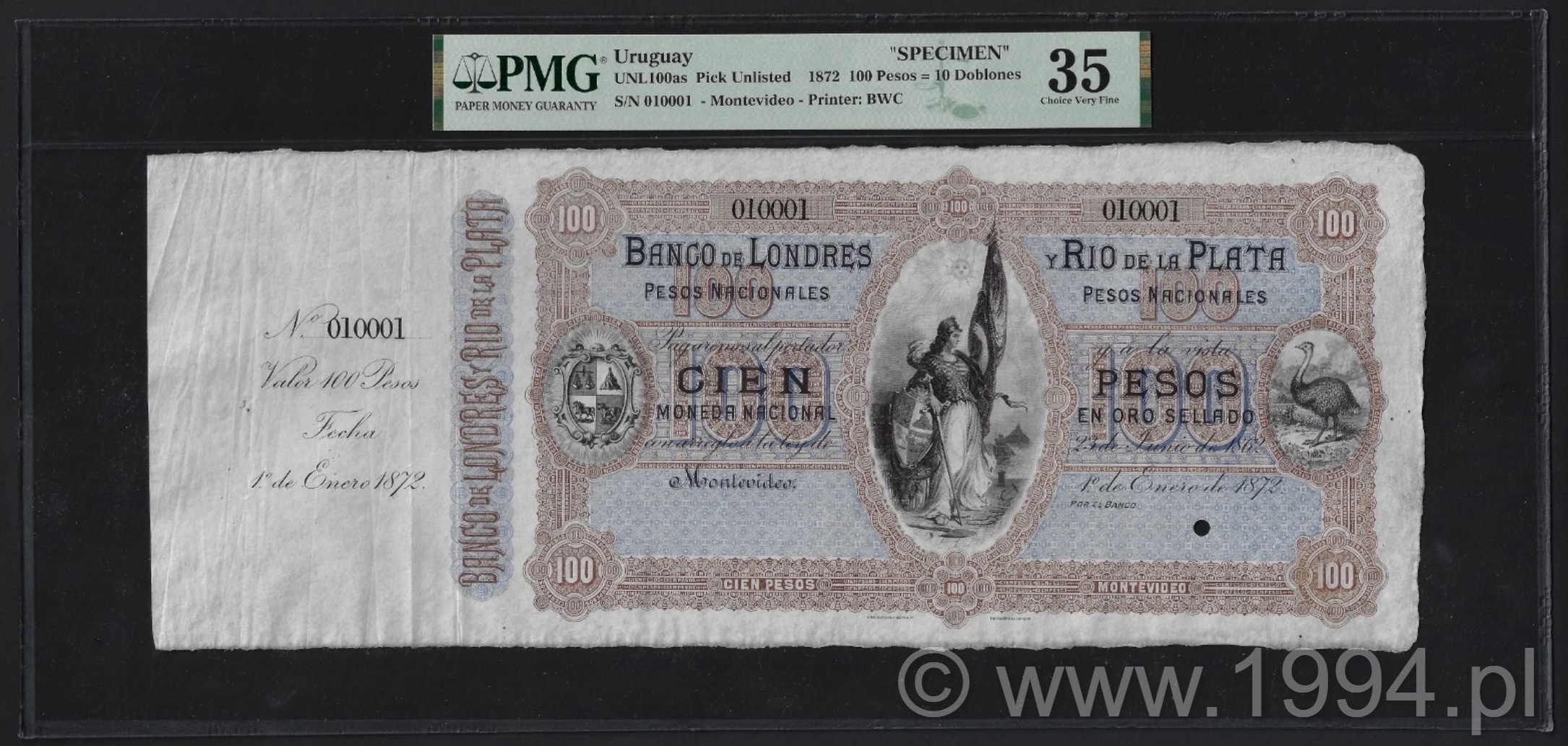
Uruguay 1872 100 Pesos equals 10 Doblones printer archival specimen, early serial number 010001, printed by Bradbury Wilkinson

Uruguay 1872 - Banco de Londres y Rio de la Plata 100 Pesos = 10 Doblones Specimen (Pick Unlisted)

This specimen stands as a singular documentary witness to Uruguay’s most explicit gold-standard experiment in paper form. It occupies a reference position not only within Uruguayan numismatics, but within the broader study of nineteenth-century Latin American monetary policy, where few surviving instruments state gold equivalence with such precision. Its uniqueness, early serial placement, and archival character place it firmly in the highest rarity tier. Read more →

UruguaySpecimen1872100 Pesos = 10 DoblonesPMG 35 Choice Very Fine SpecimenPrinter Archival SpecimenDual DenominationGold EquivalenceEarly Pull Serial 010001Oversized FormatBradbury WilkinsonBWCLondon Security PrintingNineteenth Century EngravingArchival Reference NoteGold Standard ExperimentPeso Doblone ParityBanco de Londres y Rio de la PlataLatin American Monetary HistoryNineteenth Century State FinanceUruguayMontevideo1872Pick UnlistedMuseum GradeR9 Extremely RareUnique
Held
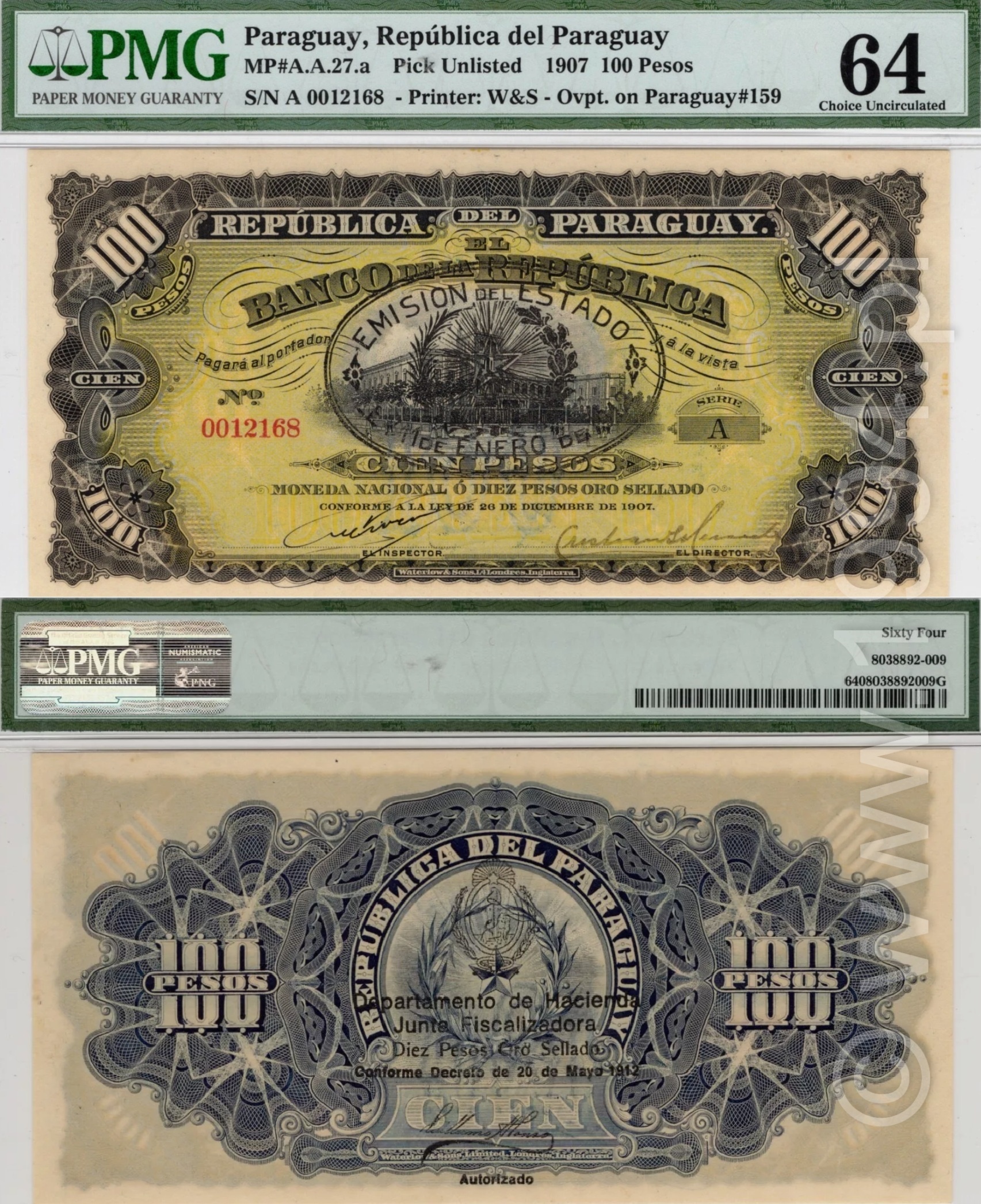
Paraguay 1907 100 Pesos Banco de la República specimen with 1912 dual-side state and treasury fiscal revalidation overprint, including Emisión del Estado on the face and Departamento de Hacienda Junta Fiscalizadora Diez Pesos Oro Sellado validation on the reverse, base Pick 159, Pick Unlisted, PMG 64 Choice Uncirculated

Paraguay 1907 - 100 Pesos with 1912 Dual-Side State and Treasury Revalidation Overprint Specimen (Pick Unlisted)

This distinction is central to understanding the rarity and historical value of the piece. A single-face overprint could identify a note as part of the emergency state emission, but the additional reverse validation created a second layer of control. It linked the note directly to the fiscal board responsible for supervising the state’s monetary obligations and for separating verified notes from unverified or less formally processed material. The reverse wording “Diez Pesos Oro Sellado” is not incidental. It deliberately echoes the gold-value clause printed on the original 1907 design, reinforcing that this selected note remained connected to the higher official monetary standard even while ordinary paper pesos were under severe pressure. Read more →

ParaguayOverprint Specimen1907100 PesosPMG 64 Choice Uncirculated Specimen100 PesosPick UnlistedPick 159OverprintState OverprintTreasury OverprintDual-Side OverprintDual-Signature OverprintProvisionalFiscal RevalidationTreasury RevalidationEmergency State IssueParaguayan Emergency Issues1912 ReformJanuary 11 1912 State EmissionMay 20 1912 DecreeBanco de la RepúblicaDepartamento de HaciendaJunta FiscalizadoraEmisión del EstadoDiez Pesos Oro SelladoGold-Value ReaffirmationWaterlow & SonsSouth American Monetary HistoryEarly 20th Century FinanceGovernment RevalidationOverprint VarietiesParaguay19071912PMG 64Choice UncirculatedMuseum GradeR9 Extremely RareUnique
Held
Late Qing Sinkiang textile emergency currency printed on red-dyed cloth using hand-carved woodblocks, circa 1880

China 1880 - Sinkiang Textile Emergency Currency, Cloth Note (Pick Unlisted)

This textile emergency currency from Sinkiang belongs to the late Qing frontier monetary tradition, when regional authorities relied on locally produced substitutes in response to chronic shortages of official coin and paper money. Executed on coarse red-dyed cloth and printed by hand-carved woodblocks, the note reflects a monetary environment shaped by isolation, logistical constraints, and reliance on pre-modern administrative practices. Read more →

ChinaTextile Emergency Currency1880Unknown Local DenominationFine (Textile Issue) Textile BanknoteTextile Emergency CurrencyCloth BanknoteCloth NoteHand-Carved Woodblock PrintingLate Qing Frontier IssueWoodblock PrintingSinkiangChina1880R9 Extremely RareUniqueMuseum GradePick Unlisted
Held
China 1915 South Sinkiang Border Defence Headquarters 1 tael textile emergency banknote printed on woven cloth with red overprint and bilingual inscriptions

China 1915 - South Sinkiang Border Defence Headquarters 1 Tael Textile Emergency Issue (Pick Unlisted)

At present, only one example of this specific 1 tael textile issue is documented. There are no confirmed specimens recorded in the holdings of the British Museum, the American Numismatic Society, the Smithsonian Institution, or major Chinese public collections. No repeat auction appearances or archival groupings are known. On the basis of observable, verifiable evidence alone, the issue qualifies as R9 - unique. Read more →

ChinaTextile Banknote19151 TaelFine (Textile Issue) Textile BanknoteTextile Emergency CurrencyCloth CurrencyMilitary Emergency Issue1 TaelWoodblock PrintingRed OverprintSouth Sinkiang Border Defence HeadquartersFrontier Military AdministrationRegional Monetary SystemUyghur-Chinese Bilingual IssueCentral Asian Frontier FinanceSecurity Printing HistoryChinaSinkiangSouth Sinkiang1915R9 Extremely RareUniqueMuseum GradePick Unlisted
Held
China 1918 Xinjiang textile emergency currency printed on red cloth by woodblock, with framed inscription panel, vegetal side borders, winged emblem, and wave-pattern lower band

China 1918 - Xinjiang Textile Emergency Currency Printed on Red Cloth, Local Authority Issue (Pick Unlisted)

The design is printed directly onto fabric in dark ink, with the textile weave clearly visible through the impression. A rectangular central inscription panel is framed by vegetal side borders, while the upper register incorporates a winged emblem rendered in a more settled and symmetrical form than earlier frontier textile issues. A wave-pattern band occupies the lower register, reflecting a regional decorative vocabulary shared across Xinjiang cloth currencies. Read more →

ChinaTextile Emergency Currency1918UnspecifiedIssued (Textile Emergency Currency) Textile BanknoteTextile Emergency CurrencyCloth BanknoteIssued Emergency MoneyWoodblock PrintingFrontier CurrencyXinjiangSinkiangLocal Authority IssueEarly Republican PeriodRegional Monetary SystemChina1918Museum GradeR9 Extremely RareUniquePick Unlisted
Held
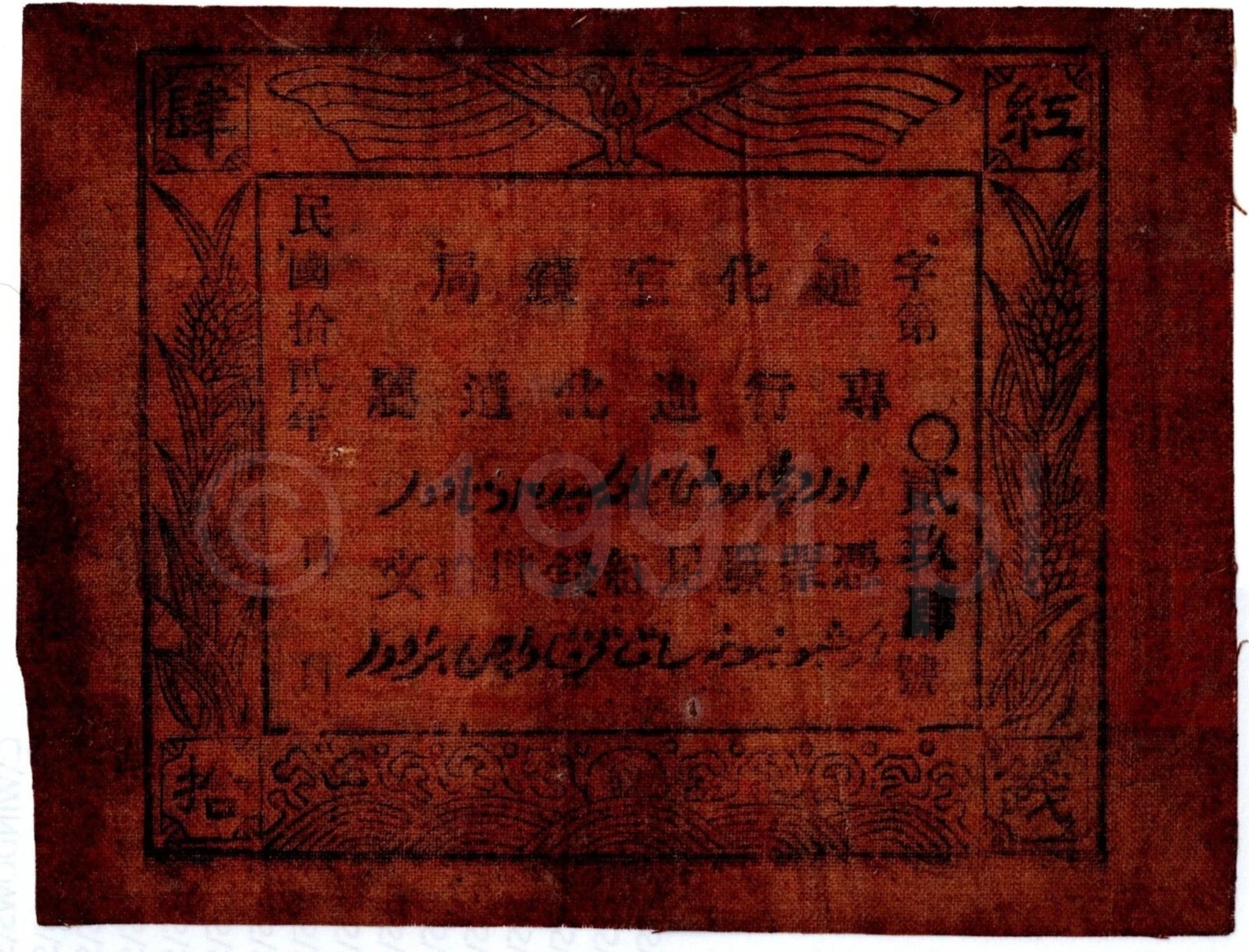
China 1920 Xinjiang textile emergency currency printed on red cloth by woodblock, showing framed inscription panel and ornamental borders

China 1920 - Xinjiang Textile Emergency Currency Printed on Red Cloth, Local Authority Issue (Pick Unlisted)

While sharing certain stylistic elements with earlier Xinjiang textile issues, including the lower wave band motif, this note is distinct in its overall composition. The upper register employs a different emblematic form, the side panels are heavier and more vertically articulated, and the calligraphy is denser and more compact than that observed on known 1880 Sinkiang examples. The ink appears darker and more saturated, suggesting either re-cut blocks or a later workshop tradition. Read more →

ChinaTextile Emergency Currency1920UnspecifiedIssued (Textile Emergency Currency) Textile BanknoteTextile Emergency CurrencyCloth BanknoteIssued Emergency MoneyWoodblock PrintingFrontier CurrencyXinjiangSinkiangLocal Authority IssueEarly Republican PeriodRegional Monetary SystemChina1920Museum GradeR9 Extremely RareUniquePick Unlisted
Held
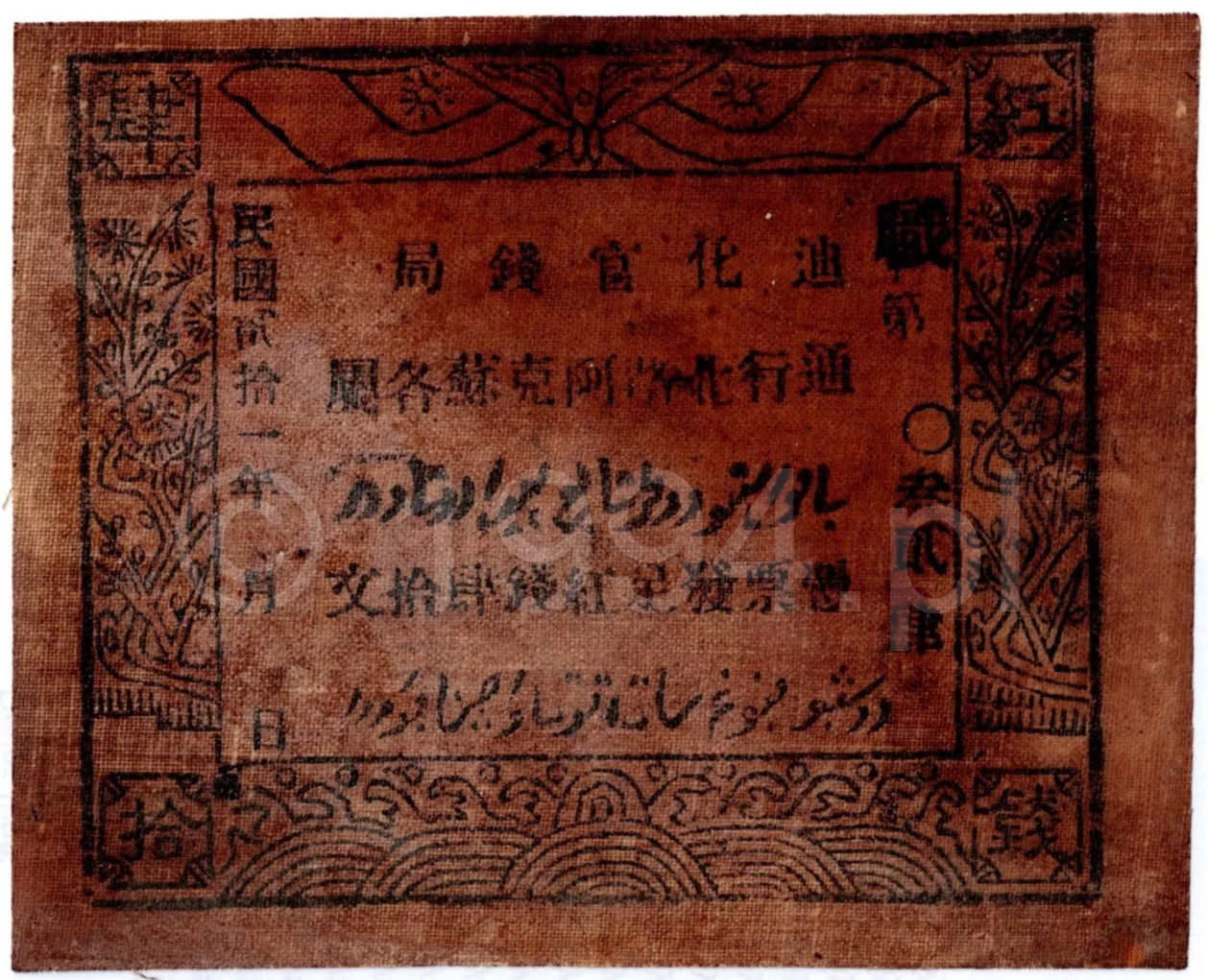
China 1921 Xinjiang textile emergency currency printed on red cloth by woodblock, featuring a winged emblem with sun motif and framed inscription panel

China 1921 - Xinjiang Textile Emergency Currency Printed on Red Cloth with Sun Emblem (Pick Unlisted)

As a historical artifact, this cloth note documents the evolution of Xinjiang textile currency from transitional local forms toward explicitly Republican visual language, illustrating how political symbolism entered frontier monetary systems prior to full bureaucratic standardization. Read more →

ChinaTextile Emergency Currency1921UnspecifiedIssued (Textile Emergency Currency) Textile BanknoteTextile Emergency CurrencyCloth BanknoteIssued Emergency MoneyWoodblock PrintingFrontier CurrencyXinjiangSinkiangLocal Authority IssueEarly Republican PeriodSun EmblemChina1921Museum GradeR9 Extremely RareUniquePick Unlisted
Held
↑ Top