Poland 1926 - Bank Polski 10 Zlotych Archival Watermarked Paper (Miłczak 64)
Blank paper stock prepared for the 1926 10 Zlotych issue, classified by PMG as Watermarked Paper. Read more →
The design combines blue-grey engraving with a warm brown underprint. Acanthus ornament, intricate guilloche work, corner denomination panels, and a distinctive repeating border surround the principal elements. An unprinted oval field at right contains the profile watermark of Tadeusz Kosciuszko, joining the patriotic subject of the engraved portrait with the note's principal paper-security feature. Read more →
The note’s design is a tour de force of neobaroque ornamentation: elaborate guilloches, scrolling acanthus motifs, and a commanding layout that conveyed prestige. Like the smaller denominations, it features Tadeusz Kosciuszko on the obverse, reinforcing his role as the symbolic figurehead of the 1919 series. Measuring 181 × 111 mm, it impresses with both scale and detail, and its watermark also carries Kosciuszko’s likeness as a security device. Read more →
The paper is of the same type as the original issue, including watermark, underscoring the sophistication of the operation. Such workshop remnants rarely survive, as they were typically destroyed once full notes were completed or abandoned. This example is preserved in a descriptive PMG holder (labeled 'Printing Remnants'), without an assigned numeric grade. By appearance, it remains close to original emission quality, showing crisp paper and fresh inks with no obvious circulation wear. Read more →
Investment Fund Voucher for 25 złotych, dated 1 December 1933 and issued by the Ministry of the Treasury of the Second Republic of Poland. Series I, with an especially attractive serial number 38888*. Certified PMG 55 EPQ, confirming original paper quality and freshness. These vouchers were printed with two different watermark types - both positive and negative patterns - making them a fascinating technical product as well as a financial one. Read more →
Comparison with a completed 500 złotych note makes the unfinished state particularly revealing. On the finished obverse, the Highlander is a repeated visual motif: the principal engraved portrait occupies the right side of the design, while a second Highlander head appears as the watermark in the paper at left. On B 2048322, the watermark is already present in the paper, but the corresponding printed portrait and the remainder of the principal obverse design were never applied. Read more →
The design is entirely typographic, consistent with early Banco-Zettel issues. Decorative borders, calligraphic denomination panels, and imperial insignia are arranged symmetrically to convey authority and legibility rather than pictorial narrative. Security relied on paper technology rather than engraving complexity, most notably a prominent watermark displaying the value in both Arabic and Roman numerals, visible under transmitted light. Read more →
The note’s design reflects the mature typographic language of the Wiener Stadt Banco. Authority and trust are conveyed through dense calligraphic text, a rigorously symmetrical layout, and clearly articulated denomination panels. Security depended on material and structural features rather than pictorial imagery, including multiple blind embossed seals, hand-applied elements, and a complex watermark system displaying the value in both Arabic and Roman numerals. These measures represent a deliberate, pre-industrial approach to counterfeit deterrence, optimized for a multi-regional empire. Read more →
Security relied on material and procedural features rather than pictorial engraving. A prominent watermark displaying the value in both Arabic and Roman numerals, multiple blind embossed seals, and hand-applied serial numbers and signatures formed the core anti-counterfeiting measures. These elements illustrate an advanced, yet still pre-industrial, approach to security printing at the beginning of the nineteenth century. Read more →
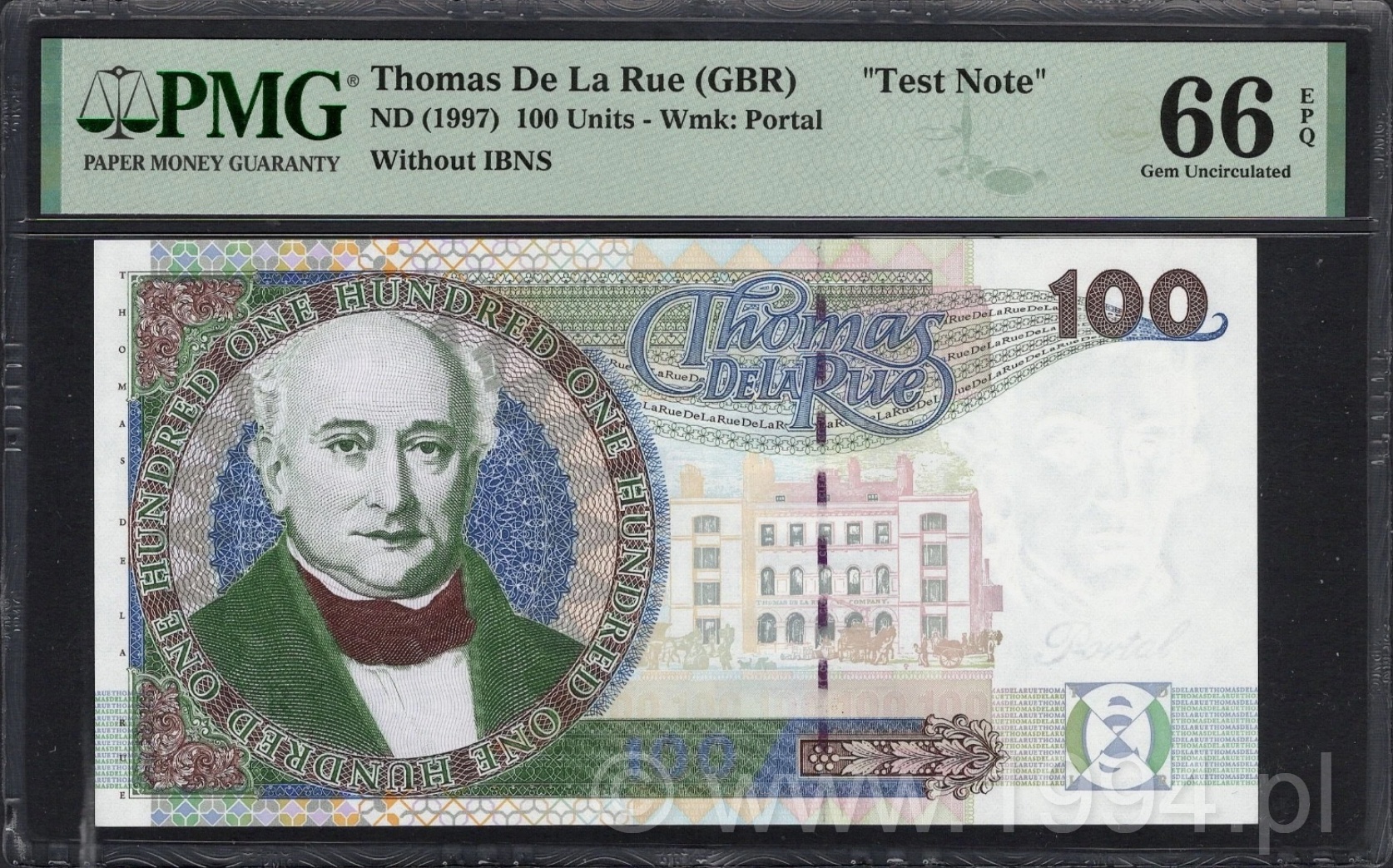
A rare Thomas De La Rue test note, issued as a demonstration piece rather than circulating currency. Dated ND (1997), this 100 Units note was printed to showcase De La Rue’s advanced banknote security design, incorporating microtext, guilloche patterns, and the portal watermark. The obverse features a portrait of Thomas De La Rue with multicolor lathework and the company’s headquarters vignette. Test notes like this were produced for presentations, sales demonstrations, and security trials, not for public issue, and remain highly sought after by collectors. Read more →
Specimen of the 2004 Northern Bank £50, printed by De La Rue for Northern Bank Limited, Belfast. This pre-issue design was the last note prepared before the bank’s December 2004 robbery, the largest cash theft in UK history. The note carries the red SPECIMEN overprint and the oval NO VALUE control stamps, serial DA000000 001, and watermark of Sir Samuel C. Davidson (1846-1921), the inventor and industrialist who founded Sirocco Engineering Works and appears on all high denominations of the series. Read more →
Specimen of the redesigned 2005 Northern Bank £50, printed by Thomas De La Rue and issued under the new Northern Bank Limited branding after the December 2004 robbery. Serial JB000000, watermark Sir Samuel Davidson, and bold red SPECIMEN overprint across the face. This version was part of the printer’s formal reference and approval series prepared for bank and regulator use. Read more →