Results for “year:<1900”
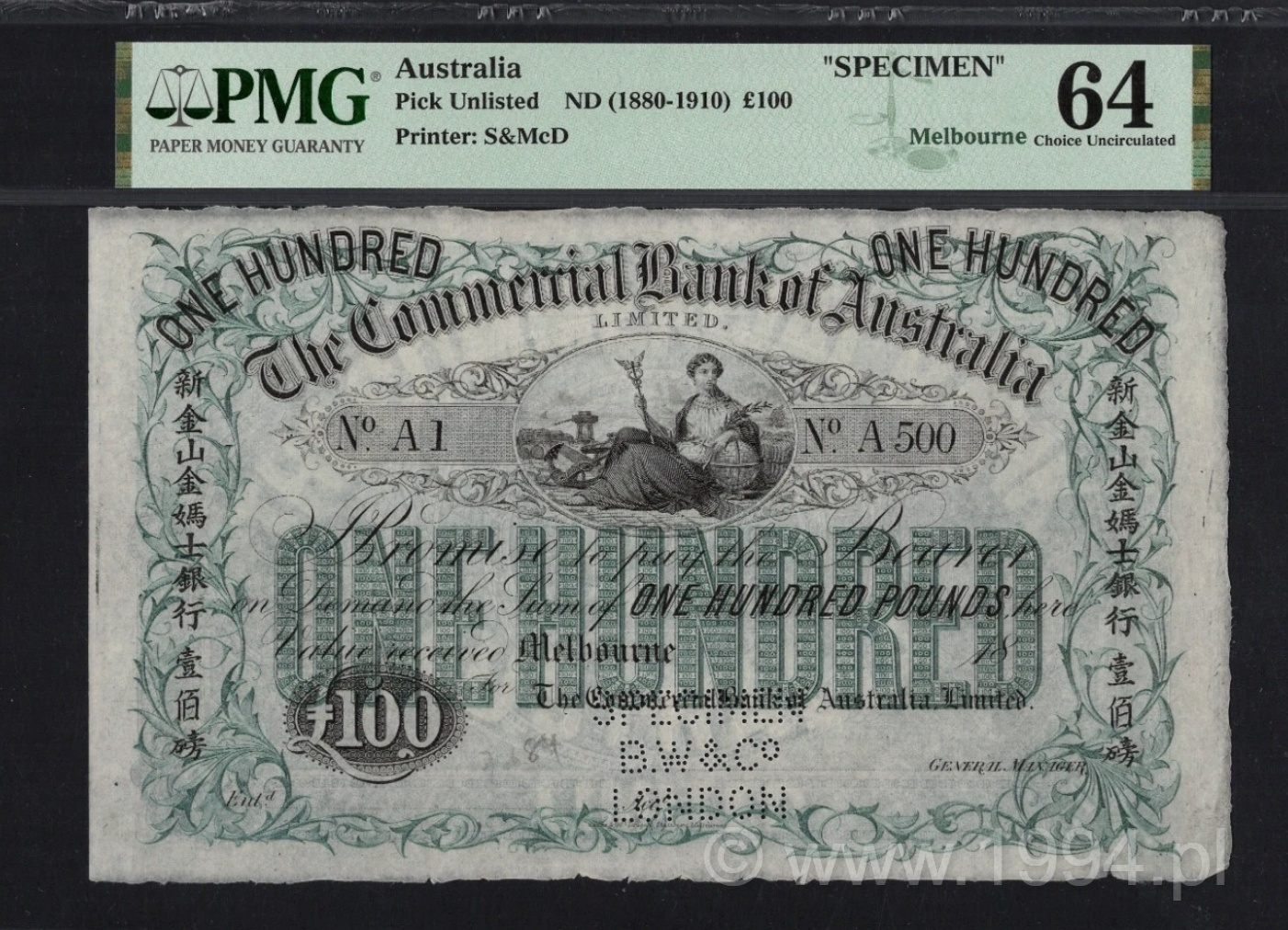
Australia 1880–1910 Commercial Bank of Australia £100 specimen, PMG 64 Choice Uncirculated

Australia 1880–1910 - Commercial Bank of Australia £100 Specimen (Pick Unlisted)

The historical context of this note is equally important. Before the 1910 Australian Notes Act, each major commercial bank operated as both a private deposit institution and a note-issuing authority, backed by gold reserves and subject to varying degrees of colonial regulation. The Commercial Bank of Australia was among the most prominent issuers, and its large denominations were used for interbank settlement, bullion transactions, and wholesale commercial payments. These notes circulated in an economy that was rapidly industrialising and integrating into global commodity markets through wool, gold, minerals, and agricultural exports. Read more →

AustraliaSpecimen1880100 PoundsPMG 64 Choice Uncirculated Specimen100 PoundsHigh DenominationCommercial Bank of AustraliaBradbury WilkinsonBWCSands & McDougallColonial SpecimenBilingualChinese-EnglishKong MengPick UnlistedColonial Banking HistoryAustralian Private BanknotesPre-Notes Act Era19th Century BankingMulticultural Trade NetworksSecurity Printing HistoryBritish Engraving InfluenceAustralian Monetary HistoryAustralia188019101880–1910PMG 64Museum GradeR9 Extremely RareUniqueAnnotationsHandwritten Annotations
Held
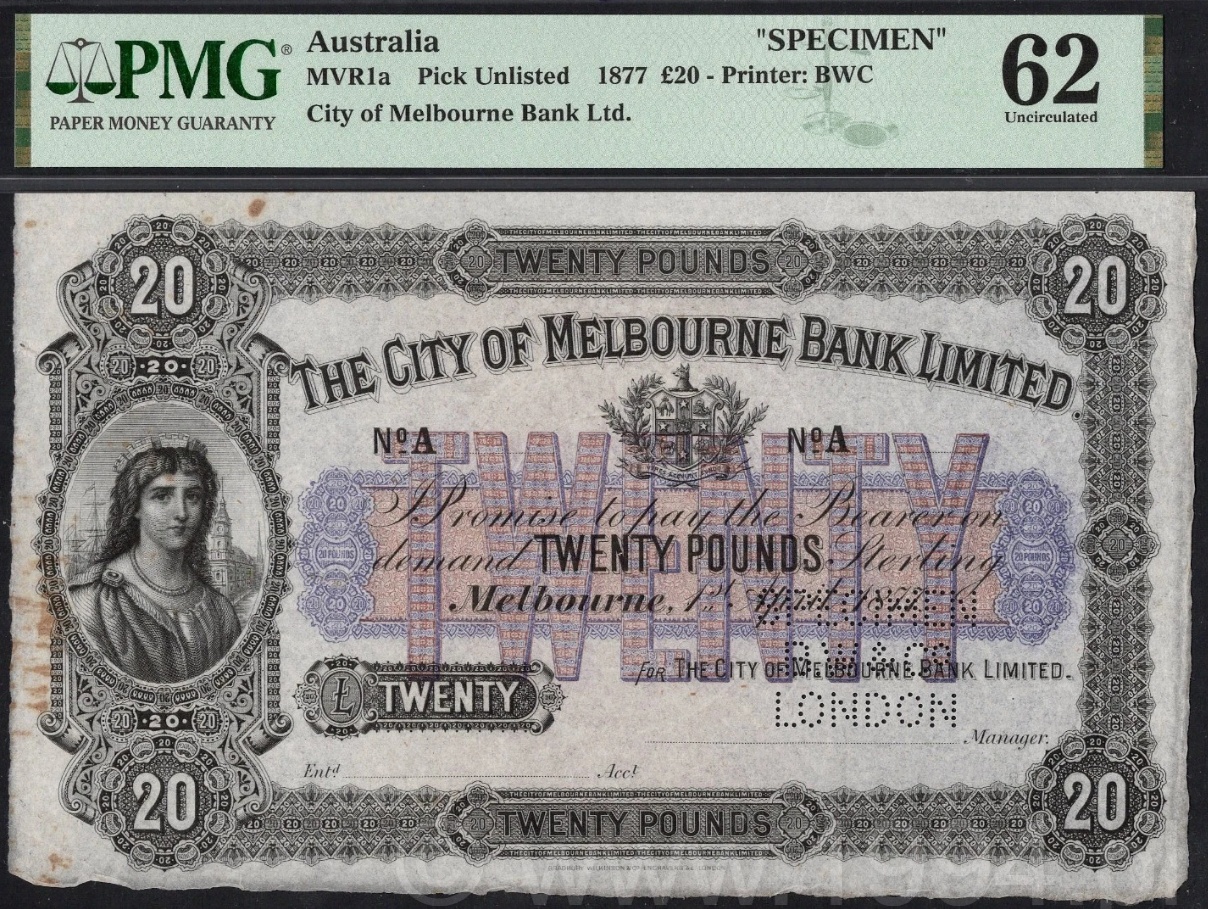
Australia 1877 City of Melbourne Bank Limited £20 specimen engraved by Bradbury Wilkinson, PMG 62 Uncirculated, unique surviving example

Australia 1877 - City of Melbourne Bank Limited £20 Specimen (Pick Unlisted)

Certified PMG 62 Uncirculated, the note stands as a singular artifact of Australia’s private-banknote era. It represents the intersection of rarity, engraving excellence, and financial history, and qualifies unequivocally for classification as R9 - Unique. Read more →

AustraliaSpecimen187720 PoundsPMG 62 Uncirculated Specimen20 PoundsCity of Melbourne Bank LimitedBradbury WilkinsonBWCPick UnlistedColonial SpecimenEngraved Security PrintingAustralian Private BanknotesVictoria Banking HistoryPre-Federation FinanceGold Rush Era BankingSecurity Printing History19th Century BankingAustralian Monetary HistoryAustraliaVictoria1877PMG 62Museum GradeR9 Extremely RareUnique
Held
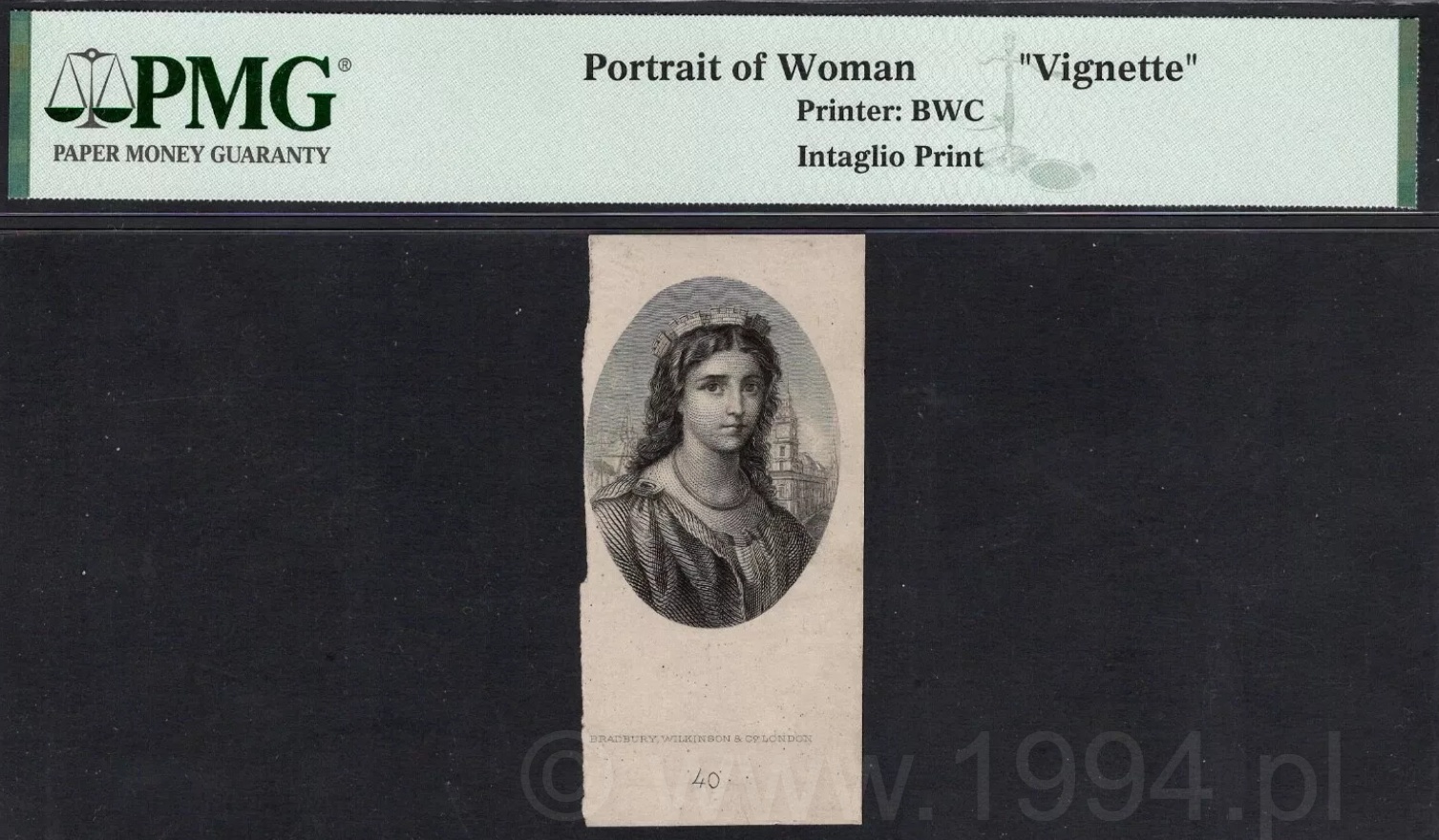
Bradbury, Wilkinson and Company 1877 Portrait of Woman intaglio vignette proof, printer's library design element associated with the City of Melbourne Bank Limited 20 Pounds colonial Australian banknote design

Australia 1877 - Bradbury, Wilkinson and Company Portrait of Woman for City of Melbourne Bank Limited 20 Pounds Design Intaglio Vignette (Pick Unlisted)

As a stand-alone intaglio impression, the vignette preserves the original pictorial element independently from the financial instrument in which it was used and documents Bradbury Wilkinson's portrait engraving and banknote production practice at the component level. Read more →

AustraliaVignette Proof1877Reference VignetteArchival Intaglio Proof Vignette ProofIntaglio Vignette ProofPortrait VignettePortrait of WomanEngraved PortraitPrinter's Library ElementPrinter's Design ArchiveProduction Stage ArtifactStandalone VignetteReference VignetteCity of Melbourne Bank Limited Design Source20 Pounds Design SourceBradbury, Wilkinson and CompanyBradbury, Wilkinson and Company LondonLondon Security PrinterIntaglio PrintingIntaglio EngravingSecurity EngravingBanknote PrintingSecurity PrintingPrivate Banknote ProductionProofing and Plate ApprovalDesign Verification ArtifactPick UnlistedAustralian Banking HistoryAustralian Colonial BankingPre Federation AustraliaVictoria Banking HistoryCity of Melbourne BankCity of Melbourne Bank LimitedColonial VictoriaPrivate Banknote TraditionNineteenth Century Paper MoneyVictorian Era EngravingHistoryAustraliaVictoria1877R9 Extremely RareUniqueMuseum Grade
Held
New Zealand Bank of Australasia £50 Christchurch proof note dated 1896, Victorian engraved colonial banknote printed by Perkins Bacon, PMG 55 proof

New Zealand 1896 - Bank of Australasia £50 Christchurch Proof (Pick Unlisted)

Surviving proof material from the Bank of Australasia New Zealand operations is exceptionally scarce. The combination of high denomination, branch specificity, and proof status positions this example as a primary documentary artifact of British colonial banking mechanics, engraving practice, and monetary authority in late nineteenth century New Zealand. Read more →

New ZealandProof189650 PoundsPMG 55 About Uncirculated Proof Banknote50 PoundsPre Issue ProofNon Circulating ProofInstitutional Presentation NoteBank of AustralasiaBritish Chartered BanksColonial Banking in New ZealandColonial FinanceBritish Security PrintingVictorian EngravingExport Engraved NotesNew ZealandChristchurch188819211896Pick UnlistedMuseum GradeR9 Extremely RareUnique
Held
Australia Bank of Australasia 10 Pounds Melbourne proof note, early Victorian colonial banknote, Perkins Bacon engraving, PMG 45 proof

Australia 1835-1850 - Bank of Australasia £10 Melbourne Proof (Pick Unlisted)

This proof represents a pre-issue banknote of the Bank of Australasia, denominated Ten Pounds and prepared for the Melbourne office during the institution early period of operation. It was produced as part of the bank internal approval and presentation process and was not intended for circulation. Read more →

AustraliaProof183510 PoundsPMG 45 Choice Extremely Fine Proof Banknote10 PoundsPre Issue ProofNon Circulating ProofInstitutional Presentation NoteBank of AustralasiaEarly Australian BankingBritish Chartered BanksColonial FinanceBritish Security PrintingEarly Victorian EngravingExport Engraved NotesAustraliaMelbourne183518501835-1850Museum GradeR9 Extremely RareUnique
Held
Brazil 1773 Tejuco Diamond Administration 6 Octavas gold receipt No. 813,

Brazil 1773 - Diamond Administration of Tejuco, 6 Octavas Gold Receipt No. 813 (Pick Unlisted)

Unlike manuscript-only diamond-district receipts, this example is produced on an officially printed fiscal form bearing the engraved royal arms of Portugal, demonstrating its use within the elite treasury office rather than in peripheral notarial contexts. The printed template, the inked manuscript completion, and the red-brown validation marks are characteristic of the administrative procedures governing all gold leaving the diamond region under crown monopoly. Read more →

BrazilFinancial Document17736 Octavas of GoldXF (Manuscript-Completed Fiscal Receipt) Financial DocumentDiamond DistrictPick unlisted1773 ReceiptNumber 8136 OctavasPortuguese Colonial BrazilCasa da Administração dos DiamantesMinas GeraisTejucoGold LedgerManuscript EntryFiscal FormRoyal Arms PortugalColonial Taxation18th Century FinancePortuguese EmpireBrazil1773R9 Extremely RareUniqueMuseum Grade
Held
Australia 1877 Mercantile Bank of Sydney £1 specimen with red ONE overprint, Pick Unlisted, printed by Bradbury Wilkinson & Co., graded PMG 66 EPQ Gem Uncirculated Pop 1, only known example

Australia 1877 - Mercantile Bank of Sydney £1 Specimen (Pick Unlisted)

Produced in London by Bradbury, Wilkinson & Co., the note displays the firm’s finely controlled intaglio characteristic of the 1870s: geometric borders, elaborate guilloches, and a bold typographic layout. The large red overprint “ONE” identifies it as an internal specimen, intended for reference or approval rather than circulation. Its pristine surfaces, confirmed by PMG’s Exceptional Paper Quality designation, reflect its archival preservation and the superior paper stock used for BWC’s specimen and proof work. Read more →

AustraliaSpecimen18771 PoundPMG 66 EPQ Gem Uncirculated (Pop 1) Specimen1 PoundPick UnlistedRed OverprintColonial Private BankBradbury WilkinsonBWCMercantile Bank of SydneyNew South Wales Banking History19th Century FinanceAustralian Private IssuesSecurity Printing HistoryColonial PeriodAustralia1877Only Known ExampleR9 Extremely RareUniquePop 1Top PopPMG 66 EPQGem UncirculatedMuseum Grade
Held
Australia Federal Bank of Australia Limited one pound Sydney specimen printed by Bradbury Wilkinson, annotated 1882, PMG 64 Choice Uncirculated

Australia 1879–1903 - Federal Bank of Australia, Limited £1 Sydney Specimen (Pick Unlisted)

The Federal Bank of Australia commenced operations in 1881 and expanded aggressively during the speculative land-boom years of the late nineteenth century. Its collapse during the catastrophic banking crisis of 1893 resulted in the rapid liquidation of assets and the withdrawal, redemption, and destruction of nearly all circulating notes. As a consequence, surviving material associated with the bank is almost entirely confined to printer’s proofs, archival specimens, and presentation examples retained outside Australia. Read more →

AustraliaSpecimen18791 PoundPMG 64 Choice Uncirculated (Annotated, Top Population) Specimen Banknote1 PoundPrinter SpecimenAnnotated SpecimenExport Engraved NoteLarge Format BanknoteBradbury WilkinsonBWCBritish Security PrintingVictorian Era EngravingPrivate Banknote ProductionFederal Bank of Australia LimitedAustralian Private BanksPre Federation AustraliaSydney Banking HistoryVictorian Banking Crisis1893 Banking CollapseAustraliaSydney187919031879–1903Pick UnlistedTop PopMuseum GradeR9 Extremely RareUniqueAnnotationsHandwritten Annotations
Held
Complete nine-note Stockholm Spinnhus pollett monetary system from circa 1785, including all denominations from one half öre to one daler, preserved in unissued condition and classified as R10 extremely rare.

Sweden 1785 - Stockholm Spinnhus Pollett System – Complete Nine-Denomination Institutional Currency Set:One Half Öre to One Daler (Pick Unlisted)

The monetary system consists of nine denominations: one half öre, one öre, two öre, five öre, six öre, seven öre, sixteen öre, twenty-four öre and one daler. Each note was engraved with a distinct ornamental frame and printed anopisthographically on eighteenth-century Swedish rag paper. All examples remain unissued and uncirculated, with several retaining archival tape residue from long-term institutional storage. Individual denominations are exceptionally rare, and the higher values-particularly seven öre, sixteen öre, twenty-four öre and one daler-are almost never encountered in private collections. Read more →

SwedenInstitutional Paper Currency Set1785Complete nine-note system: one half öre, one öre, two öre, five öre, six öre, seven öre, sixteen öre, twenty-four öre, one dalerUncirculated PollettInstitutional paper currencyEngraved copperplate noteEighteenth century rag paperAnopisthographic printingUnissuedUncirculatedStockholm engravingSwedish copperplate productionPre-industrial note manufactureStockholm SpinnhusLångholmen prison economyPenal labor currencyClosed economy tenderProto-fiat institutional moneyInternal monetary systemSweden1785One half öreOne öreTwo öreFive öreSix öreSeven öreSixteen öreTwenty-four öreOne dalerFull denomination setPick UnlistedR10 UniqueR10UniqueUnique Known ExampleUnique Set
Held
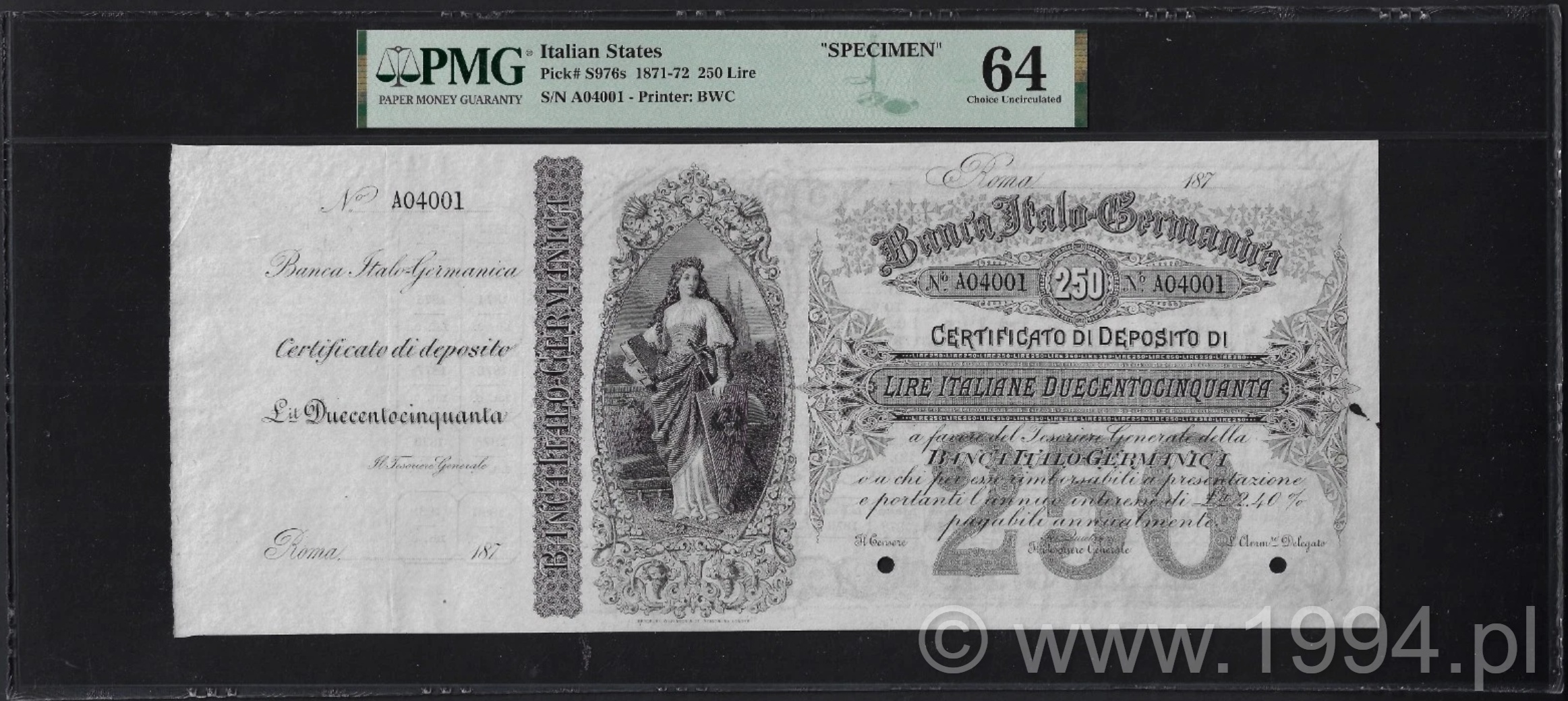
Italy 1871–1872 Banca Italo-Germanica 250 Lire specimen, Pick S976s, Bradbury Wilkinson & Co., PMG 64 Top Pop

Italy 1871–1872 - Banca Italo-Germanica 250 Lire Specimen (Pick S976s)

The survival of this particular note is itself remarkable. Oversized, fragile, and produced on early BWC security paper, such pieces were highly vulnerable to destruction. Most unadopted private note designs were discarded by banks, burned during liquidation, or lost during institutional mergers. Specimens from failed Italian banknote issuers of the 1870s are almost nonexistent, and the Banca Italo-Germanica ranks among the most elusive of them all. Read more →

ItalySpecimen1871250 LirePMG 64 (Top Pop) Private BankOversizedSpecimenDouble Punch HolePunch Cancelled250 LireEngraved Security PaperProof and Archive PieceBradbury WilkinsonBWCPick S976sItalian StatesPost Unification ItalyItalian Banking HistoryFailed Banknote IssuesGerman Capital in Italy19th Century FinanceNational AllegorySecurity Printing HistoryRome Banking ExperimentsUnissued Banknote ProjectItaly1871PMG 64Top PopR9 Extremely RareUniqueMuseum Grade
Held
Italy 1871 Germania with shield and spear vignette die proof engraved by Bradbury Wilkinson for the Banca Italo-Germanica 250 Lire (Pick PS976)

Italy 1871 - Standing Italia used on Banca Italo-Germanica 250 Lire Vignette Die Proof

On the 250 Lire specimen, the vignette occupies the prominent vertical panel near the center-left of the note, immediately beside the principal Banca Italo-Germanica text and denomination structure. Its scale and placement make it one of the dominant visual elements of the completed design and provide a direct production link between the independent engraving and the finished 1871-72 banknote. Read more →

ItalyVignette1871-Uncirculated Italia AllegoryDie ProofBanca Italo-Germanica250 LireItalian StatesBradbury WilkinsonBWCItaly1871
Held
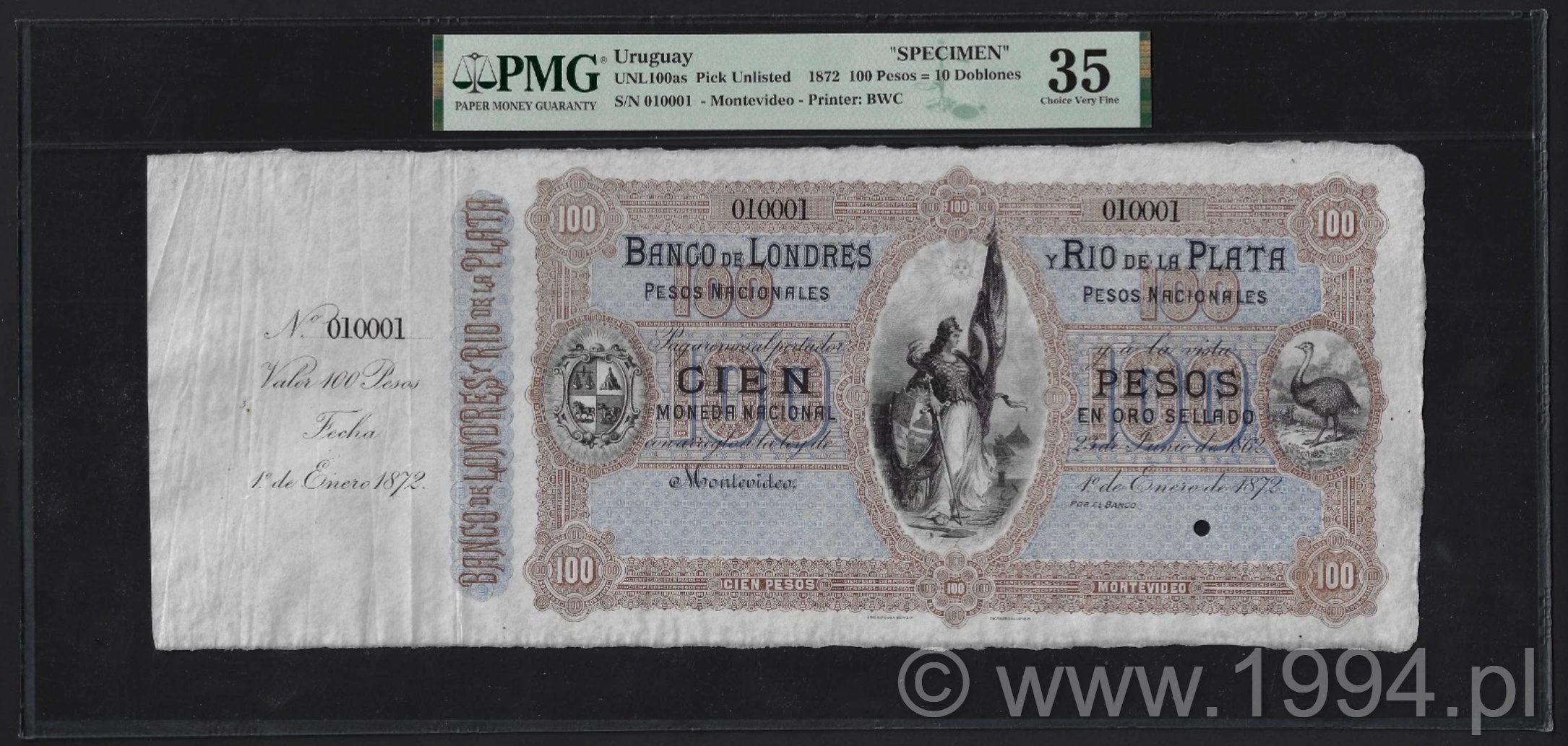
Uruguay 1872 100 Pesos equals 10 Doblones printer archival specimen, early serial number 010001, printed by Bradbury Wilkinson

Uruguay 1872 - Banco de Londres y Rio de la Plata 100 Pesos = 10 Doblones Specimen (Pick Unlisted)

At the time of writing, this is the only documented specimen of the 1872 100 Pesos = 10 Doblones type. No additional specimens are known in private collections, institutional holdings, or grading census records. The note is unlisted in Pick and absent from all major published catalogues, reflecting its survival outside the normal catalogued population rather than any provisional or trial status. Read more →

UruguaySpecimen1872100 Pesos = 10 DoblonesPMG 35 Choice Very Fine SpecimenPrinter Archival SpecimenDual DenominationGold EquivalenceEarly Pull Serial 010001Oversized FormatBradbury WilkinsonBWCLondon Security PrintingNineteenth Century EngravingArchival Reference NoteGold Standard ExperimentPeso Doblone ParityBanco de Londres y Rio de la PlataLatin American Monetary HistoryNineteenth Century State FinanceUruguayMontevideo1872Pick UnlistedMuseum GradeR9 Extremely RareUnique
Held
↑ Top