Collection PL

About 1994.pl
Results for “year:<1900”
Argentina 1866 Banco de Londres y Rio de la Plata 1 Real Rosario Type B handwritten signature serial 636796

Argentina 1866 - Banco de Londres y Rio de la Plata 1 Real Rosario Type B (Hand-Signed) PS1731 · Bauman SFE 70

This example represents the Type B variety distinguished by its handwritten authorization signature. Unlike Type A notes bearing printed authorization, Type B examples were manually countersigned by a bank officer at the Rosario branch before entering circulation. Such signatures reflect the semi-private operational structure of provincial banking during this early period. Read more →

ArgentinaIssued Note18661 RealFine (issued example with original manuscript authorization signature) Issued Note1 RealBanco de Londres y Rio de la PlataRosario BranchPrivate BanknoteHand-Signed AuthorizationTypographic Bank ValeCommercial Promissory NoteBolivian Silver StandardProvincial Currency SystemRiver Trade EconomyBritish Banking ExpansionEarly Argentine Paper MoneyEarly Argentine BanknoteNineteenth Century Provincial BankingArgentinaRosario1866Museum GradeR8 Extremely Rare
Held
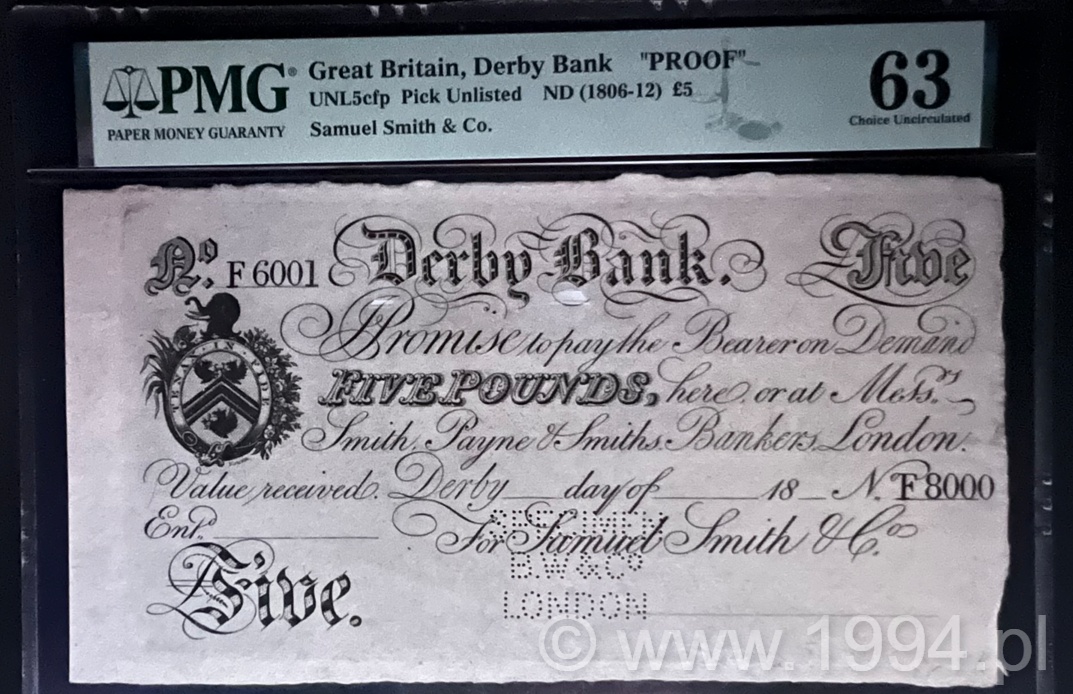
Great Britain Derby Bank £5 proof, circa 1806–1812, engraved private bank issue payable via Samuel Smith & Co., PMG 63 Choice Uncirculated

Great Britain c.1806–1812 - Derby Bank £5 Proof (Pick Unlisted)

A printer’s proof of a £5 note prepared for the Derby Bank during the formative years of British provincial banking, dating to circa 1806–1812. This piece belongs to the critical transitional period between eighteenth-century handwritten credit instruments and the fully industrialized, security-driven banknote production that would dominate the nineteenth century. Read more →

Great BritainProof18065 PoundsPMG 63 Choice Uncirculated Proof5 PoundsPrivate Bank IssueProvincial BankingEarly British BanknotesNapoleonic War EraBank Restriction PeriodSecurity EngravingCalligraphic DesignPre Standardization CurrencyLondon Correspondent BankingGreat BritainDerby18061806–1812Pick UnlistedMuseum GradeR9 Extremely RareUnique
Held
Italy ND (1868) Banco di Napoli Fede di Credito specimen, ICG 60 AU/UNC

Italy 1868 - Banco di Napoli Fede di Credito 50–200 Lire Specimen (Pick Unlisted)

Specimen Fede di Credito from the Banco di Napoli, engraved by Bradbury, Wilkinson & Co. during the early years of the unified Kingdom of Italy. The Banco di Napoli traced its roots back to charitable institutions founded in 1539, making it one of Europe’s oldest surviving banks. Rather than circulating currency in the strict sense, these fede di credito served as deposit receipts payable on demand, functioning as quasi-banknotes that circulated regionally as trusted paper. Read more →

ItalySpecimen186850–200 LireICG 60 AU/UNC Pick-UnlistedBradbury WilkinsonBWCSpecimenItalian KingdomBanco di Napoli50 lire200 lireItaly1868
Held
Italy 1869 Credito Agricolo della Cassa di Risparmio in Bologna 30 Lire specimen serial number 0001 printed by Bradbury Wilkinson and Company PMG 63 Top Pop

Italy 1869 - Credito Agricolo della Cassa di Risparmio in Bologna 30 Lire Specimen (Pick Unlisted)

As a specimen, this piece represents a pre-circulation state, typically produced for internal approval, institutional reference, or regulatory presentation. Its status is exceptional: serial No. 0001, marking it as the very first pull, likely prepared for board-level approval or formal presentation purposes. Read more →

ItalySpecimen186930 LirePMG 63 Choice Uncirculated Top Pop Serial Number 0001 SpecimenAgricultural Credit NoteCredito AgricoloCassa di Risparmio in BolognaPrivate Banking InstrumentControlled Credit IssueOdd Denomination30 LireBradbury Wilkinson and CompanySecurity PrintingGuilloche EngravingBlue UnderprintPortrait MedallionIssuance PanelItalian Banking HistoryPost Unification ItalyNineteenth Century FinanceAgricultural Credit SystemHistoryItaly1869Pick UnlistedPMG 63Top PopUniqueR9 Extremely RareMuseum Grade
Held
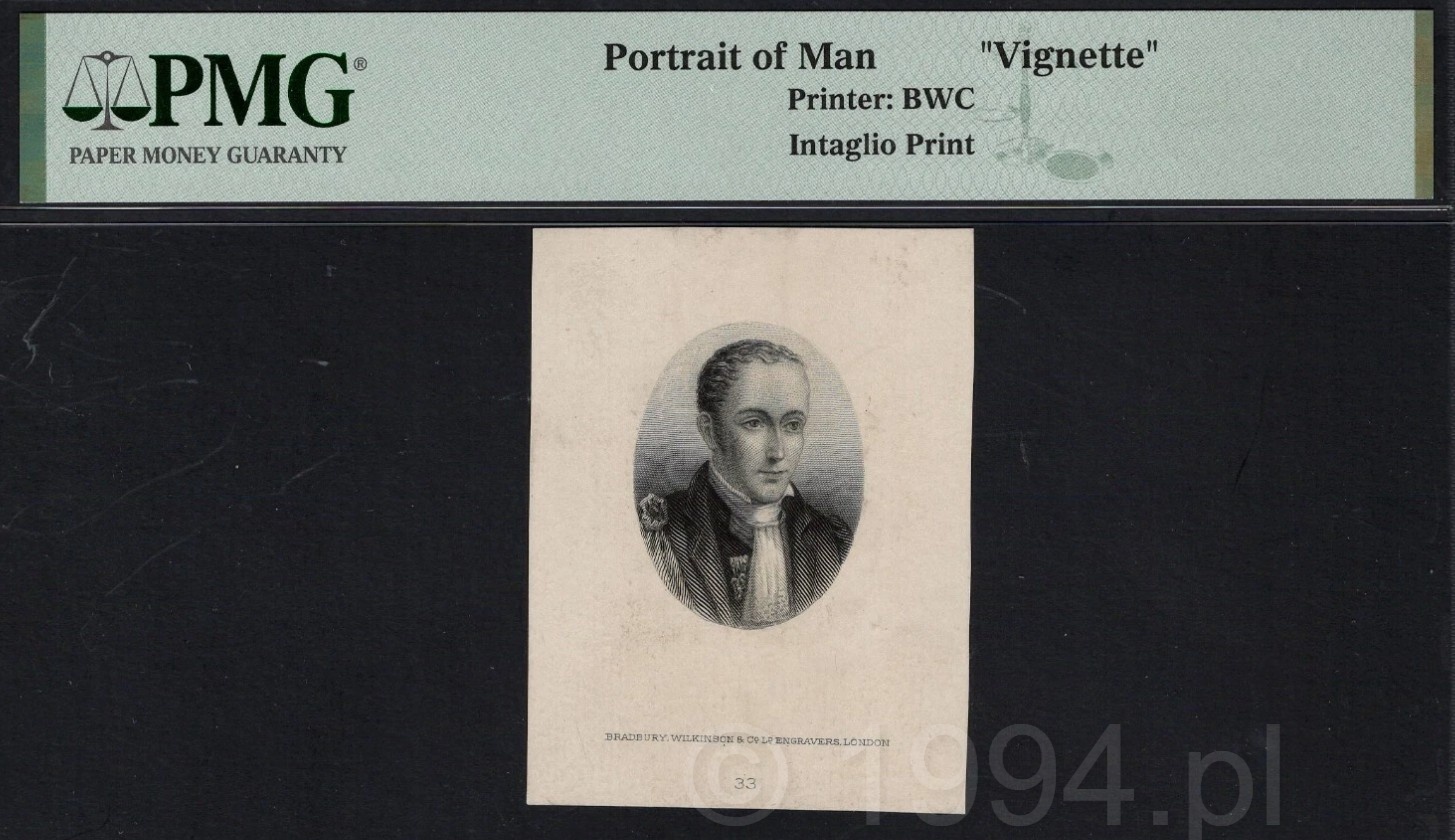
Italy 1869 Bradbury Wilkinson engraved portrait vignette used directly in the Credito Agricolo della Cassa di Risparmio in Bologna 30 Lire banknote design

Italy 1869 - Credito Agricolo della Cassa di Risparmio in Bologna 30 Lire Portrait Vignette (Bradbury Wilkinson and Company)

Vignettes of this type were engraved separately within the security printing workflow, allowing master engravers to refine portrait structure, shading, and line depth before integration into the full note layout. The precision visible in the engraving reflects high-level nineteenth century intaglio technique, with controlled line work used to build tonal realism and dimensional depth. Read more →

ItalyVignette1869Not ApplicablePMG Certified VignettePortrait VignetteEngraving ProofIntaglio EngravingBradbury Wilkinson and CompanySecurity PrintingDesign ElementBanknote ProductionCredito AgricoloCassa di Risparmio in Bologna30 Lire30 Lire IssueCompanion PieceLinked ArtifactItalian Banking HistoryPost Unification ItalyNineteenth Century FinanceHistoryItaly1869Pick UnlistedR8 Extremely RareMuseum Grade
Held
Italy 1866 Credito Fondiario di Bologna 50 Lire specimen, PMG 66 EPQ

Italy 1866 - Credito Fondiario di Bologna 50 Lire Specimen (Pick Unlisted)

The note’s oversized layout is striking, with ornate guilloché and multiple coats of arms symbolizing the pre-unification states of Italy. This heraldic display was already becoming obsolete by the 1860s as national identity consolidated, making this design a rare vestige of Italy’s regional past engraved onto its financial instruments. Wide margins, full color, and archival cancellations confirm its specimen status. Read more →

ItalySpecimen186650 LirePMG 66 EPQ (Top Pop) OversizedSpecimen ProofProofSpecimenPrivate BankItalian StatesPick UnlistedTop PopPMG 66 EPQ50 lireBradbury WilkinsonBWCItaly1866
Held
Austria 1800 Wiener Stadt Banco 1 Gulden issued note, Pick A29a, typographic Banco-Zettel design with value watermark in Arabic and Roman numerals

Austria 1800 - Wiener Stadt Banco 1 Gulden Issued Note (Pick A29a)

The 1 Gulden occupied a central role in everyday commerce across the Habsburg lands. Unlike higher denominations intended primarily for wholesale settlement, the 1 Gulden functioned as a true transactional note, widely used for wages, market trade, and routine payments. Its survival in high grade is therefore exceptional, as most examples experienced heavy circulation during a period of persistent monetary instability. Read more →

AustriaIssued Note18001 GuldenPMG 63 Choice Uncirculated Issued NoteBanco-ZettelFiduciary Paper MoneyEarly State CurrencyTypographic BanknoteWiener Stadt BancoHabsburg Monetary SystemNapoleonic Era FinanceEveryday CirculationGaliciaZłoty ReńskiPolish Language TextAustrian Partition of PolandAustria1800PMG 63 Choice UncirculatedPick A29aMuseum Grade
Held
Austria 1806 Wiener Stadt Banco 10 Gulden issued note, Pick A39a, typographic design with multilingual denomination and value watermark in Arabic and Roman numerals

Austria 1806 - Wiener Stadt Banco 10 Gulden Issued Note (Pick A39a)

The design reflects the mature typographic phase of Wiener Stadt Banco production. Authority is conveyed through dense ornamental text blocks, strict symmetry, and the expression of the denomination in multiple imperial languages. This multilingual layout was functional, allowing the note to circulate seamlessly across regions with differing linguistic traditions while maintaining a standardized monetary identity. Read more →

AustriaIssued Note180610 GuldenPMG 40 Extremely Fine Issued NoteBanco-ZettelFiduciary Paper MoneyEarly State CurrencyTypographic BanknoteWiener Stadt BancoHabsburg Monetary SystemNapoleonic Wars FinanceMultilingual DenominationImperial AustriaGaliciaZłoty ReńskiPolish Language TextAustrian Partition of PolandAustria1806PMG 40 Extremely FinePick A39aMuseum Grade
Held
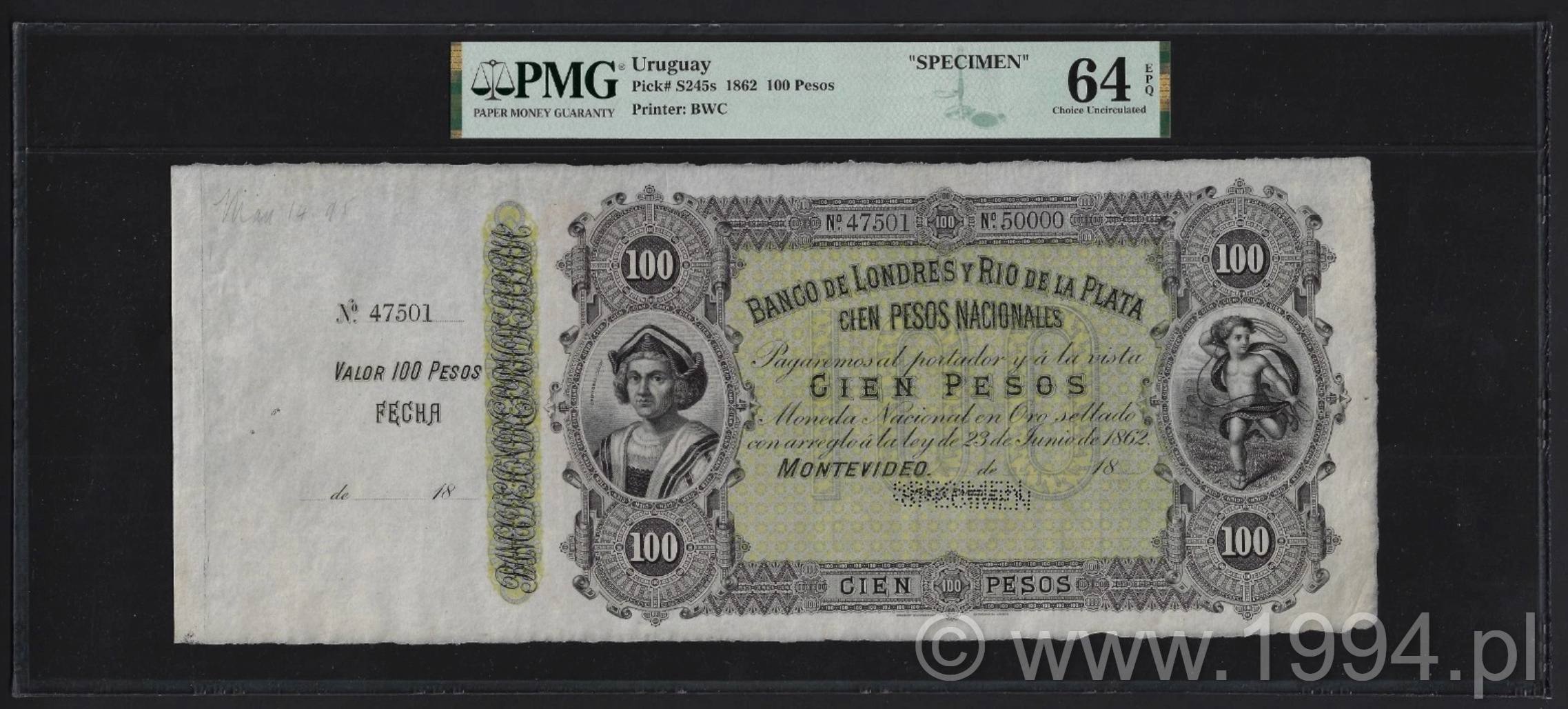
Uruguay 1862 Banco de Londres y Rio de la Plata 100 Pesos Pick S245r remainder, unissued and unsigned, engraved by Bradbury Wilkinson & Co., PMG 63 Choice Uncirculated

Uruguay 1862 - Banco de Londres y Rio de la Plata 100 Pesos Remainder (Pick S245r)

Few notes capture the working side of 19th-century banknote production like this 1862 100 Pesos remainder. Printed by Bradbury, Wilkinson & Co. for the Banco de Londres y Rio de la Plata but never signed or issued, it remains an untouched example of Uruguay’s first major British-engraved currency design. No cancellations, no serials-just the raw presswork as it left London more than 160 years ago. Read more →

UruguayRemainder1862100 PesosPMG 63 Choice Uncirculated Pick S245rPick S245RemainderBanco de Londres y Rio de la PlataBradbury WilkinsonBWCUruguay 19th Century100 PesosUruguay1862
Held
Uruguay 1872 P. Valdez & Co. Tacuarembo 10 Centesimos unissued note with harvest scene, lith. Bauer, Rincon 72 Montevideo

Uruguay 1872 - P. Valdez & Co., Tacuarembo 10 Centesimos Unissued (Pick Unlisted)

Unissued 10 Centesimos note dated 1 July 1872 from P. Valdez & Co. of Tacuarembo (then San Fructuoso), printed by Lit. F. Bauer, Rincon 72, Montevideo. Pablo Valdez was a leading figure of 19th-century Tacuarembo: a stage-coach operator connecting San Fructuoso with Paso de los Toros, the town’s first agent of livestock brands and marks, and founder of the large soap works Jaboneria de Pablo Valdez near Arroyo Tranqueras. His firm issued these small bearer chits to replace missing fractional coinage during the post-conflict period following the Revolution of the Lances (1870-1872). Read more →

UruguayPrivate Scrip187210 CentesimosRaw (VF est.) UruguayPick UnlistedUnissued NotePrivate ScripEmergency MoneyTacuaremboP. Valdez & Co.F. Bauer LithographyUruguay 19th Century10 Centesimos1872Local Issue
Held
Uruguay 1872 P. Valdez & Co. Tacuarembo 20 Centesimos unissued note with classical vignette, lith. Bauer, Rincon 72 Montevideo

Uruguay 1872 - P. Valdez & Co., Tacuarembo 20 Centesimos Unissued (Pick Unlisted)

Design: single-sided brown lithograph with a neoclassical vignette of two youths carrying a sickle and sheaf of grain, symbolizing cooperation and labor. The value VEINTE CENTESIMOS appears within rosettes marked 20; the Bauer imprint sits at base. The wide left margin and binding perforations show that these were bound in counterfoil books for controlled issue. The note measures roughly 141 by 57 mm, matching the size data preserved in Uruguayan references. Read more →

UruguayPrivate Scrip187220 CentesimosRaw (VF est.) UruguayPick UnlistedUnissued NotePrivate ScripEmergency MoneyTacuaremboP. Valdez & Co.F. Bauer LithographyUruguay 19th Century20 Centesimos1872Local Issue
Held
1863 Bank of the State of South Carolina uncut sheet with one 10c and two 15c notes

United States 1863 - Bank of the State of South Carolina 10c and 15c Uncut Sheet of 3

Why it matters: most fractional notes were cut for immediate use, and mixed denomination panes were used first. Surviving intact sheets are scarce. Mixed 10c and 15c sheets preserve the printer layout and matching back legends. The wording current funds reflects local reality in 1863 South Carolina when coins had largely disappeared and signed paper filled the gap. Read more →

United StatesUncut Sheet186310c and 15c (Sheet of 3)Raw (VF est.) Civil WarObsolete CurrencyFractionalSouth CarolinaBank of the State of South CarolinaUncut Sheet10 cents15 centsWalker Evans and Cogswell1863
Held
↑ Top