Poland’s paper money reflects a nation repeatedly redefining itself through independence, conflict, reform, and renewal. The rebirth of the Polish state after 1918 found its monetary expression in the 1919 zloty issue, printed in London by Waterlow & Sons. The 1 zloty note bearing Tadeusz Kościuszko became the emblem of that moment, a circulating symbol of sovereignty whose well-preserved survivors are today scarce. The 100 zlotych Kościuszko note served as a higher working denomination and was subjected to heavy circulation, leaving few examples intact. At the upper end, the imposing 1000 zlotych note illustrates the ambition of the early Polish monetary system: fully designed and printed, yet never released into circulation.

The interwar period brought rapid advances in design, engraving, and printing. Banknotes such as the 1936 Dąbrowski 50 zlotych represent a mature artistic language that was abruptly interrupted by the outbreak of World War II. Alongside circulation issues, non-circulating material from this era — including remainders and approval-stage prints — preserves production details that are largely absent from worn circulation survivors. These materials form an essential documentary layer within Poland’s numismatic record.

A distinct and technically well-documented chapter emerged with the introduction of the 1994 zloty series, the foundation of Poland’s modern currency. Produced as a tightly defined, one-cycle project and completed before circulation began in 1995, the series was printed jointly by Thomas De La Rue (London) and PWPW (Warsaw). Unlike long-running emissions subject to incremental revisions, the 1994 issue can be reconstructed today as a closed production process, supported by surviving pre-circulation material.

Within this process, the same banknote design existed in several clearly differentiated control forms, each tied to a specific production function. These include unmarked approval notes confirming final design and security features; reference notes bearing red WZÓR overprints (PWPW) or SPECIMEN markings and stamps (TDLR) intended for institutional distribution; and a final archival form permanently invalidated by perforation reading SPECIMEN OF NO VALUE. These forms do not represent collectible “variants” in the modern sense, but successive technical stages documenting the pathway from approval to archival closure.

Standard catalogs record only part of this structure, largely confined to the most visible approval and reference forms. Preserved material demonstrates, however, that the same production logic was applied beyond a single prefix or denomination. The 50 zlotych note with AR prefix, documented here as a complete approval–reference–archival sequence, serves as a concrete illustration of this broader pattern. Its role is evidentiary rather than exceptional: it shows how the control framework observed in the reference prefix extends across different production runs within the 1994 emission. A detailed technical breakdown of these production-stage forms is presented in the Spotlight study on the four documented control types of the 1994 issue, which situates these examples within a fully reconstructed production sequence.

Taken together, these episodes — from the 1919 Kościuszko issues and interwar design achievements to the rigorously structured 1994 production process — demonstrate how Polish banknotes function not only as instruments of payment, but as durable records of statehood, design intent, and printing practice. Preserved today in institutional and private archives, they form a continuous narrative in which circulation issues and non-circulating control material are equally essential to understanding Poland’s monetary history.
41 results · Page 4 of 4
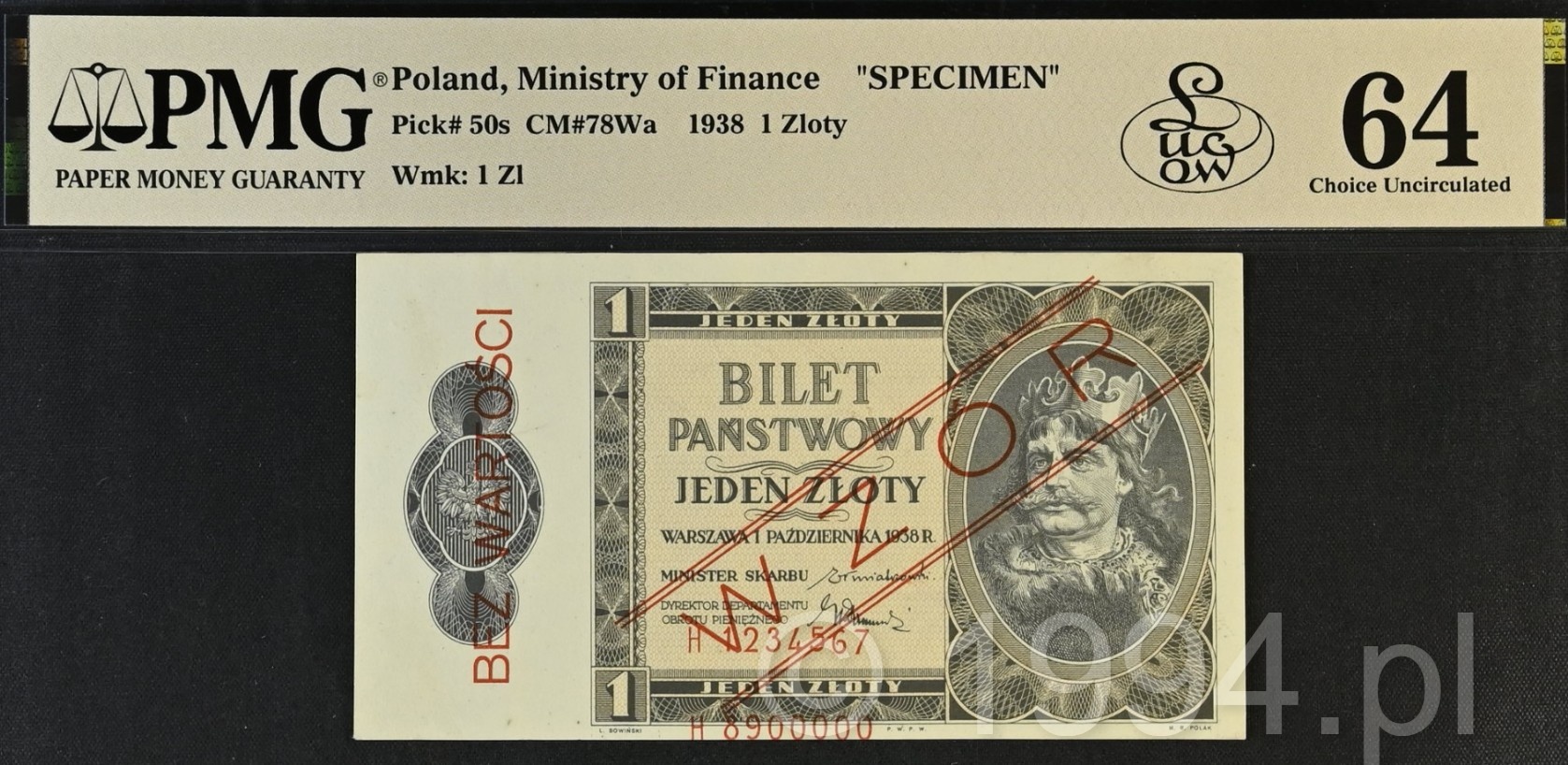
Poland 1938 1 Zloty specimen H1234567 with red WZOR overprints on both sides and vertical Bez wartosci overprint

Poland 1938 - Ministry of Finance 1 Zloty with WZÓR and BEZ WARTOŚCI Overprints Specimen (Pick 50s)

A specimen of the Ministry of Finance 1 Zloty State Ticket dated 1 October 1938, bearing red diagonal WZÓR overprints on both sides and a vertical BEZ WARTOŚCI overprint on the face. The overprints form the principal visible specimen markings applied across the completed ticket design. Read more →

PolandSpecimen19381 ZlotyPMG 64 SpecimenState TicketMinistry of FinanceMinisterstwo Skarbu1 ZlotySerial H1234567Additional Number H0900000Red WZOR OverprintWZOR Overprint on Both SidesVertical Bez wartosci OverprintEmergency Coin ReplacementTreasury-Issued Paper MoneySmall-Denomination Paper MoneySubsidiary Coinage SubstituteRepeating 1 ZL WatermarkBoleslaw I the BraveBoleslaw ChrobryPolish Crowned EagleLeonard SowinskiMarian Romuald PolakEugeniusz KwiatkowskiWieslaw DomaniewskiPolish Security Printing WorksPWPWPolska Wytwornia Papierow WartosciowychWarsaw PrintingSecurity Printing HistoryPolandPoland 1938Second Polish RepublicSecond Polish Republic CurrencyLate Prewar Issue19381939Pick 50sMilczak 78WaPMG 64Museum Grade
Held
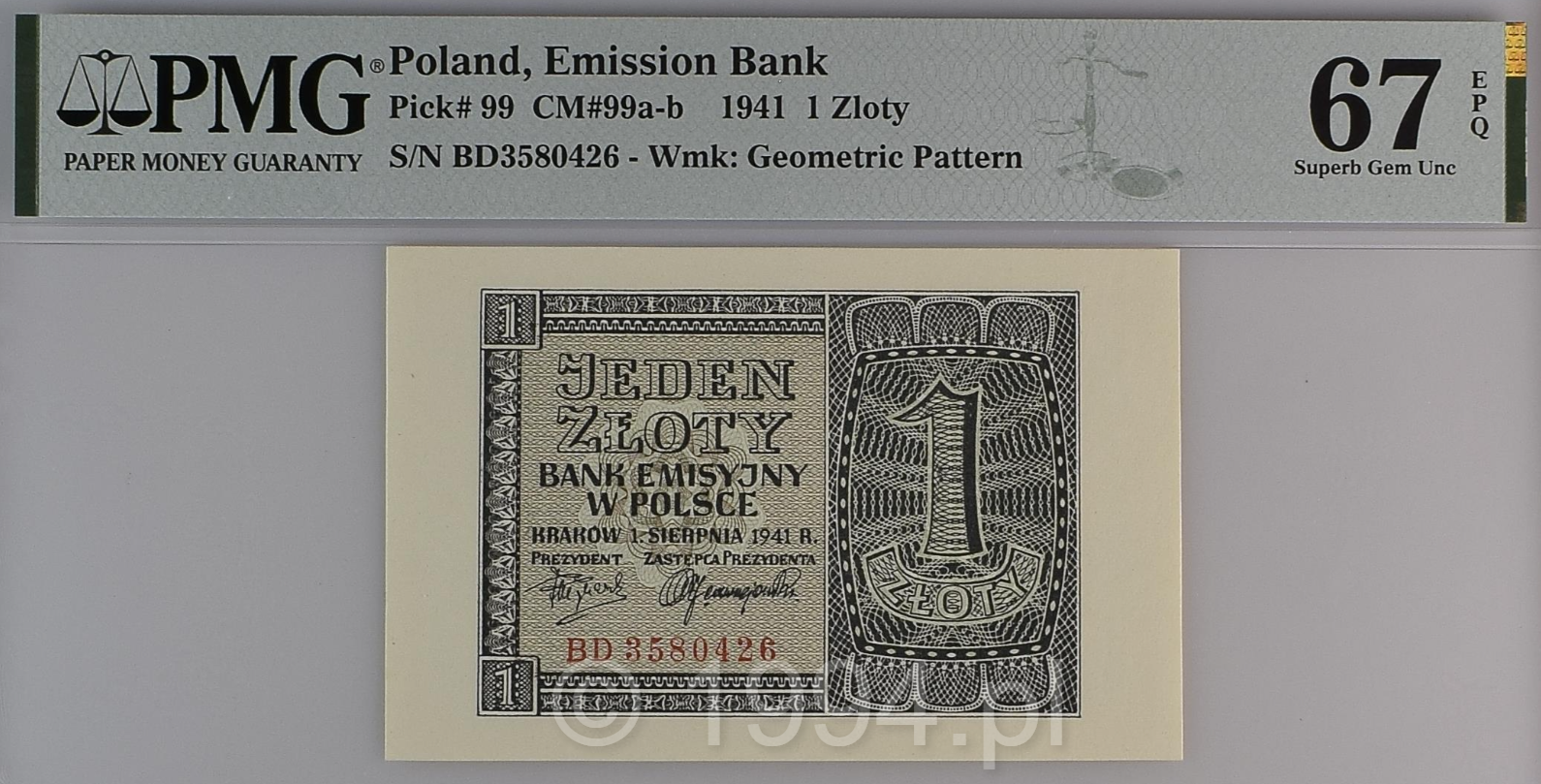
Poland 1941 Bank Emisyjny w Polsce 1 Zloty State Note, serial BD3580426, Miłczak 99b Warsaw printing, with geometric watermark, PMG 67 EPQ Superb Gem Uncirculated.

Poland 1941 - 1 Zloty Bank Emisyjny w Polsce State Note BD3580426 (Pick 99)

Banknotes issued by Bank Emisyjny w Polsce became collectively known in Poland as "Młynarki," a name derived from Bank President Feliks Młynarski. The term applies to the wider family of occupation-era issues produced under the authority of the bank. Read more →

PolandIssued State Note19411 ZlotyPMG 67 EPQ Superb Gem Uncirculated Issued State NoteState NoteBank Emisyjny w Polsce1 ZlotySerial BD3580426BD PrefixGeneral GovernmentOccupation Period CurrencySecond World War1941 IssueFeliks MłynarskiRudolf JędrzejowskiLeonard SowińskiMłynarkiWatermark Type 14Watermark Type 14AGeometric Pattern WatermarkDark and Light RectanglesGuilloche DesignSeven-Digit Red NumberingTypographic PrintingSecurity Printing HistoryStaatsdruckerei und MünzeFormer PWPWPolska Wytwórnia Papierów WartościowychWarsaw PrintingNo Known WZÓRPolandPoland 1941General Government Currency1941Pick 99Miłczak 99bPMG 67 EPQSuperb Gem UncirculatedMuseum Grade
Held
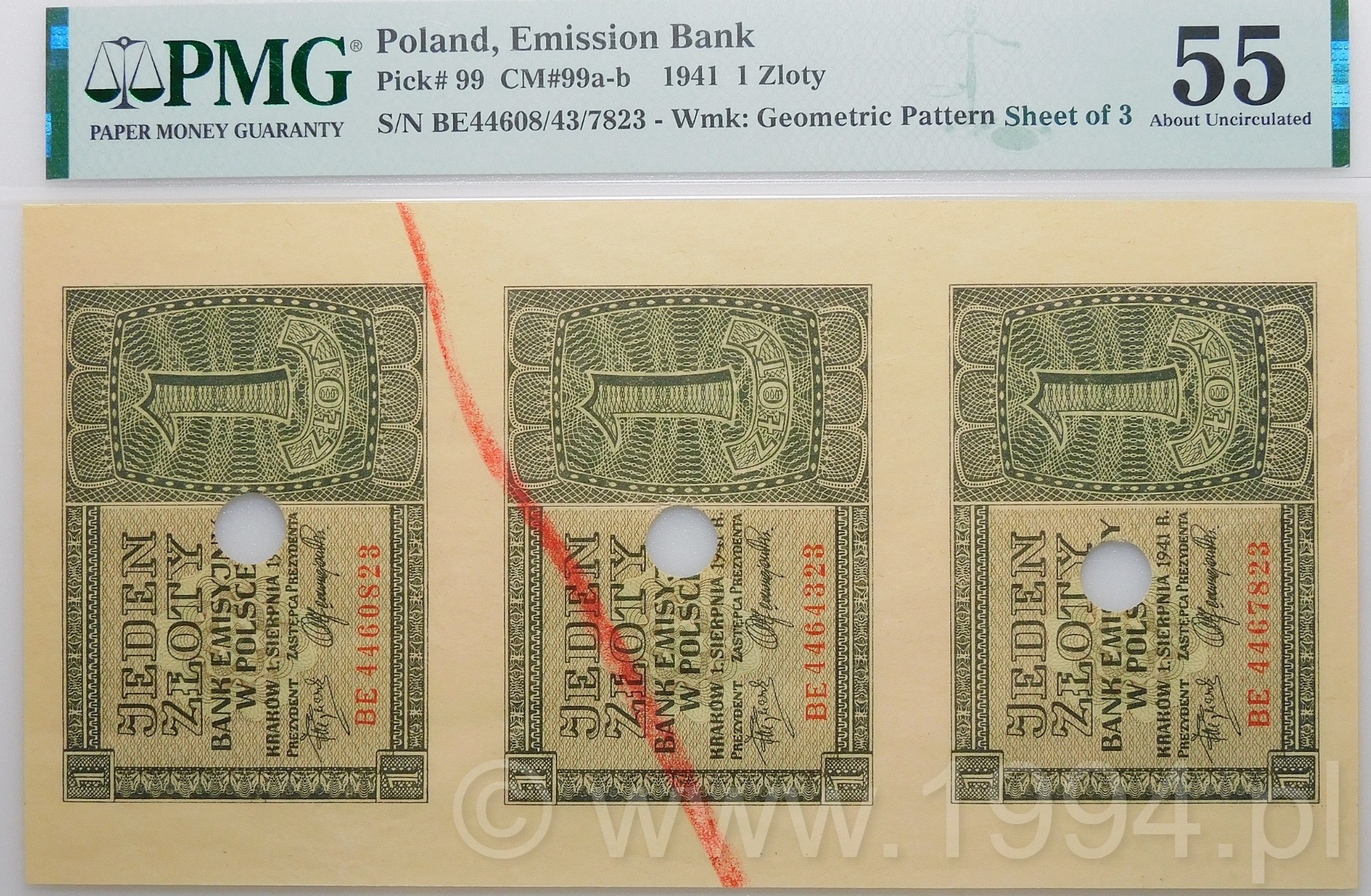
Poland 1941 Bank Emisyjny w Polsce 1 Zloty uncut sheet of three Miłczak 99b notes, serials BE4460823, BE4464323, and BE4467823, with two circular punch holes, red diagonal control mark, and PMG 55 About Uncirculated.

Poland 1941 - 1 Zloty Bank Emisyjny w Polsce Uncut Sheet of 3 Notes (Pick 99b)

No WZÓR examples of the 1941 1 Zloty issue are known. This surviving three-note section documents the issued Miłczak 99b design in connected production format and preserves three complete impressions, their full serial numbers, watermark type 14, punch holes, red control mark, and original arrangement before final separation. Read more →

PolandUncut Sheet19411 ZlotyPMG 55 About Uncirculated Uncut SheetUncut Sheet of 3 NotesBank Emisyjny w Polsce1 ZlotyBE4460823BE4464323BE4467823BE PrefixGeneral GovernmentOccupation Period CurrencySecond World War1941 IssueGeneral Government CurrencyFeliks MłynarskiRudolf JędrzejowskiLeonard SowińskiMłynarkiWatermark Type 14Watermark Type 14AGeometric Pattern WatermarkDark and Light RectanglesGuilloche DesignSeven-Digit Red NumberingTypographic PrintingTwo Circular Punch HolesRed Diagonal Control MarkProduction ControlManufacturing-Stage ArtifactConnected Production UnitOriginal Sheet Layout48-Note Printing SheetSecurity Printing HistoryStaatsdruckerei und MünzeFormer PWPWPolska Wytwórnia Papierów WartościowychWarsaw PrintingNo Known WZÓRPolandPoland 19411941Pick 99bMiłczak 99bPMG 55About UncirculatedMuseum Grade
Held
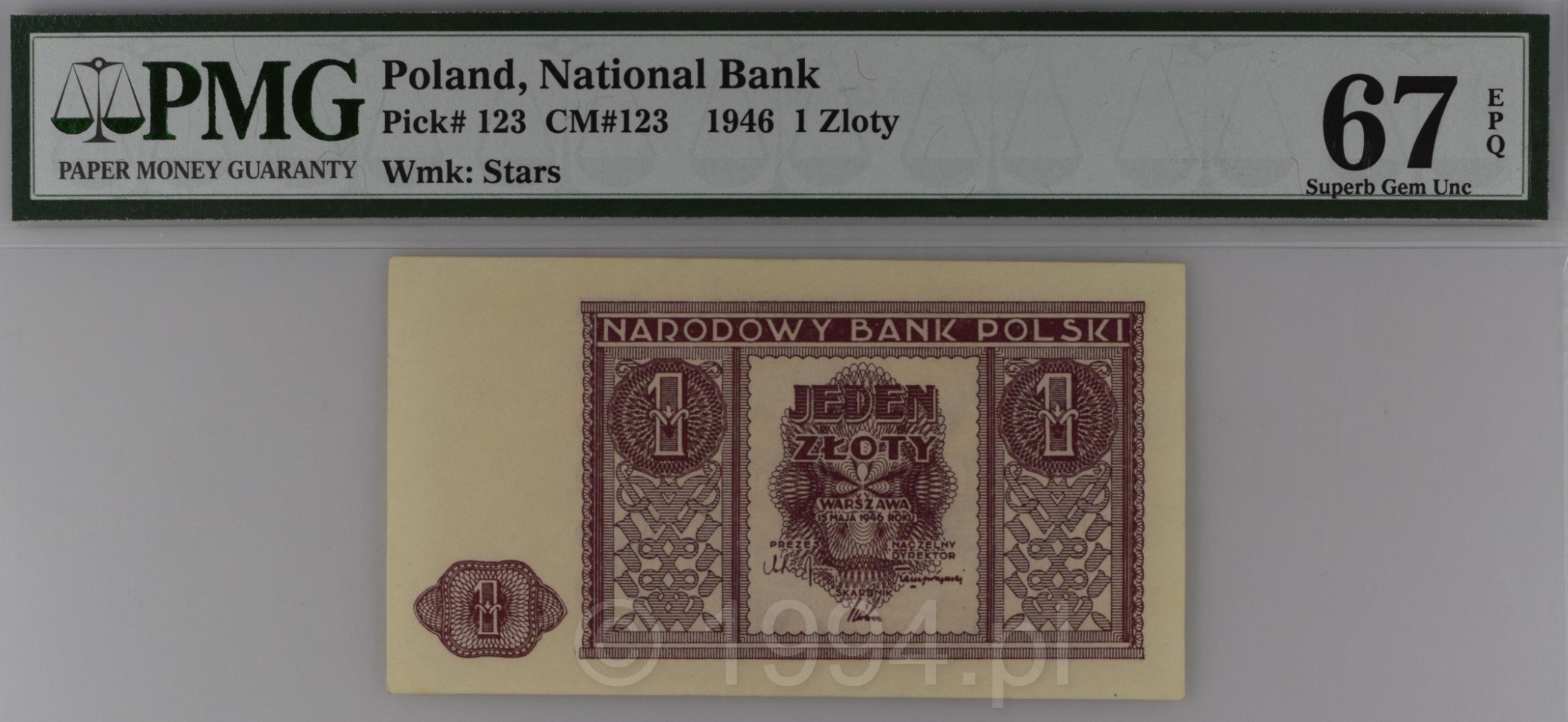
Poland 1946 Narodowy Bank Polski 1 Zloty State Note with multi-tone triangular watermark, no serial number, Pick 123, PMG 67 EPQ Superb Gem Uncirculated.

Poland 1946 - 1 Zloty Narodowy Bank Polski State Note (Pick 123)

The 1 Zloty note dated 15 May 1946 formed part of the first post-war currency issued by Narodowy Bank Polski following the establishment of the new monetary system in Poland after the Second World War. As the lowest denomination of the series, it was intended for everyday transactions and circulated extensively between 1946 and 1950. Read more →

PolandState Note19461 ZlotyPMG 67 EPQ Superb Gem Uncirculated Narodowy Bank PolskiState Note1 Zloty1946 IssueEdward DrożniakWitold TrąmpczyńskiKarol PustówkaRyszard KleczewskiMulti-tone WatermarkTriangle WatermarkNo Serial NumberTypographic PrintingGuilloche DesignPolish Security Printing WorksPWPWŁódźPolandPoland 1946Pick 123Miłczak 123PMG 67EPQSuperb Gem UncirculatedMuseum Grade
Held
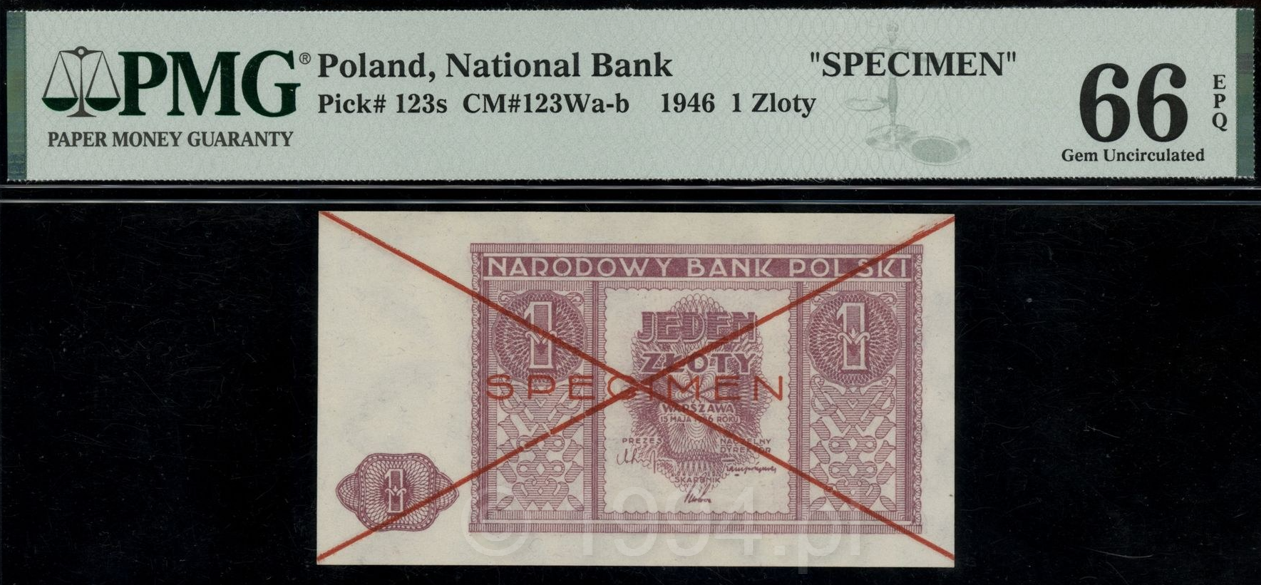
Poland 1946 Narodowy Bank Polski 1 Zloty Specimen with red SPECIMEN overprint, diagonal red cancellation lines, multi-tone triangular watermark, Pick 123s, PMG 66 EPQ Gem Uncirculated.

Poland 1946 - 1 Zloty Narodowy Bank Polski Specimen (Pick 123s)

The 1 Zloty specimen dated 15 May 1946 belongs to the first post-war currency series issued by Narodowy Bank Polski following the establishment of Poland's new monetary system after the Second World War. Prepared as an official specimen, it documents the final approved design and security features of the denomination before distribution for institutional reference and archival purposes. Read more →

PolandSpecimen19461 ZlotyPMG 66 EPQ Gem Uncirculated SpecimenNarodowy Bank PolskiState Note1 Zloty1946 IssueSPECIMEN OverprintRed Diagonal CancellationNo Serial NumberMulti-tone WatermarkTriangle WatermarkEdward DrożniakWitold TrąmpczyńskiKarol PustówkaRyszard KleczewskiTypographic PrintingGuilloche DesignPolish Security Printing WorksPWPWŁódźPolandPoland 1946Pick 123sMiłczak 123Wa-bPMG 66EPQGem UncirculatedMuseum Grade
Held
↑ Top