Collection PL

About

U.S. paper money embodies nearly two centuries of continuous change—social, technological, and institutional. From the 1830s onward, local banks, states, and private printers created an extraordinary visual record of America’s financial experimentation. Early proofs and scrips by firms such as Underwood, Bald, Spencer & Hufty or Rawdon, Wright, Hatch & Edson predate national unity, their engraved portraits and ornaments defining the first true American style of intaglio currency art.

The Civil War and Reconstruction introduced federal control and unprecedented production scale. The 1863 National Banking Act organized thousands of chartered banks whose notes—each bearing its town and charter number—documented regional enterprise from Massachusetts to Kansas. Large-size and small-size Nationals illustrate the transformation from local credit to federally secured obligations, while fractional and state issues like South Carolina’s 1872 Revenue Bonds record fiscal necessity in turbulent times.

The twentieth century shifted focus to standardization and innovation. The Series of 1914 Federal Reserve Notes established centralized issue under the new Reserve System; later small-size redesigns of 1928 codified modern U.S. dimensions. Experimental pieces—Giori press trials, C.O.P.E. calibration sheets, ABNC specimen notes—reveal the industry’s technical core, where anti-counterfeit design met production research. By mid-century, the Bureau of Engraving and Printing had refined color, security threads, and watermark technology into global benchmarks.

Spanning 1830 to 2003, this section captures the United States as engraver, innovator, and issuer—an unbroken lineage from independent presses to the Bureau’s modern laboratories of paper and ink.

61 results · Page 6 of 6
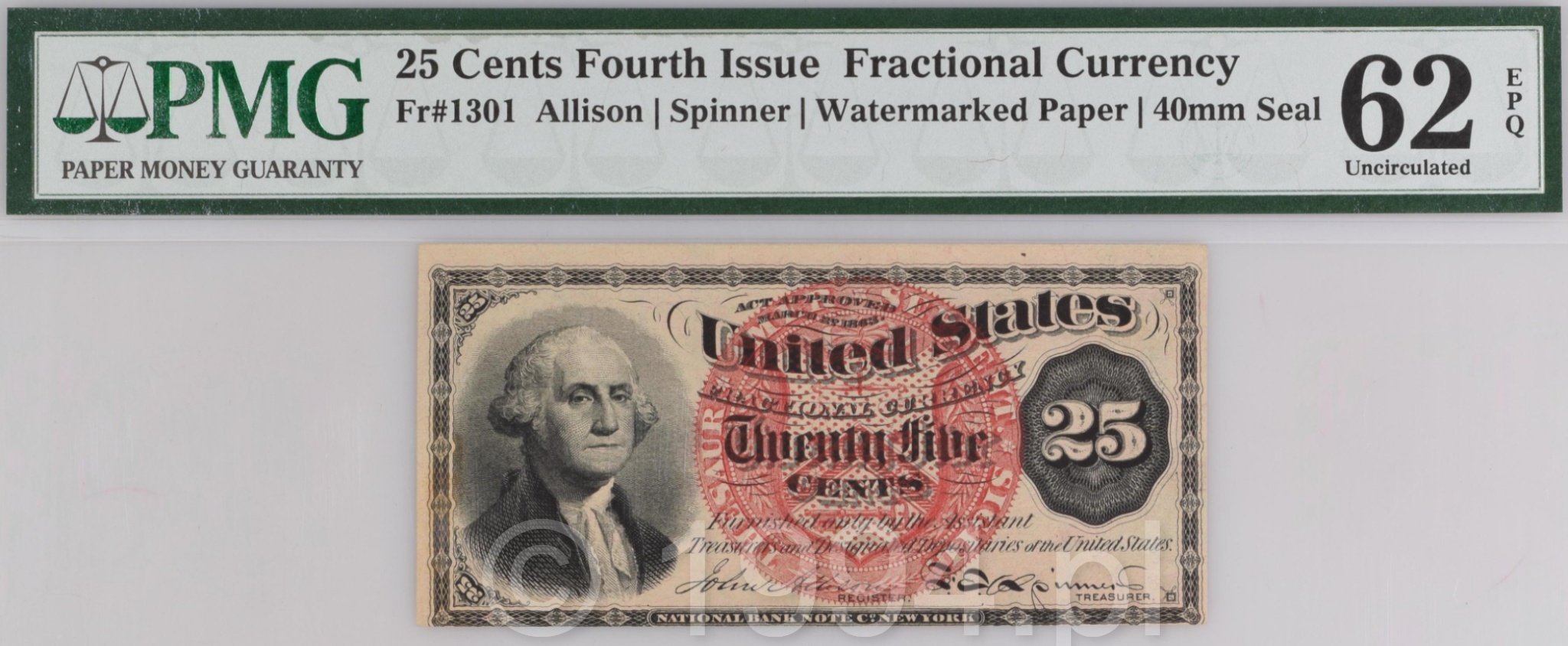
United States 1875 Fourth Issue Fractional Currency 25 Cents note, Friedberg 1301, printed on watermarked paper with 40 millimeter red Treasury seal, Allison and Spinner signatures, graded PMG 62 EPQ Uncirculated.

United States 1875 — Fourth Issue Fractional Currency, 25 Cents, Watermarked Paper, 40mm Seal (Friedberg 1301, Allison-Spinner)

The Fourth Issue 25 Cents Fractional Currency note, cataloged as Friedberg 1301, represents the mature phase of the Civil War–era fractional paper money system. Fractional currency was introduced during the coin shortages of the early 1860s when hoarding of silver created a critical absence of small change in circulation. By the Fourth Issue, the United States Treasury had refined both design and anti-counterfeiting measures to a high degree of technical sophistication. ... Read more →

United StatesIssued Note187525 CentsPMG 62 EPQ Uncirculated Fractional CurrencyFourth IssueWatermarked Paper40mm SealLarge red Treasury sealCivil War era currency25 CentsBureau of Engraving and PrintingFriedberg 1301Allison signatureSpinner signatureExceptional Paper Quality designationUnited States fractional moneyReconstruction era currencyEmergency paper currencyHistoryUnited States18751878PMG 62 EPQUncirculatedMuseum Grade
Held
↑ Top