Collection PL

About 1994.pl

U.S. paper money embodies nearly two centuries of continuous change—social, technological, and institutional. From the 1830s onward, local banks, states, and private printers created an extraordinary visual record of America’s financial experimentation. Early proofs and scrips by firms such as Underwood, Bald, Spencer & Hufty or Rawdon, Wright, Hatch & Edson predate national unity, their engraved portraits and ornaments defining the first true American style of intaglio currency art.

The Civil War and Reconstruction introduced federal control and unprecedented production scale. The 1863 National Banking Act organized thousands of chartered banks whose notes—each bearing its town and charter number—documented regional enterprise from Massachusetts to Kansas. Large-size and small-size Nationals illustrate the transformation from local credit to federally secured obligations, while fractional and state issues like South Carolina’s 1872 Revenue Bonds record fiscal necessity in turbulent times.

The twentieth century shifted focus to standardization and innovation. The Series of 1914 Federal Reserve Notes established centralized issue under the new Reserve System; later small-size redesigns of 1928 codified modern U.S. dimensions. Experimental pieces—Giori press trials, C.O.P.E. calibration sheets, ABNC specimen notes—reveal the industry’s technical core, where anti-counterfeit design met production research. By mid-century, the Bureau of Engraving and Printing had refined color, security threads, and watermark technology into global benchmarks.

Spanning 1830 to 2003, this section captures the United States as engraver, innovator, and issuer—an unbroken lineage from independent presses to the Bureau’s modern laboratories of paper and ink.

60 results · Page 5 of 5
United States 1838 Olney Alabama uncut remainder sheet with 25 cents, 50 cents, and 1 dollar notes printed by Manly and Orr, deckled bottom margin, PCGS Banknote Very Fine 25

United States 1838 - Olney, Alabama 25 Cents, 50 Cents, 1 Dollar Uncut Sheet Remainder

The notes were printed from stock designs produced by Manly and Orr of Philadelphia, a major nineteenth century security printing firm that supplied generic engraved templates to a wide range of customers across the United States during the 1830s. These designs were marketed for rapid adoption by banks, merchants, and local issuers seeking to introduce paper money without the expense of commissioning custom engravings. As a result, identical or closely related layouts appear across numerous state and local issues of the period. Read more →

United StatesRemainder183825 Cents, 50 Cents, 1 DollarPCGS Banknote Very Fine 25 RemainderUncut Sheet25 Cents50 Cents1 DollarFractional CurrencyStock EngravingManly and OrrDeckled EdgeAntebellum CurrencyPanic of 1837 EraLocal ScripUnofficial IssuerAlabama Monetary HistoryEarly American PrintingUnited StatesAlabamaOlney1838Gunther and Derby AO-386PCGS 25Museum GradeR8 Extremely Rare
Held
United States Series of 1928C Five Dollars Legal Tender Note with red Treasury seal and red serial numbers, GA block, Friedberg 1528, graded PMG 66 EPQ Gem Uncirculated, showing strong centering, vivid red seal color, and crisp engraving detail.

United States 1928C - Five Dollars Legal Tender Note Red Seal, Friedberg 1528, GA Block, PMG 66 EPQ Gem Uncirculated

The Series of 1928C Five Dollars Legal Tender Note represents one of the foundational issues of modern small-size United States currency. Authorized under the Legal Tender Acts and issued by the United States Treasury, this red seal note embodies the transition from the large format nineteenth-century designs to the compact format introduced in 1928. Friedberg 1528, bearing the signatures of W. A. Julian as Treasurer of the United States and Henry Morgenthau, Jr. as Secretary of the Treasury, belongs to the early production waves of small-size Legal Tender Notes. Read more →

United StatesLegal Tender Note19285 DollarsPMG 66 EPQ Gem Uncirculated Legal Tender NoteIssued NoteRed SealSmall size banknotePortrait of Abraham LincolnLincoln Memorial reverse5 DollarsBureau of Engraving and PrintingTreasury obligationJulian and Morgenthau signaturesGA blockFriedberg 1528Exceptional Paper Quality designationUnited States Legal Tender NotesEarly small size United States currencyTwentieth century United States paper moneyHistoryUnited States19281928CPMG 66 EPQGem UncirculatedMuseum Grade
Held
United States Series of 1934 5 Dollars Federal Reserve Note from the Cleveland District, Friedberg 1956-Dm DGS Mule, DA block, graded PMG 35 EPQ Choice Very Fine, showing portrait of Abraham Lincoln and black Federal Reserve seal.

United States 1934 - 5 Dollars Federal Reserve Note, Cleveland District, DGS Mule (DA Block), Friedberg 1956-Dm, PMG 35 EPQ Choice Very Fine

This Cleveland District issue, identified by the bold black Federal Reserve seal and the letter D within the district emblem, carries the signatures of W. A. Julian as Treasurer of the United States and Henry Morgenthau, Jr. as Secretary of the Treasury. The portrait of Abraham Lincoln dominates the obverse, rendered in layered intaglio engraving that preserves the depth and sculptural quality characteristic of early twentieth-century American banknote design. Read more →

United StatesFederal Reserve Note19345 DollarsPMG 35 EPQ Choice Very Fine Federal Reserve NoteIssued NoteSmall size banknoteBlack sealPortrait of Abraham Lincoln5 DollarsBureau of Engraving and PrintingCleveland Federal Reserve DistrictDGS Mule varietyDA blockFriedberg 1956-DmJulian and Morgenthau signaturesExceptional Paper Quality designationSeries of 1934 Federal Reserve NotesTransitional plate pairingUnited States monetary reform eraHistoryUnited States1934PMG 35 EPQChoice Very FineMuseum Grade
Held
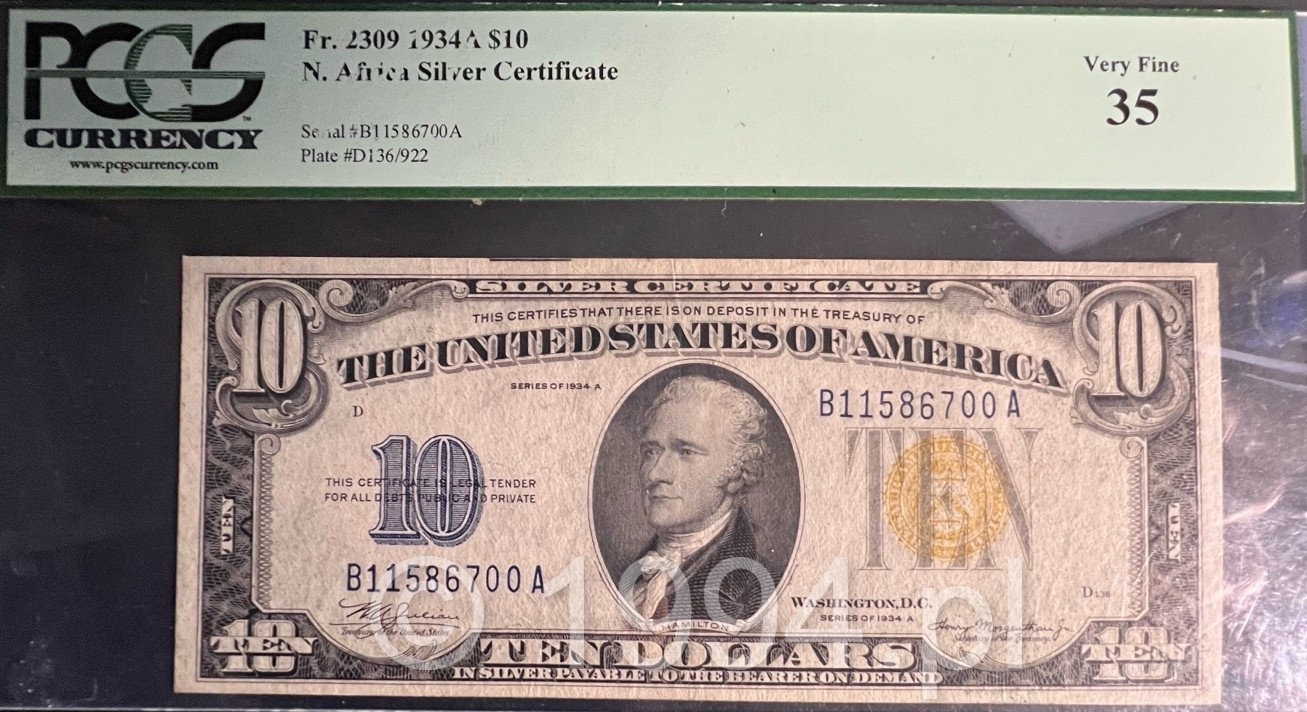
United States Series 1934A 10 Dollars North Africa Silver Certificate with yellow Treasury seal, Friedberg 2309, graded PCGS 35 Very Fine, featuring portrait of Alexander Hamilton.

United States 1934A - 10 Dollars North Africa Silver Certificate (Friedberg 2309), PCGS 35 Very Fine

Issued primarily for use by United States military personnel operating in North Africa and the Mediterranean theater, these notes reflect the logistical and financial complexities of global conflict. The yellow seal served as a rapid visual identifier, allowing for swift demonetization if necessary. Although the emergency cancellation authority was never exercised on a wide scale, the series stands as a tangible artifact of wartime contingency planning. Read more →

United StatesSilver Certificate193410 DollarsPCGS 35 Very Fine Silver CertificateNorth Africa issueYellow Treasury sealSmall size banknotePortrait of Alexander Hamilton10 DollarsBureau of Engraving and PrintingNew York Federal Reserve DistrictFriedberg 2309Second World War emergency issueUnited States wartime currencyEmergency seriesHistoryUnited States19341934APCGS 35Very FineMuseum Grade
Held
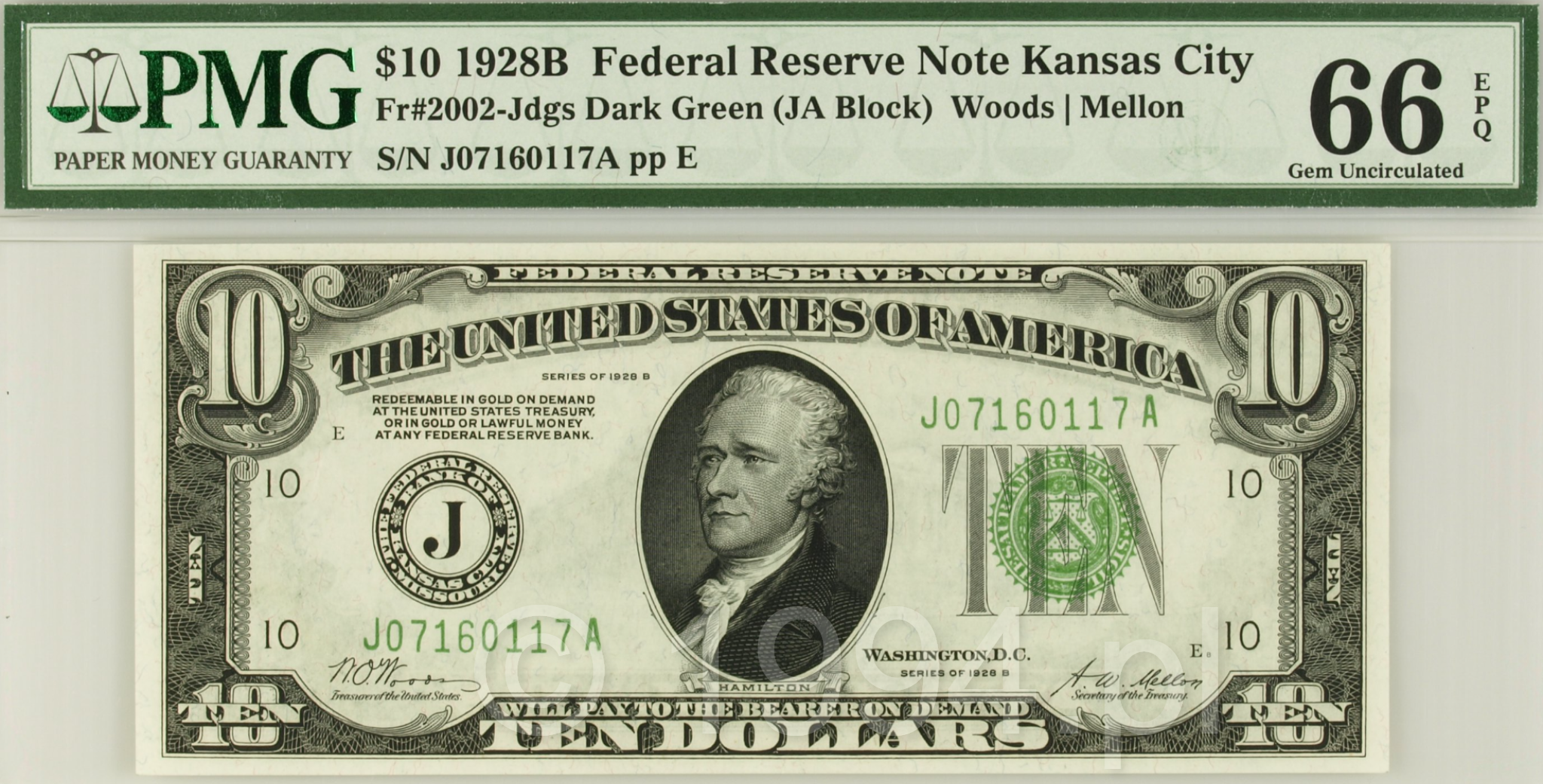
United States Series 1928B 10 Dollars Federal Reserve Note from the Kansas City District with Dark Green Seal, JA block, Friedberg 2002-Jdgs, graded PMG 66 EPQ Gem Uncirculated.

United States 1928B - 10 Dollars Federal Reserve Note, Kansas City District, Dark Green Seal, JA Block (Friedberg 2002-Jdgs), PMG 66 EPQ Gem Uncirculated

The Series 1928B 10 Dollars Federal Reserve Note from the Kansas City District, cataloged as Friedberg 2002-Jdgs, represents one of the early small-size Federal Reserve issues that defined modern United States currency. Bearing the signatures of Woods and Mellon, this example features the Dark Green Seal variety and belongs to the JA block, a detail of interest to specialists tracking early district production sequences. Read more →

United StatesFederal Reserve Note192810 DollarsPMG 66 EPQ Gem Uncirculated Federal Reserve NoteIssued NoteDark Green SealSmall size banknotePortrait of Alexander Hamilton10 DollarsBureau of Engraving and PrintingKansas City Federal Reserve DistrictJA blockFriedberg 2002-JdgsWoods and Mellon signaturesExceptional Paper Quality designationEarly small size United States currencyGold redemption clausePre-Great Depression issueHistoryUnited States19281928BPMG 66 EPQGem UncirculatedMuseum Grade
Held
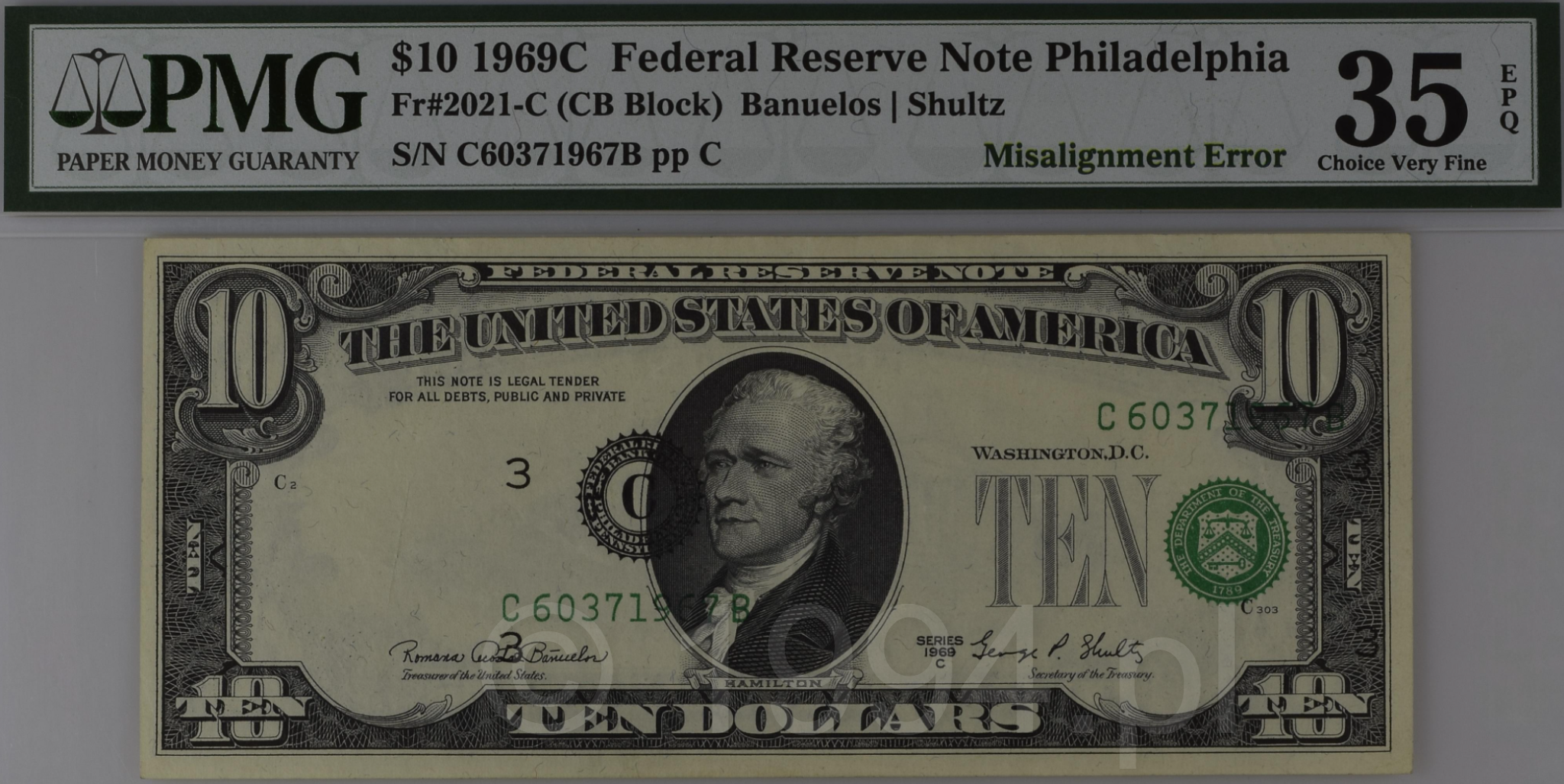
United States Series 1969C 10 Dollars Federal Reserve Note from the Philadelphia District with overprint misalignment error affecting the green seal and serial numbers, Friedberg 2021-C, graded PMG 35 EPQ Choice Very Fine.

United States 1969C - 10 Dollars Federal Reserve Note, Philadelphia District, Overprint Misalignment Error (Friedberg 2021-C, CB Block), PMG 35 EPQ Choice Very Fine

The obverse features the portrait of Alexander Hamilton, rendered in finely layered intaglio, while the reverse depicts the United States Treasury Building in Washington, D.C. The Philadelphia Federal Reserve District is identified by the letter C within the district seal and serial prefix. As a mid-century Federal Reserve issue, the note reflects the stabilized fiat monetary system established after the suspension of gold convertibility. Read more →

United StatesError Note196910 DollarsPMG 35 EPQ Choice Very Fine Federal Reserve NoteIssued NoteError NoteOverprint misalignment errorSmall size banknotePortrait of Alexander Hamilton10 DollarsBureau of Engraving and PrintingPhiladelphia Federal Reserve DistrictCB blockFriedberg 2021-CBanuelos and Shultz signaturesExceptional Paper Quality designationModern United States currencyUnited States printing errorFiat currency eraHistoryUnited States19691969CPMG 35 EPQChoice Very FineMuseum Grade
Held
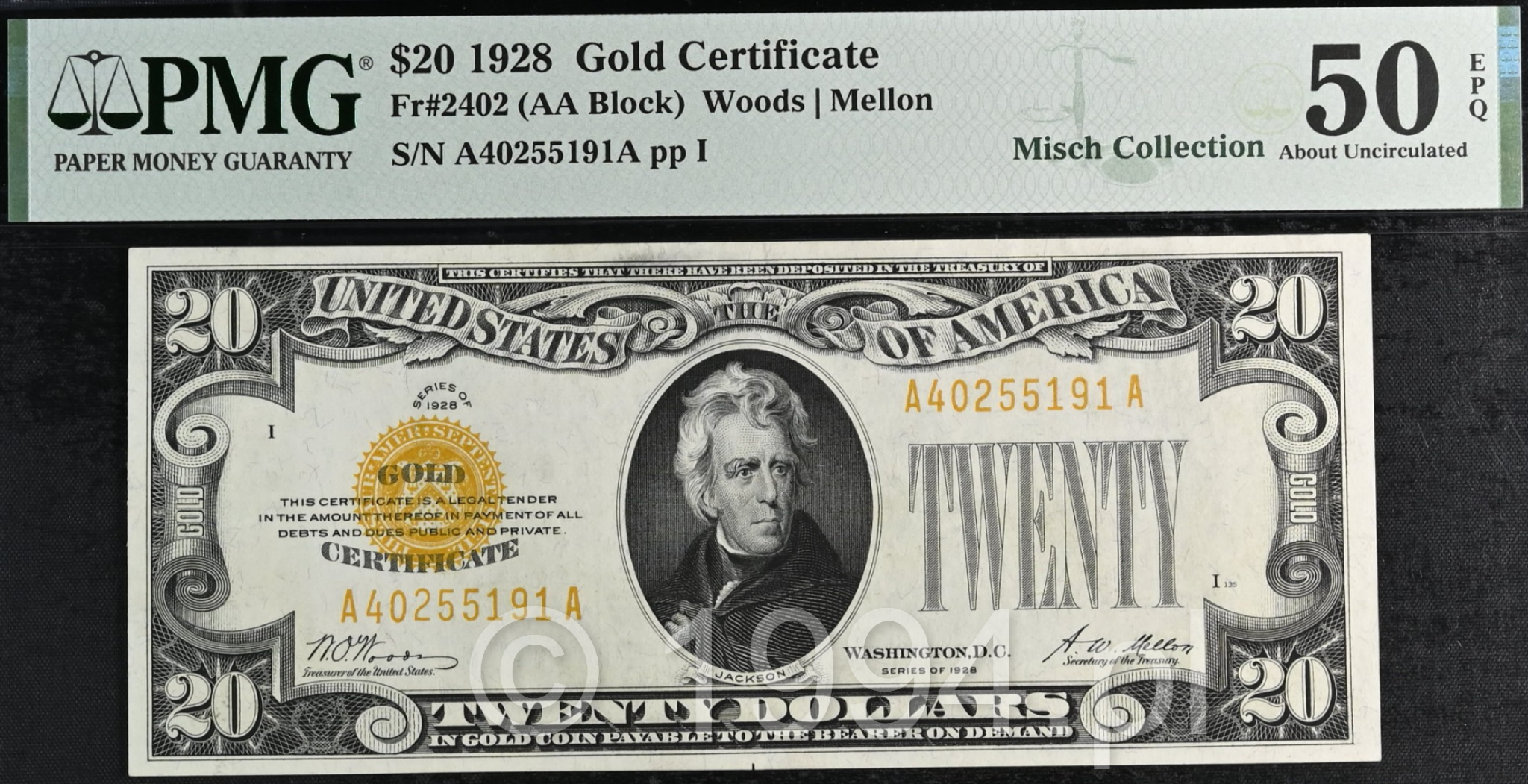
United States Series 1928 20 Dollars Gold Certificate with orange-gold Treasury seal and serial numbers, Friedberg 2402 AA block, graded PMG 50 EPQ About Uncirculated from the Misch Collection.

United States 1928 - 20 Dollars Gold Certificate (Friedberg 2402, AA Block), PMG 50 EPQ About Uncirculated

The Series 1928 20 Dollars Gold Certificate, cataloged as Friedberg 2402, represents the inaugural small-size issue of the denomination and one of the final circulating forms of gold-backed United States paper money. Bearing the signatures of Woods and Mellon, this example from the AA block carries the distinctive orange-gold Treasury seal and matching serial numbers that define Gold Certificate issues of the era. Read more →

United StatesGold Certificate192820 DollarsPMG 50 EPQ About Uncirculated Gold CertificateOrange-gold Treasury sealSmall size banknotePortrait of Andrew JacksonWhite House reverse20 DollarsBureau of Engraving and PrintingAA blockFriedberg 2402Woods and Mellon signaturesExceptional Paper Quality designationGold redemption clausePre-1933 gold standard eraUnited States gold-backed currencyHistoryUnited States1928PMG 50 EPQAbout UncirculatedMisch CollectionMuseum Grade
Held
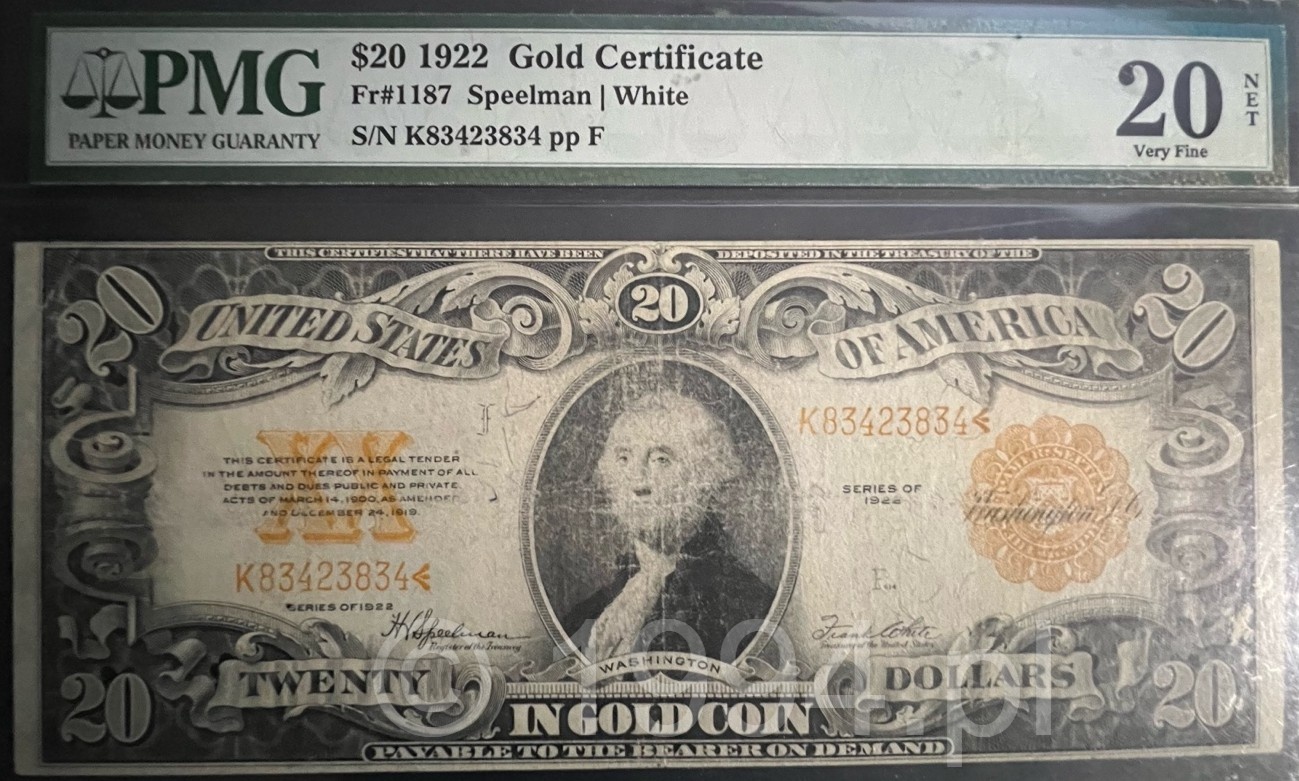
United States Series 1922 20 Dollars Gold Certificate with orange-gold Treasury seal and serial numbers, Friedberg 1187, graded PMG 20 Very Fine, featuring portrait of Andrew Jackson in large-size format.

United States 1922 - 20 Dollars Gold Certificate (Friedberg 1187), PMG 20 Very Fine

The Series 1922 20 Dollars Gold Certificate, cataloged as Friedberg 1187, represents one of the final large-size gold-backed issues prior to the transition to standardized small-size currency in 1928. Bearing the signatures of Treasurer Frank White and Register of the Treasury Frank Speelman, this issue embodies the mature phase of large-format United States Gold Certificates during the final decade of the classical gold standard era. Read more →

United StatesGold Certificate192220 DollarsPMG 20 Very Fine Gold CertificateLarge size banknoteOrange-gold Treasury sealPortrait of Andrew Jackson20 DollarsBureau of Engraving and PrintingFriedberg 1187Speelman and White signaturesGold redemption clausePre-1933 gold standard eraUnited States gold-backed currencyHistoryUnited States1922PMG 20Very FineMuseum Grade
Held
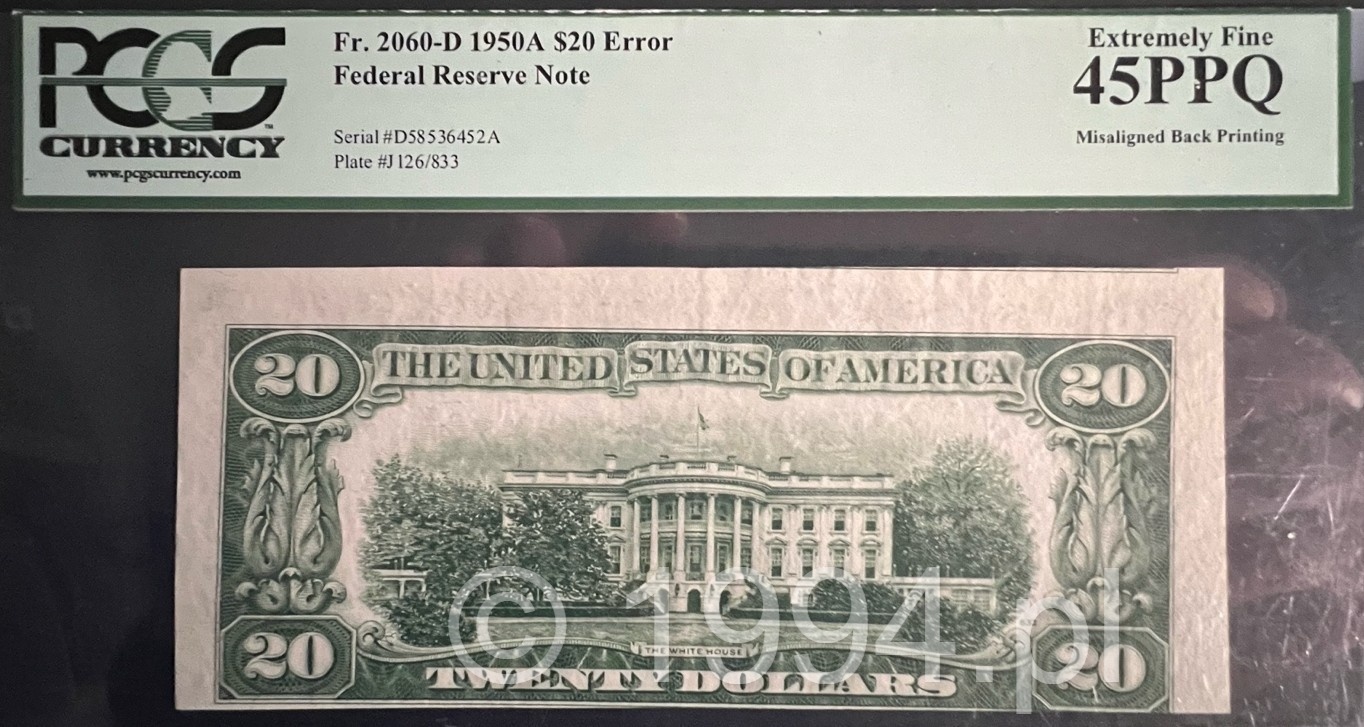
United States Series 1950A 20 Dollars Federal Reserve Note from the Cleveland District with misaligned back printing error, Friedberg 2060-D, graded PMG 45 PPQ Extremely Fine.

United States 1950A - 20 Dollars Federal Reserve Note, Cleveland District, Misaligned Back Printing Error (Friedberg 2060-D), PMG 45 PPQ Extremely Fine

Issued during the post-war fiat currency era, Series 1950A notes reflect the stabilized monetary system that followed the abandonment of domestic gold redemption. Although standard circulation pieces are common, error varieties such as misaligned back printings add significant mechanical and production interest to the type. Read more →

United StatesError Note195020 DollarsPMG 45 PPQ Extremely Fine Federal Reserve NoteIssued NoteError NoteMisaligned back printingSmall size banknotePortrait of Andrew Jackson20 DollarsBureau of Engraving and PrintingCleveland Federal Reserve DistrictFriedberg 2060-DPremium Paper Quality designationPost-war fiat currency eraUnited States printing errorMid twentieth century United States currencyHistoryUnited States19501950APMG 45 PPQExtremely FineMuseum Grade
Held
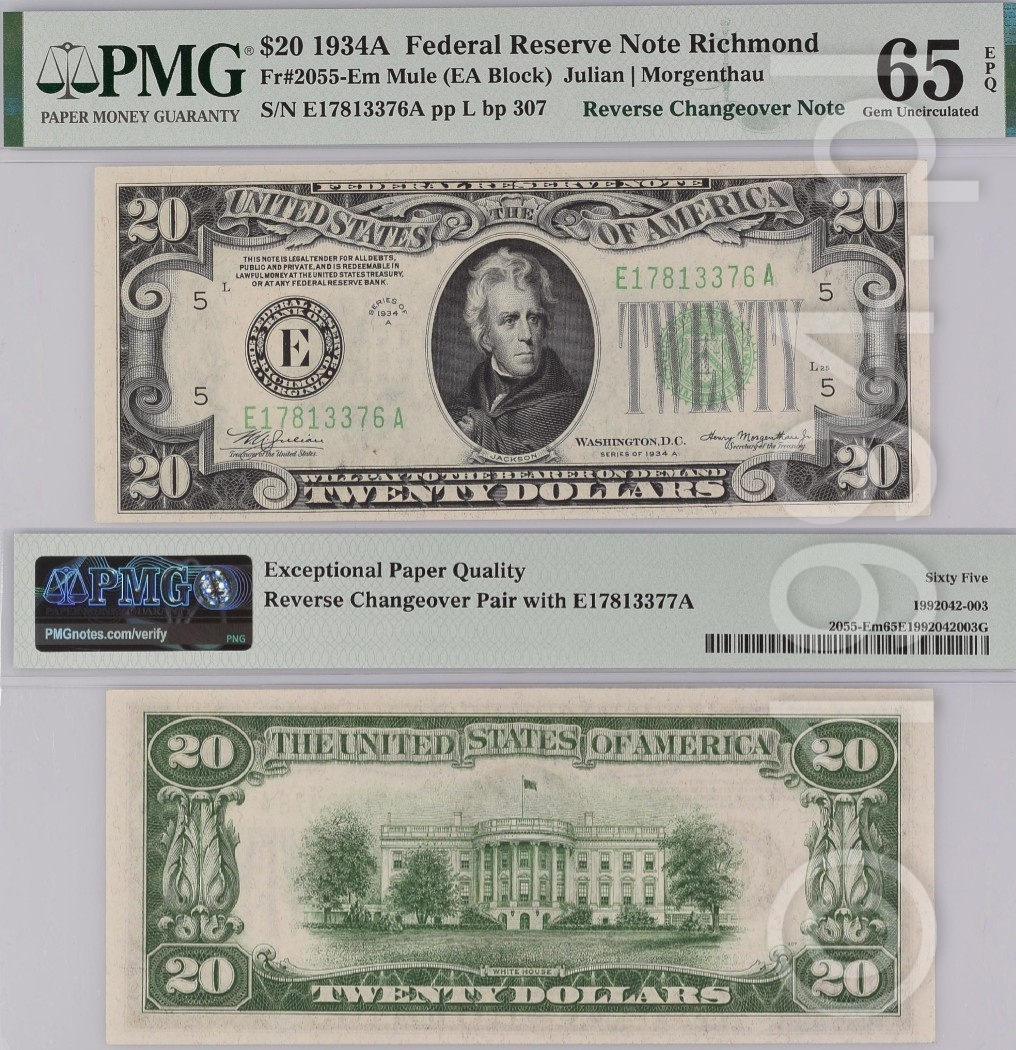
United States Series 1934A Reverse Changeover Mule 20 Dollars Richmond, Serial E17813376A paired with E17813377A, Friedberg 2055-Em, PMG 65 EPQ Gem Uncirculated.

United States 1934A - Reverse Changeover Mule, 20 Dollars Richmond, Serials E17813376A and E17813377A (Friedberg 2055-Em, EA Block)

The Series 1934A 20 Dollars Federal Reserve Note from the Richmond Federal Reserve District, cataloged as Friedberg 2055-Em, is certified as a Reverse Changeover Mule and represents the concluding position in a documented consecutive serial boundary pairing. Reverse changeover mules arise when the Bureau of Engraving and Printing transitions between reverse plate configurations within an active production sequence, resulting in adjacent serial numbers being printed from differing reverse plate states. Read more →

United StatesFederal Reserve Note193420 DollarsPMG 65 EPQ Gem Uncirculated Federal Reserve NoteIssued NoteReverse changeoverReverse changeover muleMuleMule varietyReverse plate transitionSerial boundary transitionConsecutive serial pairPlate change documentationSmall size banknotePortrait of Andrew Jackson20 DollarsBureau of Engraving and PrintingRichmond Federal Reserve DistrictEA blockFriedberg 2055-EmExceptional Paper Quality designationDepression era United States currencyEarly small size Federal Reserve NotesUnited States paper money varietyHistoryUnited States19341934AReverse Changeover Pair Richmond 1934 E17813376-77E17813376AE17813377APMG 65 EPQGem UncirculatedMuseum Grade
Held
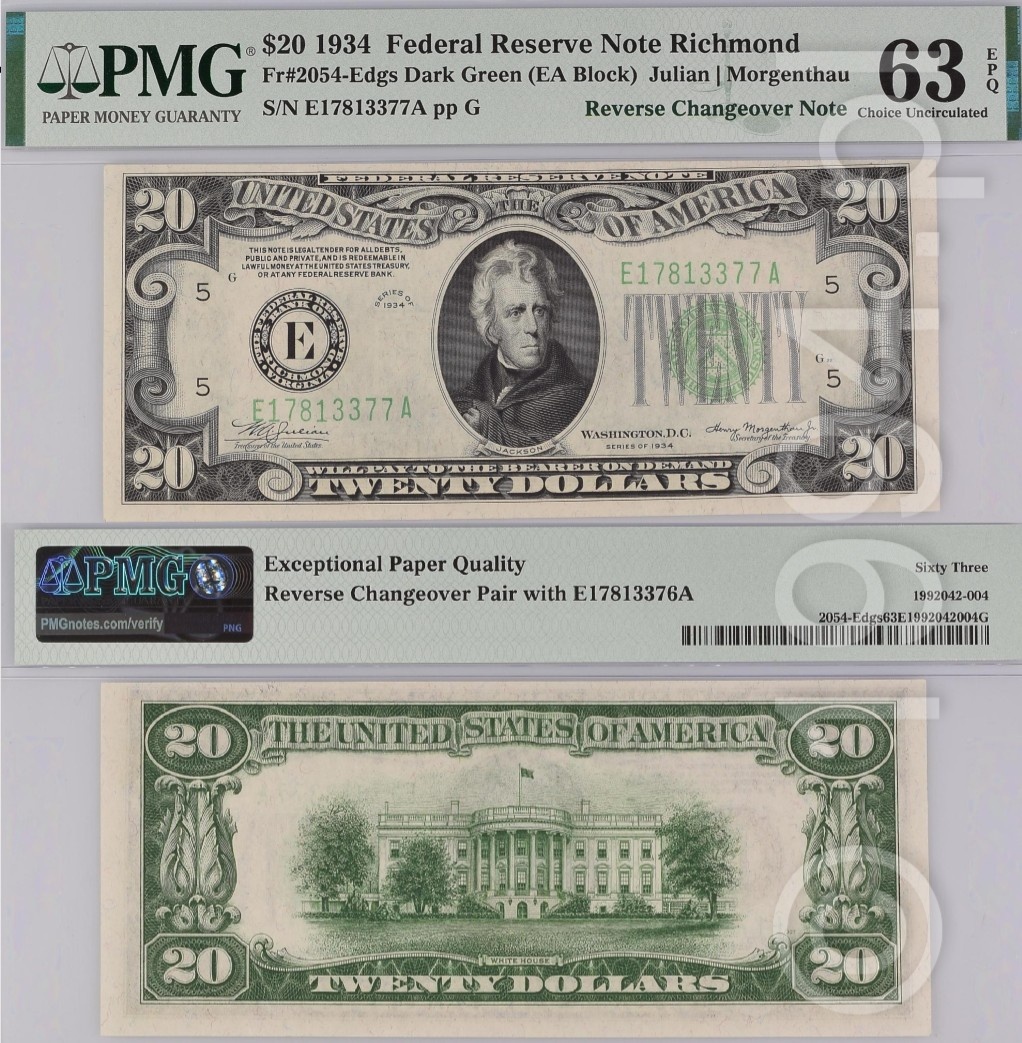
United States Series 1934 Reverse Changeover 20 Dollars Richmond, Dark Green, Serial E17813377A paired with E17813376A, Friedberg 2054-Edgs EA Block, PMG 63 EPQ Choice Uncirculated.

United States 1934 - Reverse Changeover, 20 Dollars Richmond, Dark Green, Serials E17813376A and E17813377A (Friedberg 2054-Edgs, EA Block)

Reverse changeover notes preserve the exact moment when the Bureau of Engraving and Printing transitioned between reverse plate states during active production. Serial E17813377A immediately follows Serial E17813376A, forming a mechanically verified consecutive boundary that captures the change in reverse plate configuration within Richmond District twenty-dollar printing. Read more →

United StatesFederal Reserve Note193420 DollarsPMG 63 EPQ Choice Uncirculated Federal Reserve NoteIssued NoteReverse changeoverDark GreenDark Green reverseReverse plate transitionSerial boundary transitionConsecutive serial pairPlate change documentationSmall size banknotePortrait of Andrew Jackson20 DollarsBureau of Engraving and PrintingRichmond Federal Reserve DistrictEA blockFriedberg 2054-EdgsExceptional Paper Quality designationDepression era United States currencyEarly small size Federal Reserve NotesUnited States paper money varietyHistoryUnited States1934Reverse Changeover Pair Richmond 1934 E17813376-77E17813376AE17813377APMG 63 EPQChoice UncirculatedMuseum Grade
Held
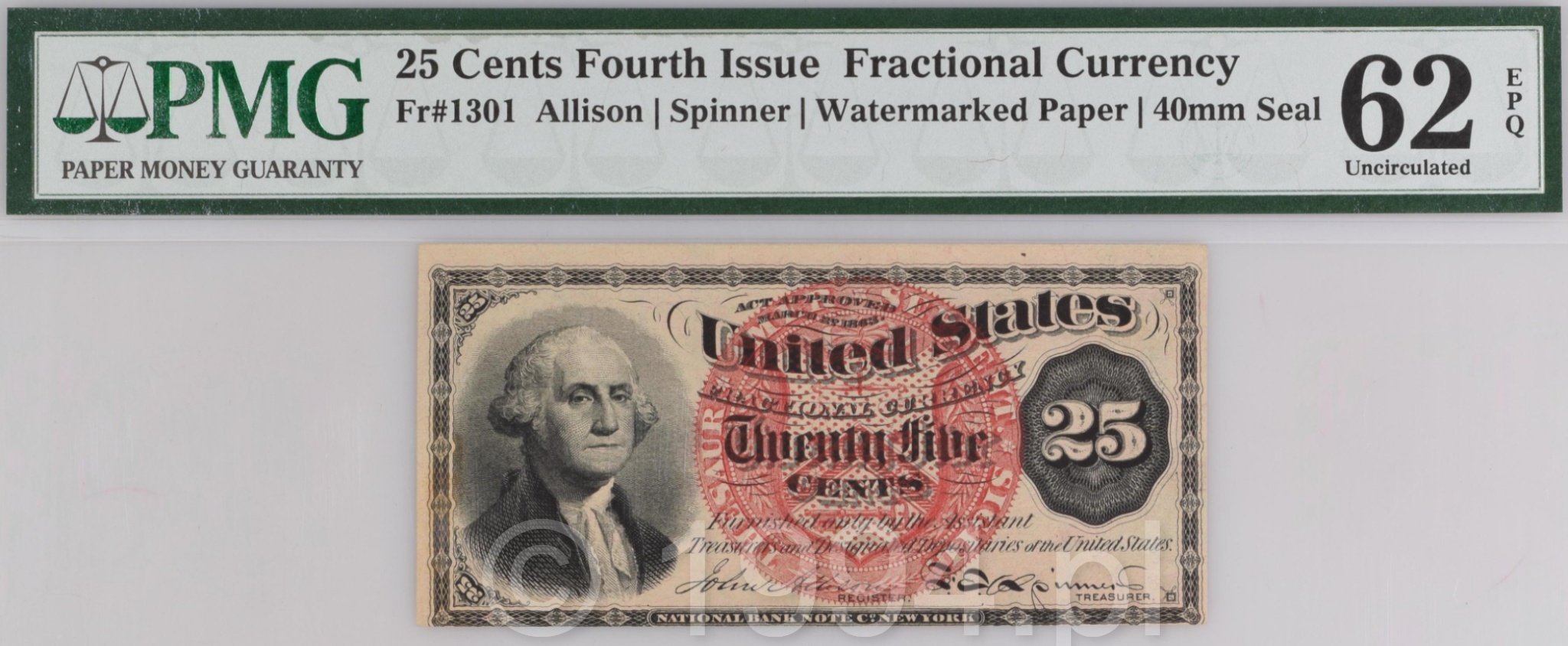
United States 1875 Fourth Issue Fractional Currency 25 Cents note, Friedberg 1301, printed on watermarked paper with 40 millimeter red Treasury seal, Allison and Spinner signatures, graded PMG 62 EPQ Uncirculated.

United States 1875 - Fourth Issue Fractional Currency, 25 Cents, Watermarked Paper, 40mm Seal (Friedberg 1301, Allison-Spinner)

The Fourth Issue 25 Cents Fractional Currency note, cataloged as Friedberg 1301, represents the mature phase of the Civil War–era fractional paper money system. Fractional currency was introduced during the coin shortages of the early 1860s when hoarding of silver created a critical absence of small change in circulation. By the Fourth Issue, the United States Treasury had refined both design and anti-counterfeiting measures to a high degree of technical sophistication. Read more →

United StatesFractional Currency187525 CentsPMG 62 EPQ Uncirculated Fractional CurrencyIssued NoteFourth IssueWatermarked Paper40mm SealLarge red Treasury sealCivil War era currency25 CentsBureau of Engraving and PrintingFriedberg 1301Allison signatureSpinner signatureExceptional Paper Quality designationUnited States fractional moneyReconstruction era currencyEmergency paper currencyHistoryUnited States18751878PMG 62 EPQUncirculatedMuseum Grade
Held
↑ Top