China’s paper-money history is defined by fragmentation rather than uniformity. From the late Qing dynasty through the Republican period and into the immediate post-war years, monetary authority was frequently exercised at the provincial, military, or municipal level. Alongside centrally issued notes, a wide range of emergency, command-level, and substitute currencies circulated, authorised locally and intended for limited regional use. These systems emerged in response to political collapse, occupation, and the absence of a stable national banking framework.

Textile currency represents one of the most distinctive material responses to these conditions, produced when paper, secure printing facilities, or transport routes were unavailable. Issued by frontier military commands and provisional administrations, such notes functioned as practical instruments of local finance. Equally significant are wartime and post-war command-issued paper currencies, including notes produced under direct military authority during periods of occupation and administrative transition, when monetary control was exercised outside civilian institutions.

The material presented here emphasizes evidence rather than typology: issued notes, revalidated wartime currency, and archival printer material that document how denomination, authority, and legitimacy were established under extreme constraints. Read together, these objects allow reconstruction of parallel monetary systems that operated alongside or in place of formal banking, offering direct insight into how currency functioned at the margins of state control in modern Chinese history.

9 results · Page 1 of 1
Late Qing Sinkiang textile emergency currency printed on red-dyed cloth using hand-carved woodblocks, circa 1880

China 1880 - Sinkiang Textile Emergency Currency Cloth Note (Pick Unlisted)

As a historical artifact, this note records how late Qing frontier authorities sustained economic continuity using locally adapted solutions. It stands as material evidence of a monetary system operating beyond the reach of centralized control, relying instead on durability, recognizability, and regional legitimacy to function. Read more →

ChinaTextile Emergency Currency1880Unknown Local DenominationFine (Textile Issue) Textile BanknoteTextile Emergency CurrencyCloth BanknoteCloth NoteHand-Carved Woodblock PrintingLate Qing Frontier IssueWoodblock PrintingSinkiangChina1880R9 Extremely RareUniqueMuseum GradePick Unlisted
Held
China 1915 South Sinkiang Border Defence Headquarters 1 tael textile emergency banknote printed on woven cloth with red overprint and bilingual inscriptions

China 1915 - South Sinkiang Border Defence Headquarters 1 Tael Textile Emergency Issue (Pick Unlisted)

At the center of the design appears a radiating sun emblem enclosing Chinese characters identifying the issuing authority. Surrounding ornamental frames incorporate geometric and vegetal motifs that draw from both Han Chinese and Islamic decorative traditions. This hybrid visual language reflects the multiethnic administrative environment of southern Sinkiang, where monetary instruments had to function across linguistic and cultural boundaries. Inscriptions appear in both Chinese and Uyghur or Chagatai script, reinforcing the note’s official status within a bilingual bureaucratic system. Read more →

ChinaTextile Banknote19151 TaelFine (Textile Issue) Textile BanknoteTextile Emergency CurrencyCloth CurrencyMilitary Emergency Issue1 TaelWoodblock PrintingRed OverprintSouth Sinkiang Border Defence HeadquartersFrontier Military AdministrationRegional Monetary SystemUyghur-Chinese Bilingual IssueCentral Asian Frontier FinanceSecurity Printing HistoryChinaSinkiangSouth Sinkiang1915R9 Extremely RareUniqueMuseum GradePick Unlisted
Held
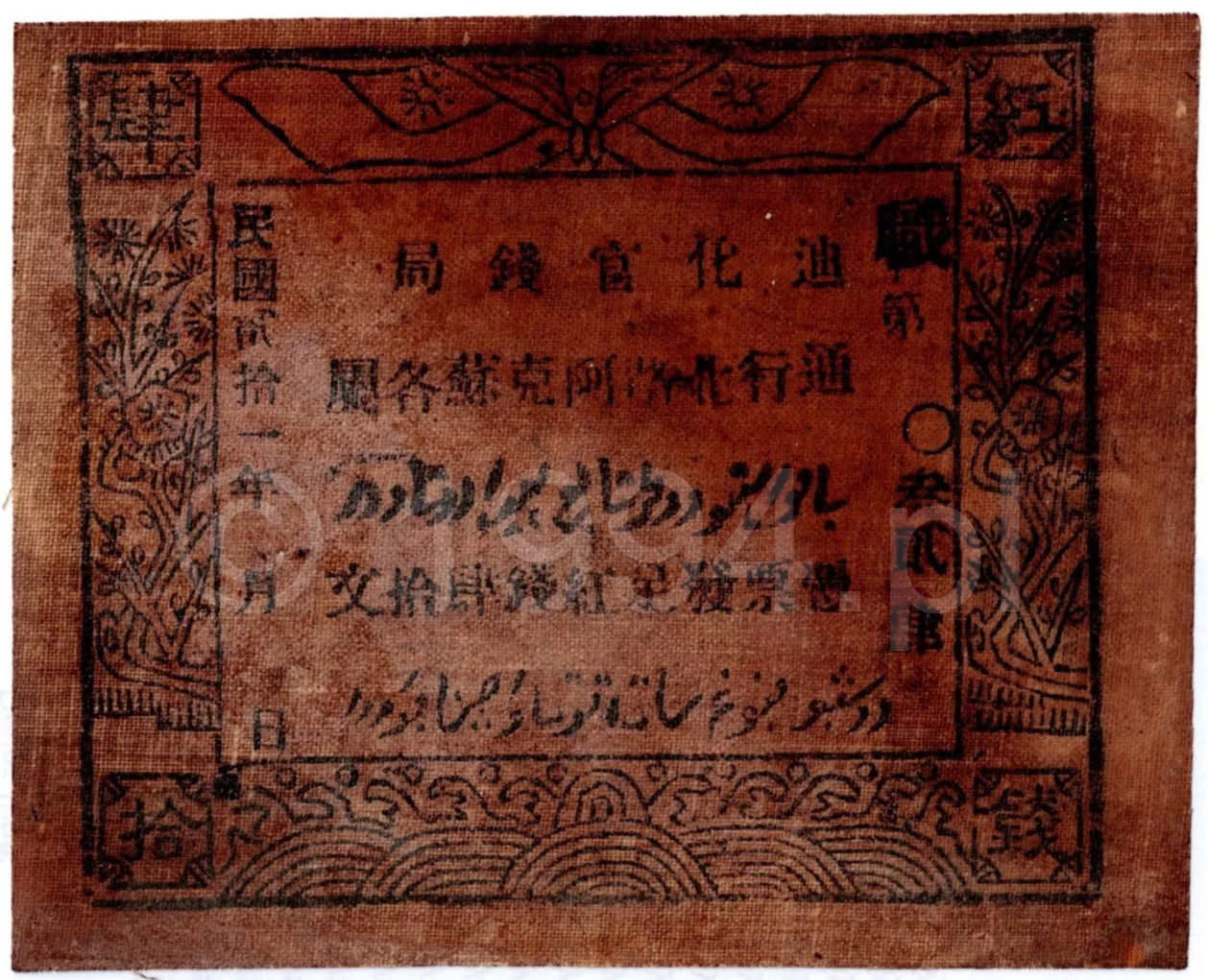
China 1918 Xinjiang textile emergency currency printed on red cloth by woodblock, with framed inscription panel, vegetal side borders, winged emblem, and wave-pattern lower band

China 1918 - Xinjiang Textile Emergency Currency Printed on Red Cloth, Local Authority Issue (Pick Unlisted)

Textile emergency currency of this type was issued as functional money for everyday transactions, provisioning, and local settlement in environments where paper currency was unavailable or impractical. Once monetary conditions stabilized, such notes were typically withdrawn and destroyed, accounting for their extremely low survival rate. Read more →

ChinaTextile Emergency Currency1918UnspecifiedIssued (Textile Emergency Currency) Textile BanknoteTextile Emergency CurrencyCloth BanknoteIssued Emergency MoneyWoodblock PrintingFrontier CurrencyXinjiangSinkiangLocal Authority IssueEarly Republican PeriodRegional Monetary SystemChina1918Museum GradeR9 Extremely RareUniquePick Unlisted
Held
China 1920 Xinjiang textile emergency currency printed on red cloth by woodblock, showing framed inscription panel and ornamental borders

China 1920 - Xinjiang Textile Emergency Currency Printed on Red Cloth, Local Authority Issue (Pick Unlisted)

The note was issued as functional money, not as symbolic or ceremonial material. Textile currency of this type was intended for everyday transactions, provisioning, and local settlement in environments where paper currency was unavailable or impractical. Once monetary conditions stabilized, such notes were typically withdrawn and destroyed, resulting in extremely low survival rates. Read more →

ChinaTextile Emergency Currency1920UnspecifiedIssued (Textile Emergency Currency) Textile BanknoteTextile Emergency CurrencyCloth BanknoteIssued Emergency MoneyWoodblock PrintingFrontier CurrencyXinjiangSinkiangLocal Authority IssueEarly Republican PeriodRegional Monetary SystemChina1920Museum GradeR9 Extremely RareUniquePick Unlisted
Held
China 1921 Xinjiang textile emergency currency printed on red cloth by woodblock, featuring a winged emblem with sun motif and framed inscription panel

China 1921 - Xinjiang Textile Emergency Currency Printed on Red Cloth with Sun Emblem (Pick Unlisted)

An issued textile emergency currency produced in Xinjiang (Sinkiang) during the early Republican period, printed by hand from carved woodblocks onto red-dyed cotton cloth. This note represents a distinct local issue within the Xinjiang textile tradition, created for circulation under conditions of monetary instability, limited access to paper currency, and decentralized administrative control in China’s western frontier. Read more →

ChinaTextile Emergency Currency1921UnspecifiedIssued (Textile Emergency Currency) Textile BanknoteTextile Emergency CurrencyCloth BanknoteIssued Emergency MoneyWoodblock PrintingFrontier CurrencyXinjiangSinkiangLocal Authority IssueEarly Republican PeriodSun EmblemChina1921Museum GradeR9 Extremely RareUniquePick Unlisted
Held
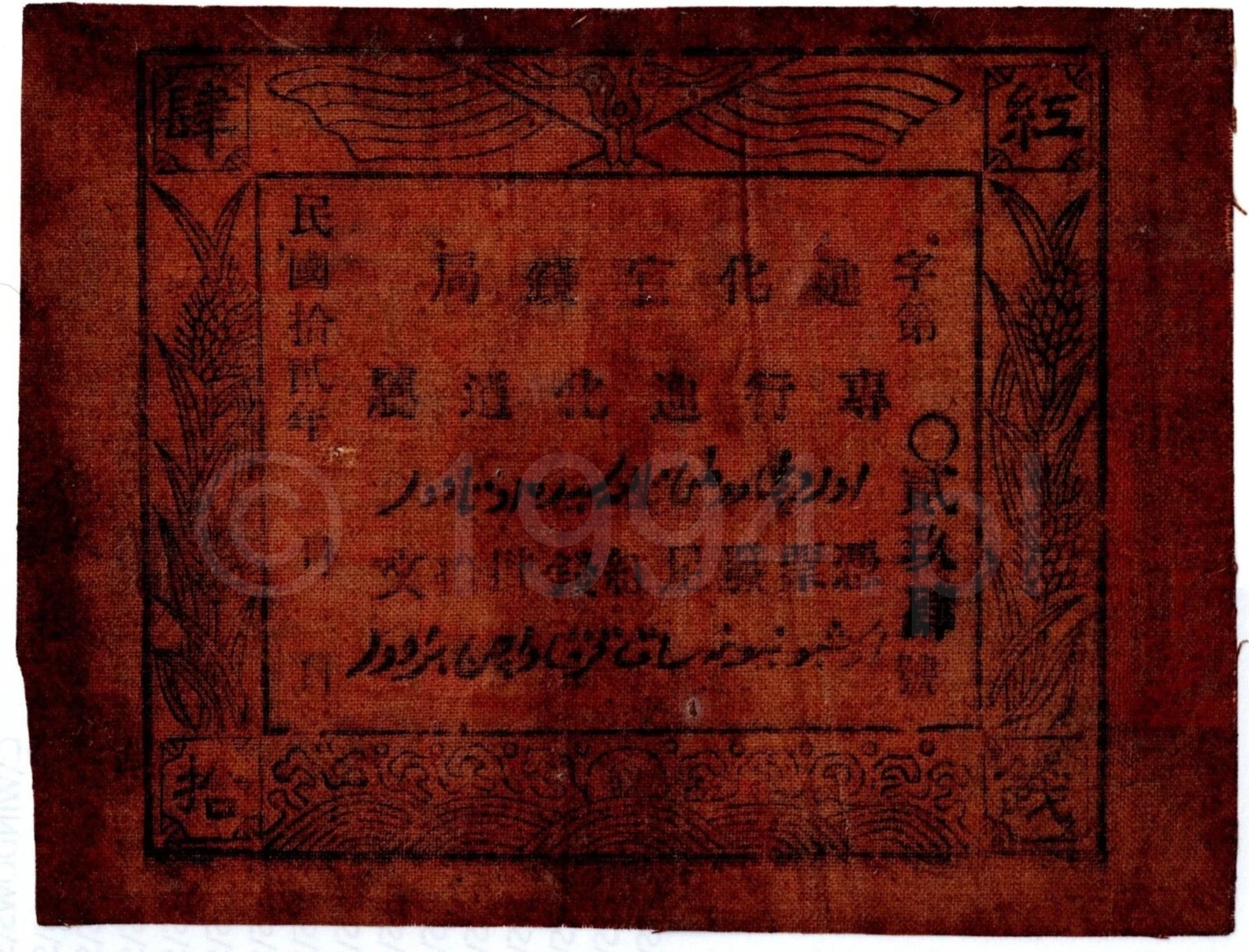
China 1922 Xinjiang textile emergency currency printed on red cloth by woodblock, with framed inscription panel, vegetal borders, and wave-pattern lower band

China 1922 - Xinjiang Textile Emergency Currency Printed on Red Cloth, Local Authority Issue (Pick Unlisted)

Calligraphy on this note is denser and more compact than that seen on earlier Xinjiang textile currency, with tighter spacing and heavier stroke weight. Ink saturation is deeper and more uniform, suggesting a later workshop phase or revised production method while still retaining the irregularities characteristic of hand-printed cloth money. Read more →

ChinaTextile Emergency Currency1922UnspecifiedIssued (Textile Emergency Currency) Textile BanknoteTextile Emergency CurrencyCloth BanknoteIssued Emergency MoneyWoodblock PrintingFrontier CurrencyXinjiangSinkiangLocal Authority IssueEarly Republican PeriodRegional Monetary SystemChina1922Museum GradeR9 Extremely RareUniquePick Unlisted
Held
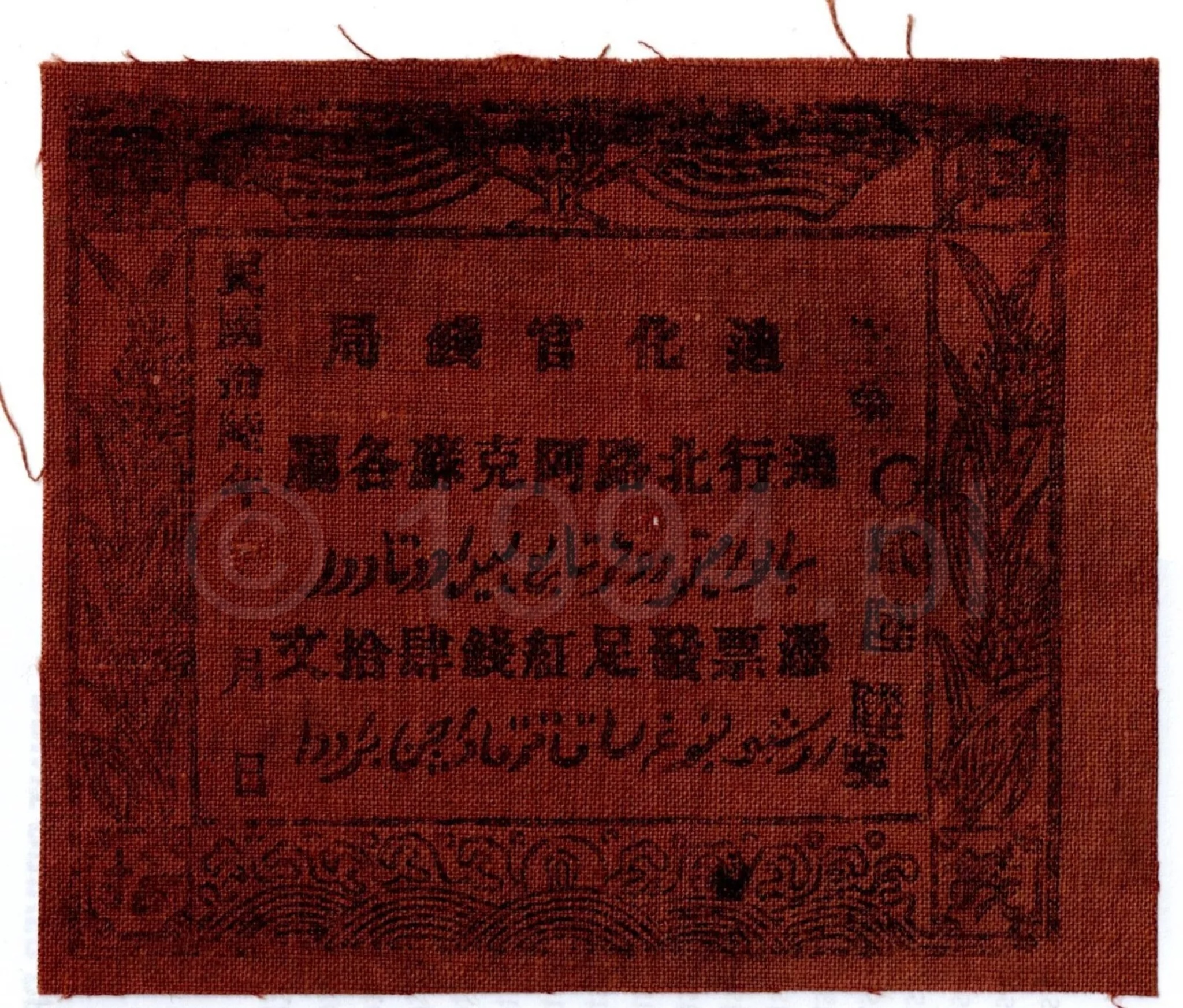
China 1924 Dihua Official Coin Bureau 40 wen textile emergency banknote printed on red cotton with Chinese and Uyghur inscriptions

China 1924 - Dihua Official Coin Bureau 40 Wen Textile Emergency Issue (Pick Unlisted)

This 40 wen textile banknote represents a formally authorized emergency issue produced in 1924 by the Dihua Official Coin Bureau during a period of acute monetary disruption in Xinjiang. Faced with shortages of paper currency, disrupted transport routes, and limited access to centralized printing facilities, local authorities adopted cloth as an alternative monetary substrate to sustain everyday economic activity. Read more →

ChinaTextile Banknote192440 WenCirculated (Textile Issue) Textile BanknoteTextile Emergency CurrencyCloth CurrencyEmergency Issue40 WenWoodblock PrintingDihua Official Coin BureauXinjiangRepublican ChinaRegional Monetary SystemMultilingual CurrencyProvisional FinanceChina1924R8 Extremely RareMuseum GradePick Unlisted
Held
China 1945 Soviet Red Army Headquarters 100 yuan issued banknote with serial numbers and official 1946 revalidation mark

China 1945 - Soviet Red Army Headquarters 100 Yuan Issued Note, Revalidated 1946 (Pick M36)

As a historical object, this banknote provides direct evidence of how military command substituted for central banking in post-war Manchuria. It illustrates the intersection of armed authority, emergency finance, and provisional governance at a moment when sovereignty, currency, and legitimacy were actively renegotiated in northeastern China. Read more →

ChinaIssued Note1945100 YuanAbout Uncirculated (Issued, Revalidated) Issued BanknoteMilitary Authority CurrencyWartime IssueRevalidated Issue100 YuanRussiaSoviet Red Army HeadquartersRed Army Command CurrencyPost-War ManchuriaMilitary Occupation FinanceProvisional Monetary SystemChinaManchuria19451946R7 Extremely RareMuseum GradePick M36
Held
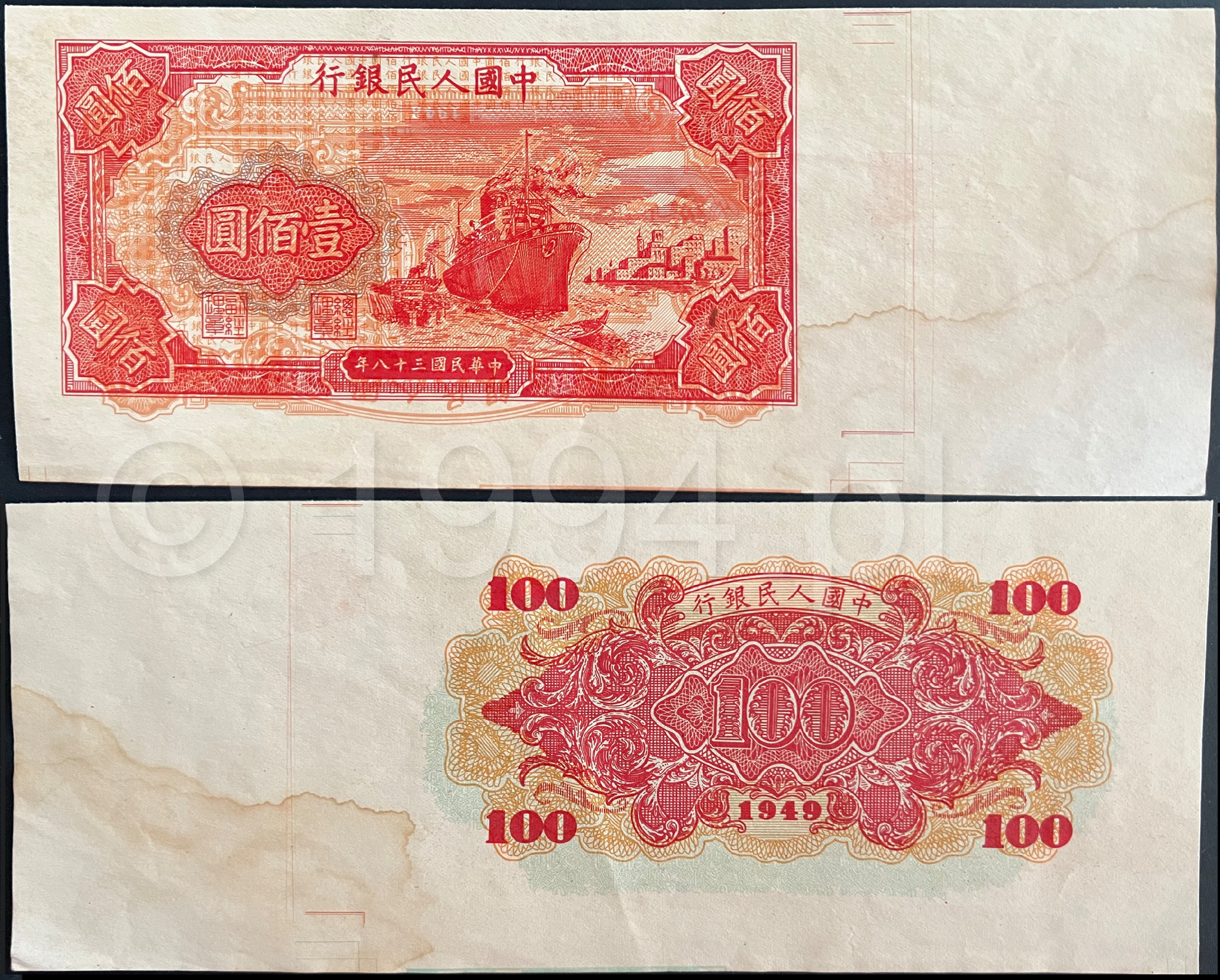
China 1949 People's Bank of China 100 Yuan Red Ship unnumbered multi-layer alignment trial printed by the Shanghai Banknote Printing Plant, with oversized sheet margin, printer guide marks, no serial number, inverted 1948 100 Yuan Ploughing and Factory underprint beneath the face design, and blue 100-denomination underprint visible beneath the reverse, cataloged as Pick Unlisted

China 1949 - People's Bank of China 100 Yuan Red Ship Unnumbered Multi-Layer Alignment Trial with Inverted 1948 100 Yuan Underprint (Pick Unlisted)

The reverse preserves a separate blue 100-denomination underprint or background layer beneath the Red Ship design. Repeating 100 numerals remain visible throughout the exposed blue field, most prominently below the main reverse design and continuing into both side margins. Read more →

ChinaAlignment Trial1949100 YuanUngraded Alignment TrialProduction TrialUnnumbered Alignment TrialMulti-layer Alignment TrialPre-numbering Trial ImpressionSheet-margin Trial ImpressionPrinting ErrorAlignment Error1948 100 Yuan Underprint1948 100 Yuan Ploughing and Factory UnderprintInverted 1948 100 Yuan UnderprintInverted Ploughing and Factory Underprint1948 100 Yuan Reverse UnderprintBlue 100 Yuan UnderprintBlue 100-denomination UnderprintBlue Security Underprint100 Yuan Security UnderprintDisplaced 1948 100 Yuan UnderprintDisplaced Blue 100 Yuan UnderprintDisplaced Production PrintingProduction-stage Printing AnomalyLower Margin PrintingNo Serial NumberPick Unlisted100 YuanRed ShipPloughing and FactoryCargo VesselIndustrial HarborOversized Sheet MarginPrinter Guide MarksFirst Series RenminbiShanghai Banknote Printing PlantBanknote PrintingProduction-stage MaterialPrinting AlignmentBackground Impression AlignmentSecurity Printing LayerColor Registration MarksUntrimmed Sheet MarginPre-numbering StagePeople's Bank of ChinaChinese Monetary HistoryEarly People's Republic of ChinaRenminbi Monetary ConsolidationPostwar ChinaSecurity Printing HistoryPublic Finance HistoryHistoryChina19491948Pick number 831bPick number 807aUniqueMuseum GradeR9 Extremely Rare
Held
↑ Top