Description and research notes
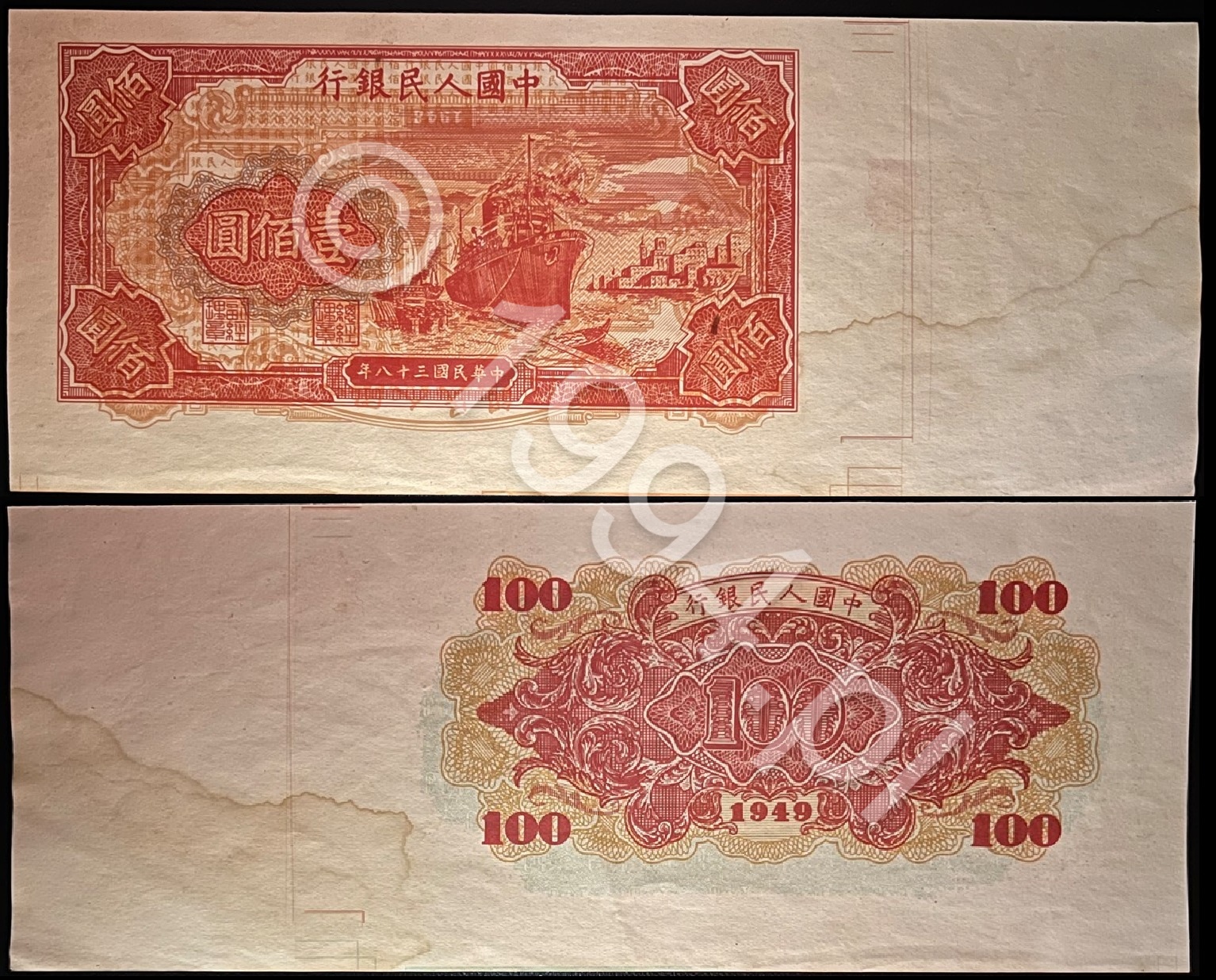
This 1949 100 Yuan Red Ship unnumbered alignment trial from the People's Bank of China belongs to the production history of the First Series Renminbi, the founding paper-money issue of the early People's Republic of China. The issued Red Ship note is cataloged as Pick 831b, while this piece is Pick Unlisted because it survives outside the finished note format: unnumbered, untrimmed, with printer guide marks, and with an inverted 1948 100 Yuan Ploughing and Factory underprint visible beneath the later Red Ship face.
The Red Ship type was printed by the Shanghai Banknote Printing Plant at a time when China's new national currency was still being prepared under pressure. This piece reflects that working environment. It is not a normal issued note and not a circulation error. It is a production-stage sheet, most likely connected to press setup, alignment, color, pressure, or layout testing before sheets were finished, numbered, trimmed, and released.
Issued Red Ship notes were completed with a three-character prefix and serial number. This example remains before that finishing stage. The oversized margin, missing serial number, and guide marks place it within the pressroom process rather than the circulation life of the note.
The defining feature is the inverted 1948 100 Yuan Ploughing and Factory underprint beneath the 1949 Red Ship face. The visible 1948 date, 100 Yuan denomination elements, scroll ornaments, and border structure match the 1948 100 Yuan design. These are not stains, ink transfer, or random press marks. They are structured printed banknote elements from an earlier 100 Yuan impression reused beneath the later Red Ship printing.
The inverted orientation is important because it helps reveal the earlier layer. If the 1948 100 Yuan underprint had aligned in the same direction as the later Red Ship design, much of it may have disappeared into the heavier borders, title, denomination panels, and harbor illustration of the new print. Instead, the 180-degree reversal allowed parts of the older design to remain visible through lighter areas of the Red Ship face.
The most practical explanation is that a sheet already carrying the earlier 1948 100 Yuan Ploughing and Factory impression was reused as setup or test waste during production of the later Red Ship design. In that context, the presence of old printing on the sheet would not itself have mattered. The sheet was not intended to become a finished note. Its purpose was likely practical: testing alignment, color, pressure, layout, or press behavior.
What makes the object important is not simply that scrap material was reused, but that this sheet survived after the test stage. Material like this should normally have been destroyed with other pressroom waste. Instead, it preserves a visible overlap between two production moments: an earlier 1948 100 Yuan Ploughing and Factory impression and the later 1949 Red Ship design.
The reverse presents the normal ornamental 100 Yuan Red Ship reverse dated 1949, printed in red and yellow with pale blue-green background elements. Together with the face, margins, guide marks, missing serial number, and inverted underlying 1948 100 Yuan impression, it confirms the object as an unfinished production-stage survivor rather than a completed banknote.
The interest of this piece lies in its physical printing evidence. It shows the Red Ship design before the final note became clean, numbered, trimmed, and ordinary. At the same time, it preserves the accidental survival of an earlier 1948 100 Yuan Ploughing and Factory underprint underneath. That combination of later Red Ship printing, earlier inverted 1948 100 Yuan underprint, oversized margin, guide marks, and pre-numbering state is what makes the piece unusual. It is a pressroom survivor that should normally have disappeared before collectors ever had a chance to see it.