Description and research notes
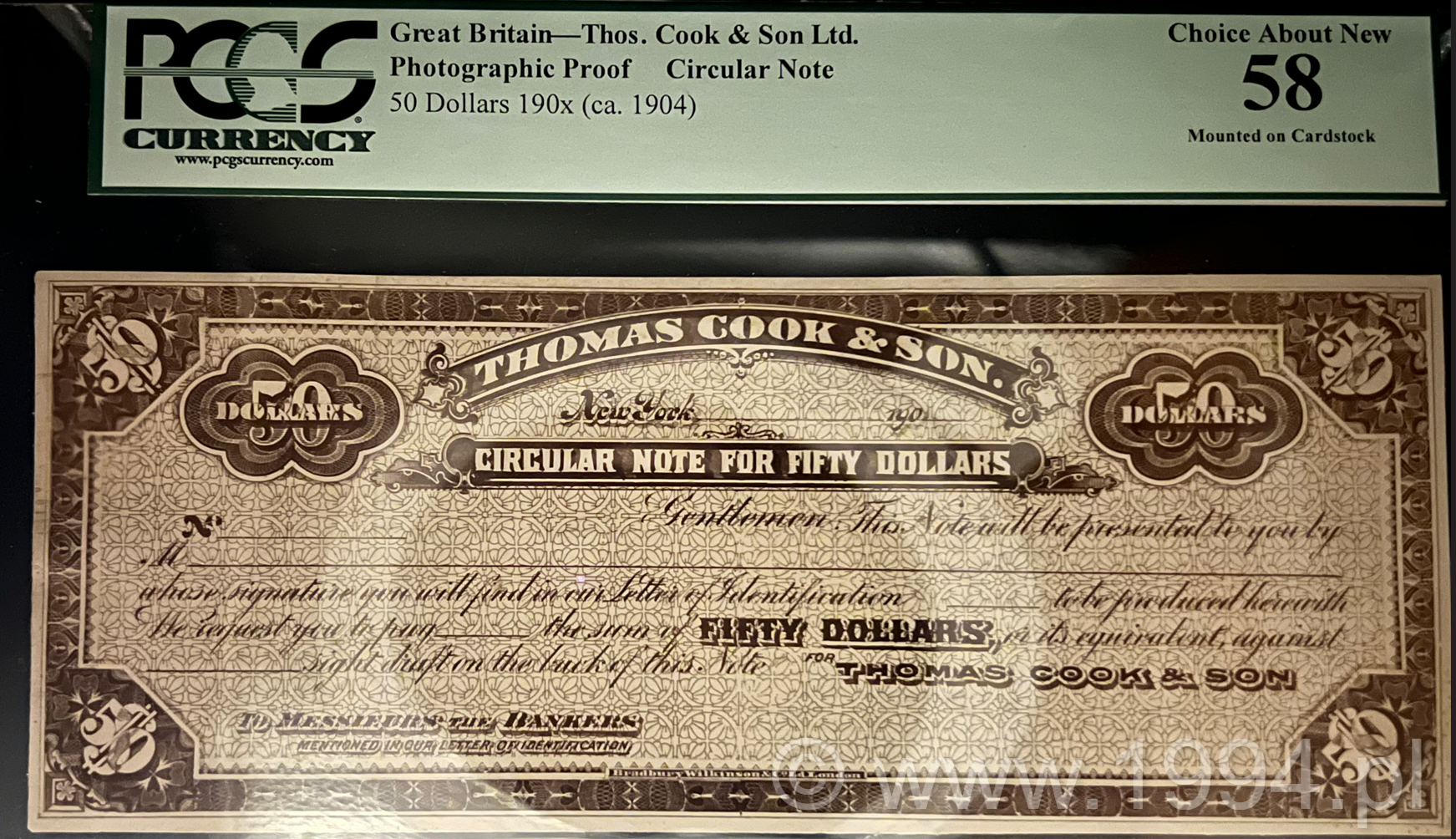
Photographic proof of the 50 Dollars Travellers Cheques prepared for Thomas Cook and Son Limited in 1919, representing a highly developed control-layout design for the firm's post First World War international traveller-payment system. Mounted on cardstock and dated 29 March 1919 on the reverse mount, this proof records a more operationally structured 50 Dollars form than the companion United States and Canada design proofs, with serial-number placement, formal payment instruction text, and a detailed international exchange-rate grid built directly into the face.
The upper field is dominated by the Thomas Cook and Son name, with New York printed beneath it, immediately identifying the design as part of the firm's transatlantic payment network. A specimen serial number field appears as No. 000000 at the left, while ornate 50 Dollars value devices appear in the upper-right and lower-left corners. This use of a zero serial number gives the proof a specimen-style control character and separates it visually from the companion 50 Dollars proof designs that rely more heavily on pictorial or ornamental payment-panel treatment.
The central title reads "Travelers Cheque for Fifty Dollars," using the American spelling on the face, and the right-side text box states "Good for Twelve Months from Date." Beneath the title, the payment instruction is addressed formally to the paying correspondent, beginning with "Gentlemen," and explains that the cheque will be presented by a named holder whose signature appears in the firm's letter of identification. The text directs payment against a sight draft on the back of the cheque, showing how the document was designed to operate through controlled presentation, identification, and correspondent-bank settlement rather than through ordinary circulation.
The most important structural feature of this proof is the printed exchange-rate grid across the lower middle of the face. The grid states the value of the 50 Dollars cheque across multiple monetary areas: United States and Canada as Fifty Dollars, Great Britain and Ireland as 10 Pounds, 4 Shillings, 1 Penny, France, Belgium and Switzerland as 256.25 Francs, Germany as 208.30 Marks, Italy as 256.25 Lire, Scandinavia as 183.49 Kroner, Holland as 122.70 Florins, Austria as 245.10 Kronen, and other countries payable at current rates. This grid makes the proof especially important because it records Thomas Cook and Son Limited's attempt to standardize a dollar cheque across a wide international exchange environment.
The lower text addresses the instrument to the bankers mentioned in the letter of identification, reinforcing the administrative system behind the cheque. The printed Thomas Cook and Son authority at the lower right, together with the cursive Thomas Cook and Son signature, gives the proof the appearance of a working financial form rather than a purely decorative design study. The face integrates denomination, serial control, expiry period, holder identification, bank correspondence, sight-draft settlement, and exchange conversion into one compact security-printed instrument.
This proof belongs to the same Bradbury Wilkinson and Company Limited security-printing group as the related Thomas Cook and Son Limited 50 Dollars photographic proofs, whose London engraver imprint is visible on the companion design state. The dense guilloche work, layered lettered security field, denomination devices, exchange-rate table, and formal payment layout all reflect a London security-printer's production environment, where visual hierarchy, anti-alteration structure, payment wording, and operational detail were reviewed together.
This proof differs clearly from the 20 October 1919 Thomas Cook and Son Limited 50 Dollars Travellers Cheques photographic proof with pictorial payment panel design and the 10 November 1919 Thomas Cook and Son Limited 50 Dollars Travellers Cheques photographic proof with ornamental oval design. Those related proofs emphasize the United States and Canada payment field and broader design presentation, while the present proof is centered on serial control, identification language, and an explicit international exchange-rate table. It is therefore best understood as a separate control-layout state within the same 1919 50 Dollars traveller-payment development group.
The proof also belongs within the wider Thomas Cook and Son Limited transition from circular notes into standardized travellers cheques. It follows the earlier circular-note branch represented by the 1919 Thomas Cook and Son 5 Pounds Circular Note photographic proof and the alternate 1919 Thomas Cook and Son 5 Pounds Circular Note photographic proof, while helping explain how the firm moved toward traveller-payment instruments with clearer numbering, expiry, identification, exchange, and correspondent-bank functions.
As a dated photographic proof with No. 000000 serial control, New York wording, a 50 Dollars denomination, formal letter-of-identification language, and a multi-country exchange-rate grid, this piece is a museum-grade archival survivor from the technical development of Thomas Cook and Son Limited's international payment system. Its importance lies in the way it preserves the financial mechanics of the cheque directly on the face, making it a primary reference item for the study of private travel finance, early twentieth-century exchange practice, security printing, and the evolution of portable money for international travel.