Description and research notes
An exceptional unfinished 500 złotych production remnant dated 1 March 1940, prepared for the Bank Emisyjny w Polsce during the German occupation. The note survives at an incomplete stage of manufacture, preserving a direct record of the printing process rather than the finished appearance of the issued currency.
The obverse is dominated by the green underprint, with its guilloche work, background ornament and central 500 denomination device already established. The principal dark printed design was never applied, leaving absent the portrait, surrounding frames, inscriptions, date, signatures and other elements that define the completed obverse. Despite this unfinished state, the red Series B serial number B 2048322 had already been applied.
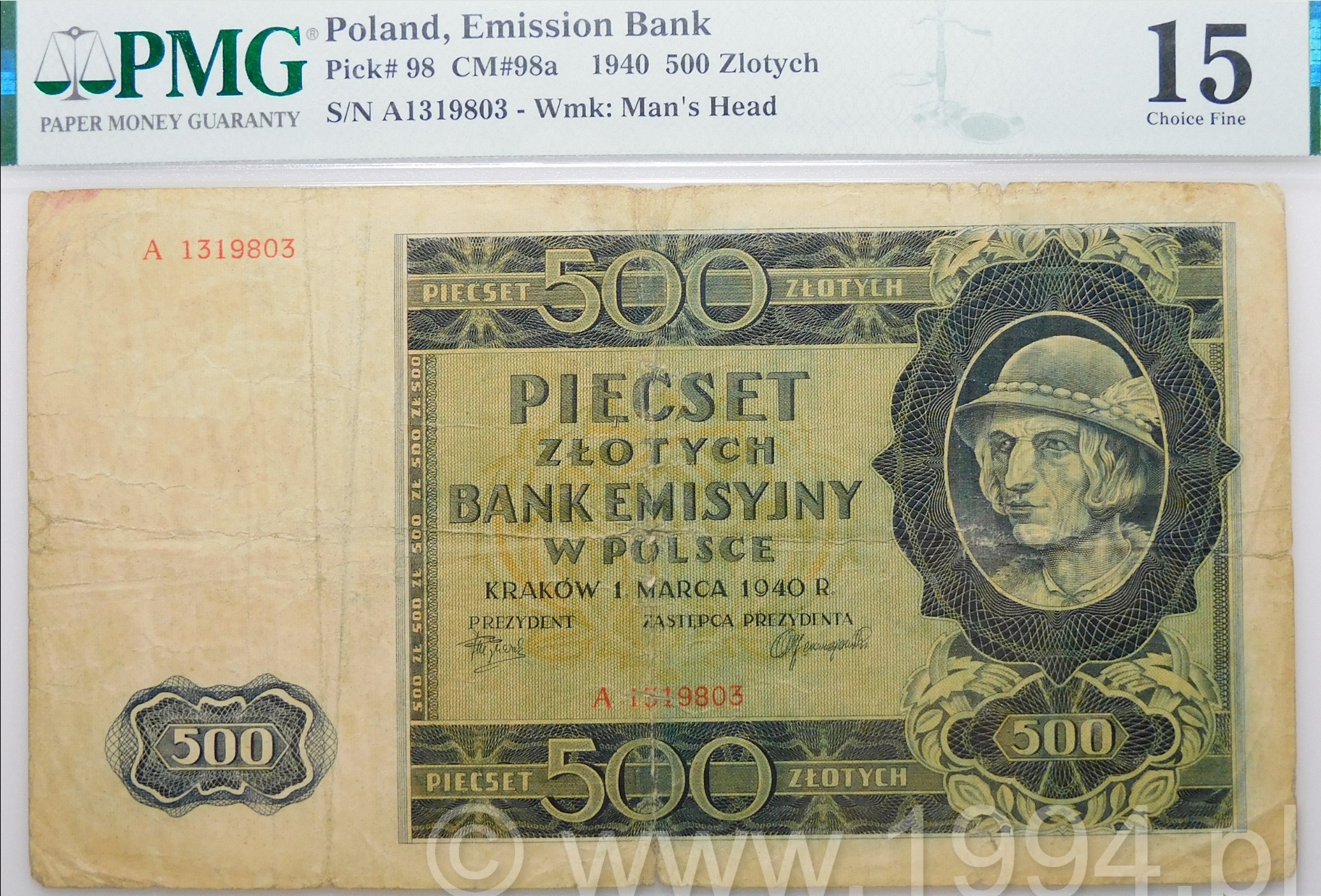
Comparison with a completed 500 złotych note makes the unfinished state particularly revealing. On the finished obverse, the Highlander is a repeated visual motif: the principal engraved portrait occupies the right side of the design, while a second Highlander head appears as the watermark in the paper at left. On B 2048322, the watermark is already present in the paper, but the corresponding printed portrait and the remainder of the principal obverse design were never applied.
The reverse is considerably more advanced, carrying the view of Morskie Oko and the Tatra Mountains together with the principal denomination elements. At right, the open field of the paper contains the watermark. When the same reverse is viewed under transmitted light, the watermark becomes especially clear, showing the profile of a Highlander wearing traditional headwear. PMG identifies the watermark on the holder as "Man's Head."
Of particular significance is the serial number B 2048322. Documented completed examples of the 1940 500 złotych Series B are known only through approximately the 19xxxxx range, while this unfinished note records a number in the 20xxxxx sequence. No fully completed note from this higher Series B numbering range is presently documented. Its survival therefore provides physical evidence that numbering progressed beyond the range represented by known finished notes, preserving a production sequence that appears not to have reached completed circulation form.
PMG encapsulated the piece under the descriptive designation "Printing Remnants" without assigning a numerical grade. Its importance lies in the production evidence retained within a single unfinished note: the established obverse underprint, the absence of the principal obverse design, a substantially developed reverse, the B 2048322 serial number and the original watermarked paper. Together, these features preserve several normally integrated elements of banknote manufacture in an unfinished state.
As surviving production material, the note offers an unusual view into the manufacture of Bank Emisyjny w Polsce currency during the Second World War. The relationship between the surviving Highlander watermark and the absent printed Highlander portrait adds a particularly clear visual record of what had and had not yet been completed. Combined with the otherwise undocumented 20xxxxx Series B numbering, it makes the note a significant research piece for reconstructing the production history of the 1940 500 złotych issue.
Reference: cf. Milczak 98.