Description and research notes
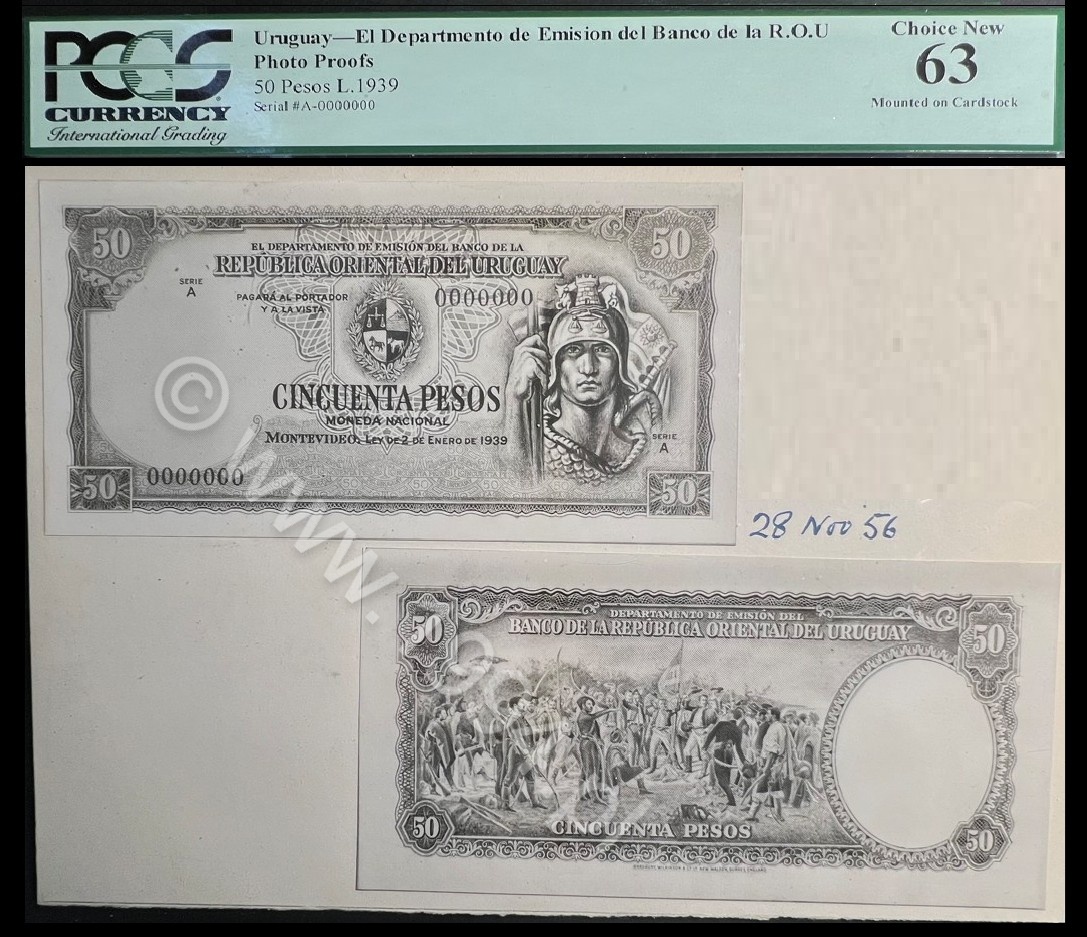
Issued by the Departamento de Emision del Banco de la Republica Oriental del Uruguay, this mounted photographic proof pair preserves the completed face and reverse designs of the 1939 fifty pesos Serie A banknote in archival photographic form. The pair records the full visual structure of the denomination outside the normal sequence of engraved plate proofs, color trials, specimens, and issued notes, providing a direct documentary image of the approved design maintained within the printer's working and reference archive.
The two photographic impressions are mounted together on a single original cardstock sheet, with the face positioned above the reverse. A handwritten date, 28 November 1956, appears between the two photographs and gives the archival assembly a precise documentary context. The inscription records a specific moment in the later handling of the design, showing that the established 1939 fifty pesos type remained part of an active institutional or printer reference archive seventeen years after its original authorization.
The face photograph reproduces the Serie A configuration with all-zero serial numbers and the complete institutional title of the Departamento de Emision del Banco de la Republica Oriental del Uruguay. The denomination CINCUENTA PESOS occupies the central field beneath the national arms, surrounded by engraved ornament, repeated value devices, geometric security patterns, and carefully balanced areas of open paper.
At right appears the denomination's monumental Indigenous warrior portrait, one of the most commanding images used on Uruguay's twentieth-century paper currency. The figure wears an elaborate headdress and ornamental beadwork, with a ceremonial staff or weapon rising behind the shoulder. Even in monochrome photographic form, the portrait retains the sculptural modeling, controlled facial expression, and dense line structure developed for the finished intaglio design.
The large open oval at left corresponds to the watermark area of the production note and provides a visual counterweight to the heavily engraved portrait. The photographic proof preserves the intended relationship between the printed design and the paper security structure, allowing the full face layout to be examined as an integrated composition.
The reverse photograph presents the denomination's expansive historical assembly scene. Armed, mounted, and standing figures occupy a broad ceremonial landscape, arranged within an ornate frame containing repeated denomination numerals and a large reserved watermark oval at right. The composition combines movement, military presence, public assembly, and national historical memory within a single panoramic engraved image.
The face and reverse photographs are presented as a coordinated archival pair rather than as separate isolated images. Their placement on one cardstock mount preserves the intended relationship between the two sides and documents the complete design program of the fifty pesos denomination. The assembly records the portrait, national arms, denomination structure, watermark placement, historical reverse, and full ornamental framework in a form suitable for internal comparison, reference, review, and preservation.
The photographic pair corresponds directly to the completed Serie A design represented by the related Pick 38as specimen. Both preserve the same all-zero Serie A layout, Indigenous warrior portrait, national arms, watermark positions, denomination structure, and historical assembly reverse. The finished specimen demonstrates how the monochrome photographic record translated into the fully printed blue, brown, red, and multicolor production design prepared by Thomas De La Rue and Company Limited.
This direct relationship gives the photographic pair exceptional documentary value. It preserves the complete design as an archival image, while the related Pick 38as specimen records the same composition as a finished security-printed reference note. Viewed together, the two objects form a surviving design-to-production sequence connecting the photographic archive with the completed specimen state of the 1939 fifty pesos Serie A issue.
The handwritten 28 November 1956 date also establishes that the design remained relevant well beyond its original 1939 preparation. The mounted pair may have been retained for later institutional reference, historical documentation, design comparison, or review connected with the continued use and eventual adaptation of the fifty pesos type. Its dated survival records the longevity of the design within Uruguay's monetary and security-printing archives.
The photographic process gives the object a character distinct from conventional banknote proofs. Rather than presenting impressions pulled directly from engraved plates, it records the complete design photographically, preserving scale, arrangement, and visual relationships in monochrome. Photographic proofs formed part of the documentary infrastructure surrounding security printing, allowing completed designs to be retained, circulated internally, compared, and reviewed without requiring additional plate impressions.
The underlying banknote was printed by Thomas De La Rue and Company Limited and represents the refined security engraving and national symbolism associated with Uruguay's 1939 monetary series. The photographic pair preserves that work as an archival object in its own right, while the original cardstock mount and dated handwritten notation provide material evidence of its later institutional handling.
Certified PCGS 63 Choice New, this photographic proof pair survives as a complete face-and-reverse archival ensemble. Its importance lies in the combination of the Serie A design, all-zero serial configuration, original photographic presentation, shared cardstock mount, handwritten 28 November 1956 date, and direct correspondence with the finished Pick 38as specimen. Together, these features make it a significant documentary record of Uruguay's fifty pesos design and of the archival practices through which security printers preserved and managed banknote imagery across different stages of production and institutional use.