Description and research notes
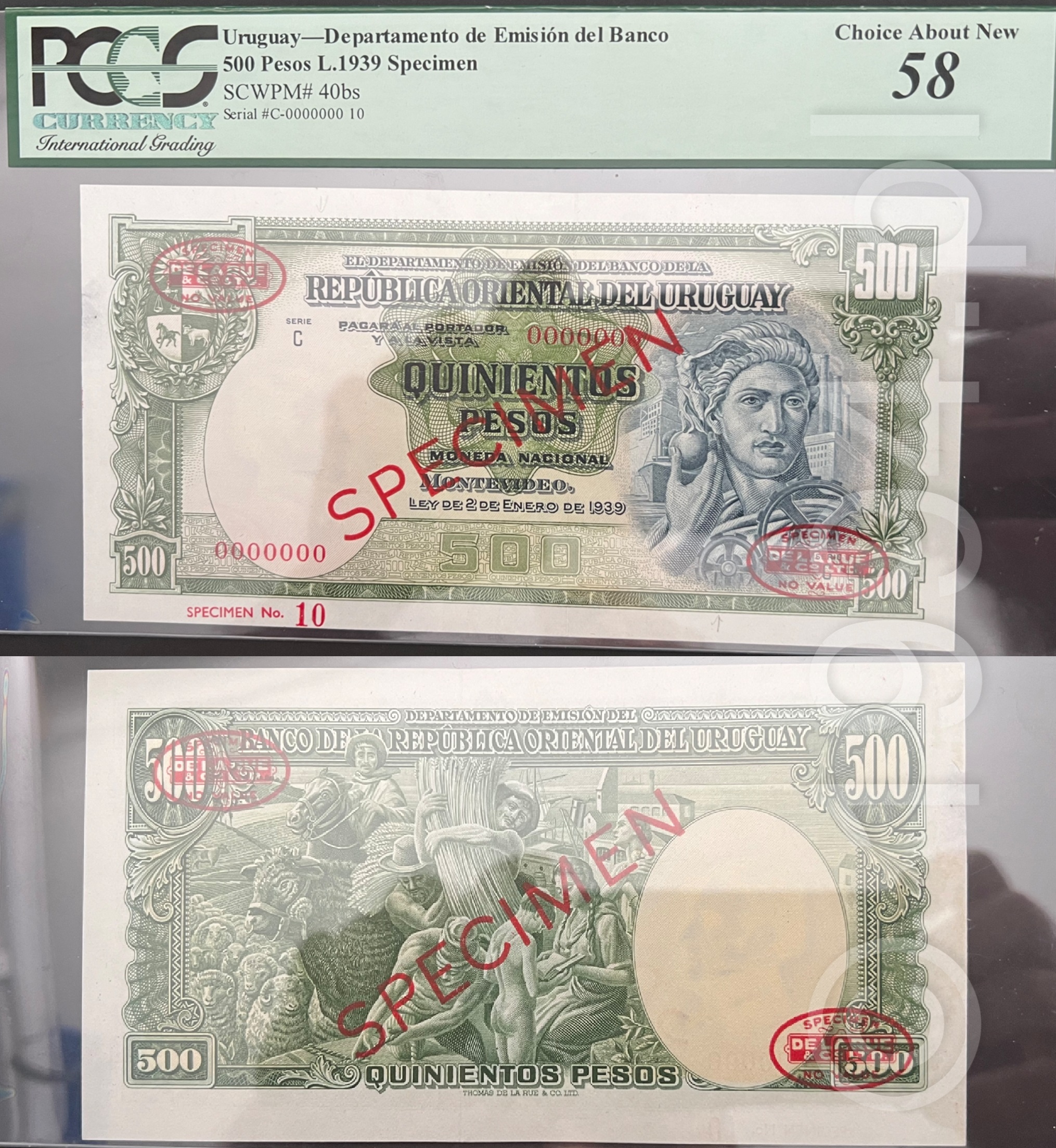
Serie C, Specimen No. 10, represents a fully marked reference form of the Banco de la Republica Oriental del Uruguay five hundred pesos issue of 1939. Its importance rests in the completeness of its specimen-control system: all-zero serial numbers, an individually printed specimen number, a large diagonal red SPECIMEN inscription, and multiple Thomas De La Rue cancellation stamps applied across both sides of the finished note.
The low number 10 places this piece close to the beginning of its documented specimen sequence. Printed at the lower margin, the number gives the note an administrative identity independent of its denomination and series. It indicates a controlled reference object prepared for accountable distribution, retention, or comparison, with each example distinguished from the others by its assigned place in the sequence.
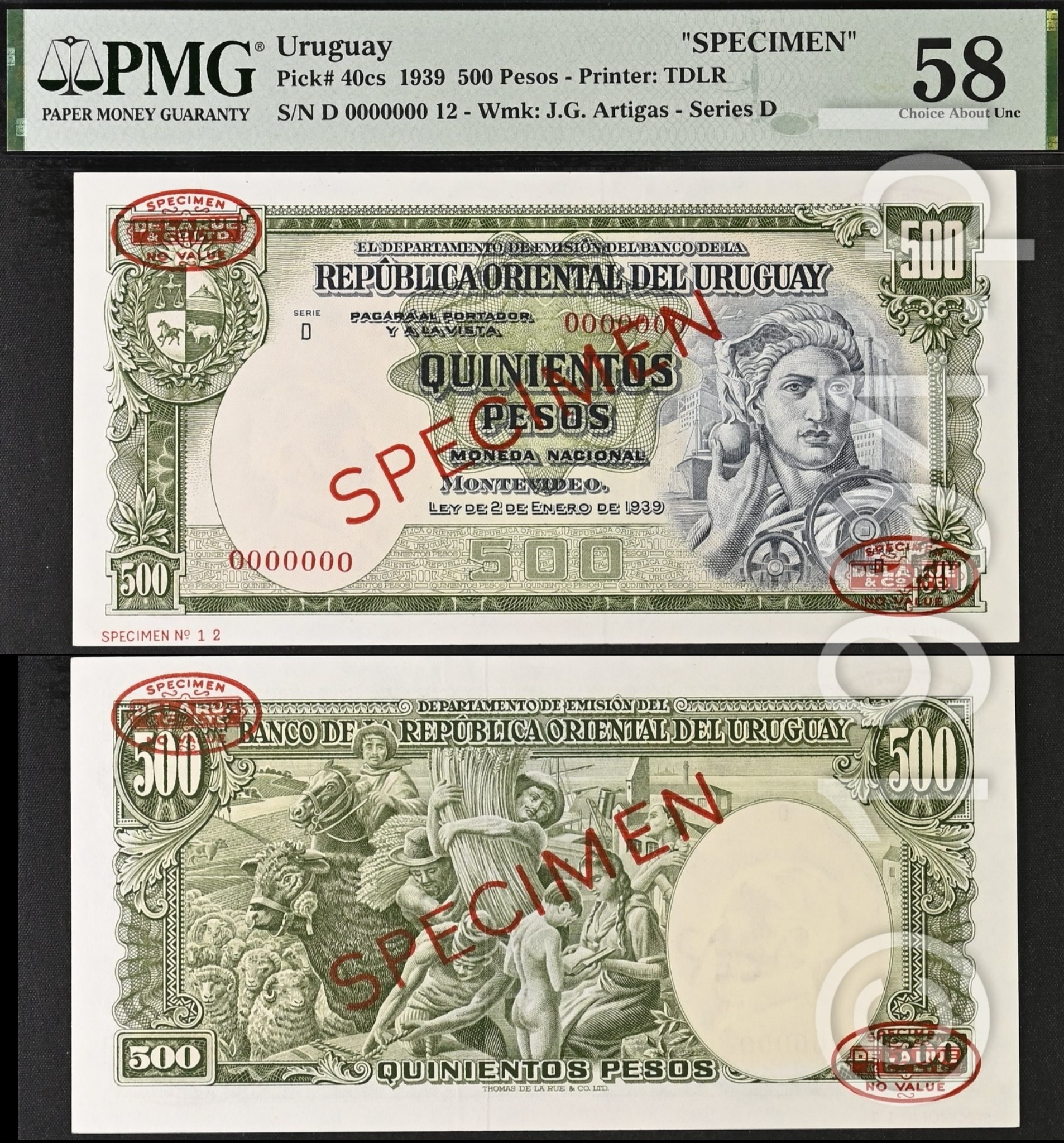
On the obverse, the institutional title of the Republica Oriental del Uruguay dominates the upper field, while QUINIENTOS PESOS forms the visual center of the note. Serie C appears beside the principal design elements, and the zero serials preserve the spacing and appearance of the numbering system used on circulation notes. Architectural borders, ornamental panels, and dense geometric backgrounds create a strong security framework around the central typography.
The engraved portrait at right is set against an industrial environment that presents economic development as part of the state's visual identity. Its sharply modeled face and clothing contrast with the structured machinery and linear backgrounds surrounding it. At left, the large watermark oval introduces an area of open paper, ensuring that the embedded security feature could be examined clearly within the completed specimen.
The obverse cancellation system is intentionally emphatic. A diagonal red SPECIMEN overprint cuts across the center, while two oval SPECIMEN DE LA RUE CANCELLED stamps reinforce the printer's control over the piece. These markings do more than invalidate the note. They establish a visible chain of institutional authority, leaving no uncertainty about its reference status while preserving the underlying engraving for technical inspection.
The reverse carries the same documentary logic. Its agricultural scene shows workers, livestock, cultivated land, and the broader landscape as interconnected elements of national production. The diagonal SPECIMEN inscription and corresponding oval control stamp are repeated over this side, creating a complete two-sided specimen format rather than a face-only cancellation.
This comprehensive marking system distinguishes the Serie C example from more restrained formats within the same denomination. Printed by Thomas De La Rue and Company Limited, Specimen No. 10 preserves the entire visual and administrative identity of the note: the finished design, the series designation, the controlled numbering, and the full printer-authorized cancellation protocol used for institutional reference material.