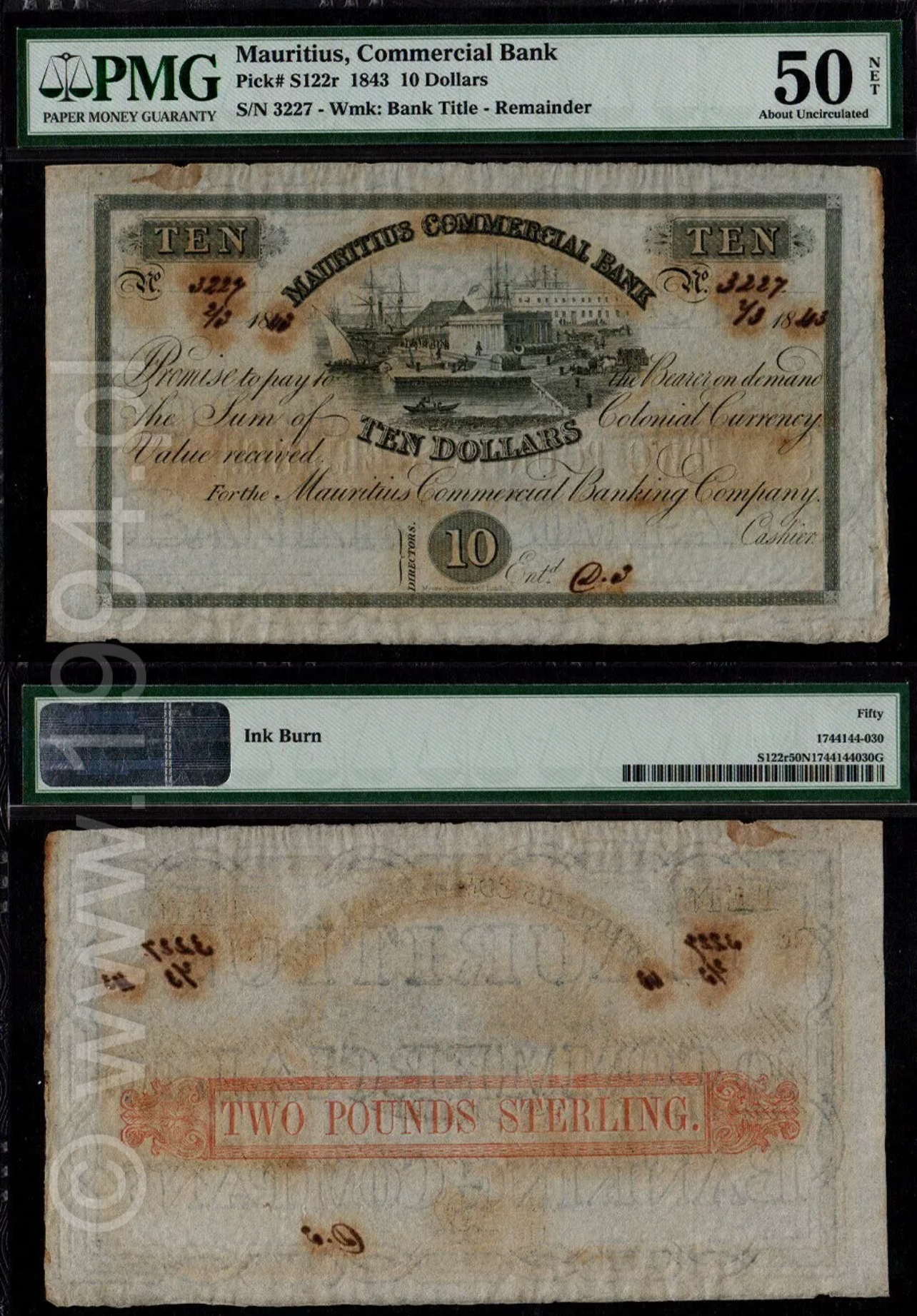
Mauritius 1843 - Mauritius Commercial Bank 10 Dollars / 2 Pounds Sterling Remainder (Pick S122r)
Unissued remainder from the earliest Mauritius Commercial Bank dual-currency series, printed by Myers Frs. & Co., London. Read more →
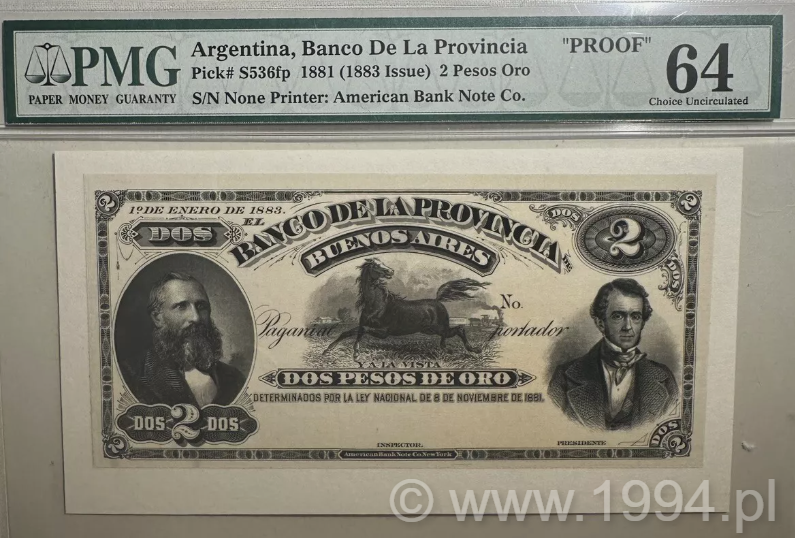
As a period ABNC India-paper proof, this piece captures the engraving exactly as it existed on the master plate before tint stones, serialing, or final production adjustments. Such proofs were archived by both the printer and the bank, used as reference material, and later preserved in private collections after the dispersal of ABNC archives. Survival of a single proof of this denomination-especially at PMG 64 Top Pop-marks it as a museum-grade artifact documenting the peak of American engraving influence in South America and the early evolution of Argentina's 'Pesos Oro' monetary standard. Read more →
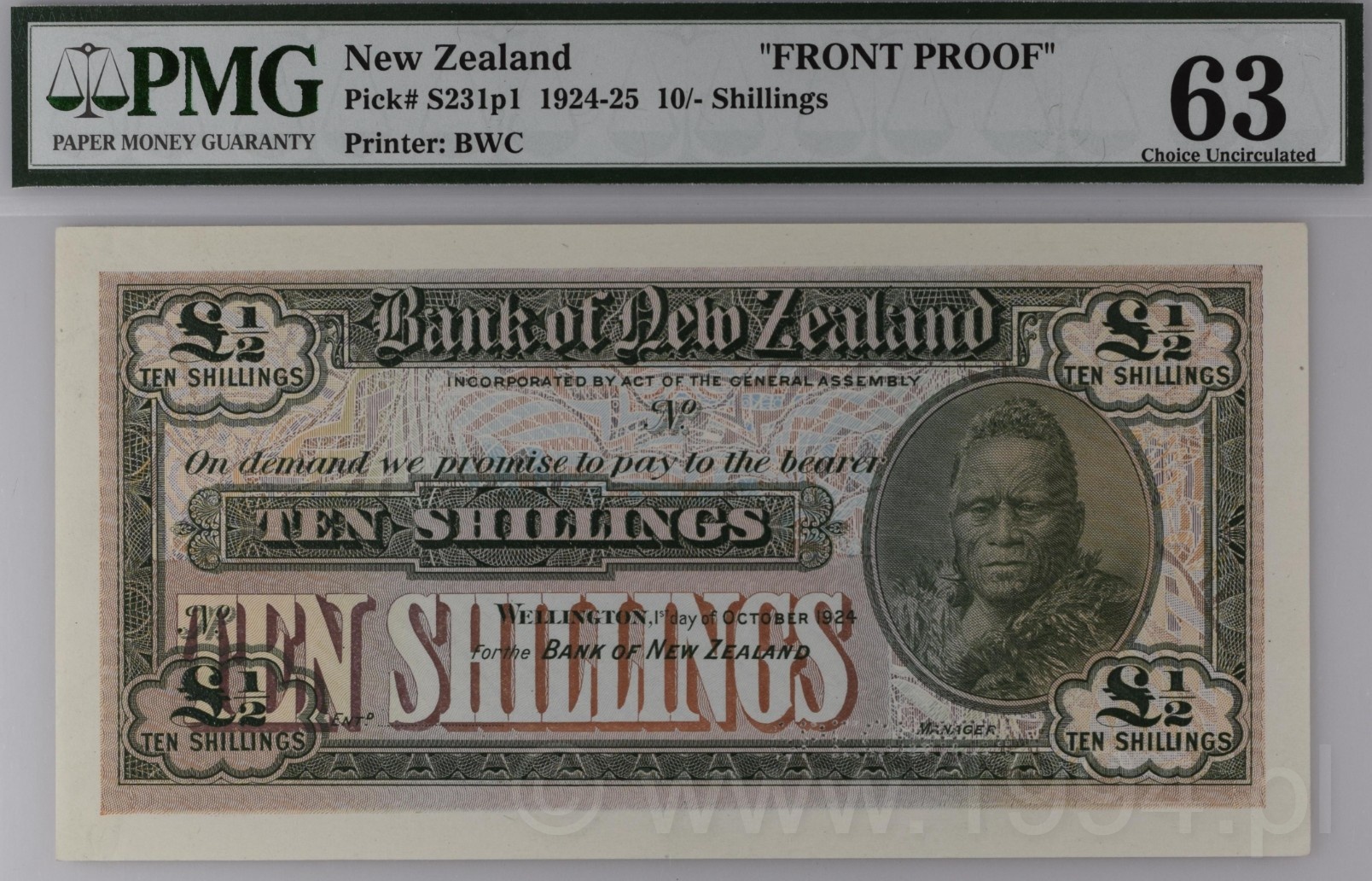
Beyond its technical and artistic importance, the 1924–25 10 Shillings proof captures a pivotal shift in New Zealand’s visual and monetary identity. The decision to place Tamati Waka Nene on the obverse marked a rare and forward-looking acknowledgment of Māori leadership at a time when indigenous representation on currency across the British Empire was almost nonexistent. His role as a stabilizing force during the early colonial period mirrored the note’s function: a unit of everyday exchange meant to circulate broadly among both Māori and Pākehā communities. Read more →
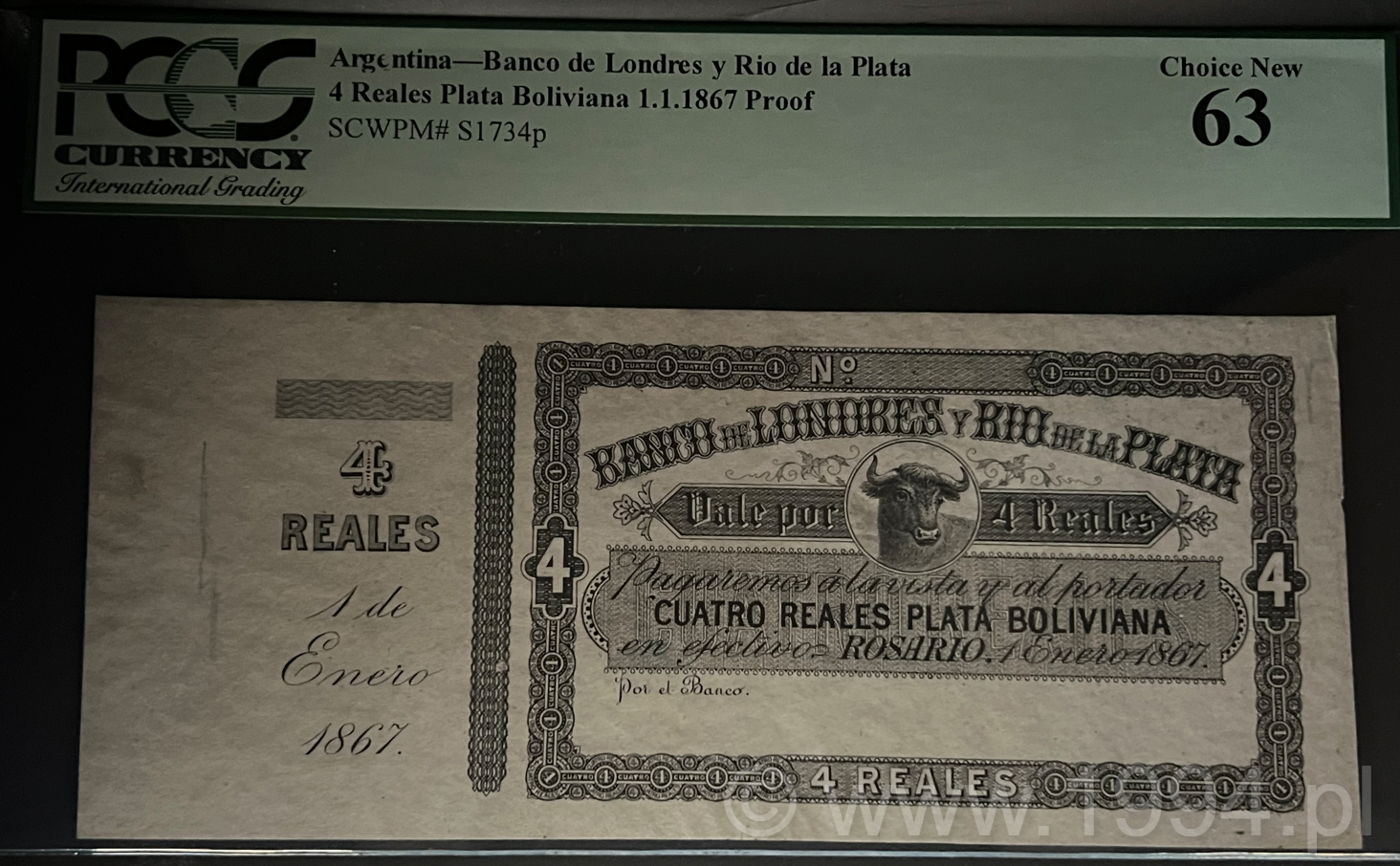
The bull’s head - easily dismissed as simple ornament - actually spoke to Rosario’s identity at the time: a river port surging with cattle shipments heading toward Buenos Aires and Montevideo. Using an animal instead of an allegory made the note instantly recognizable to rural traders, many of whom were illiterate but fully attuned to livestock symbolism. This was smart banking, not decorative indulgence. Read more →
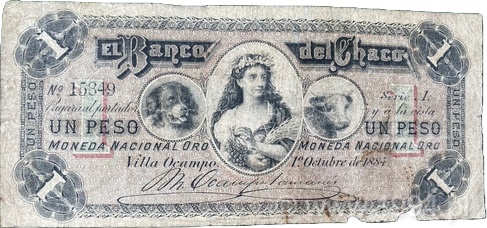
As a surviving piece of working frontier money, this fragment is one of the most authentic artifacts of northern Argentina’s 19th-century provincial banking system-proof that even in incomplete form, the historical value of a note can exceed any aesthetic measure. Read more →
As a high-serial, fully signed, fully circulated example, this 1 Peso Oro is not merely a numismatic item-it is a document of Argentina’s northern frontier economy at a moment when provincial banking, British influence, and agricultural expansion collided. Circulated survivors like this one provide insight into how money actually functioned outside the urban centers, preserving the lived history that pristine specimens can never show. Read more →
This note is certified by Paper Money Guaranty as PMG 15 Choice Fine and is designated on the grading label as plate position pp B. While PMG does not formally define plate position categories within the Pick catalog, such annotations document internal production or numbering distinctions recognized during third-party examination and provide additional technical context for comparative study. Read more →
Serial number 23286 is distinguished by the presence of two fully handwritten circulation signatures, one placed at the left side and one at the right side of the signature area. This is the only known authorization state of the issue in which dual manual signatures were simultaneously required. Both signatures were applied in ink after printing and numbering, reflecting a temporary internal control measure rather than a change in design or denomination. Read more →
Serial number 35345 is distinguished by a single handwritten circulation signature placed centrally within the designated signature area. This centered placement differs from both the original right-side handwritten signature format and the later right-side facsimile signature format. Its positioning reflects a deliberate layout adjustment following the abandonment of the dual-signature authorization model. Read more →
Within a complete four-state study of the Banco Oriental Doblón series, serial 74487 serves as the terminal reference point, illustrating the conclusion of the bank’s shift from individualized manual control toward standardized mechanized currency production. Read more →
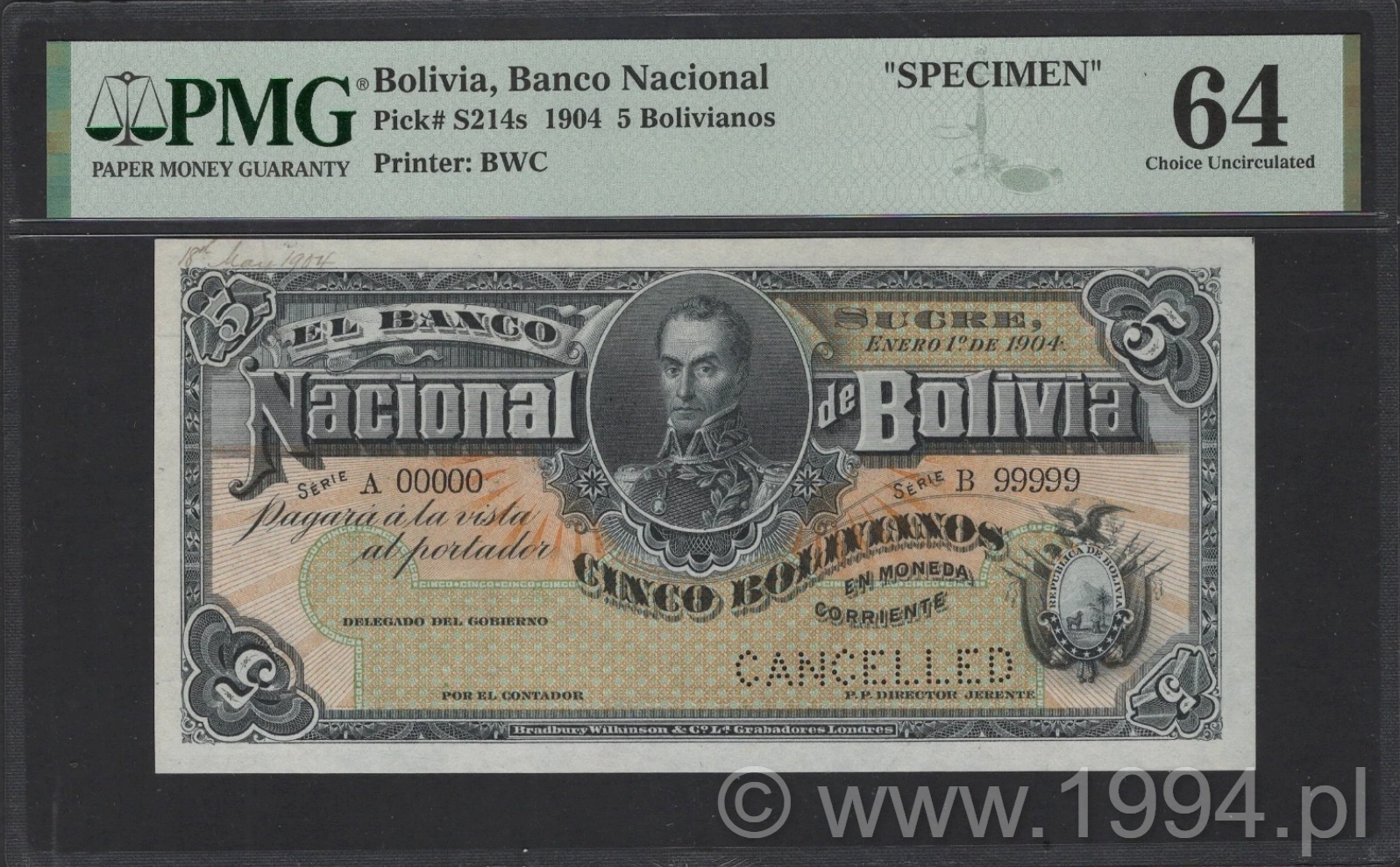
Graded PMG 64 Choice Uncirculated and standing at the top of the population report, this example ranks as the finest known for the type. Beyond rarity, it illustrates both the artistry of BWC’s export engravings and the transitional stage of Bolivia’s financial system in the early 1900s-when private banks carried national currency responsibility. As such, it is a cornerstone type for collectors of Bolivian paper money and a reference piece for the study of South American banknote history. Read more →
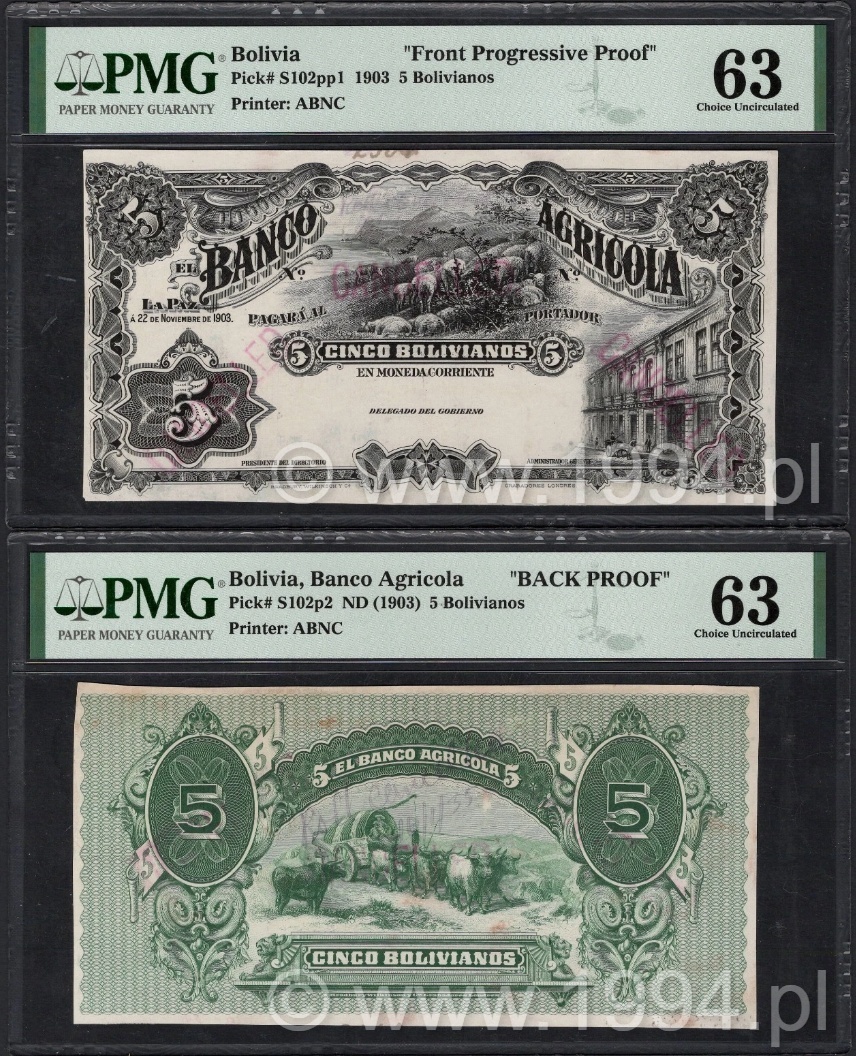
Together, the two proofs show the complete visual program prepared for the 5 Bolivianos denomination. The pairing makes it possible to study the note as a full design rather than as an isolated side, including the relationship between the front's institutional and agricultural imagery and the reverse's more concentrated rural theme. Read more →