Uruguay 1872 - P. Valdez & Co., Tacuarembo 10 Centesimos Unissued (Pick Unlisted)
Unissued 10 Centesimos note dated 1 July 1872 from P. Valdez & Co. of Tacuarembo (then San Fructuoso), printed by Lit. ... Read more →
Unissued 20 Centesimos note dated 1 July 1872 from P. Valdez & Co. of Tacuarembo (then San Fructuoso), printed by Lit. ... Read more →
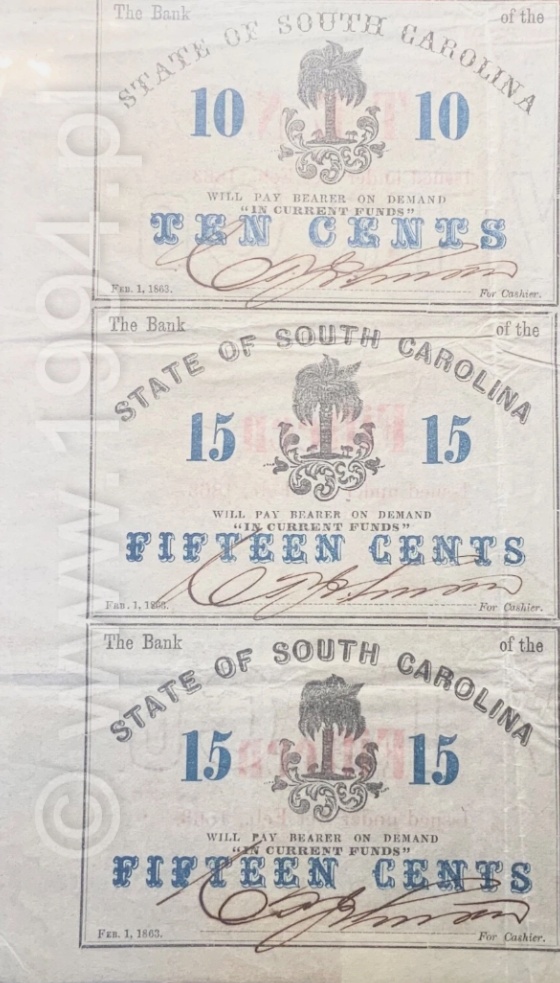
Uncut vertical sheet of three fractional notes from the Bank of the State of South Carolina in Charleston, dated February 1, 1863. The pane contains one 10 cents and two 15 cents notes. These pieces were issued during the Civil War coin shortage under the Act of February 1863 and were payable to bearer in current funds rather than in coin. ... Read more →
Specimen of the 2004 Northern Bank £50, printed by De La Rue for Northern Bank Limited, Belfast. This pre-issue design was the last note prepared before the bank’s December 2004 robbery, the largest cash theft in UK history. The note carries the red SPECIMEN overprint and the oval NO VALUE control stamps, serial DA000000 001, and watermark of Sir Samuel C. ... Read more →
Specimen of the redesigned 2005 Northern Bank £50, printed by Thomas De La Rue and issued under the new Northern Bank Limited branding after the December 2004 robbery. Serial JB000000, watermark Sir Samuel Davidson, and bold red SPECIMEN overprint across the face. This version was part of the printer’s formal reference and approval series prepared for bank and regulator use. ... Read more →
Circulation version of the 2005 Northern Bank £50, printed by Thomas De La Rue for Northern Bank Limited, Belfast. Serial range JB000001 onward, watermark Sir Samuel C. Davidson, printer imprint TDLR. ... Read more →
Replacement note for the 2005 Northern Bank £50 issue, printed by Thomas De La Rue, bearing the distinct 'YY' prefix used exclusively for replacement sheets following the 2004 Belfast vault robbery. These notes were part of the emergency replacement program that saw all pre-robbery stock withdrawn and destroyed, with new serial ranges produced under enhanced security oversight. Featuring the portrait of Sir Samuel Cleland Davidson (1846–1921), inventor and industrialist, the design celebrates Northern Ireland’s engineering legacy. ... Read more →
Specimen of the 50 Pesos dated 22 January 1939 for the Departamento de Emision del Banco de la Republica Oriental del Uruguay, printed by Thomas De La Rue, London. This specimen carries the red ESPECIMEN overprint, the perforated cancellation reading 'SIN VALOR', and multiple circular punch holes applied by Thomas De La Rue as part of printer archive control. Serial 00000000, Series C. ... Read more →
Dated 4 de Mayo de 1870, this 1 Peso note represents the same first national issue of the Junta de Credito Publico but bearing a different handwritten signature type, executed by another board member whose autograph remains partially illegible due to cancellation and ink staining. The printing is identical to the 'Ruy / West' variety, featuring Mercury seated left, Uruguay’s arms top center, and the text 'Ley de 4 de Mayo de 1870'. The green paper stock and scalloped margin are characteristic of local lithography by G. ... Read more →
Issued 50 Złotych banknote of the Narodowy Bank Polski dated 1 December 1988 displaying a major typographic omission error. The entire printed layer containing the line 'WARSZAWA, 1 GRUDNIA 1988' together with the signatures of the issuing officials (Prezes and Główny Skarbnik) is completely absent. The national eagle emblem printed in the central guilloche remains intact, demonstrating that only the upper black typographic layer failed to transfer during printing. ... Read more →
This one pound note issued for Fiji in 1942 was created by overprinting an existing Reserve Bank of New Zealand £1 note originally dated 1 August 1934. The base note was printed by Thomas De La Rue & Company in London for circulation in New Zealand, but during the Second World War it was adapted for emergency use within the British colony of Fiji. In early 1942 Japanese military expansion across the Pacific severely disrupted supply lines throughout the British colonial network. ... Read more →
The fifty-dollar Revenue Bond Scrip authorized by the Act of March 2, 1872, stands among the most elaborate and symbolically charged notes of Reconstruction-era South Carolina. Produced by the American Bank Note Company of New York, these notes were issued to pay state obligations and to function as tax receipts, serving as both a medium of exchange and an assertion of solvency during a turbulent postwar decade. The design balances artistry and propaganda. ... Read more →