U.S. paper money embodies nearly two centuries of continuous change—social, technological, and institutional. From the 1830s onward, local banks, states, and private printers created an extraordinary visual record of America’s financial experimentation. Early proofs and scrips by firms such as Underwood, Bald, Spencer & Hufty or Rawdon, Wright, Hatch & Edson predate national unity, their engraved portraits and ornaments defining the first true American style of intaglio currency art.

The Civil War and Reconstruction introduced federal control and unprecedented production scale. The 1863 National Banking Act organized thousands of chartered banks whose notes—each bearing its town and charter number—documented regional enterprise from Massachusetts to Kansas. Large-size and small-size Nationals illustrate the transformation from local credit to federally secured obligations, while fractional and state issues like South Carolina’s 1872 Revenue Bonds record fiscal necessity in turbulent times.

The twentieth century shifted focus to standardization and innovation. The Series of 1914 Federal Reserve Notes established centralized issue under the new Reserve System; later small-size redesigns of 1928 codified modern U.S. dimensions. Experimental pieces—Giori press trials, C.O.P.E. calibration sheets, ABNC specimen notes—reveal the industry’s technical core, where anti-counterfeit design met production research. By mid-century, the Bureau of Engraving and Printing had refined color, security threads, and watermark technology into global benchmarks.

Spanning 1830 to 2003, this section captures the United States as engraver, innovator, and issuer—an unbroken lineage from independent presses to the Bureau’s modern laboratories of paper and ink.

60 results · Page 3 of 5
United States 1995 5 Dollars Federal Reserve Note from the San Francisco District showing Insufficient Inking Error on Face with faded left-side border and corner medallions, PCGS 58 PPQ Choice About New

United States 1995 - 5 Dollars Federal Reserve Note San Francisco District Insufficient Ink on Face Error (Friedberg 1985-L)

Certified PCGS 58 PPQ Choice About New, this note retains original embossing, crisp paper, and full color fidelity in unaffected areas. The subtle fold that prevents a higher grade does not detract from the visual impact of the printing flaw, which cleanly exposes the mechanics of Bureau of Engraving and Printing intaglio production. Errors of this nature are seldom preserved in near-uncirculated condition - most were caught during press inspection or quickly worn out in circulation. Read more →

United StatesError Note19955 DollarsPCGS 58 PPQ Choice About New Federal Reserve NoteIssued NoteError NoteInsufficient ink errorSmall size banknotePortrait of Abraham Lincoln5 DollarsBureau of Engraving and PrintingSan Francisco Federal Reserve DistrictFriedberg 1985-LPremium Paper Quality designationModern United States currencyUnited States printing errorContemporary error note collectingHistoryUnited States1995PCGS 58 PPQChoice About NewMuseum Grade
Held
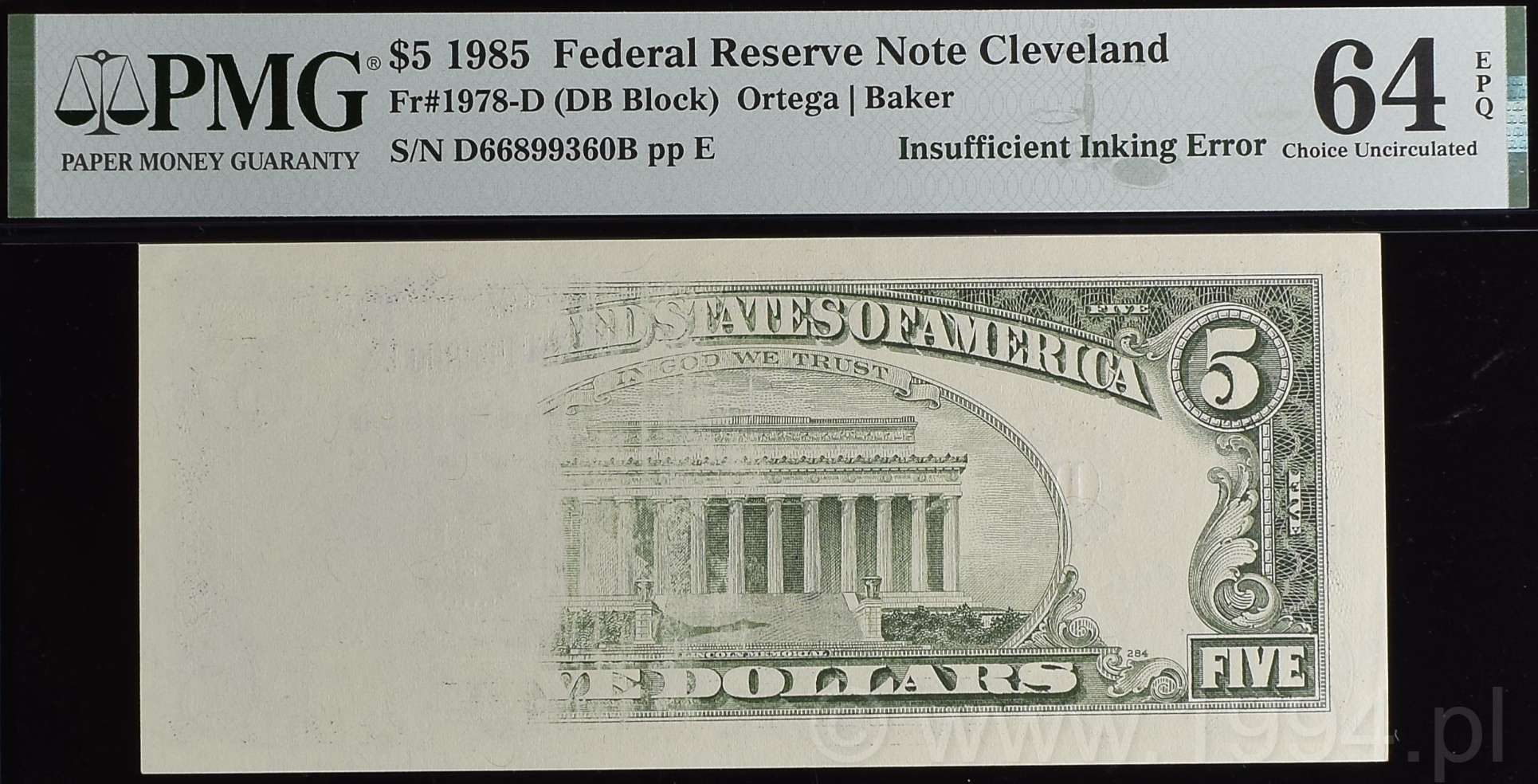
United States 1985 5 Dollars Federal Reserve Note from the Cleveland District showing Insufficient Inking Error on back with faded left-side vignette and frame, PMG 64 EPQ Choice Uncirculated

United States 1985 - 5 Dollars Federal Reserve Note Cleveland District Insufficient Inking on Back Error (Friedberg 1978-D)

Such large-area insufficient inking errors are among the most revealing BEP production anomalies, offering collectors and researchers a direct look at the mechanical limits of high-speed intaglio printing. Few survive in gem-level condition, making this Cleveland District note a cornerstone piece for any serious study of modern United States printing errors. Read more →

United StatesError Note19855 DollarsPMG 64 EPQ Choice Uncirculated United StatesFederal Reserve NoteIssued NoteError NoteInsufficient Inking ErrorPrinting ErrorBureau of Engraving and PrintingCleveland DistrictFriedberg 1978-D1985 Series1985PMG 64 EPQChoice UncirculatedModern Error NoteIntaglio PrintingUnited States Currency5 Dollars
Held
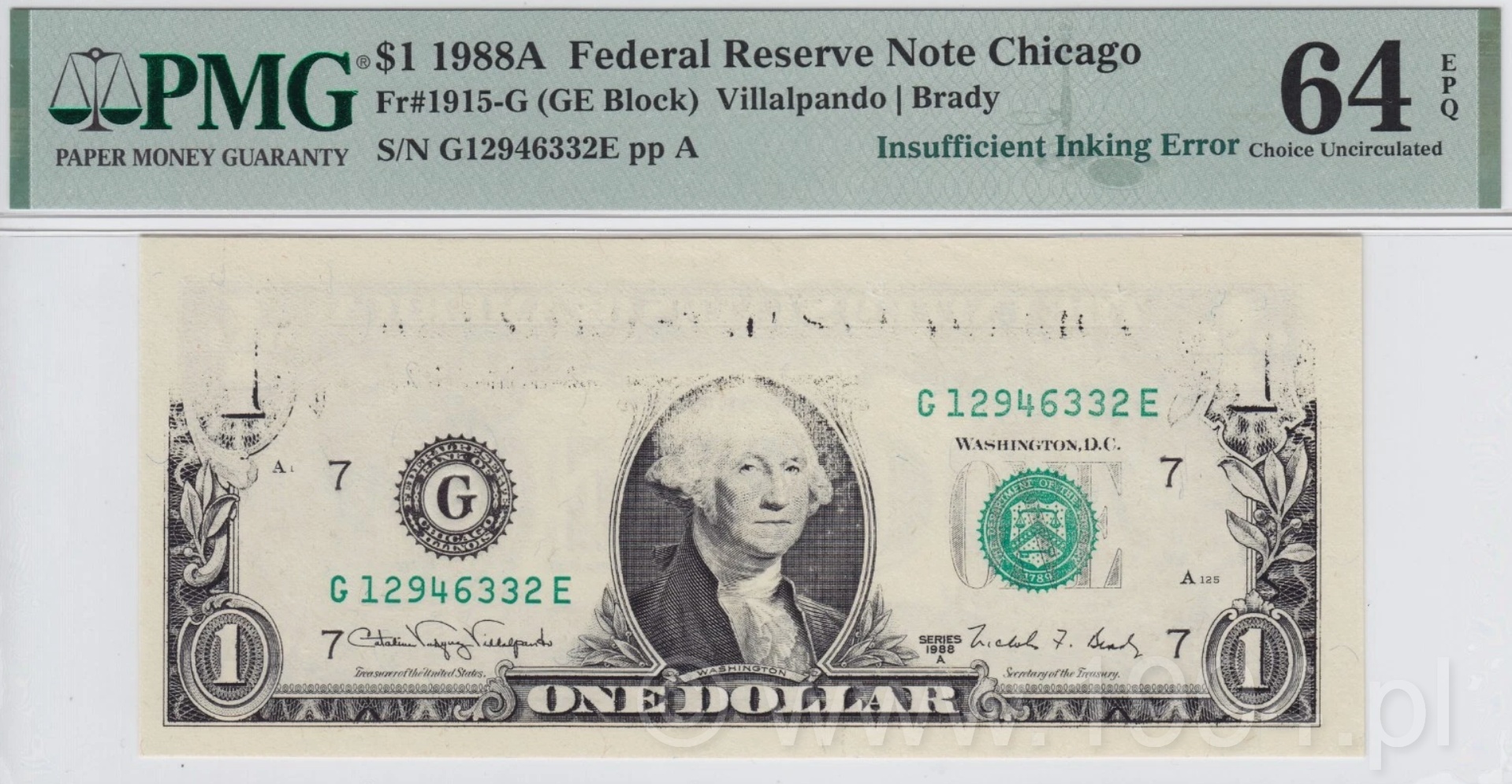
United States 1988A 1 Dollar Federal Reserve Note from the Chicago District with Insufficient Inking Error on the obverse, PMG 64 EPQ Choice Uncirculated, showing faint upper printing and clear portrait of George Washington

United States 1988A - 1 Dollar Federal Reserve Note Chicago District Insufficient Inking Error (Friedberg 1915-G)

While minor under-inking is occasionally seen on low-denomination issues, examples this pronounced are rare in the modern era-especially when preserved in high grade. The note’s pale upper register provides an instructive look into the Bureau of Engraving and Printing’s mechanical process during the late 1980s. At the time, the BEP was operating high-speed presses that printed both faces in successive passes; a deviation in ink viscosity, plate temperature, or wiping pressure could yield the kind of ghosted areas evident here. Read more →

United StatesError Note19881 DollarPMG 64 EPQ Choice Uncirculated United StatesFederal Reserve NoteIssued NoteError NotePrinting ErrorInsufficient Inking ErrorModern Printing ErrorBureau of Engraving and PrintingChicago DistrictFriedberg 1915-G1988A Series1988Choice UncirculatedPMG 64 EPQUnited States CurrencyModern Rarity1 Dollar
Held
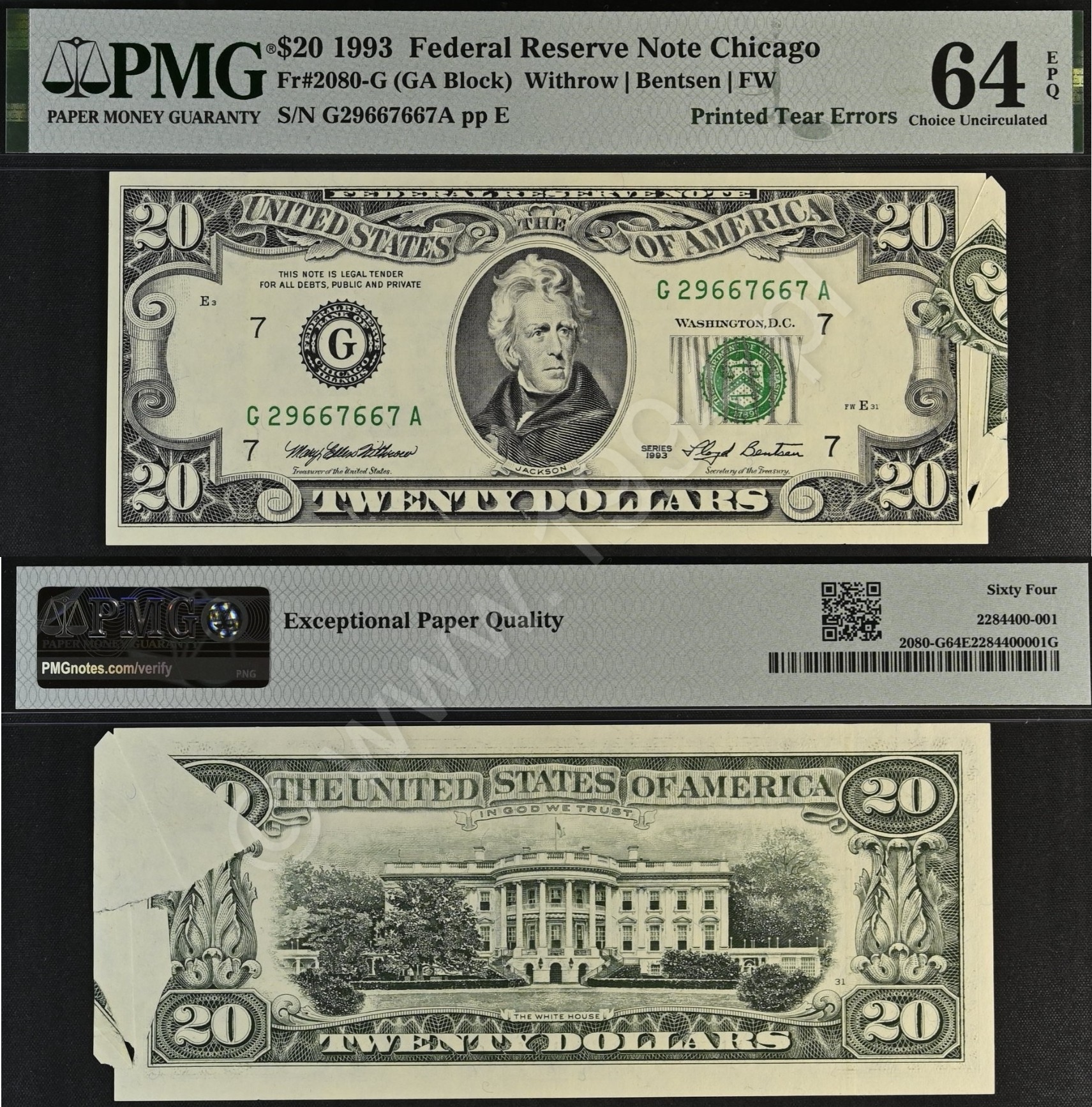
United States 1993 20 Dollars Federal Reserve Note from the Chicago District with dramatic Printed Tear Errors on both sides, PMG 64 EPQ Choice Uncirculated, showing folded and torn corners obstructing ink transfer

United States 1993 - 20 Dollars Federal Reserve Note Chicago District Printed Tear Error (Friedberg 2080-G)

Certified PMG 64 EPQ Choice Uncirculated, this example retains bright paper, crisp embossing, and outstanding originality. The sharply defined tear pattern on both obverse and reverse demonstrates the precise moment when physical distortion intersected with intaglio precision-a vivid artifact of the mechanical risks inherent to industrial-scale currency manufacture. For error specialists, it serves as both a textbook illustration and a visual spectacle within the modern Federal Reserve Note series. Read more →

United StatesError Note199320 DollarsPMG 64 EPQ Choice Uncirculated United StatesFederal Reserve NoteIssued NoteError NotePrinting ErrorPrinted Tear ErrorFolded During PrintingBureau of Engraving and PrintingMechanical ErrorProduction AnomalyChicago DistrictFriedberg 2080-G1993 Series1993Choice UncirculatedPMG 64 EPQUnited States CurrencyModern Error Note20 Dollars
Held
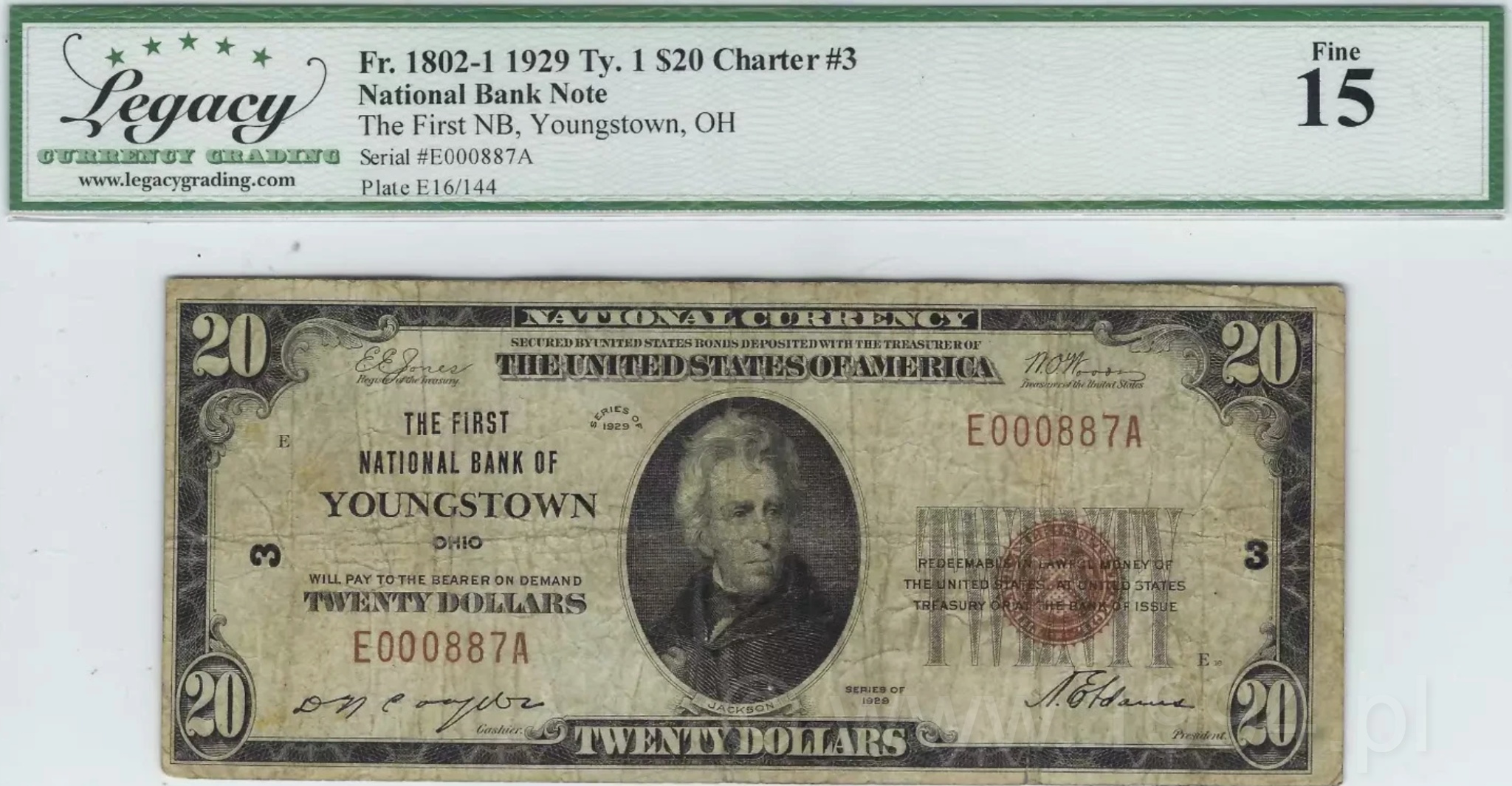
United States 1929 Type 1 20 Dollars National Bank Note from The First National Bank of Youngstown, Ohio, Charter 3, Friedberg 1802-1, Grading Fine 15

United States 1929 - 20 Dollars Type 1 National Bank Note - The First National Bank of Youngstown, Ohio Charter 3 (Fr. 1802-1)

Low-charter national. The First National Bank of Youngstown operated under Charter 3, a single-digit charter number issued in the opening days of the National Banking era. Early charters are coveted because they document the very first adopters of the 1863 National Banking system and their numbers stayed with the bank through every redesign and consolidation. Read more →

United StatesNational Bank Note192920 DollarsLegacy Currency Grading Fine 15 20 DollarsNational Bank NoteIssued NoteType 1YoungstownOhioCharter 3Low Charter1929Legacy Fine 15Bureau of Engraving and Printing
Held
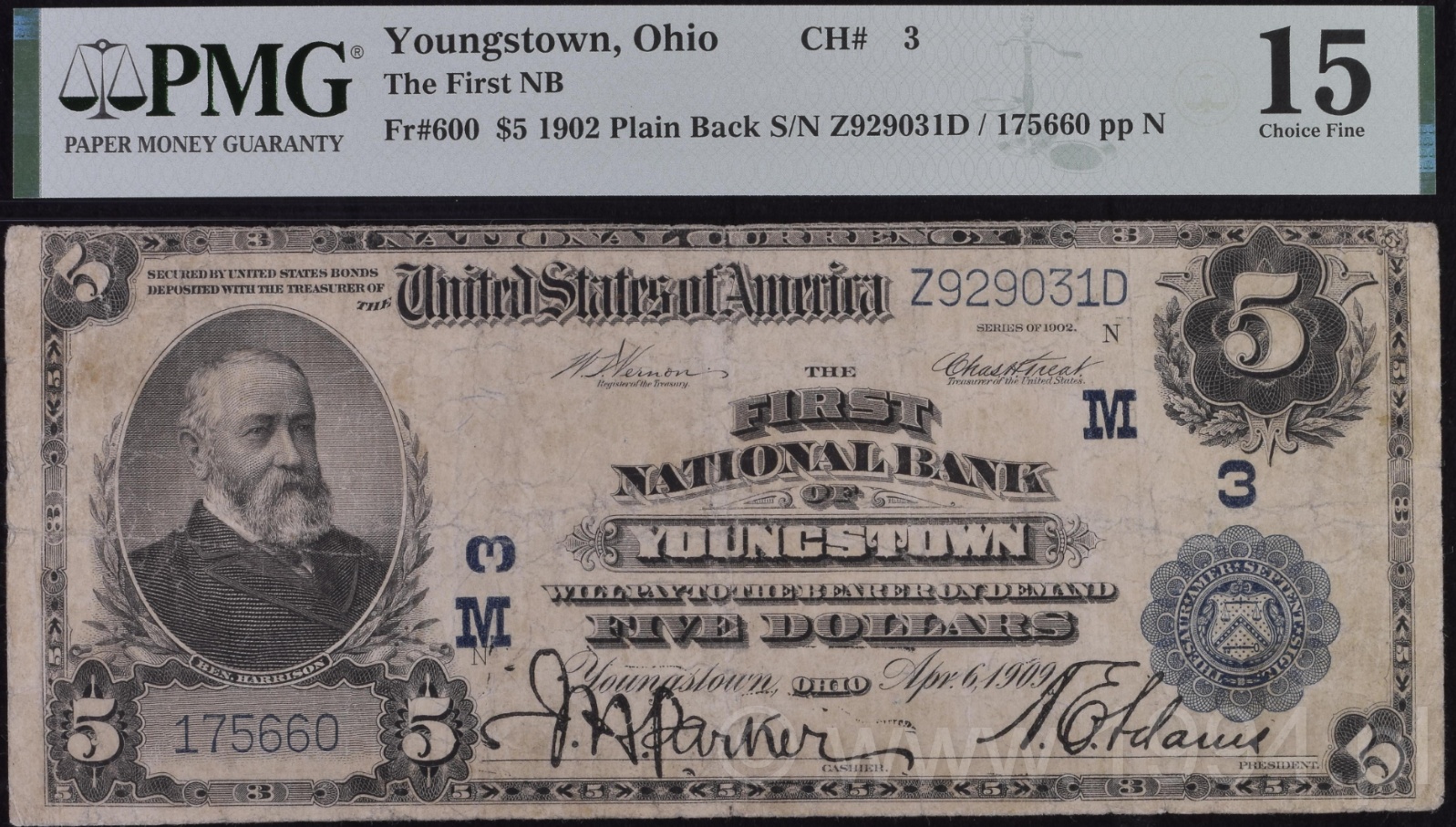
United States 1902 5 Dollars National Bank Note, The First National Bank of Youngstown, Ohio, Blue Seal Plain Back, Friedberg 600, Charter 3, PMG 15 Choice Fine, serial Z929031D with bank serial 175660

United States 1902 - 5 Dollars Blue Seal Plain Back National Bank Note - The First National Bank of Youngstown, Ohio Charter 3 (Friedberg 600)

Format: Series of 1902 Blue Seal Plain Back, $5. Portrait of President Benjamin Harrison at left, blue Treasury seal and blue Treasury serial Z929031D, with black bank serial 175660 at lower left. Engraved local officers sign along the bottom; the date line reads Apr 6, 1909. Federal signatures are Register of the Treasury William T. Vernon and Treasurer of the United States Charles H. Treat, the pair associated with Friedberg 600. The right margin shows the blue charter numeral 3, affirming the low‑charter status. Read more →

United StatesNational Bank Note19095 DollarsPMG 15 Choice Fine National Bank NoteIssued NoteLarge SizeBlue SealPlain BackBenjamin HarrisonYoungstownOhioCharter 3Low CharterFriedberg 6001902 Series1902Bureau of Engraving and Printing
Held
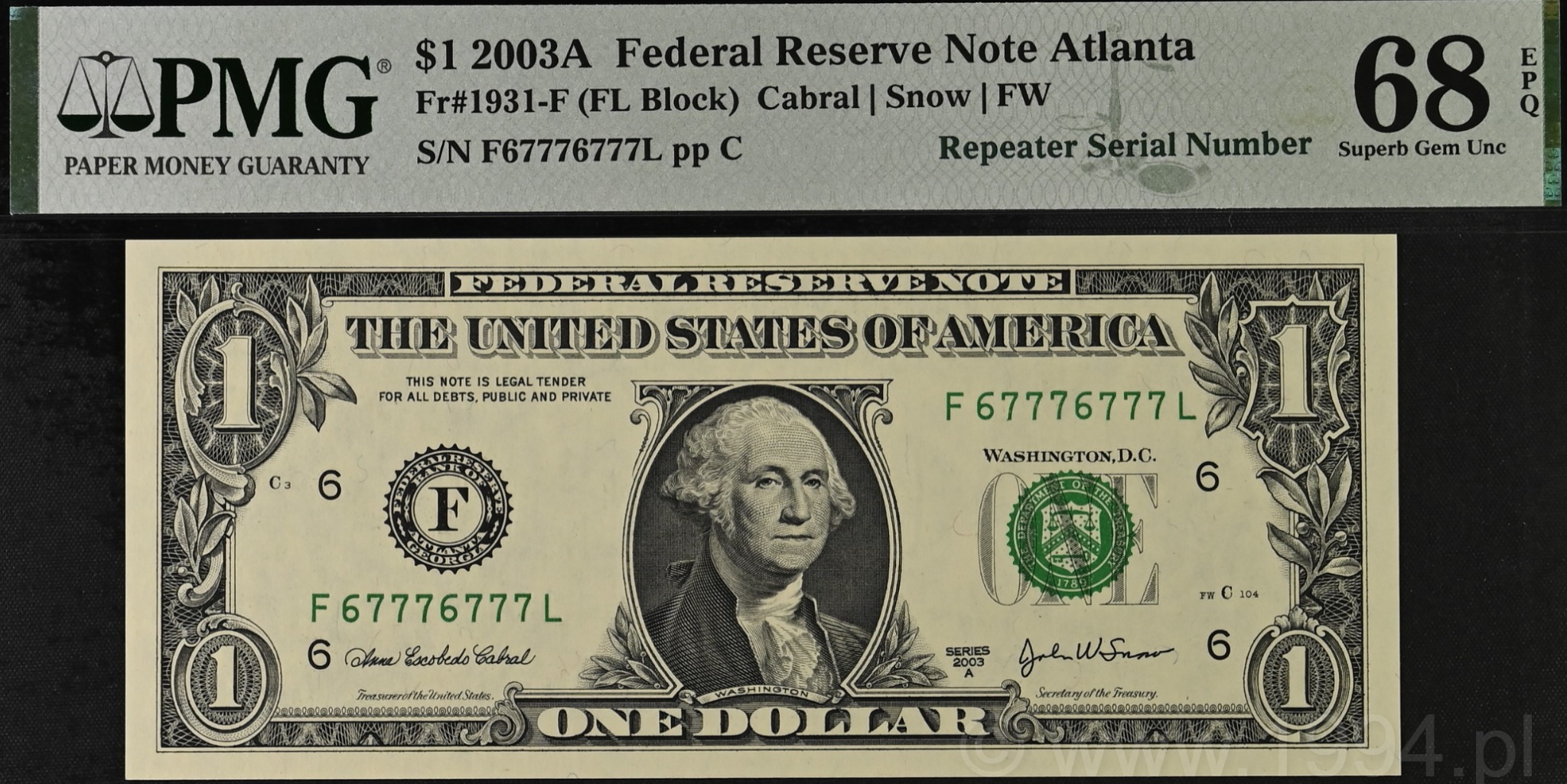
United States 2003A 1 Dollar Federal Reserve Note from the Atlanta District with Repeater Serial Number F67776777L, graded PMG 68 EPQ Superb Gem Uncirculated, showing strong centering, bright original paper, and crisp engraving detail.

United States 2003A - 1 Dollar Federal Reserve Note Atlanta District Repeater Serial Number F67776777L (Friedberg 1931-F)

The 2003A series was printed at the Fort Worth facility, carrying the signatures of Anna Escobedo Cabral and John W. Snow. Atlanta’s F district seal anchors the design, featuring the portrait of George Washington on the obverse and the Great Seal of the United States on the reverse. Even within a vast production of identical 1 Dollar notes, this specimen stands apart for its numerical symmetry and visual rhythm. Read more →

United StatesFancy Serial Note20031 DollarPMG 68 EPQ Superb Gem Uncirculated Federal Reserve NoteIssued NoteFancy Serial NoteRepeater Serial NumberSmall size banknoteGreen sealPortrait of George WashingtonTreasury seal1 DollarBureau of Engraving and PrintingFort Worth printing facilityAtlanta Federal Reserve DistrictFriedberg 1931-FCabral and Snow signaturesExceptional Paper Quality designationModern United States currencyFancy serial number collectingMathematical pattern collectingHistoryUnited States20032003APMG 68 EPQMuseum Grade
Held
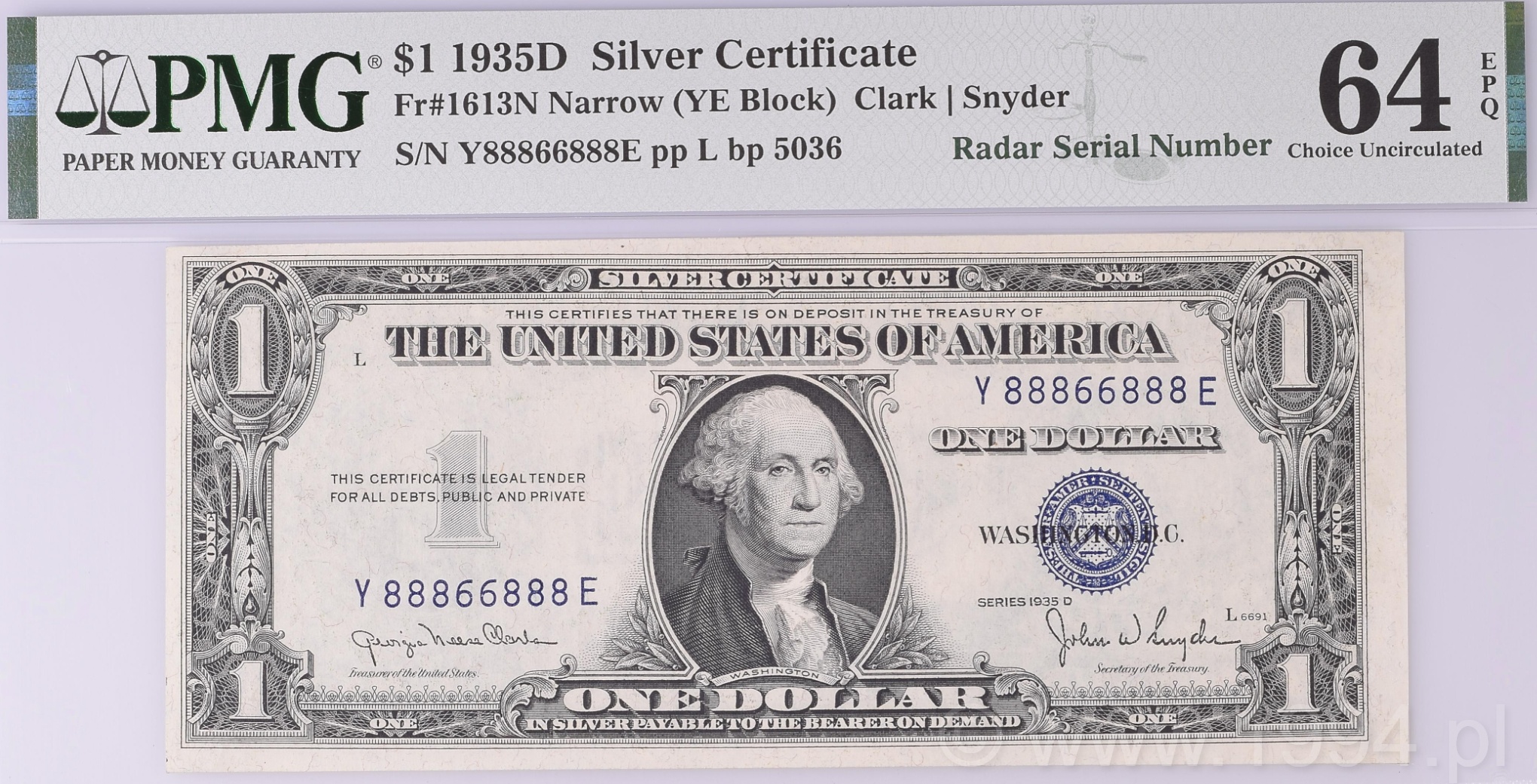
United States 1935D 1 Dollar Silver Certificate with Radar Serial Number Y88866888E, PMG 64 EPQ Choice Uncirculated, blue seal issue signed by Clark and Snyder with mirror-symmetric serial pattern

United States 1935D - 1 Dollar Silver Certificate Radar Serial Number Y88866888E (Friedberg 1613N, YE Block)

As a historical artifact, the 1935D Silver Certificate marks the last widely circulated U.S. note explicitly backed by silver - a tangible connection between paper money and physical commodity value. In the fancy-serial niche, radar examples from this series bridge artistry, mathematics, and monetary history. This Y88866888E specimen, certified Choice Uncirculated with EPQ originality, ranks among the most desirable blue-seal radar notes known in private hands. Read more →

United StatesFancy Serial Note19351 DollarPMG 64 EPQ Choice Uncirculated United StatesSilver CertificateFancy Serial NoteRadar Serial NumberFriedberg 1613N1935D Series1935Clark–Snyder SignaturesBlue SealNarrow FormatPMG 64 EPQChoice UncirculatedBureau of Engraving and PrintingPalindrome SerialUnited States Currency1 Dollar
Held
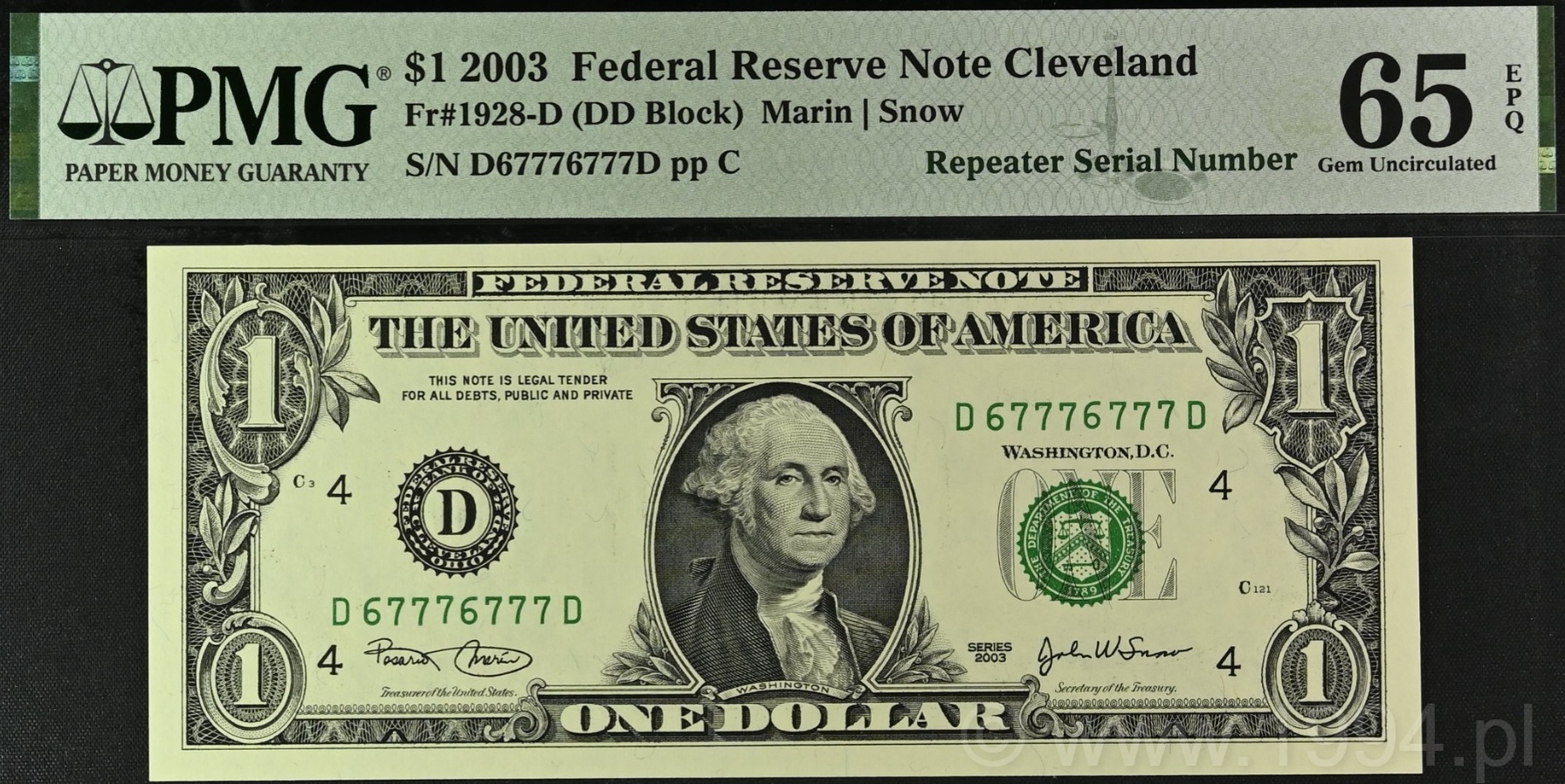
United States 2003 1 Dollar Federal Reserve Note from the Cleveland District featuring Repeater Serial Number D67776777D, PMG 65 EPQ Gem Uncirculated, with vibrant green seal and balanced centering

United States 2003 - 1 Dollar Federal Reserve Note, Cleveland District Repeater Serial Number D67776777D (Friedberg 1928-D, DD Block)

Repeater serial numbers are a popular subset of fancy notes, defined by recurring digit groupings or mirrored patterns that occur by pure statistical chance during numbering. The Bureau of Engraving and Printing does not control these outcomes; they arise naturally in the numbering press cycle, making high-grade examples an accidental rarity. For collectors, such notes combine precision mechanics with the unpredictability of probability, turning ordinary currency into an exercise in mathematical beauty. Read more →

United StatesFancy Serial Note20031 DollarPMG 65 EPQ Gem Uncirculated United StatesFederal Reserve NoteIssued NoteFancy Serial NoteRepeater Serial NumberFriedberg 1928-DCleveland District2003 Series2003Marin–Snow SignaturesPMG 65 EPQGem UncirculatedBureau of Engraving and PrintingModern United States CurrencySerial Number CollectingMathematical Pattern1 Dollar
Held
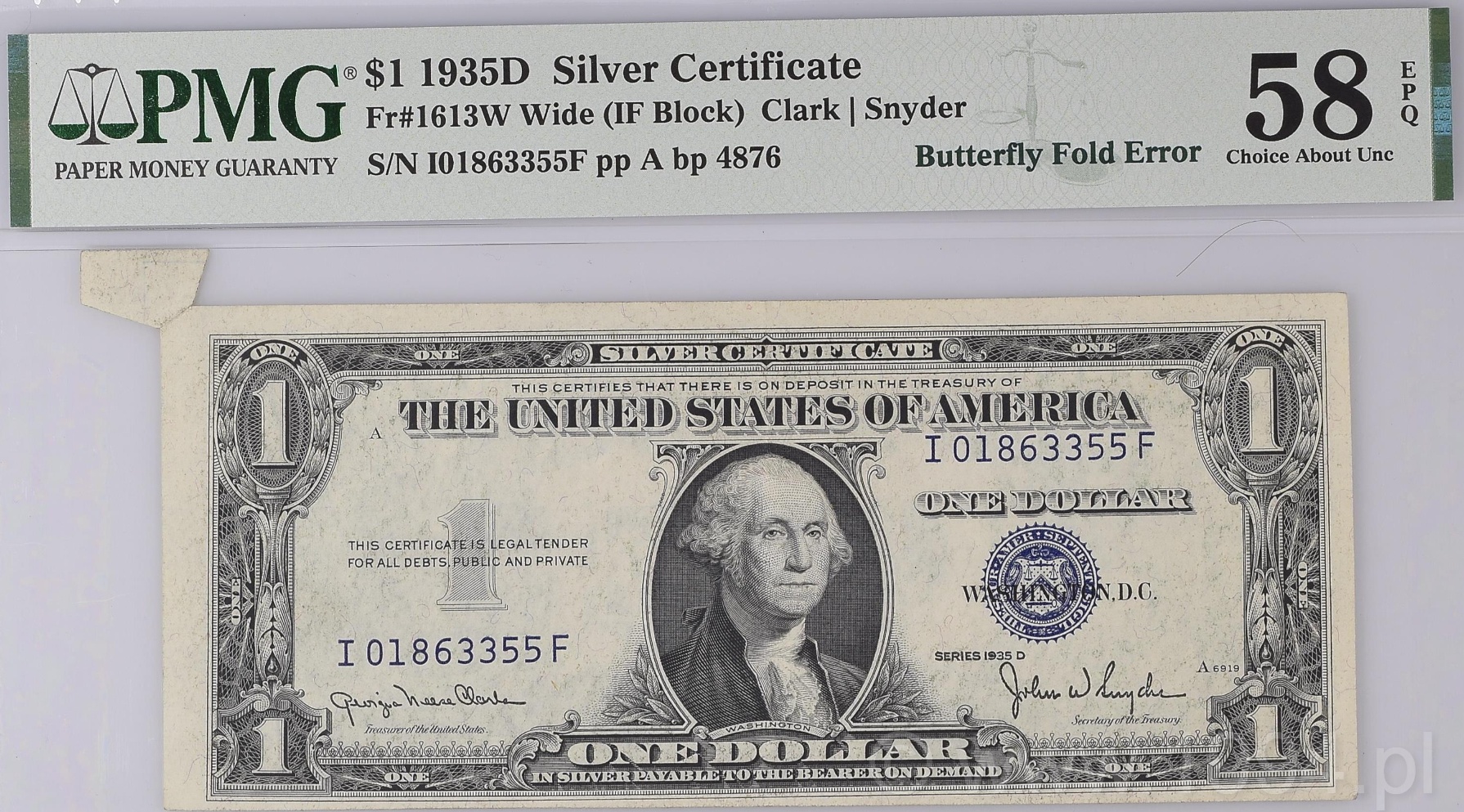
United States 1935D 1 Dollar Silver Certificate showing Butterfly Fold Error with upper left corner folded and partially printed, PMG 58 EPQ Choice About Uncirculated, blue seal issue signed by Clark and Snyder

United States 1935D - 1 Dollar Silver Certificate Butterfly Fold Error (Friedberg 1613W, IF Block)

From a technical and educational standpoint, butterfly errors are invaluable for demonstrating how mechanical stress, humidity, and press speed interact during the intaglio process. This particular example is especially striking for its perfectly preserved fold tab extending beyond the note’s frame, showing exactly how the paper folded during production. For collectors, such notes are more than curiosities-they are tangible evidence of how human and mechanical precision occasionally diverge, producing a one-of-a-kind anomaly that transforms a common note into a specimen of industrial history. Read more →

United StatesError Note19351 DollarPMG 58 EPQ Choice About Uncirculated United StatesSilver CertificateError NoteButterfly Fold ErrorFriedberg 1613W1935D Series1935Clark–Snyder SignaturesBlue SealPMG 58 EPQChoice About UncirculatedBureau of Engraving and PrintingPrinting ErrorProduction AnomalyUnited States Currency1 Dollar
Held
United States 1974 1 Dollar Federal Reserve Note from the Chicago District showing Paper Jam Error at lower right margin, PMG 45 Choice Extremely Fine, with visible folded and misfed corner

United States 1974 - 1 Dollar Federal Reserve Note, Chicago District Paper Jam Error (Friedberg 1908-G, GD Block)

Among mechanical errors, paper jams are particularly instructive because they illustrate a process failure rather than an ink or cutting mistake. The folded paper physically interferes with the press, creating a three-dimensional deformation that can be analyzed to reconstruct the precise phase of production during which it occurred. For collectors and students of numismatic production, such pieces are prized for their diagnostic clarity, demonstrating how even the most mechanized operations can yield unpredictable individuality within the mass production of money. Read more →

United StatesError Note19741 DollarPMG 45 Choice Extremely Fine United StatesFederal Reserve NoteIssued NoteError NotePaper Jam ErrorFriedberg 1908-GChicago District1974 Series1974Neff–Simon SignaturesPMG 45Choice Extremely FineBureau of Engraving and PrintingMechanical ErrorPrinting ErrorProduction AnomalyUnited States Currency1 Dollar
Held
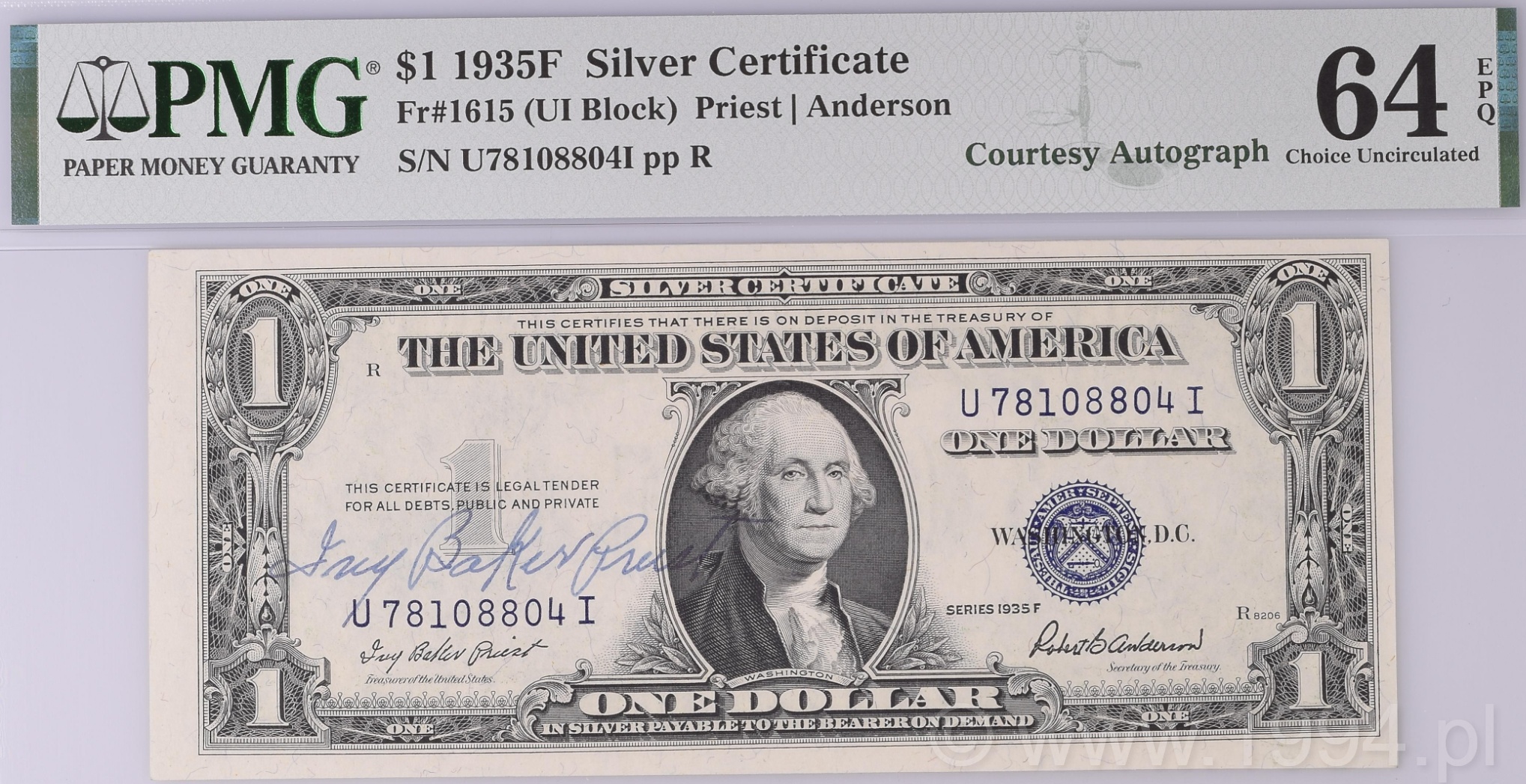
United States 1935F 1 Dollar Silver Certificate with Courtesy Autograph by Treasurer Ivy Baker Priest in blue ink, PMG 64 EPQ Choice Uncirculated, blue seal issue signed by Priest and Anderson

United States 1935F - 1 Dollar Silver Certificate Courtesy Autograph by Treasurer Ivy Baker Priest (Friedberg 1615, UI Block)

This 1935F 1 Dollar Silver Certificate (Friedberg 1615, UI Block) bears a distinguished Courtesy Autograph by Ivy Baker Priest, Treasurer of the United States from 1953 to 1961 under President Dwight D. Eisenhower. Her handwritten blue-ink signature appears directly above the printed facsimile of her name, representing one of the most desirable forms of official Treasury autographs collected today. Read more →

United StatesCourtesy Autograph19351 DollarPMG 64 EPQ Choice Uncirculated United StatesSilver CertificateAutographed NoteCourtesy AutographIvy Baker PriestFriedberg 16151935F Series1935Robert B. AndersonBlue SealPMG 64 EPQChoice UncirculatedBureau of Engraving and PrintingPolitical HistorySigned CurrencyTreasurer of the United StatesUnited States Currency1 Dollar
Held
↑ Top