Collection PL

About

U.S. paper money embodies nearly two centuries of continuous change—social, technological, and institutional. From the 1830s onward, local banks, states, and private printers created an extraordinary visual record of America’s financial experimentation. Early proofs and scrips by firms such as Underwood, Bald, Spencer & Hufty or Rawdon, Wright, Hatch & Edson predate national unity, their engraved portraits and ornaments defining the first true American style of intaglio currency art.

The Civil War and Reconstruction introduced federal control and unprecedented production scale. The 1863 National Banking Act organized thousands of chartered banks whose notes—each bearing its town and charter number—documented regional enterprise from Massachusetts to Kansas. Large-size and small-size Nationals illustrate the transformation from local credit to federally secured obligations, while fractional and state issues like South Carolina’s 1872 Revenue Bonds record fiscal necessity in turbulent times.

The twentieth century shifted focus to standardization and innovation. The Series of 1914 Federal Reserve Notes established centralized issue under the new Reserve System; later small-size redesigns of 1928 codified modern U.S. dimensions. Experimental pieces—Giori press trials, C.O.P.E. calibration sheets, ABNC specimen notes—reveal the industry’s technical core, where anti-counterfeit design met production research. By mid-century, the Bureau of Engraving and Printing had refined color, security threads, and watermark technology into global benchmarks.

Spanning 1830 to 2003, this section captures the United States as engraver, innovator, and issuer—an unbroken lineage from independent presses to the Bureau’s modern laboratories of paper and ink.

61 results · Page 2 of 6
United States 1872 State of South Carolina 20 Dollars Revenue Bond Scrip Columbia Act March 2 1872 PMG 66 EPQ Gem Uncirculated

United States 1872 – State of South Carolina $20 Revenue Bond Scrip (Act of March 2, 1872, Columbia Issue, PMG 66 EPQ Gem Uncirculated)

The $20 Revenue Bond Scrip of the State of South Carolina, dated March 2, 1872, represents one of the most ornate and historically revealing fiscal issues of the Reconstruction era. Authorized by the Act of March 2, 1872, these notes were used by the state government to pay outstanding obligations and to serve as tax receipts during a period of severe post–Civil War financial strain. Printed by the American Bank Note Company in New York, the scrip combined fine engraving, symbolic imagery, and the technical artistry characteristic of the firm’s early 1870s production. ... Read more →

United StatesState Issue187220 DollarsPMG 66 EPQ Gem Uncirculated United StatesSouth CarolinaColumbiaState IssueRevenue Bond Scrip1872ABNCAmerican Bank Note CompanyReconstruction EraPMG 66 EPQGem Uncirculated20 Dollars
Held
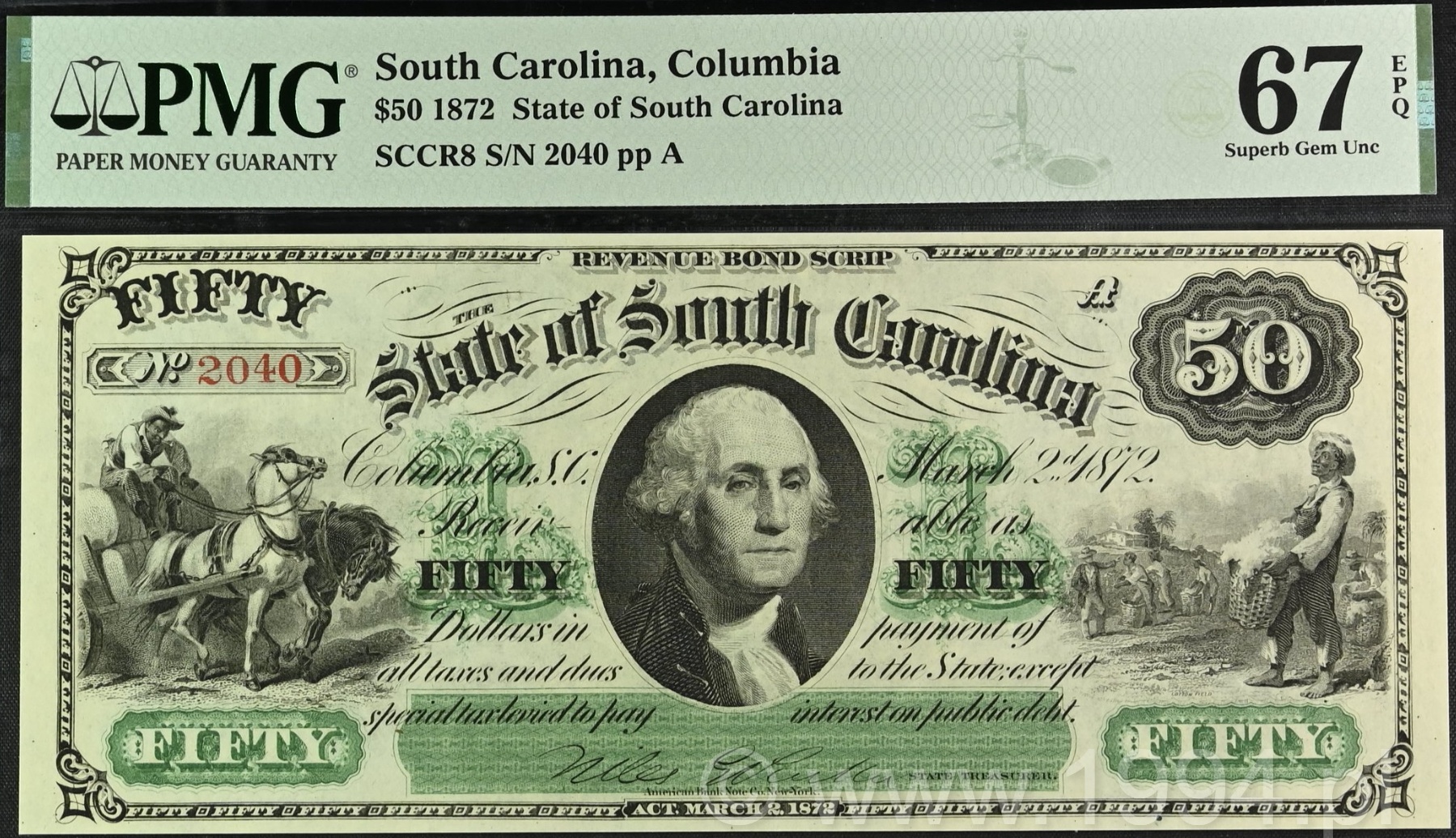
United States 1872 State of South Carolina 50 Dollars Revenue Bond Scrip Columbia Act March 2 1872 PMG 67 EPQ Superb Gem Uncirculated

United States 1872 – State of South Carolina $50 Revenue Bond Scrip (Act of March 2, 1872, Columbia Issue, PMG 67 EPQ Superb Gem Uncirculated)

The fifty-dollar Revenue Bond Scrip authorized by the Act of March 2, 1872, stands among the most elaborate and symbolically charged notes of Reconstruction-era South Carolina. Produced by the American Bank Note Company of New York, these notes were issued to pay state obligations and to function as tax receipts, serving as both a medium of exchange and an assertion of solvency during a turbulent postwar decade. The design balances artistry and propaganda. ... Read more →

United StatesState Issue187250 DollarsPMG 67 EPQ Superb Gem Uncirculated United StatesSouth CarolinaColumbiaState IssueRevenue Bond Scrip1872ABNCAmerican Bank Note CompanyReconstruction EraPMG 67 EPQSuperb Gem Uncirculated50 Dollars
Held
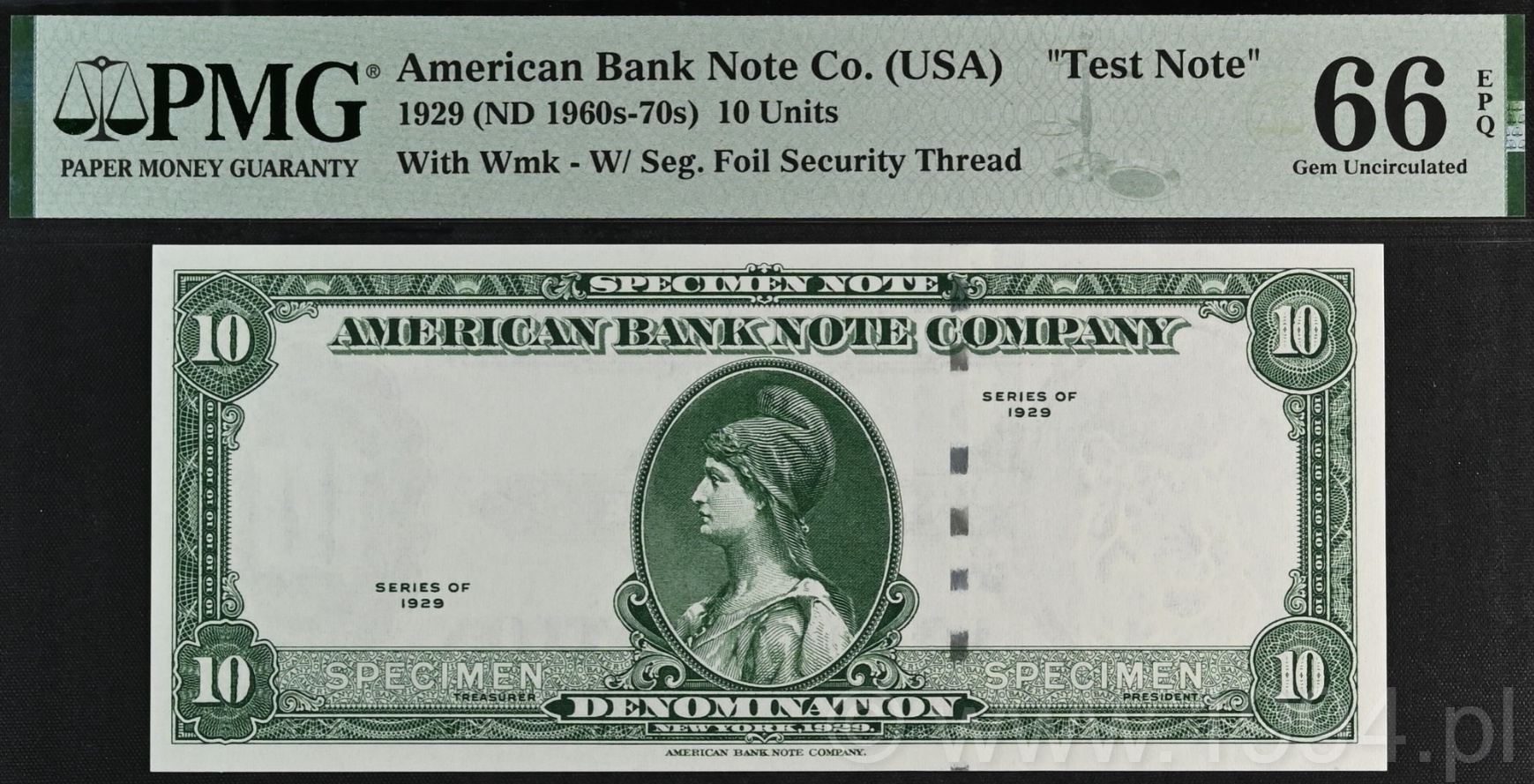
United States American Bank Note Company 10 Units green Series of 1929 specimen note with watermark and foil security thread PMG 66 EPQ Gem Uncirculated

United States ca. 1960s–70s – American Bank Note Company Test Note, 10 Units, Green Series of 1929 (With Watermark and Segmented Foil Security Thread, PMG 66 EPQ Gem Uncirculated)

This engraved test note by the American Bank Note Company (ABNCo) represents one of the firm’s most enduring demonstration designs, known as the 'Series of 1929' specimen. Although dated 1929, these were printed decades later—primarily in the 1960s and 1970s—as house proofs and sales samples showcasing engraving precision, watermark technology, and later innovations such as foil-thread anti-counterfeiting devices. The layout follows classic ABNCo symmetry: a central allegorical portrait of Liberty, derived from earlier U.S. ... Read more →

United StatesTest Note192910 UnitsPMG 66 EPQ Gem Uncirculated United StatesABNCAmerican Bank Note CompanyTest NoteSpecimen10 UnitsGreen SeriesWatermarkFoil ThreadEngraving ArtPMG 66 EPQ
Held
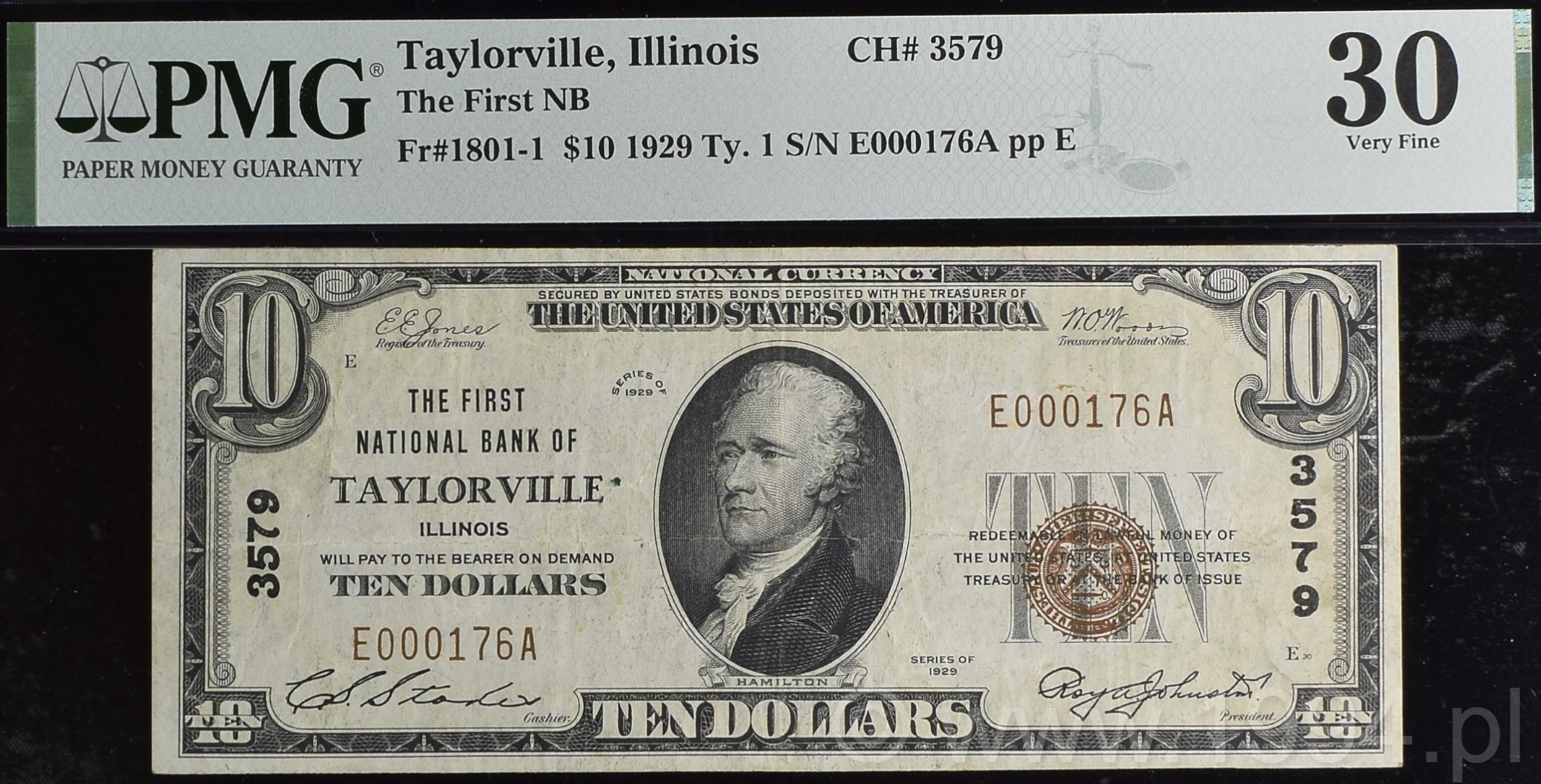
United States 1929 Type 1 - 10 Dollars National Bank Note The First National Bank of Taylorville Illinois Fr1801-1 CH 3579 PMG 30 Very Fine

United States 1929 Type 1 – 10 Dollars National Bank Note – The First National Bank of Taylorville, Illinois (Fr.1801-1, Charter 3579, PMG 30 Very Fine)

This Series 1929 Type 1 ten-dollar note from The First National Bank of Taylorville, Illinois (Charter 3579) is a national-level rarity and a true anomaly in U.S. banking history. The bank officially ceased operations in October 1929—barely months after the introduction of small-size National Bank Notes—making it one of the first casualties of the transition from large-size to small-size currency. ... Read more →

United StatesNational Bank Note192910 DollarsPMG 30 Very Fine 10 DollarsNational Bank NoteType 1TaylorvilleIllinoisCharter 3579Hamilton1929PMG 30Ghost NoteNational Rarity
Held
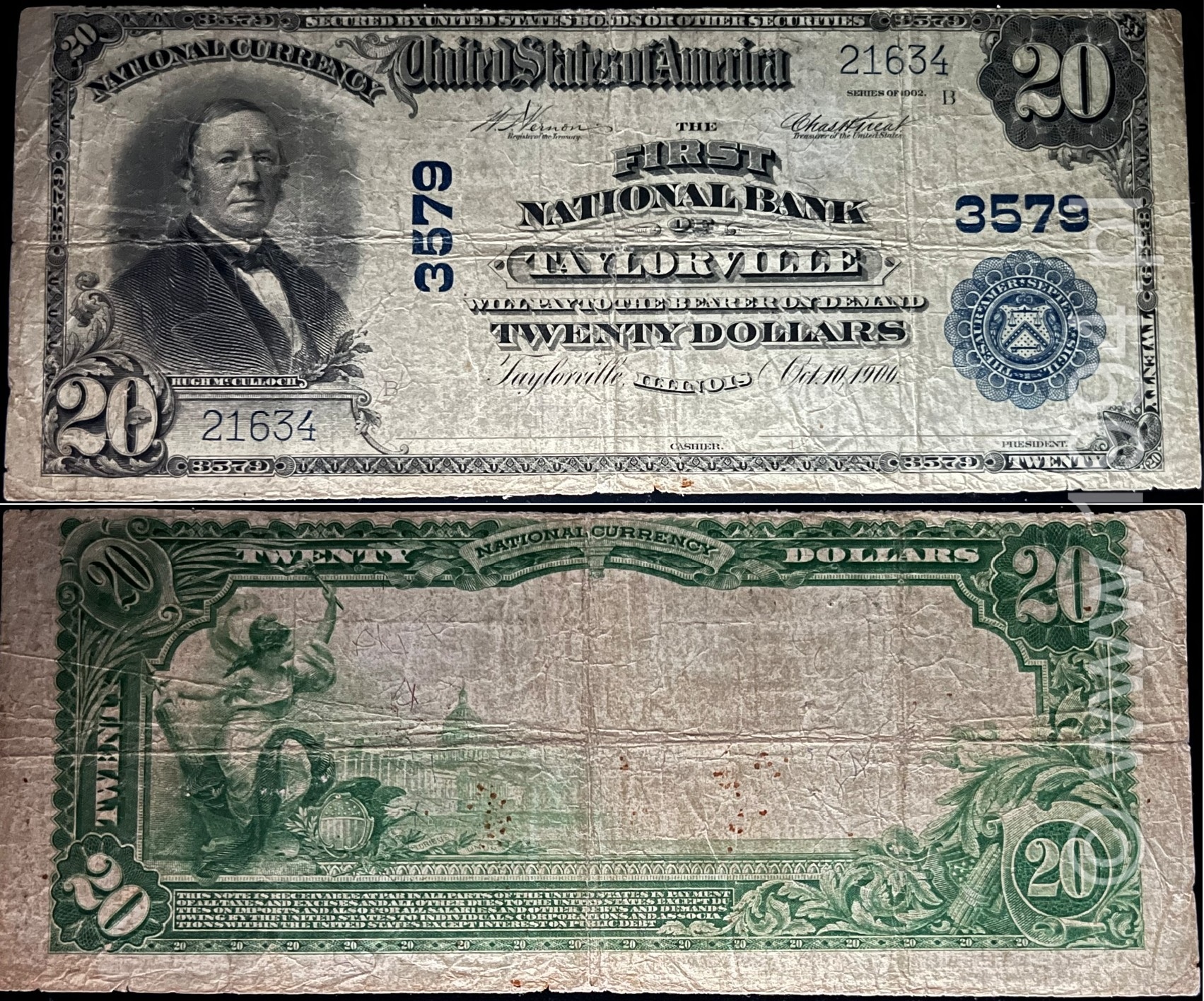
United States 1902 20 Dollars National Bank Note First National Bank of Taylorville Illinois CH 3579 large size plain back blue seal serial 21634

United States 1902 – 20 Dollars National Bank Note – The First National Bank of Taylorville, Illinois (Charter 3579, Large Size Plain Back, Raw Very Good)

Large-size 1902 Plain Back twenty from The First National Bank of Taylorville, Illinois, Charter 3579, a seldom-seen issuer that entered receivership on October 18, 1929 at the very start of the small-size era. Organized and chartered in October 1886, the bank operated for more than four decades, but its total national-currency output was modest for an Illinois institution and survivorship today is extremely thin. Face design shows Treasury Secretary Hugh McCulloch at left, blue charter numerals 3579, and the classic U.S. ... Read more →

United StatesNational Bank Note190220 DollarsRaw Very Good (estimated) 20 DollarsNational Bank NotePlain BackTaylorvilleIllinoisCharter 3579Hugh McCullochLarge Size1902Banking History
Held
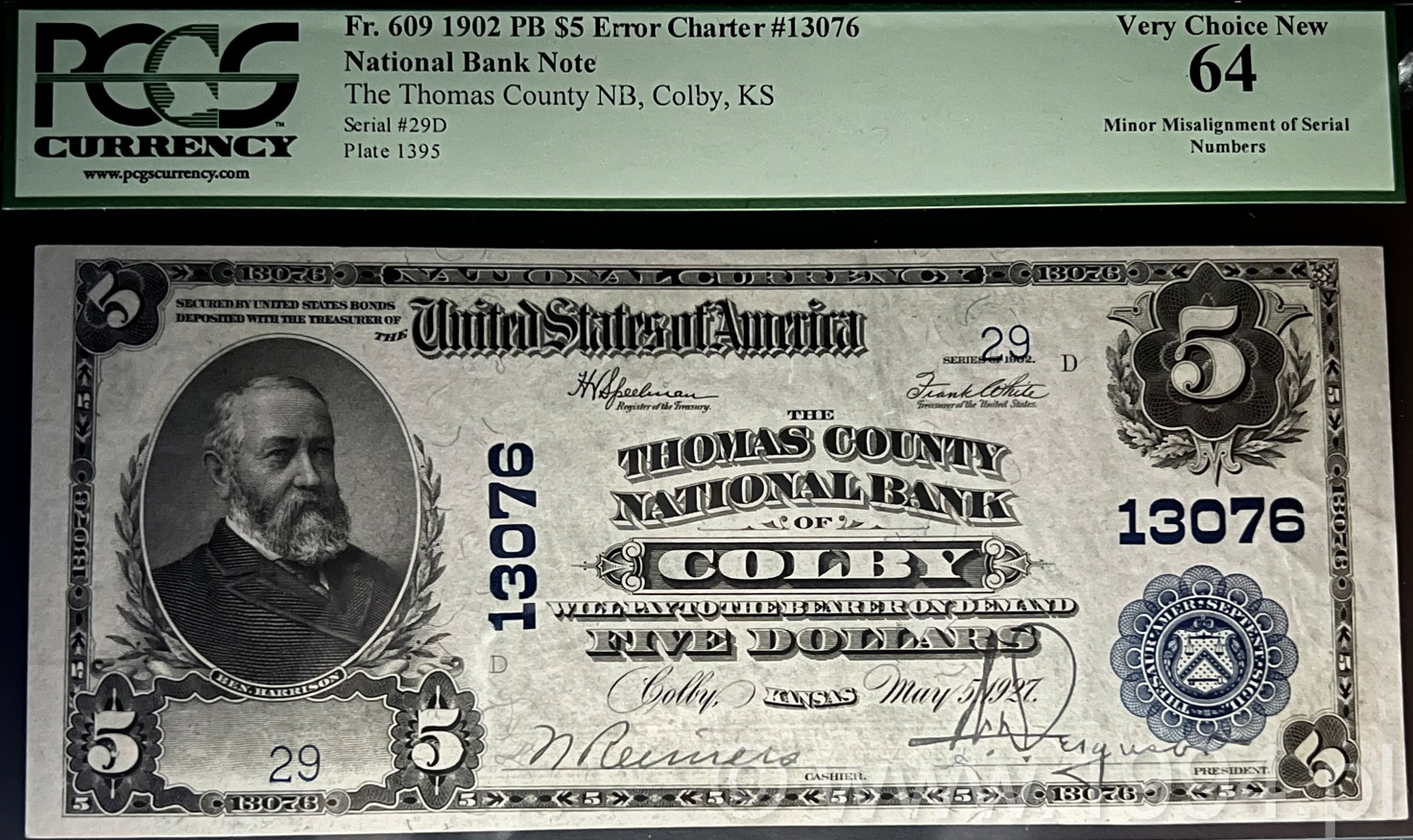
United States 1902 5 Dollars National Bank Note The Thomas County National Bank of Colby Kansas Fr 609 CH 13076 PCGS 64 Very Choice New Error Minor Misalignment of Serial Numbers

United States 1902 – 5 Dollars National Bank Note – The Thomas County National Bank of Colby, Kansas (Fr.609, Charter 13076, Error Note, PCGS 64 Very Choice New)

Organized in May 1927, The Thomas County National Bank of Colby, Kansas, was one of the last institutions chartered under the National Banking Act, entering the system just as small-town banks faced increasing consolidation pressures. Chartered as number 13076, it was led by cashier N. Reimers and president W. ... Read more →

United StatesNational Bank Note Error19025 DollarsPCGS 64 Very Choice New 5 DollarsNational Bank NoteError NoteColbyKansasCharter 13076Benjamin Harrison1902 Plain Back1902PCGS 64Banking History
Held
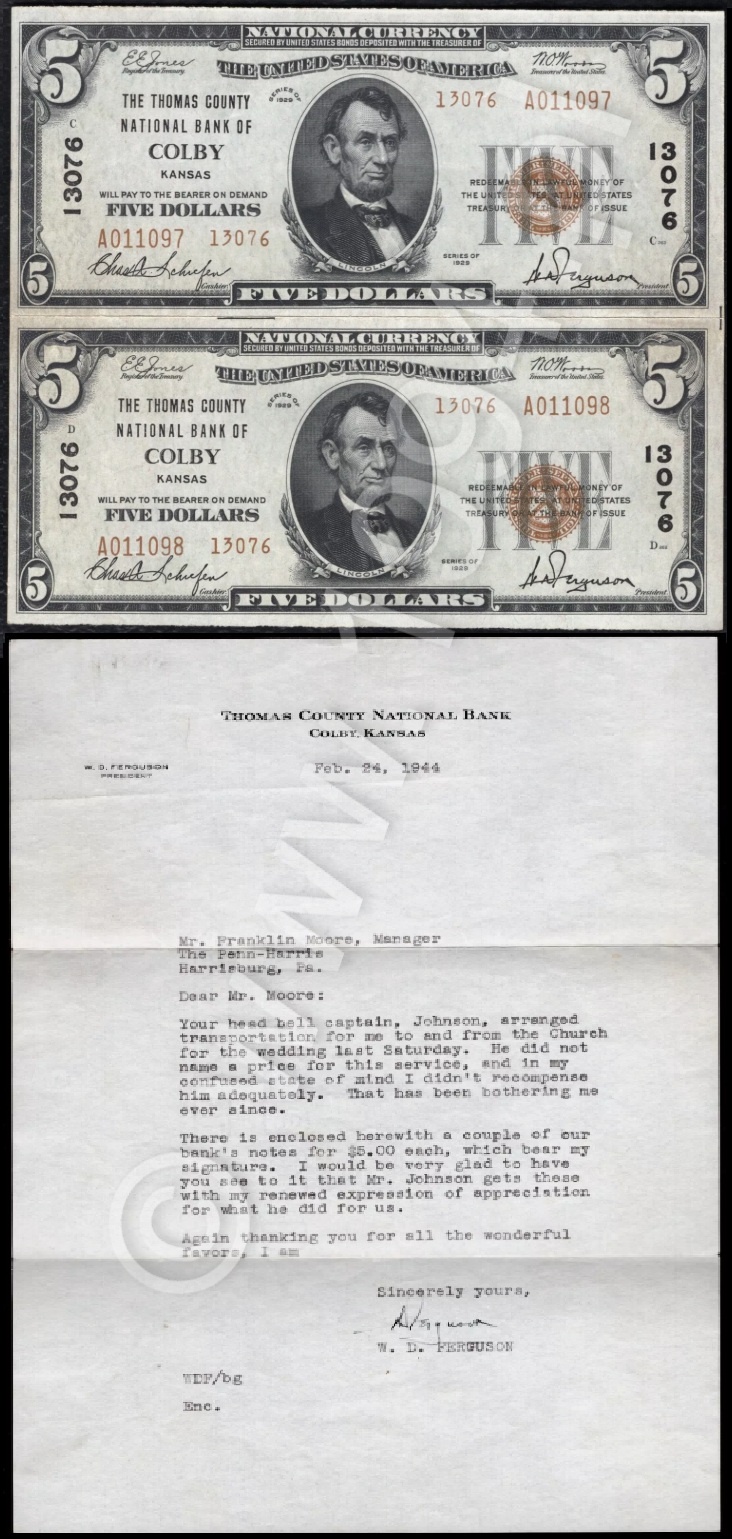
United States 1929 Type 2 uncut pair of 5 Dollars National Bank Notes from The Thomas County National Bank of Colby Kansas Charter 13076 with original 1944 W.D. Ferguson signed bank letter

United States 1929 Type 2 – Uncut Pair of $5 National Bank Notes with 1944 Bank Letter – The Thomas County National Bank of Colby, Kansas (Charter 13076, W.D. Ferguson Provenance)

Uncut consecutive pair of Series of 1929 Type 2 five-dollar National Bank Notes from The Thomas County National Bank of Colby, Kansas (Charter 13076), accompanied by the original 1944 letter of transmittal from the bank’s president, W. D. Ferguson. ... Read more →

United StatesNational Bank Note Provenance Set19295 Dollars (Uncut Pair)Uncirculated (Estimated Choice–Gem) 5 DollarsNational Bank NoteType 2Uncut PairColbyKansasCharter 13076W.D. FergusonProvenance Letter1944 Correspondence1922Small Size NationalBank HistoryPick UnlistedMuseum GradeR9 Extremely RareUnique
Held
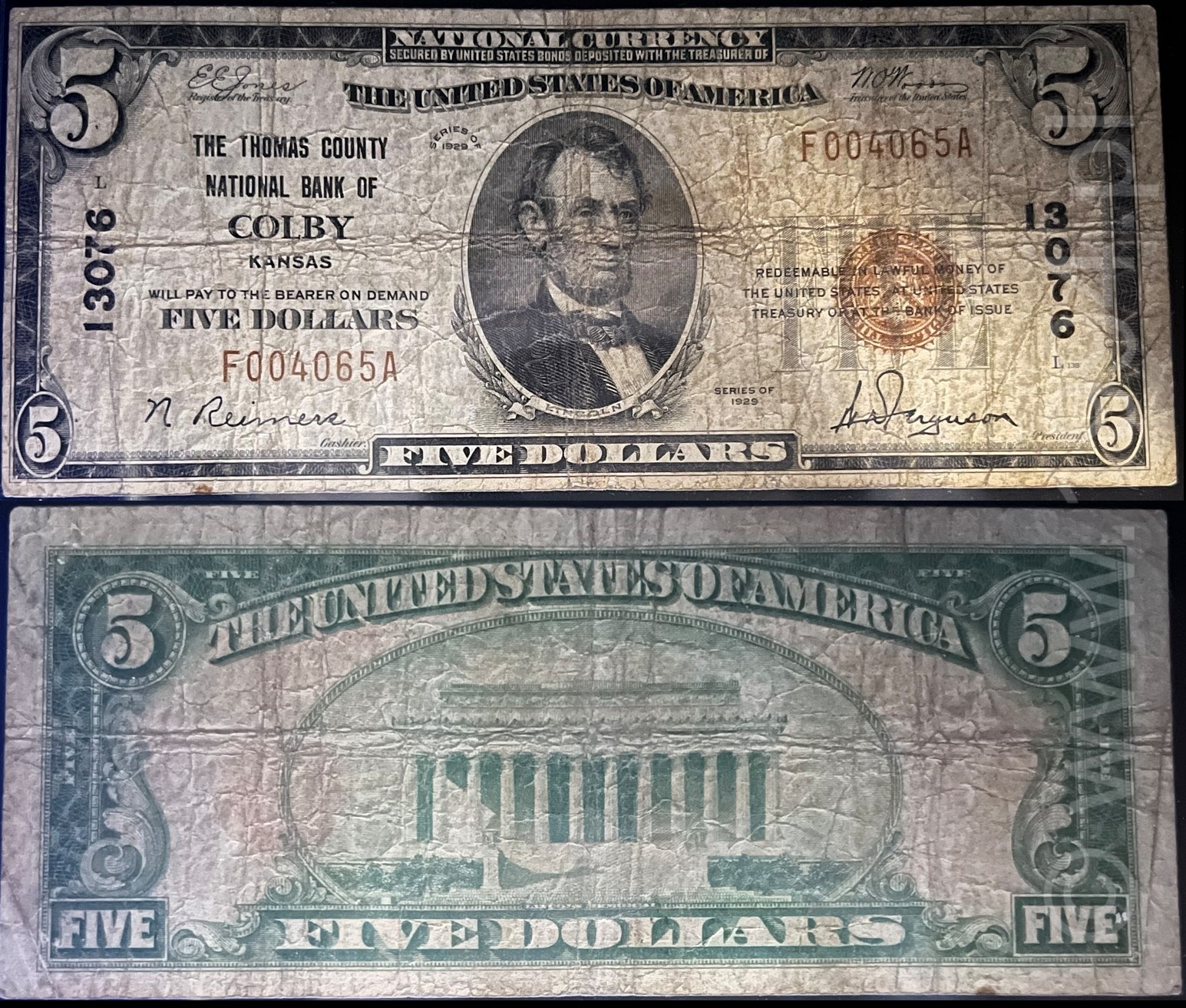
United States 1929 Type 1 - 5 Dollars National Bank Note The Thomas County National Bank of Colby Kansas Charter 13076 raw circulated example with signatures of N Reimers and W D Ferguson

United States 1929 Type 1 – 5 Dollars National Bank Note – The Thomas County National Bank of Colby, Kansas (Charter 13076, Raw Circulated Example)

Circulated five-dollar note from The Thomas County National Bank of Colby, Kansas (Charter 13076), Series of 1929 Type 1. This example represents the true working currency of the Great Plains during the Depression years—money that passed through farms, shops, and local hands in northwest Kansas at a time when the nation’s economy was in flux. The note follows the standard small-size Type 1 national design with Abraham Lincoln’s engraved portrait at center, flanked by bold denomination counters and the brown Treasury seal at right. ... Read more →

United StatesNational Bank Note19295 DollarsRaw Circulated (Good–Very Good, estimated) 5 DollarsType 1National Bank NoteColbyKansasCharter 13076Lincoln1929Circulated ExampleGreat DepressionBanking History
Held
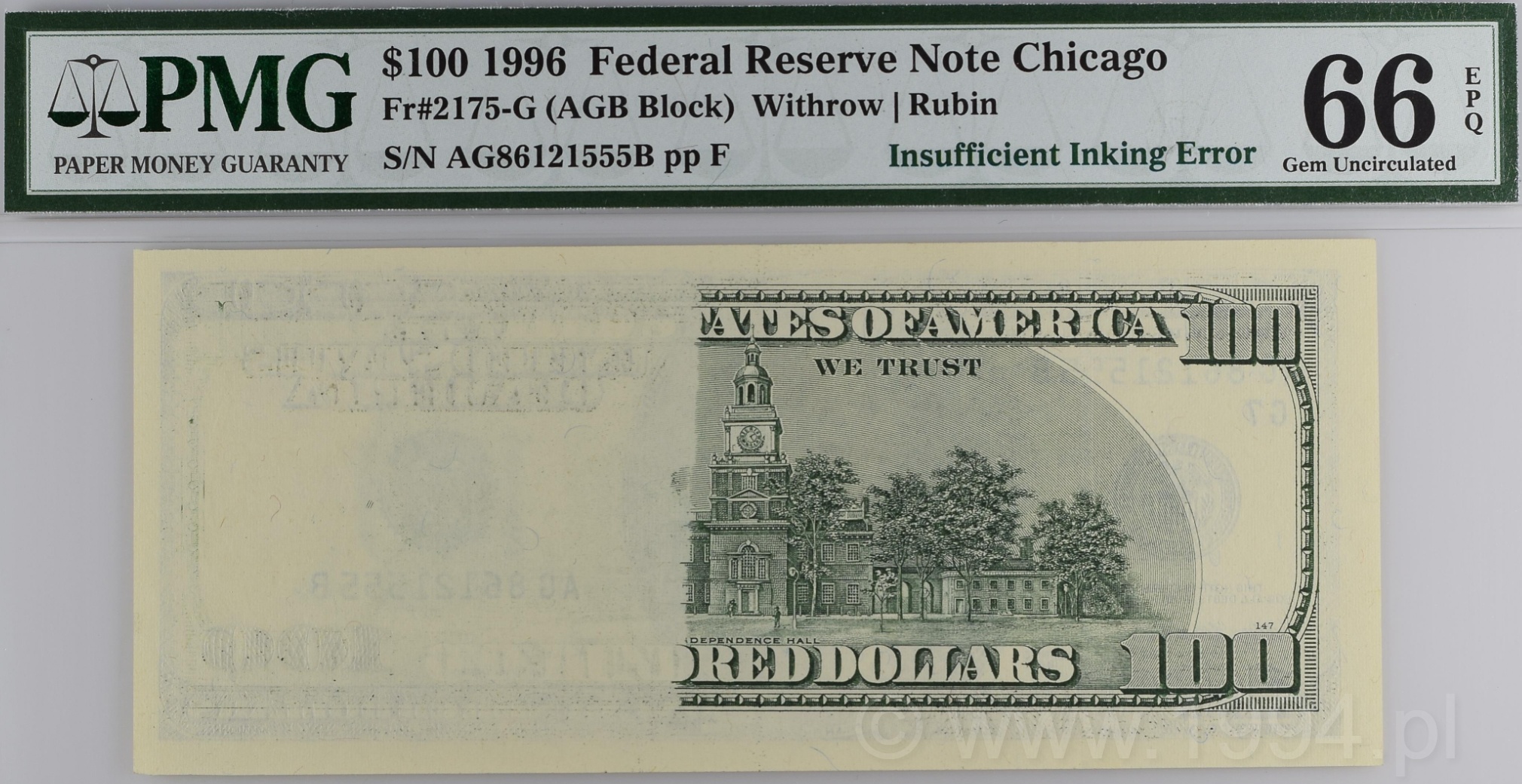
United States 1996 100 Dollars Federal Reserve Note from the Chicago District with Insufficient Inking Error on the reverse, PMG 66 EPQ Gem Uncirculated, showing faint Independence Hall design

United States 1996 — 100 Dollars Federal Reserve Note, Chicago District (Friedberg 2175-G) Insufficient Inking Error, PMG 66 EPQ Gem Uncirculated

This 1996 100 Dollars Federal Reserve Note from the Chicago District (Friedberg 2175-G, AGB Block) presents one of the most striking examples of an Insufficient Inking Error recorded on a modern U.S. high-denomination note. The entire reverse is drastically under-inked: the normally bold depiction of Independence Hall appears as a pale, incomplete impression, with architectural outlines faintly visible but lacking depth and saturation. ... Read more →

United StatesError Note1996100 DollarsPMG 66 EPQ Gem Uncirculated United StatesFederal Reserve NoteError NotePrinting ErrorInsufficient Inking ErrorModern Printing ErrorBureau of Engraving and PrintingChicago DistrictFriedberg 2175-G1996Gem UncirculatedPMG 66 EPQCurrency ProductionModern RarityUnited States Currency100 Dollars
Held
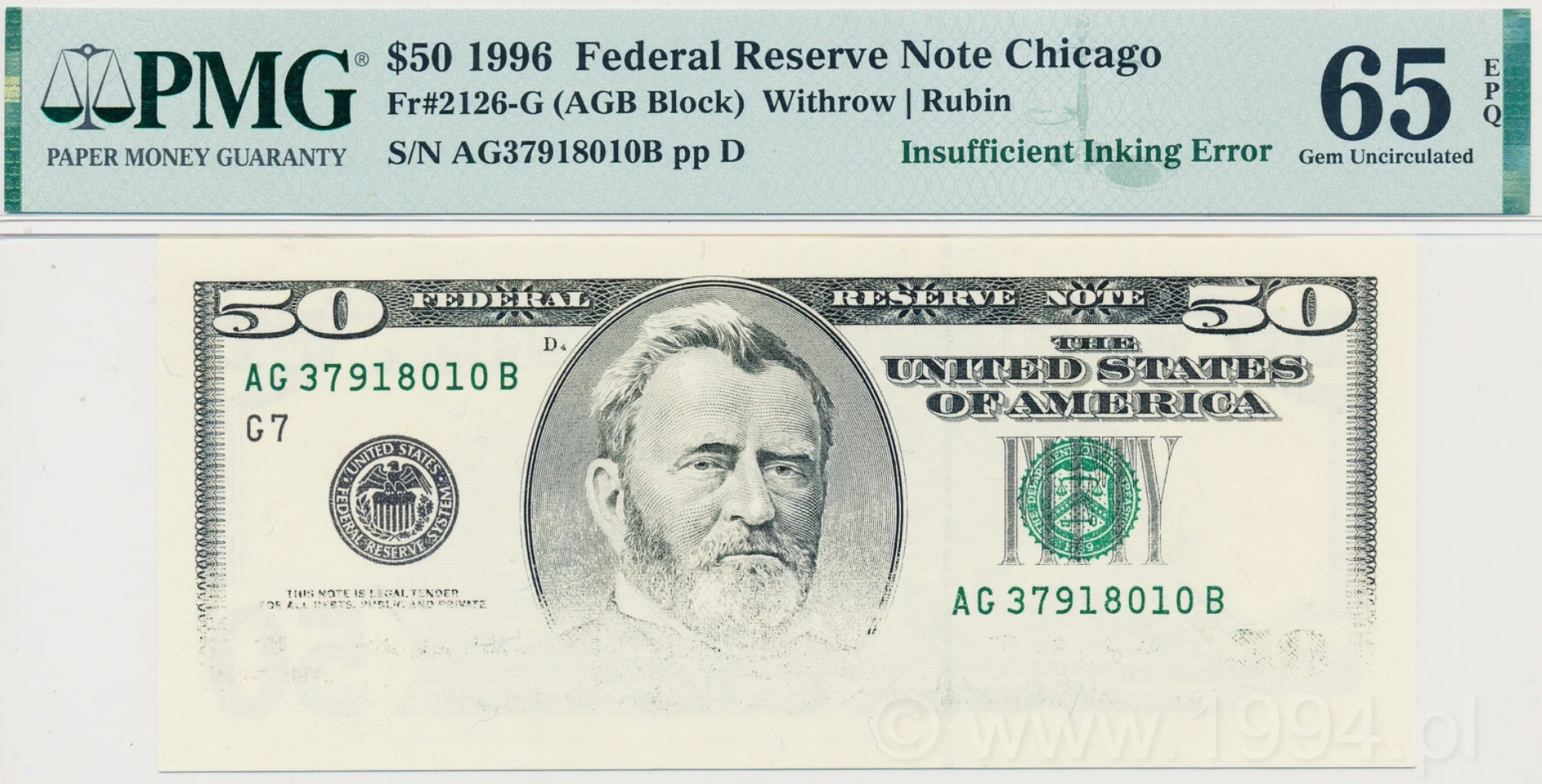
United States 1996 50 Dollars Federal Reserve Note from the Chicago District with Insufficient Inking Error affecting the left side of the obverse, PMG 65 EPQ Gem Uncirculated, portrait of Ulysses S. Grant visible with pale printing

United States 1996 — 50 Dollars Federal Reserve Note, Chicago District (Friedberg 2126-G) Insufficient Inking Error, PMG 65 EPQ Gem Uncirculated

This 1996 50 Dollars Federal Reserve Note from the Chicago District (Friedberg 2126-G, AGB Block) demonstrates a dramatic Insufficient Inking Error affecting the left side of the obverse. The portrait of Ulysses S. Grant remains fully defined, yet the surrounding text, borders, and background show substantial ink loss, fading into near blankness. ... Read more →

United StatesError Note199650 DollarsPMG 65 EPQ Gem Uncirculated United StatesFederal Reserve NoteError NotePrinting ErrorInsufficient Inking ErrorModern Printing ErrorBureau of Engraving and PrintingChicago DistrictFriedberg 2126-G1996Gem UncirculatedPMG 65 EPQCurrency ProductionModern RarityUnited States Currency50 Dollars
Held
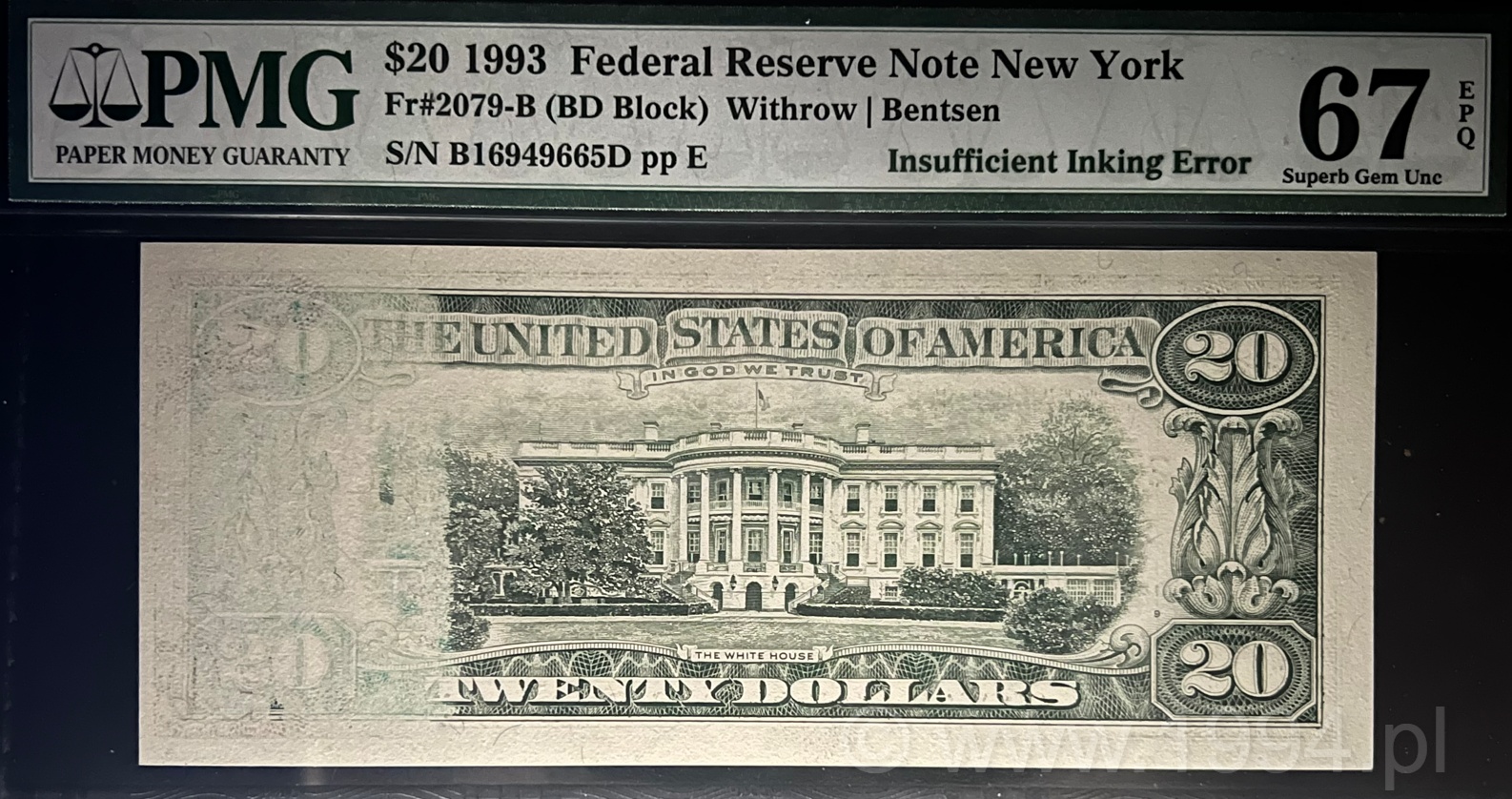
United States 1993 20 Dollars Federal Reserve Note from the New York District with Insufficient Inking Error on the reverse, PMG 67 EPQ Superb Gem Uncirculated, showing faint White House vignette and missing ink coverage

United States 1993 — 20 Dollars Federal Reserve Note, New York District (Friedberg 2079-B) Insufficient Inking Error, PMG 67 EPQ Superb Gem Uncirculated

This 1993 20 Dollars Federal Reserve Note from the New York District (Friedberg 2079-B, BD Block) is a superbly preserved example of an Insufficient Inking Error that drastically weakens the reverse printing. The normally dark green depiction of the White House appears faint and washed out, with many architectural and background details missing. Only fragments of the design—such as the central columns, the inscription 'UNITED STATES OF AMERICA', and the denomination numerals—remain clearly visible. ... Read more →

United StatesError Note199320 DollarsPMG 67 EPQ Superb Gem Uncirculated United StatesFederal Reserve NoteError NotePrinting ErrorInsufficient Inking ErrorBureau of Engraving and PrintingNew York DistrictFriedberg 2079-B1993Superb Gem UncirculatedPMG 67 EPQModern RarityUnited States Currency20 DollarsProduction Anomaly
Held
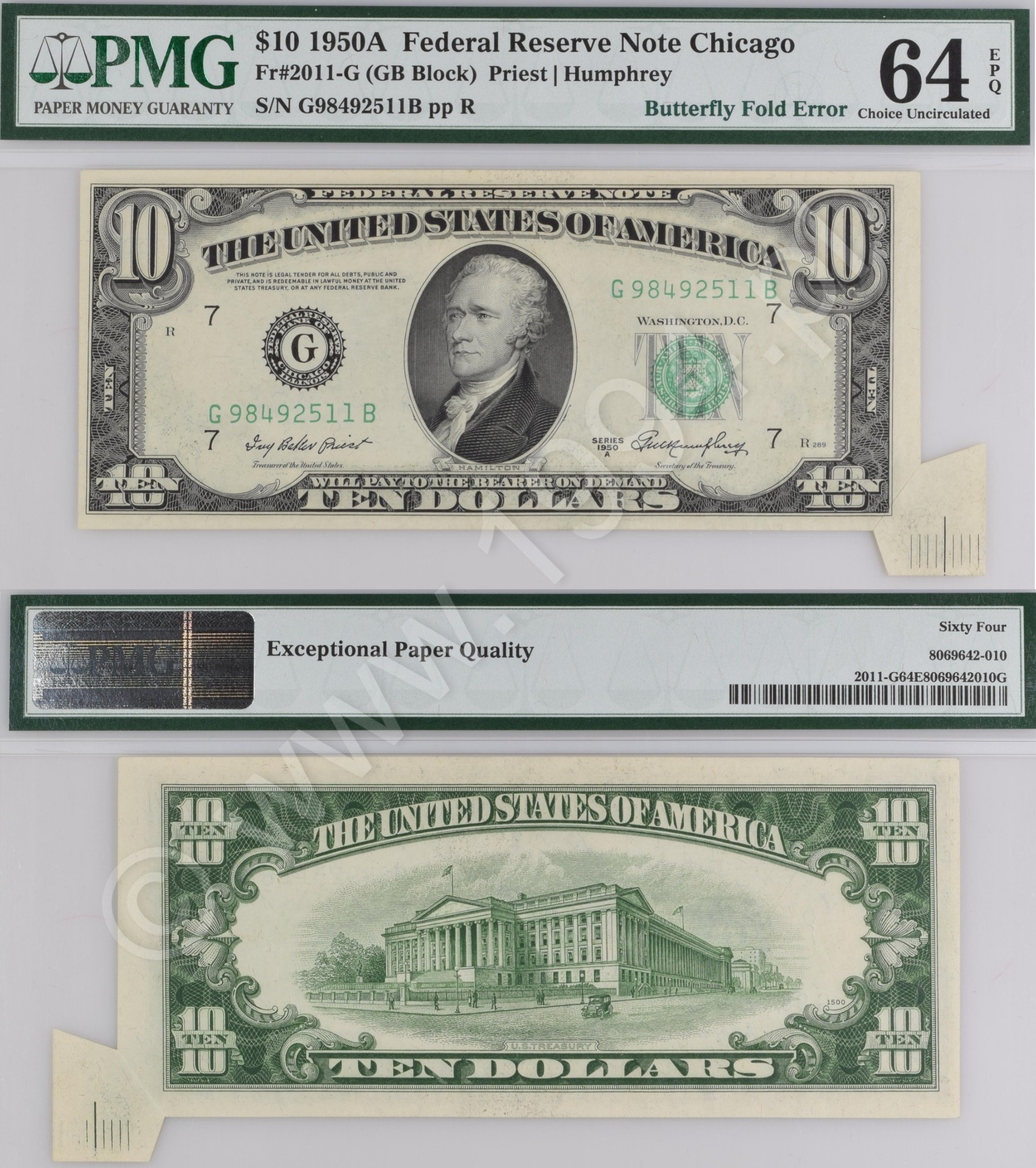
United States 1950A 10 Dollars Federal Reserve Note from the Chicago District with Butterfly Fold Error extending from the lower right corner, PMG 64 EPQ Choice Uncirculated, showing misprinted triangular fold pattern

United States 1950A — 10 Dollars Federal Reserve Note, Chicago District (Friedberg 2011-G) Butterfly Fold Error, PMG 64 EPQ Choice Uncirculated

This 1950A 10 Dollars Federal Reserve Note from the Chicago District (Friedberg 2011-G, GB Block) displays a striking Butterfly Fold Error, one of the most visually dramatic mechanical mishaps encountered in modern U.S. currency production. During printing, a corner of the paper was unintentionally folded over, causing part of the note’s design to print on the folded flap and leaving an unprinted void once the fold was later unfolded. ... Read more →

United StatesError Note195010 DollarsPMG 64 EPQ Choice Uncirculated United StatesFederal Reserve NoteError NoteButterfly Fold ErrorFolding ErrorPrinting ErrorBureau of Engraving and PrintingChicago DistrictFriedberg 2011-G1950A Series1950PMG 64 EPQChoice UncirculatedModern Error NoteProduction AnomalyUnited States Currency10 Dollars
Held
↑ Top