Description and research notes
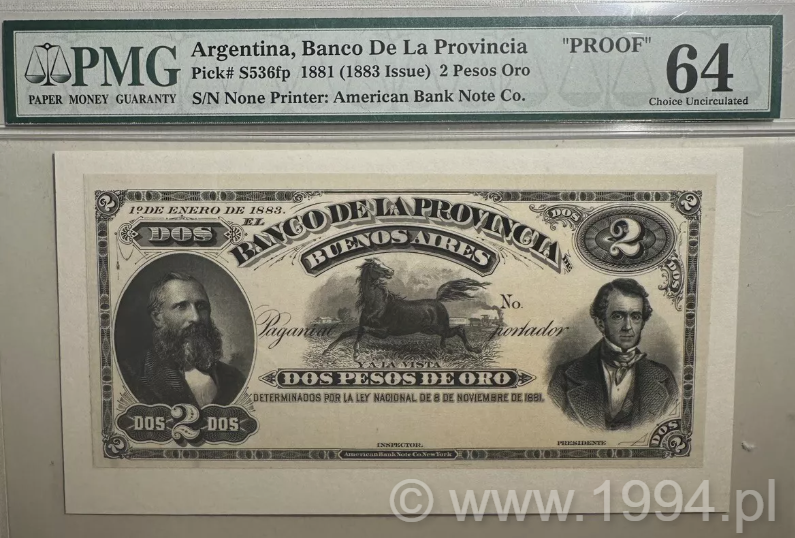
Superb proof engraving prepared by the American Bank Note Company for the Banco de la Provincia de Buenos Aires, dated 19 de Enero de 1883. The design features an equestrian vignette at center symbolizing progress and vitality, flanked by portraits of Florencio Varela and Valentín Alsina, two influential figures in Argentina’s political and intellectual life.
Printed directly from ABNC master plates in black ink on thin India paper and mounted on card stock, this piece confirms its pre-issue proof status. Such proofs were prepared as part of the approval process before full production, allowing the bank to review design and engraving quality. The absence of serial numbers and signatures reflects its archival purpose rather than circulation intent.
The 1883 proof belongs to a short transitional period between the 1881 and 1885 'Pesos Oro' issues, representing the modernization of Argentina’s provincial currency design. During this time, the Banco de la Provincia served as both a provincial and quasi-national financial institution, bridging regional economic autonomy with the emerging central banking structure that would later unify Argentina’s monetary system.
Only one example is certified in the PMG census, graded 64 Choice Uncirculated (Top Pop) — the sole recorded proof of this denomination and date. Beyond its rarity, this engraving illustrates the precision and artistry characteristic of the American Bank Note Company during the late 19th century, when U.S. firms dominated Latin American banknote production. This proof stands as a tangible artifact of that era’s intersection between artistry, financial expansion, and technological excellence.
Historically, the Banco de la Provincia de Buenos Aires played a central role in Argentina’s economic development. Founded in 1822 and operating as a hybrid provincial–national entity, it served as the fiscal engine of Buenos Aires—the country’s largest port, commercial hub, and financial capital. The bank financed infrastructure, immigration, agriculture, and early industrialization, and its banknotes dominated circulation in the Rio de la Plata region until national consolidation in the late 1880s.
The ABNC proof aesthetic is immediately recognizable: deep intaglio linework; elegant guilloché borders; idealized allegorical portraits; and sharply modeled central vignettes. The equestrian scene symbolizes movement, energy, and Argentina’s frontier identity, while the portraits of Varela and Alsina highlight the political leadership that shaped Buenos Aires’s institutional development. These design choices were calculated to project stability, legitimacy, and modernity to a public still shaken by recurring bank crises and provincial–national political conflict.
As a period ABNC India-paper proof, this piece captures the engraving exactly as it existed on the master plate before tint stones, serialing, or final production adjustments. Such proofs were archived by both the printer and the bank, used as reference material, and later preserved in private collections after the dispersal of ABNC archives. Survival of a single proof of this denomination—especially at PMG 64 Top Pop—marks it as a museum-grade artifact documenting the peak of American engraving influence in South America and the early evolution of Argentina's 'Pesos Oro' monetary standard.