Description and research notes
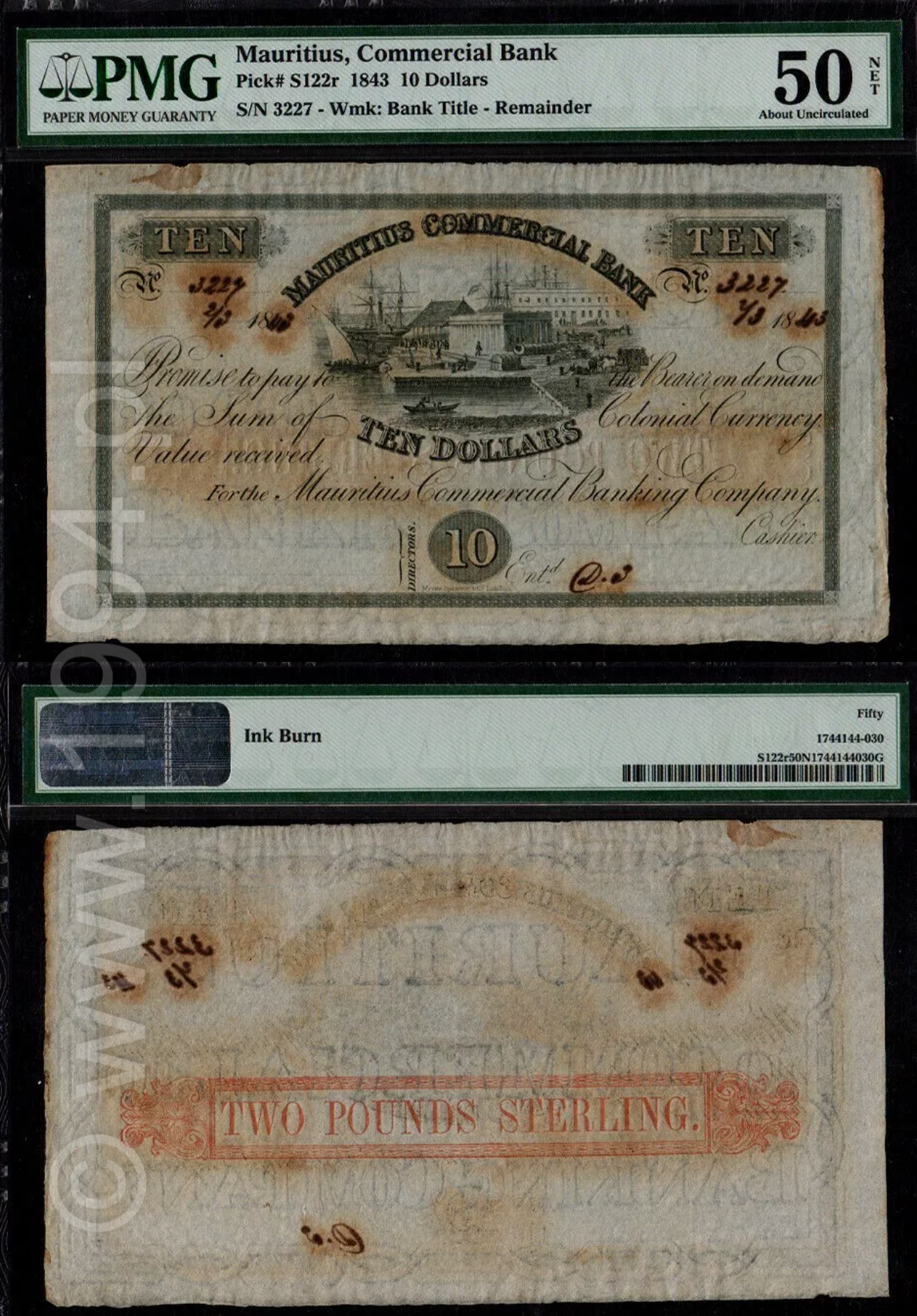
Unissued remainder from the earliest Mauritius Commercial Bank dual-currency series, printed by Myers Frs. & Co., London.
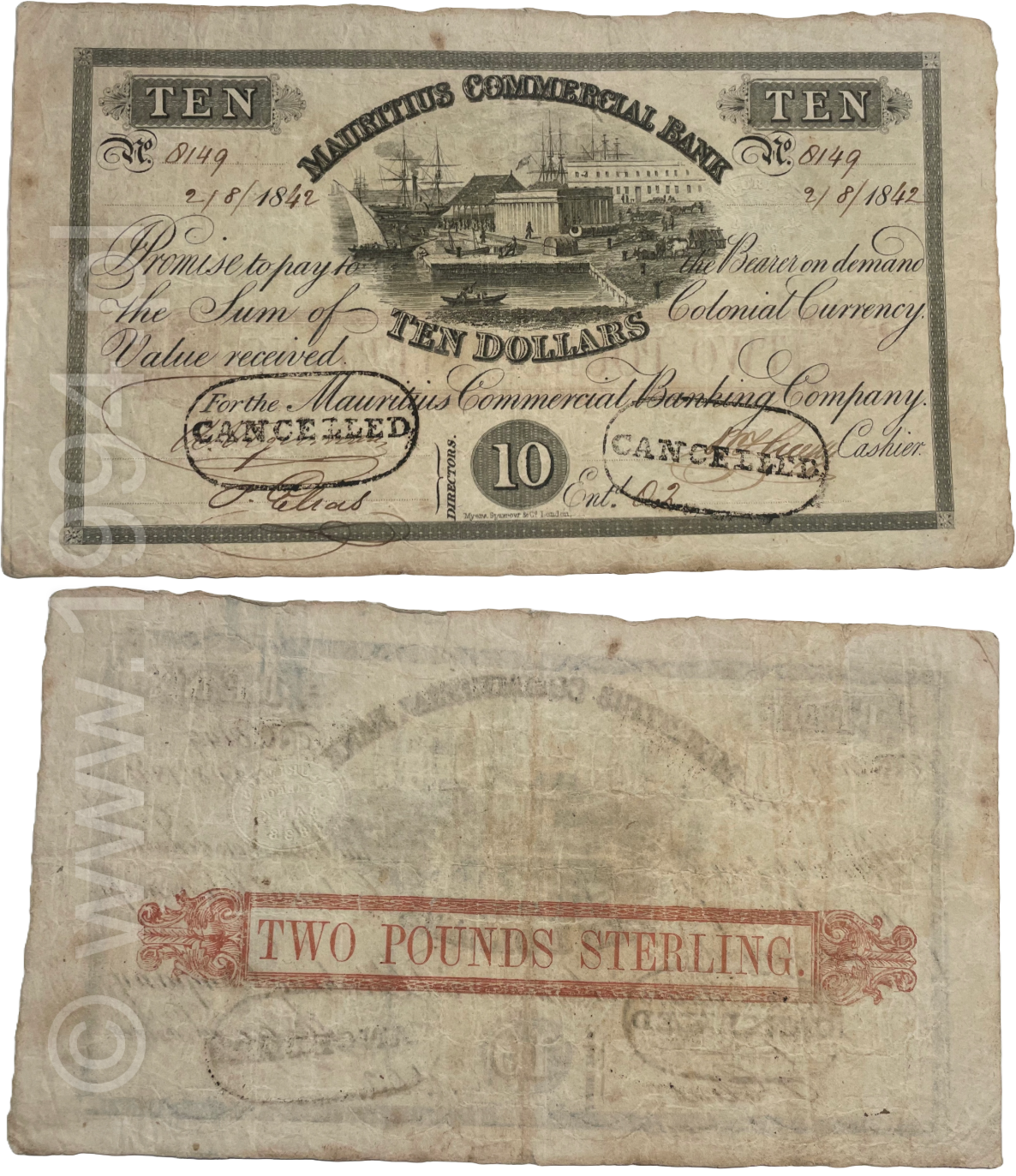
This note represents the archival stock of the 1840s issue - printed but never signed or circulated. It carries the same engraving and layout as the fully issued 1842 Ten Dollars / Two Pounds Sterling notes, showing the Port Louis harbor with moored vessels, bonded warehouses, and the neoclassical bank building anchoring the composition. The vignette is among the earliest engraved landscapes used on any Mauritian banknote, reflecting the colony’s maritime identity and its economic dependence on shipping and re-export trade.
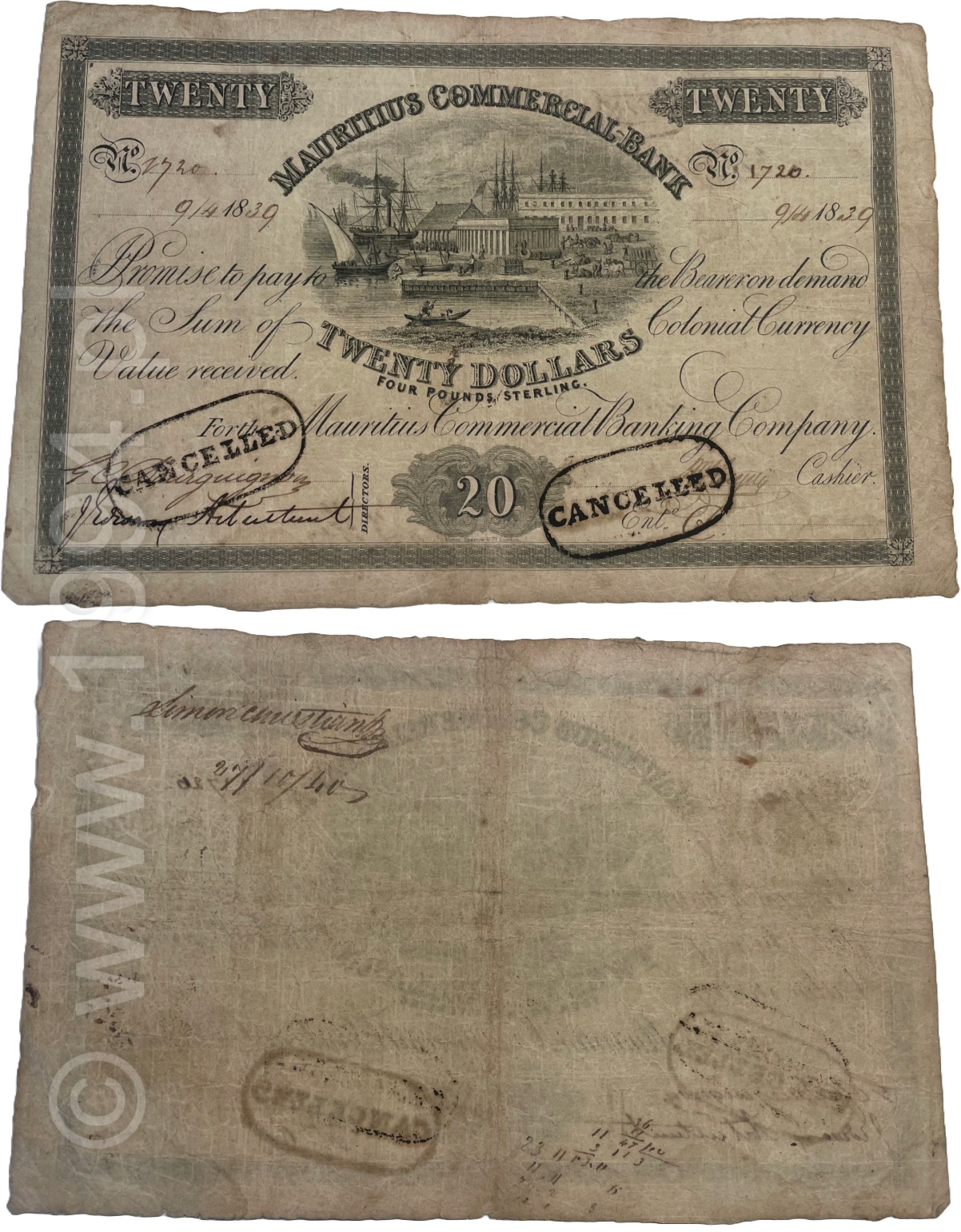
By 1843, the design had fully adopted the red reverse overprint 'TWO POUNDS STERLING', creating a clear dual-currency layout that paired locally reckoned dollars with their pound-sterling equivalent for imperial accounting. Earlier designs - such as the 1839 Twenty Dollars note - had printed the sterling value only on the front in black. The adoption of the red reverse panel marked the formal consolidation of Mauritius’s dual-currency monetary system as used throughout the 1840s.
As an unissued remainder, this note was never completed with manuscript signatures, serials, or cashier validations. Instead, it shows wide margins, crisp plate detail, and period ink burn caused by iron-gall annotations during internal inventorying at the bank or printer. The 'ink burn' noted by PMG is a natural oxidation effect from 19th-century ink formulas and is frequently found on surviving remainders from Mauritius and other tropical colonies where humidity accelerated the chemical reaction.
The survival of any Mauritius Commercial Bank remainder from the early 1840s is exceptionally rare. Most printed stock was either overprinted, used for training, or destroyed during later reconciliations as the bank retired the dollar series. Fully issued examples were almost all redeemed and cancelled, while unissued sheets were typically discarded or reused. This 1843-dated remainder is therefore one of the only high-grade witnesses to the precise engraved state of the early dual-currency series.
Graded PMG 50 NET About Uncirculated for ink burn alone - rather than circulation wear - the note retains exceptional embossing, paper strength, and plate clarity. As a high-denomination Ten Dollar / Two Pounds Sterling remainder from the earliest functional period of Mauritian banking under British administration, it stands as a museum-grade artifact documenting the origins of the island’s formal monetary structure, its dependence on sterling, and the technical evolution of one of the British Empire’s rarest early colonial paper-money systems.