Description and research notes
A numbered approval specimen of the Bank of New Zealand £5 Orange design, printed by Bradbury Wilkinson & Co., London, circa 1913. Though derived from the original 1895 S192 plate, this example bears two distinct serial numbers (286901 and 296900), identifying it as a multi-serial approval specimen drawn from the opening and closing positions of a controlled production range. Such pieces were created for printer audit, plate verification, and contractual record-keeping rather than circulation. PMG catalogs this variant as Pick S192ms.
Multi-serial approval specimens were retained at the beginning of a production run and preserved exclusively for archival inspection. Unlike standard zero-serial file specimens, these pieces document live numbering behavior and plate stability under operational conditions. As a result, they were produced in far smaller quantities and were far more likely to be destroyed during later file reductions.
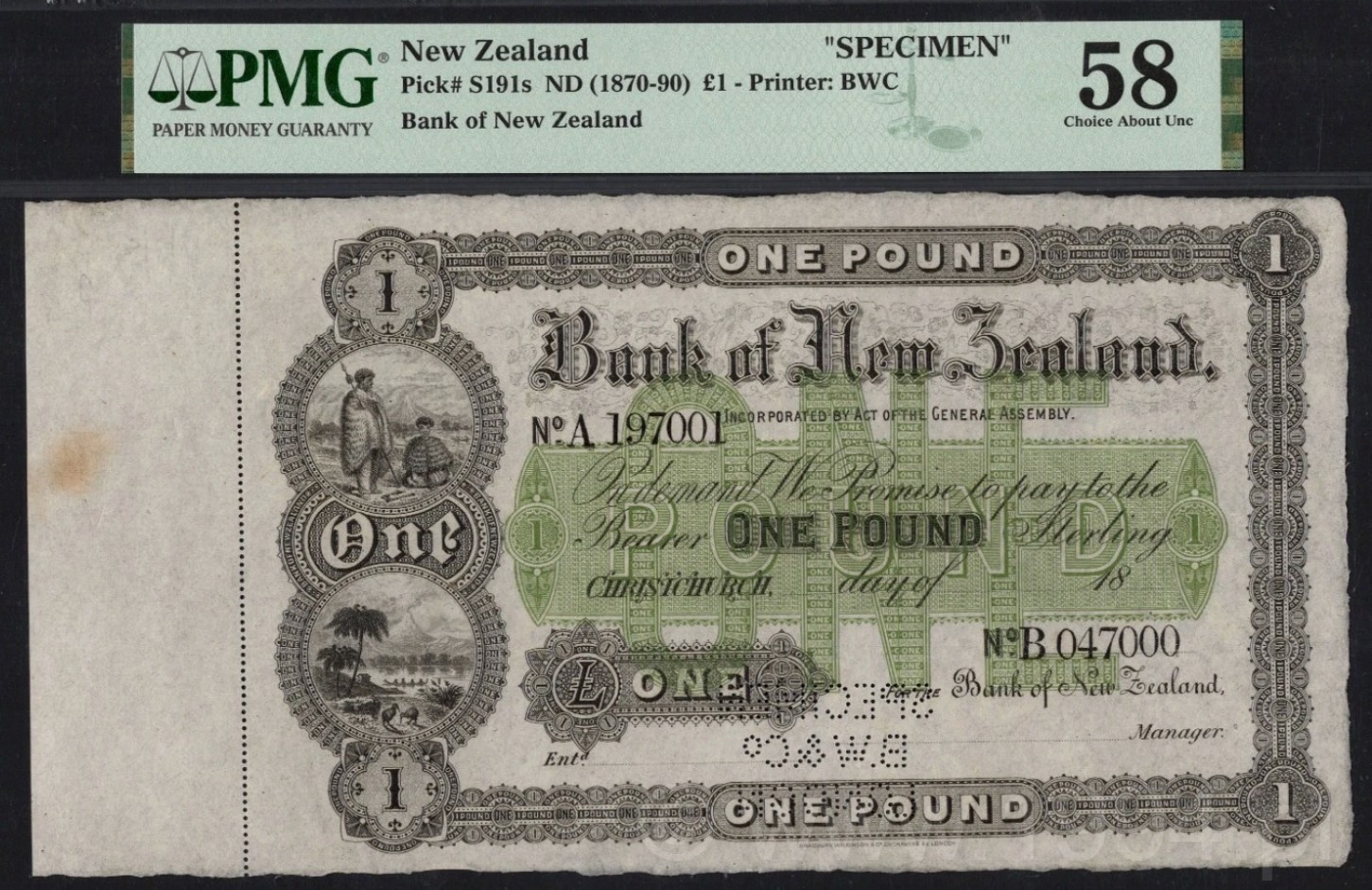
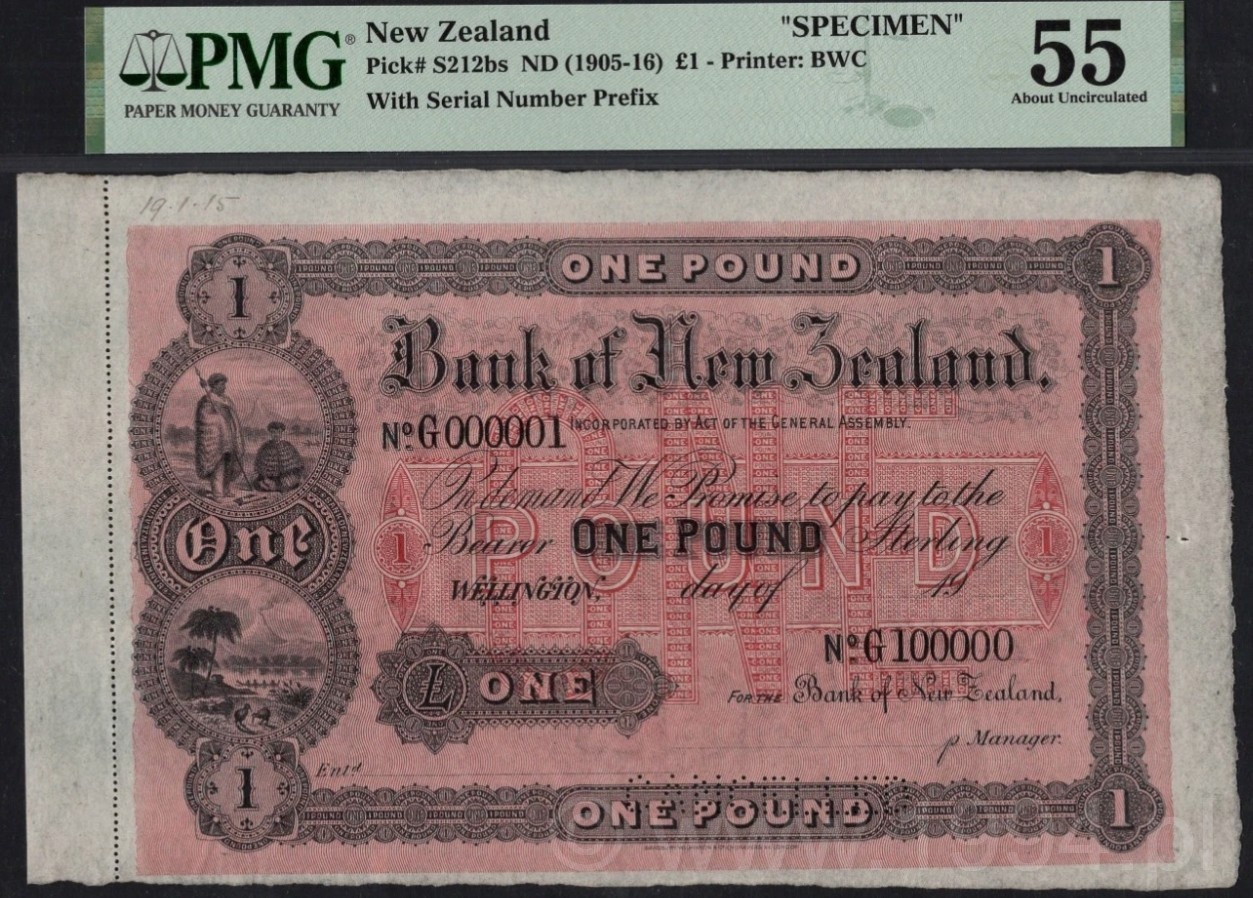
The design retains the canonical BNZ Victorian layout: Māori portrait figures at left, a coastal vignette symbolizing New Zealand’s maritime economy, and dense guilloche frameworks engraved to Bradbury Wilkinson’s late-19th-century standard. By 1913, however, the orange duty tint had been deepened and the geometry subtly regularized, reflecting the broader transition from ornate Victorian engraving toward the more disciplined Edwardian and early WWI-era printing style.
Within the BNZ color lineage, the £5 Orange occupies the central position between the £1 Green and the higher-denomination £10 Brown. This warm-toned middle tier served as a long-standing visual identifier for the denomination across decades of private-bank issuance. The continued use of orange into the 1910s demonstrates Bradbury Wilkinson’s commitment to chromatic continuity even as engraving practices evolved.
The presence of two printed serial numbers-marking the start and end of a controlled numbering block-reveals the operational role of this specimen in Bradbury Wilkinson’s workflow. Such pieces were used to confirm serial-register alignment, verify numbering machinery accuracy, and establish accountable production ranges for bank audits. Very few escaped archival destruction.
By 1913, the Bank of New Zealand’s commercial note-issuing era was approaching its end. Two decades later, issuance would be centralized under the Reserve Bank, and most private-bank archival material was destroyed. Surviving multi-serial approval specimens such as this are therefore exceptionally rare. In light of known populations and the specialized function of the type, Pick S192ms properly belongs in the R8 rarity tier. It stands today as one of the most important reference artifacts for the study of New Zealand’s private-banknote system and Bradbury Wilkinson’s Oceania output.