Collection PL

About 1994.pl
Results for “history”
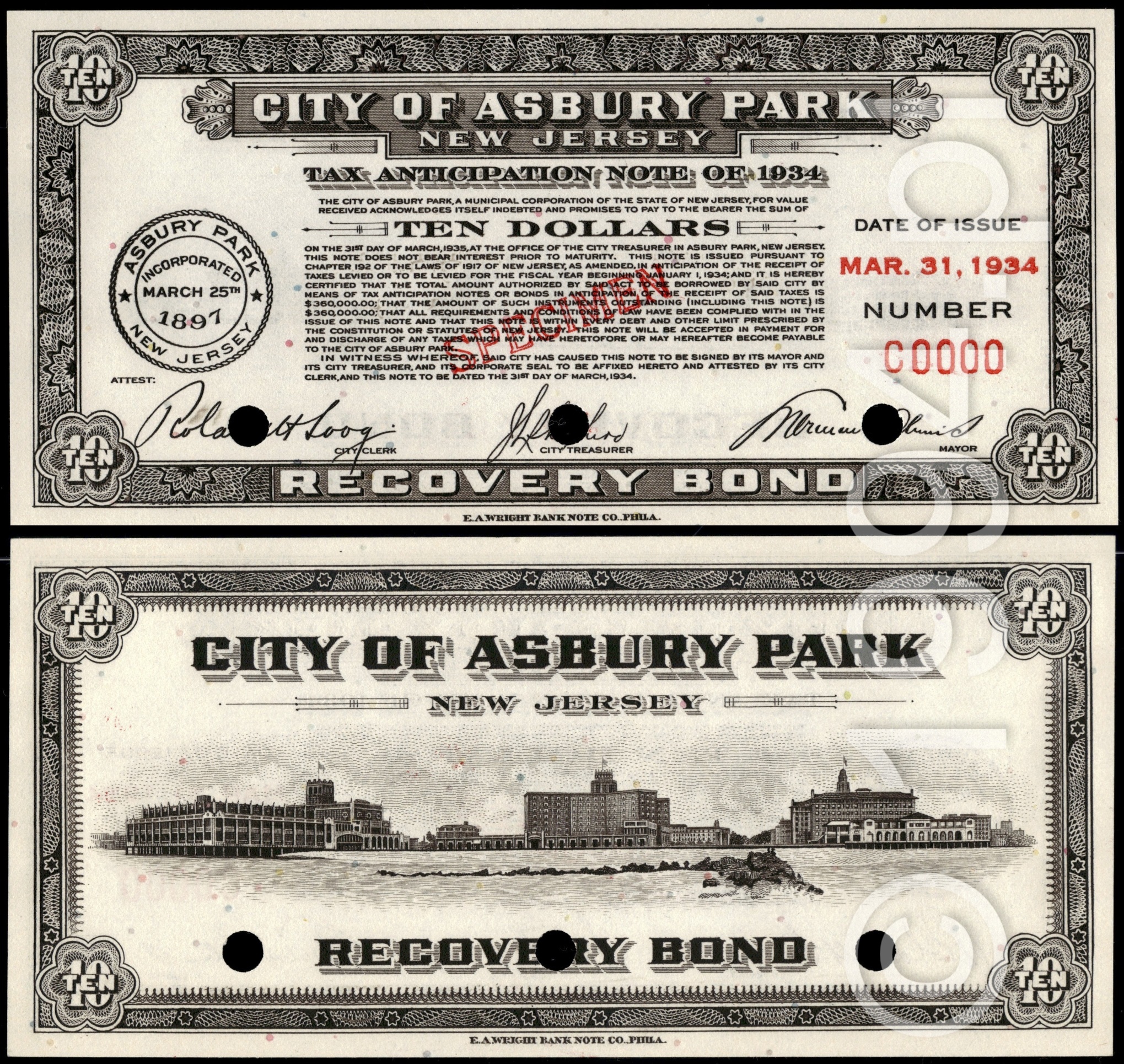
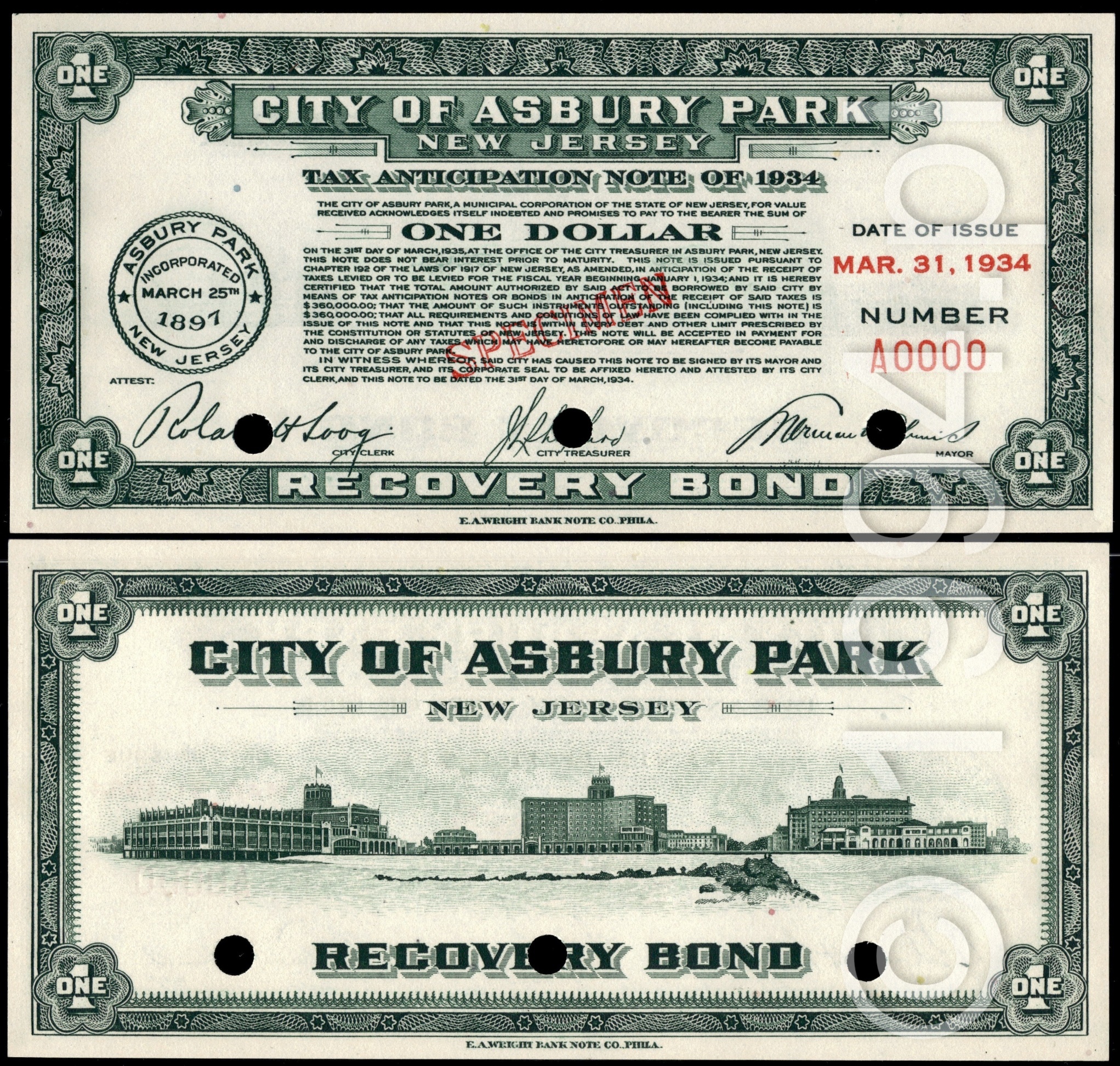
United States 1934 New Jersey City of Asbury Park Tax Anticipation Note Ten Dollars Recovery Bond specimen, black engraved design, serial C0000, Depression era municipal bond instrument

United States 1934 - New Jersey 10 Dollars City of Asbury Park Tax Anticipation Note Recovery Bond Specimen (March 31 Issue)

No other specimen example of this City of Asbury Park Ten Dollars Tax Anticipation Note of 1934 is documented in institutional collections, auction records, certification census data, or standard reference literature. Based strictly on observed and recorded evidence, this piece stands as a unique surviving specimen and serves as a definitive documentary artifact of Depression-era municipal finance and recovery policy in the United States. Read more →

United StatesTax Anticipation Note Specimen193410 DollarsUncirculated Specimen Tax Anticipation NoteRecovery BondMunicipal Bond InstrumentCity Issued Obligation10 DollarsBlack Engraved NoteSpecimen OverprintRed OverprintSerial Number C0000Municipal SealE. A. Wright Bank Note CompanySecurity PrintingDepression Era PrintingMunicipal Finance InstrumentGreat DepressionTax Anticipation FinancingMunicipal Recovery ProgramsNew Jersey Monetary HistoryUnited States Fiscal HistoryUnited States1934New JerseyAsbury ParkPick UnlistedMuseum GradeR9 Extremely RareUnique
Held
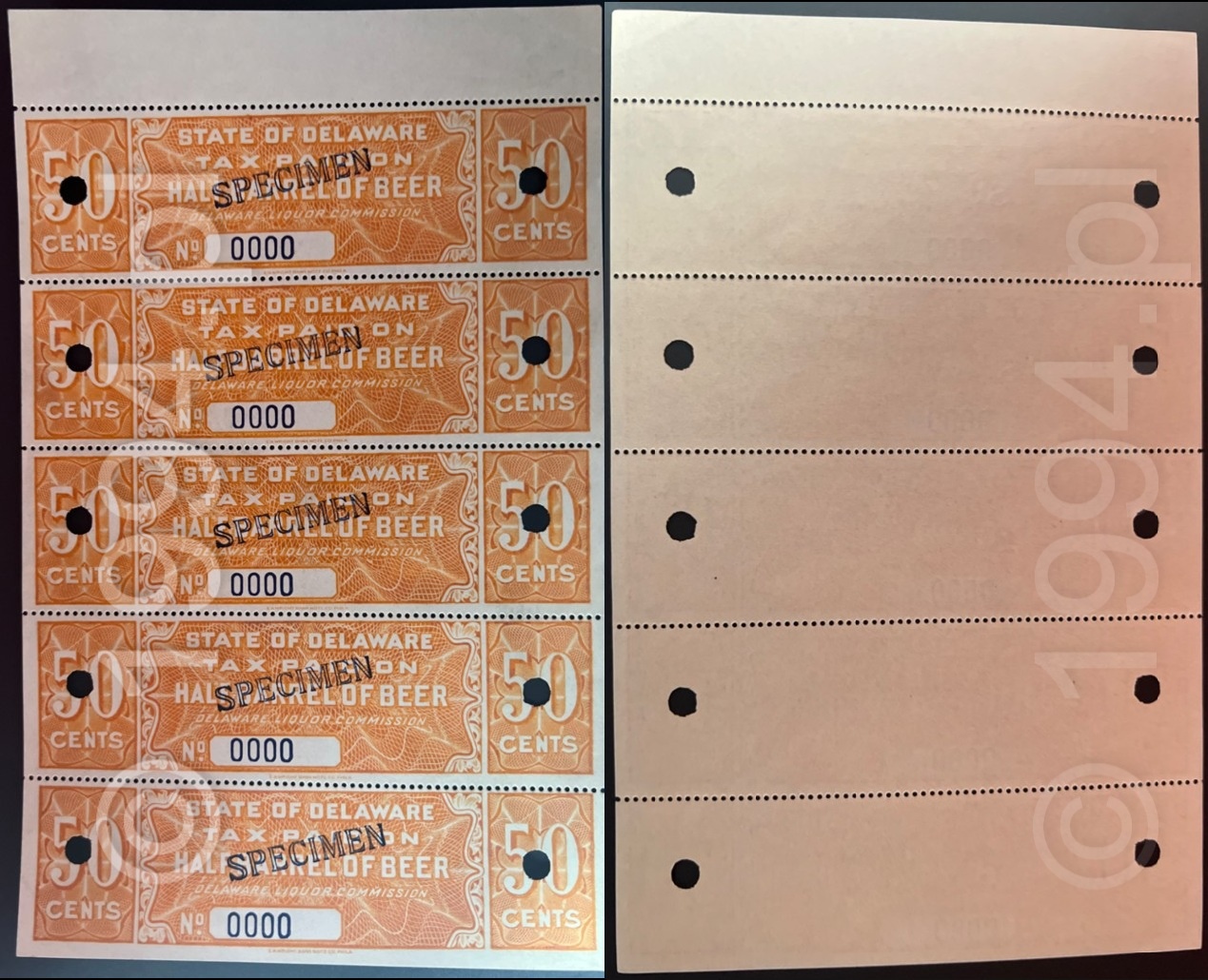
United States 1933 State of Delaware Tax Paid on Half Barrel of Beer fifty cents specimen strip of five orange engraved fiscal stamps with specimen overprint and punch cancellations, post Prohibition excise taxation

United States 1933 - State of Delaware 50 Cents Tax Paid on Half Barrel of Beer Uncut Specimen Strip of Five

This specimen strip represents an official State of Delaware excise tax stamp issued in 1933 for beer, explicitly designated TAX PAID ON HALF BARREL OF BEER and denominated Fifty Cents. It originates from the earliest phase of state-level alcohol regulation following the repeal of national Prohibition, when individual states were forced to reconstruct taxation, licensing, and enforcement systems that had been dormant or dismantled for more than a decade. Read more →

United StatesFiscal Stamp Specimen193350 CentsUncirculated Specimen Strip Fiscal StampBeer Tax StampAlcohol Excise TaxState Revenue StampsExcise Tax StampsHalf Barrel of Beer50 CentsSpecimen OverprintSerial Number 0000Perforated StripPunch CancelledDelaware Liquor CommissionState Tax InstrumentPost Prohibition Alcohol ControlFiscal Printing HistoryUnited StatesDelaware1933Museum GradeR9 Extremely RareUnique
Held
United States 1844 four dollars state bank note issued by the Bank of Florida in Tallahassee during its final revival, engraved by Rawdon Wright Hatch and Edson, New York payable, bearing official crosscut cancellation, graded PCGS 58 Choice About Uncirculated

United States 1844 - Bank of Florida - Tallahassee 4 Dollars, State Bank Note, Final Revival Issue, FL-65-G26

Surviving issued notes from the Bank of Florida’s 1844 revival form a closed and non-renewable population. The combination of a brief issuance period, high redemption attrition, and the bank’s rapid second failure sharply limits the number of original examples that could persist. Later engraved reference impressions and commemorative reproductions serve to document the design but do not expand the circulating survivor base, instead reinforcing the fixed historical boundaries of production. Read more →

United StatesState Bank Note18444 DollarsPCGS Banknote 58 Choice About Uncirculated 4 DollarsState Bank NoteBank of FloridaTallahasseeFlorida TerritoryFinal Revival IssueNew York PayableCrosscut CancelledRedeemed BanknoteAntebellum BankingState Chartered BankingFlorida Banking HistoryAmerican Engraved BanknotesUnited StatesFlorida1844PCGS BanknotePCGS 58Haxby Florida FL-65-G26Museum Grade
Held
Lower Canada 1837 Champlain and St. Lawrence Railroad full uncut sheet showing six notes with 15 Sous, Quarter Dollar, and Half Dollar denominations in A and B series paired layout

Lower Canada 1837 - Champlain and St. Lawrence Railroad - 15 Sous, Quarter Dollar, Half Dollar (Full Uncut Dual Series Sheet)

The denominations themselves correspond to multiple monetary systems in concurrent use. Fifteen sous aligns with fifteen pence, the quarter dollar corresponds to seven pence half penny, and the half dollar reflects a higher transactional unit. The simultaneous presence of British sterling, French-derived sou denominations, and dollar-based values illustrates the fragmented and hybrid monetary environment of Lower Canada in the 1830s. Read more →

Lower CanadaRailroad Scrip Uncut Sheet183715 Sous, Quarter Dollar, Half DollarUncut Sheet, ungraded Railroad ScripUncut SheetFull SheetDual Series LayoutA SeriesB SeriesPaired Denomination FormatTwo of Each DenominationSix Note SheetChamplain and St. Lawrence RailroadLower CanadaPrivate CurrencyTransportation CurrencyLocomotive VignettesIndustrial Engraving15 SousQuarter DollarHalf DollarFifteen PenceSeven Pence Half PennyThirty SousThree FrancsPre Confederation CanadaLower Canada Rebellion EraCanadian Railroad HistoryNineteenth Century FinanceHistory1837August 1 1837350mm x 220mmUngradedR8 Extremely RareMuseum Grade
Held
Spain 1875 Banco de España 50 pesetas contemporary counterfeit, Pick 7x, with large circular hole punches and FALSO stamp, one of only two graded examples, graded PMG 25 Very Fine

Spain 1875 - Banco de España 50 Pesetas Contemporary Counterfeit (Pick 7x)

The design closely imitates the official Banco de España issue, including allegorical figures, ornamental frames, and serial numbering conventions. While visually convincing at first glance, deviations in engraving quality, line density, and execution distinguish the note from official production. These characteristics are consistent with contemporary counterfeiting practices rather than later imitative efforts. Read more →

SpainContemporary Counterfeit187550 PesetasPMG 25 Very Fine Contemporary CounterfeitBanco de España50 PesetasPeriod ForgeryCirculating CounterfeitFALSO StampHole Punch CancelledNineteenth Century CurrencySpanish Monetary HistoryPaper Money SecurityCounterfeit StudiesSpain1875Pick 7xPMG 25R8 Extremely RareMuseum Grade
Held
Spain 1876 Banco de España one hundred pesetas contemporary counterfeit, Pick 11x, with large circular hole punches and FALSO stamp, Top Pop graded PMG 40 Extremely Fine

Spain 1876 - Banco de España 100 Pesetas Contemporary Counterfeit (Pick 11x)

According to current publicly visible PMG population data, only two examples of this Pick 11x contemporary counterfeit have been graded to date. The present note, graded Extremely Fine 40, is the highest graded example recorded, with no examples known in higher condition. Its status as Top Population reflects both the extreme scarcity of surviving examples and the limited preservation of period counterfeits. Read more →

SpainContemporary Counterfeit1876100 PesetasPMG 40 Extremely Fine Contemporary CounterfeitBanco de España100 PesetasPeriod ForgeryCirculating CounterfeitFALSO StampHole Punch CancelledNineteenth Century CurrencySpanish Monetary HistoryPaper Money SecurityCounterfeit StudiesSpain1876Pick 11xPMGPMG 40Top PopR8 Extremely RareMuseum Grade
Held
South Africa 1828 Cape of Good Hope Bank five shillings pre issue sample note, engraved border and ships vignette, Smithsonian class institutional artifact

South Africa 1828 - Cape of Good Hope Bank 5 Shillings Pre-Issue Sample (Pick S171p)

The Cape of Good Hope Bank occupies a unique position in South African monetary history. While earlier banking activity existed under Dutch East India Company administration, including the state-controlled Lombard Bank established in 1793, the Cape of Good Hope Bank was the first true private commercial bank in southern Africa. Its eventual opening in 1837 marked a decisive transition from state-issued colonial notes toward privately organized banking and credit formation within the Cape economy. Read more →

South AfricaPre-Issue Sample1828Five Shillings SterlingUncirculated Pre Issue Sample5 Shillings SterlingSample NoteApproval Stage CurrencyCape of Good Hope BankPrivate Colonial BankingEarly Nineteenth Century CurrencyCape Colony Monetary HistoryBritish Colonial FinanceInstitutional ProvenanceSouth Africa1828Pick S171pR9 Extremely RareMuseum GradeSmithsonian Held Class
Held
South Africa 1861 Montagu Bank five pounds remainder, large format steel plate engraved private banknote with green counterfeit protector

South Africa 1861 - Montagu Bank 5 Pounds Remainder (Pick S231r)

The Montagu Bank ultimately failed after only a few years of operation, closing its doors in 1868 following sustained financial losses. Subsequent ownership passed to the African Banking Corporation, whose assets were later absorbed by Standard Bank. The short lifespan of the Montagu Bank places its surviving documentary material, including unissued banknotes, firmly within the context of institutional failure and liquidation rather than long-term circulation. Read more →

South AfricaRemainder18615 Pounds SterlingUncirculated Remainder5 PoundsUnissued CurrencyMontagu BankPrivate BanknoteSteel Plate EngravingMid Nineteenth Century CurrencyCape Colony BankingCounterfeit ProtectorColonial Monetary HistorySouth Africa1861Pick S231rR7 Very RareMuseum Grade
Held
Uruguay 1939 Banco de la Republica Oriental del Uruguay 1000 Pesos specimen, Serie D, Specimen No. 23, Pick 41cs, with all-zero serial numbers, diagonal red SPECIMEN overprint, red oval specimen stamps, portrait and watermark of Jose Gervasio Artigas, and equestrian reverse, graded PMG 65 Gem Uncirculated Exceptional Paper Quality

Uruguay 1939 - Banco de la Republica Oriental del Uruguay 1000 Pesos Specimen, Printed Cancel, Serie D, Specimen No. 23 (Pick 41cs)

The obverse is dominated by the full institutional title REPUBLICA ORIENTAL DEL URUGUAY, placed above the monumental denomination MIL PESOS. To the right appears a finely engraved portrait of Jose Gervasio Artigas, shown in military dress with a strong frontal expression. Artigas serves here as more than a commemorative portrait. His presence places the authority of the banknote within Uruguay's national foundation, linking the monetary promise of the state with the country's principal independence figure. Read more →

UruguaySpecimen with Red Overprint and Oval Stamps19391000 PesosPMG 65 Gem Uncirculated Exceptional Paper Quality Specimen1000 PesosSerie DSpecimen No 23All Zero Serial NumbersRed SPECIMEN OverprintRed Oval Specimen StampsJose Gervasio Artigas PortraitJose Gervasio Artigas WatermarkEquestrian ReverseBanco de la Republica Oriental del UruguayThomas De La Rue and Company LimitedIntaglio PrintingSecurity EngravingGuilloche DesignWatermarked PaperPrinted Specimen CancellationInstitutional Reference SpecimenUruguay Monetary HistoryLaw of 2 January 1939High Denomination CurrencyState BankingSpecimen DistributionBanknote Production HistoryHistoryUruguay19391000 PesosPick 41csPick 41cPMG 65Exceptional Paper QualityR8 Extremely RareMuseum Grade
Held
Uruguay 1939 Banco de la Republica Oriental del Uruguay 1000 Pesos specimen, Serie C, Specimen No. 2, Pick 41bs, with all-zero serial numbers, diagonal red SPECIMEN overprints, red oval specimen stamps, portrait and watermark of Jose Gervasio Artigas, and mounted rider reverse, graded PMG 63 Choice Uncirculated

Uruguay 1939 - Banco de la Republica Oriental del Uruguay 1000 Pesos Specimen, Printed Cancel, Serie C, Specimen No. 2 (Pick 41bs)

Jose Gervasio Artigas appears at right in a sharply engraved military portrait. The treatment emphasizes his facial expression, uniform, cloak, and historic authority through closely controlled engraved lines. Artigas was central to Uruguay's national memory, and his placement on this high denomination gave the note an immediate connection to independence, sovereignty, and the legitimacy of the republic. Read more →

UruguaySpecimen with Red Overprint and Oval Stamps19391000 PesosPMG 63 Choice Uncirculated Specimen1000 PesosSerie CSpecimen No 2Low Specimen NumberAll Zero Serial NumbersRed SPECIMEN OverprintRed Oval Specimen StampsJose Gervasio Artigas PortraitJose Gervasio Artigas WatermarkEquestrian ReverseBanco de la Republica Oriental del UruguayThomas De La Rue and Company LimitedIntaglio PrintingSecurity EngravingGuilloche DesignWatermarked PaperPrinted Specimen CancellationNumbered Reference SpecimenUruguay Monetary HistoryLaw of 2 January 1939High Denomination CurrencyState BankingEarly Specimen SequenceBanknote Production HistoryHistoryUruguay19391000 PesosPick 41bsPick 41bPMG 63R8 Extremely RareMuseum Grade
Held
United States 1854 Empire City Bank 100 Dollars proof note, Collins Line steamship vignette, blank reverse with American Bank Note Company archival stamp, PMG Uncirculated 62 EPQ

United States 1854 - Empire City Bank 100 Dollars Proof (Pick NY1585G16P)

The Empire City Bank was organized in 1851 and operated during a highly unstable phase of New York banking history, characterized by aggressive credit expansion and the absence of a central banking authority. In early December 1854 the bank failed to meet its Clearing House obligations and was suspended, with formal receivership following in February 1855. Proof material associated with the bank must therefore predate its suspension, firmly placing this note within the closing chapter of the bank’s active life. Read more →

United StatesProof1854100 DollarsPMG Uncirculated 62 EPQ ProofProof Banknote100 DollarsHigh DenominationEmpire City BankABNCAmerican Bank Note CompanyArchival ProofPunch of CancellationAmerican Private BankingPre Civil War CurrencyNew York Banking HistoryNineteenth Century BankingSecurity Printing HistoryCollins Line Steamer VignetteUnited States1854Pick NY1585G16PPMG 62Museum GradeR8 Extremely Rare
Held
United States 1838 Olney Alabama uncut remainder sheet with 25 cents, 50 cents, and 1 dollar notes printed by Manly and Orr, deckled bottom margin, PCGS Banknote Very Fine 25

United States 1838 - Olney, Alabama 25 Cents, 50 Cents, 1 Dollar Uncut Sheet Remainder

Each note bears a promise to pay George Washington or bearer in bills of the Bank of the State of Alabama, or its branches, once the aggregate amount of five dollars was presented. This conditional redemption structure reflects the widespread use of fractional and small denomination scrip during the late 1830s, when shortages of hard money and economic instability following the Panic of 1837 forced communities to rely on paper substitutes for everyday transactions. Read more →

United StatesRemainder183825 Cents, 50 Cents, 1 DollarPCGS Banknote Very Fine 25 RemainderUncut Sheet25 Cents50 Cents1 DollarFractional CurrencyStock EngravingManly and OrrDeckled EdgeAntebellum CurrencyPanic of 1837 EraLocal ScripUnofficial IssuerAlabama Monetary HistoryEarly American PrintingUnited StatesAlabamaOlney1838Gunther and Derby AO-386PCGS 25Museum GradeR8 Extremely Rare
Held
↑ Top