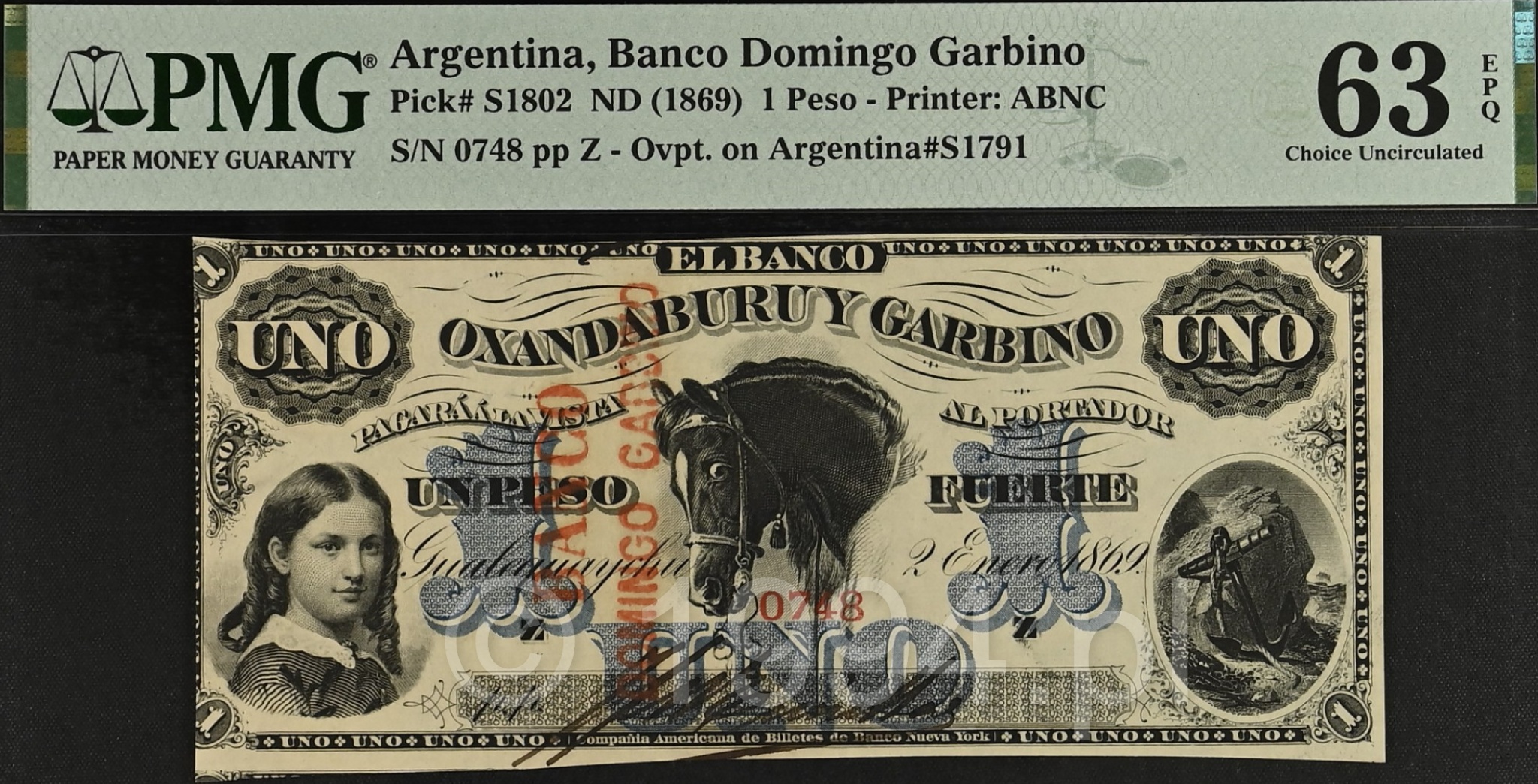
Description and research notes
This specimen represents the sole documented control specimen of the Banco de San Juan 1 Peso Fuerte issue, printed in 1876 by Bradbury, Wilkinson & Company in London for one of Argentina’s provincially chartered banks during the formative period of regional monetary autonomy. It is not part of a surviving series, but a single archival output with no issued, proof, or parallel specimen counterparts known.
The Banco de San Juan operated within the interior province of San Juan during a period when Argentina’s banking system was highly decentralized. Provincial banks issued their own paper currency under legal frameworks that allowed convertibility into metallic pesos fuertes, supporting local economies centered on mining, viticulture, mule transport, and inter-Andean trade routes. These institutions functioned independently of Buenos Aires, reflecting a fragmented national monetary structure that would only be consolidated decades later.
This note was produced as a specimen and never intended for circulation. Its pristine paper, absence of circulation wear, and specimen cancellation confirm its role as an internal control, approval, or archival reference. There is no evidence that an issued 1 Peso Fuerte note of this Banco de San Juan type ever entered circulation, nor is any proof state documented.
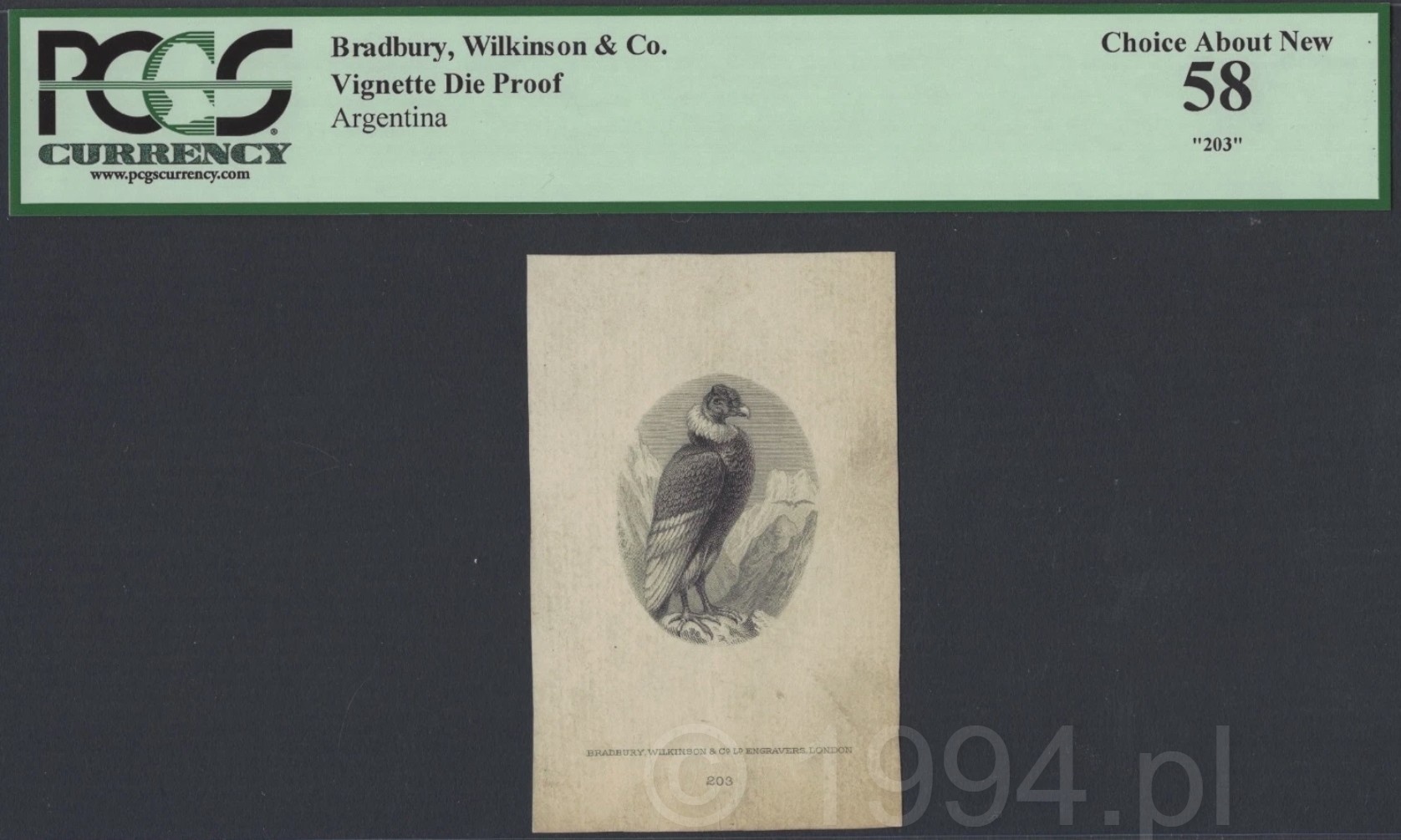
The design reflects early British export engraving for Latin America. Bradbury Wilkinson employed refined lathe-work borders, dense guilloché structures, and a central condor vignette, a powerful regional symbol associated with vigilance, sovereignty, and the Andean frontier. The choice of imagery reinforced provincial identity while the technical execution projected credibility in regions where confidence in paper money depended heavily on perceived printing authority.
The condor vignette, engraved with layered line work and controlled relief, anchors the composition and illustrates the firm’s early approach to portrait and emblem engraving for South American clients. Surrounding security geometry demonstrates anti-counterfeiting standards far beyond the capabilities of local lithographers, underscoring why provincial banks turned to London printers despite geographic distance.
Bradbury, Wilkinson & Company’s involvement documents the early penetration of British security printing into Argentina’s interior provinces. While later national issues would dominate the historical record, provincial banknotes such as this one represent the experimental and transitional phase of Argentine monetary development, when regional institutions exercised near-sovereign authority over credit and currency.
No issued example of this Banco de San Juan 1 Peso Fuerte type is known. No proof state is known. No second specimen has been recorded in institutional collections, auction archives, grading census data, or reference literature. Within the specimen category, this note stands alone as the only observable output of its kind.
As such, this piece constitutes a structurally unique archival artifact documenting provincial private banknote authorization in nineteenth-century Argentina. Its importance lies not in circulation history, but in its role as the sole surviving physical evidence of a San Juan-specific monetary issue during Argentina’s brief era of provincial financial autonomy.