Description and research notes
The high-denomination anchor of the Bank of New Zealand color series, this five pounds orange specimen (Pick S192s) represents one of the most structurally complex and production-informative notes of New Zealand’s private banking era. Printed by Bradbury, Wilkinson & Company, Limited, London, it embodies the transition from richly ornamental Victorian engraving toward the more controlled and symmetrical Edwardian framework that followed. The composition preserves the defining elements of the earlier series-paired Māori figures within oval medallions at left, a lower maritime vignette reflecting colonial trade identity, and a dense guilloche lattice enclosing the denomination-while introducing a more disciplined spatial hierarchy across the central obligation panel.
This specimen carries a dual A-prefix serial system, with A000001 positioned at left and A020000 at right, reflecting Bradbury Wilkinson’s internal control numbering methodology rather than circulation sequencing. The use of two distinct serial placements allowed verification across multiple stages of production, ensuring alignment between plate, print batch, and ledger records. The A-prefix itself identifies the note as part of the earliest specimen and approval sequence, reserved for internal reference and controlled archival distribution.
A perforated CANCELLED marking is applied across the lower central area, executed through pin-perforation rather than ink overprint, serving as the primary method of invalidation. At far left, a wide vertical audit margin remains visible, a characteristic feature of printer’s file copies retained for inspection and documentation. This margin, combined with the cancellation method, firmly places the note within Bradbury Wilkinson’s internal specimen retention system rather than external presentation formats.
Across the upper margin, multiple handwritten annotations are present, including the notation '073207 24.6.15', which corresponds to a dated printer’s ledger or batch control entry-interpretable as 24 June 1915. These annotations document the note’s passage through production oversight stages, including review, approval, and archival filing. Such markings are rarely preserved and provide direct physical evidence of internal workflow processes within the printing house.
The visual architecture of the note is highly structured. The left vertical column presents stacked vignette medallions-Māori portraiture above and a pastoral or maritime landscape below-serving both decorative and symbolic functions tied to New Zealand identity. The central orange-tinted obligation panel anchors the composition, overlaid with intricate guilloche and denomination text, while the outer borders exhibit dense, repeating security patterns designed to resist reproduction. The denomination appears in multiple formats-numeric, textual, and embedded within ornamental devices-creating layered redundancy typical of high-value colonial issues.
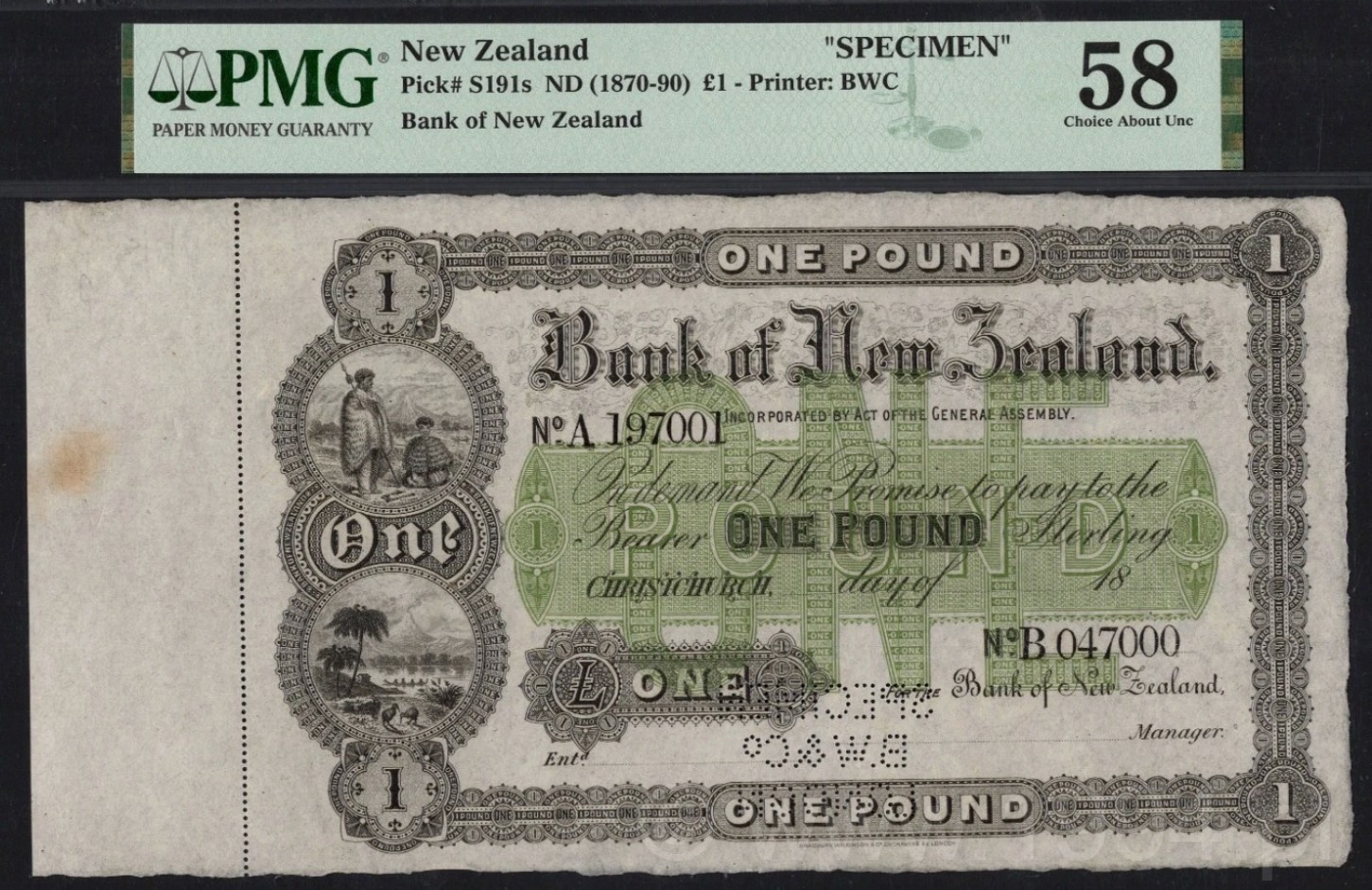
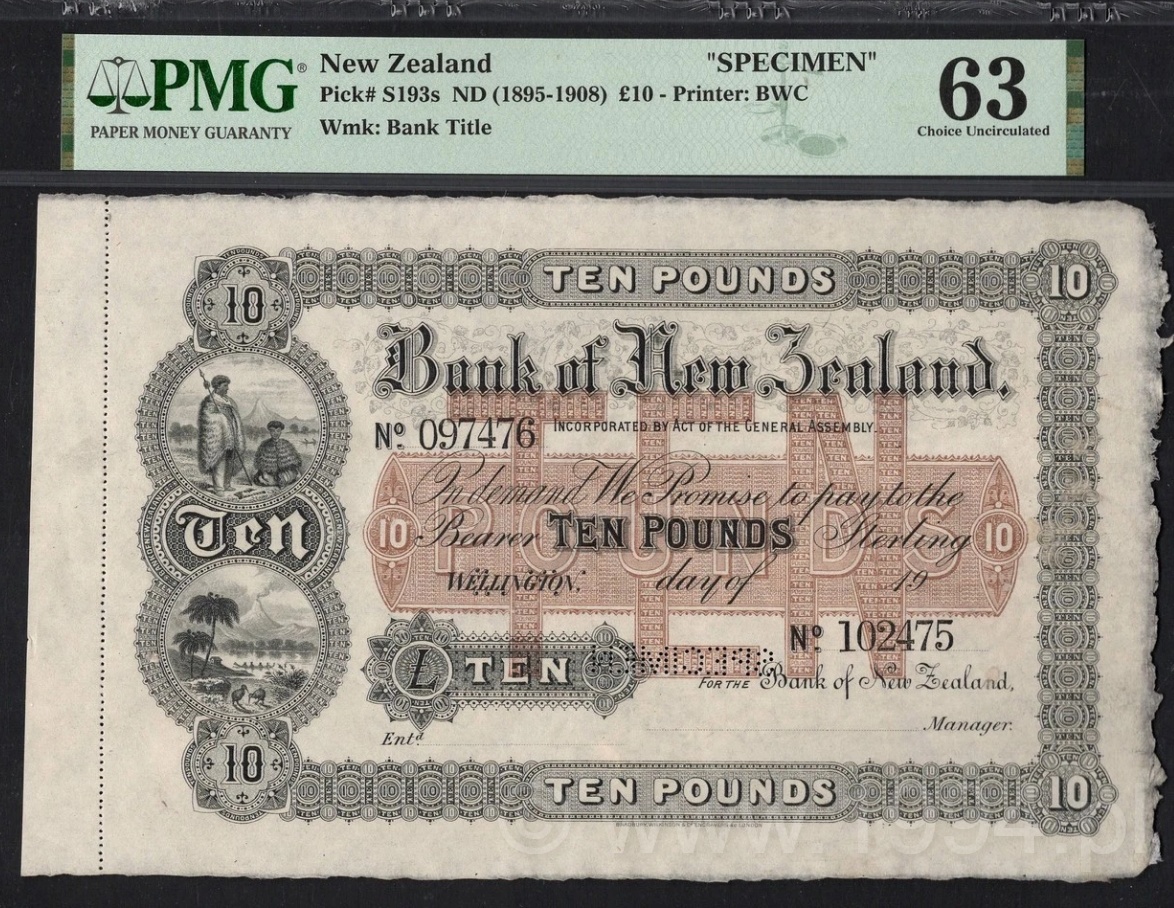
The five pounds orange denomination occupies a central position within the Bank of New Zealand’s chromatic system-bridging the one pound green and the ten pounds brown-forming the structural core of the series. This structured denomination-color mapping forms the basis of the Bank of New Zealand color lineage, a consistent system applied across the pre-Reserve Bank series to standardize denomination recognition and visual hierarchy. This color logic would later influence Reserve Bank issues, demonstrating continuity from private to centralized currency systems.
As a specimen combining dual control serials, perforated cancellation, retained audit margin, and original printer annotations, this example provides a comprehensive record of Bradbury Wilkinson’s production and verification methodology during the late colonial period. It stands not only as a high-denomination note but as a working document of the printing process itself, preserving layers of operational history rarely visible in surviving material.
Surviving examples of the S192s specimen type remain extremely scarce, with most archival copies destroyed or lost during transitions in banking structure and currency authority. Positioned between the one pound green (Pick S191s) and the ten pounds brown (Pick S193s), this five pounds orange specimen completes the central triad of New Zealand’s most important pre-Reserve Bank engraved series, representing both artistic and technical maturity within early banknote production.