Description and research notes
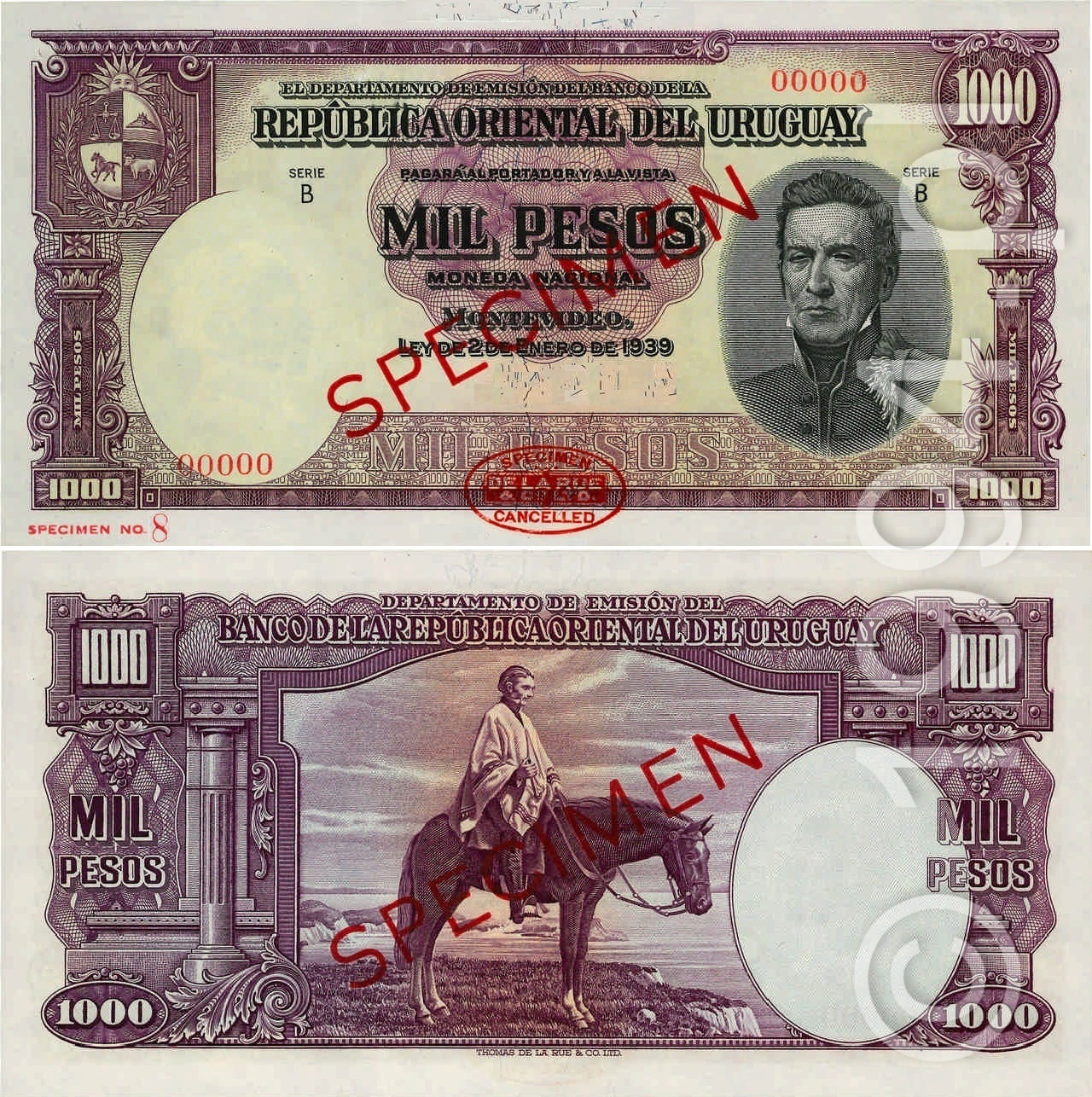
This Banco de la Republica Oriental del Uruguay one thousand pesos specimen is identified as Serie C, Specimen No. 2, placing it near the beginning of its numbered specimen sequence. Rather than serving as a general representation of the denomination, it is an individually numbered control piece documenting the Serie C form of the 1939 issue in its completed printed state.
The low specimen number is an important part of the note's identity. Specimen No. 2 indicates an early position within the controlled group prepared for reference, presentation, verification, or institutional retention. Combined with the Serie C designation and paired all-zero serial numbers, it records a specific administrative example rather than an anonymous specimen impression.
Across the obverse, the issuer's authority is stated in exceptionally prominent form. REPUBLICA ORIENTAL DEL URUGUAY stretches across the upper center, while MIL PESOS occupies the central ornamental panel. The obligation text and reference to the law of 2 January 1939 establish the note within the legal structure of the issue, making the design both a monetary instrument and a printed declaration of state-backed value.
Jose Gervasio Artigas appears at right in a sharply engraved military portrait. The treatment emphasizes his facial expression, uniform, cloak, and historic authority through closely controlled engraved lines. Artigas was central to Uruguay's national memory, and his placement on this high denomination gave the note an immediate connection to independence, sovereignty, and the legitimacy of the republic.
The Serie C designation appears on both sides of the obverse, separating this variety from the related Serie D specimen form. Architectural side panels, the national arms, repeated denomination numerals, fine geometric backgrounds, and ornamental borders create a tightly organized composition around the portrait and central value. The large unprinted oval at left accommodates the Artigas watermark and balances the engraved portrait on the opposite side.
The specimen-control system is visually decisive. A diagonal red SPECIMEN inscription crosses the obverse from lower left toward upper right. Red oval Thomas De La Rue specimen stamps are applied over the upper-left area and the lower-right corner. At the lower margin, the designation SPECIMEN No. 2 is printed in red, preserving the note's exact place within the distribution sequence.
The reverse shifts from portraiture and institutional text to a wide landscape scene centered on a mounted rider. The figure, horse, distant terrain, and open horizon form a narrative image of mobility, land, and national tradition. This central vignette is enclosed by substantial engraved architecture, including columns, scrollwork, grape clusters, and large vertical MIL PESOS panels.
A second diagonal SPECIMEN marking crosses the reverse vignette, accompanied by red oval control stamps at the upper left and lower right. The repeated cancellation pattern on both faces was designed to protect the monetary design while preserving every major component for comparison, recordkeeping, and technical examination.
Thomas De La Rue and Company Limited printed the note in London, as stated in the lower reverse margin. The work reflects the firm's ability to unite symbolic portraiture, narrative engraving, watermark security, ornamental geometry, and large-denomination typography within a single coherent banknote design.
Graded Paper Money Guaranty 63 Choice Uncirculated, this Serie C, Specimen No. 2 note preserves a particularly early numbered specimen from the issue. Its importance rests in the combination of denomination, series identity, low specimen number, complete two-sided cancellation system, Artigas portrait and watermark, and the finished production quality of Thomas De La Rue and Company Limited. It is a significant archival record of how Uruguay's 1939 one thousand pesos design was documented and controlled before or alongside formal monetary distribution.