Description and research notes
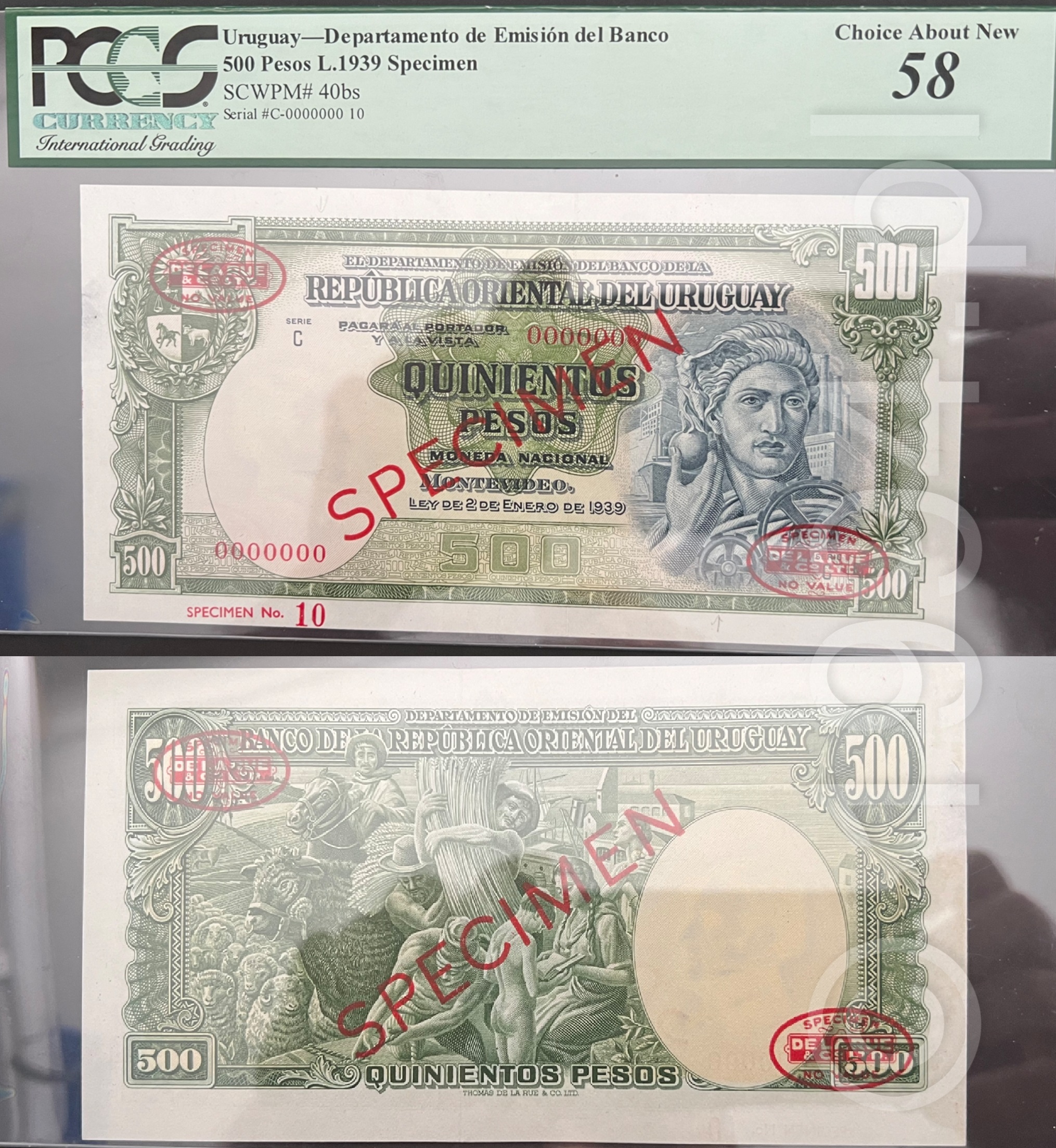
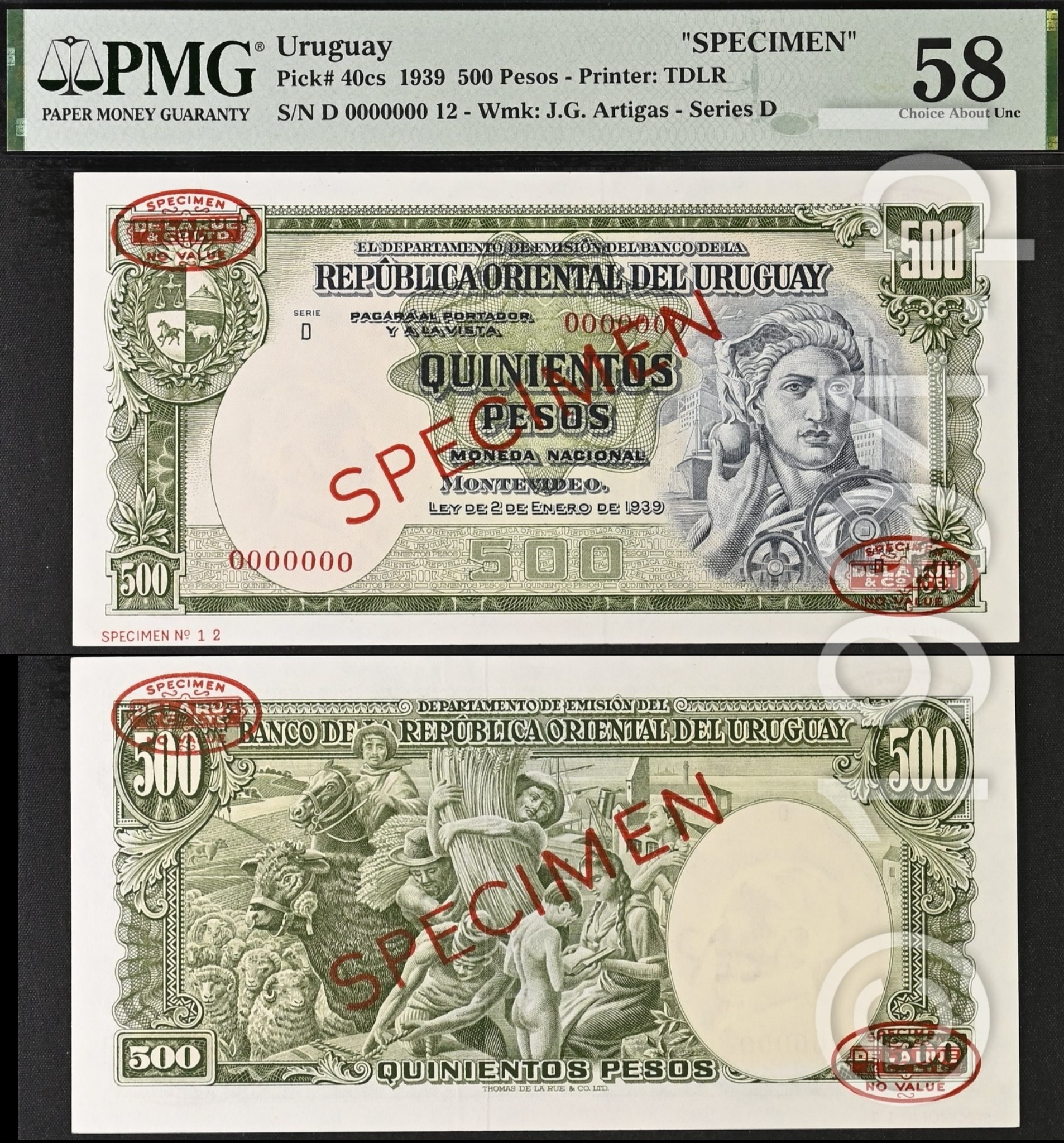
Numbered Specimen No. 29, this Serie A five hundred pesos note was prepared as a formally identified reference example of the Banco de la Republica Oriental del Uruguay issue authorized under the law of 2 January 1939. Its combination of all-zero serial numbers, a printed specimen number, a diagonal red SPECIMEN inscription, and a Thomas De La Rue control stamp places it within a managed distribution sequence rather than an anonymous archive group.
The printed number at the lower margin is central to the note's documentary character. Specimen No. 29 records the piece as an individually tracked example, allowing it to be associated with a specific position in the group prepared for official reference, institutional comparison, or controlled presentation. Such numbering transformed the specimen into an accountable object whose movement and retention could be supervised independently of the circulation issue.
The obverse design gives monumental treatment to the five hundred pesos denomination. QUINIENTOS PESOS occupies the center of an ornate composition formed from engraved frames, vertical architectural elements, fine geometric backgrounds, and repeated value devices. Above, the name of the Republica Oriental del Uruguay establishes the issuing authority, while Serie A and the paired zero serials reproduce the formal structure of an issued note in a securely neutralized form.
The portrait vignette at right is modeled through dense intaglio linework and placed against imagery associated with industry and economic activity. It forms the human center of the design, while the watermark area at left provides an open counterweight within the otherwise heavily engraved surface. This balance between portraiture, unprinted paper, monumental typography, and ornamental security work is characteristic of Thomas De La Rue and Company Limited's high-denomination designs of the period.
A broad diagonal red SPECIMEN overprint crosses the principal design field, immediately establishing the note's reference status. The oval SPECIMEN DE LA RUE CANCELLED control stamp adds a second level of authority, identifying the cancellation as part of the printer's formal handling system. Unlike a purely decorative overprint, the combined markings communicate both function and custody: the note was intentionally prepared, recorded, and invalidated under controlled conditions.
The reverse is devoted to an agricultural allegory in which labor, animals, cultivated land, and the broader landscape are presented as sources of national wealth. The composition is not incidental decoration. It links the denomination to Uruguay's productive economy and gives the note a narrative dimension beyond the institutional language of the face. Fine engraved framing and large denomination panels preserve visual continuity between the two sides.
As a numbered Serie A reference note, this specimen represents one clearly documented point within the official specimen sequence for the five hundred pesos denomination. Printed by Thomas De La Rue and Company Limited, it combines finished production quality with a complete administrative identity, preserving the design, series, specimen number, and printer-controlled cancellation method in a single institutional artifact.