Collection PL

About

Australia’s paper money did not originate as a national project. Throughout the nineteenth century, banknotes were issued by private and colonial banks operating under local statutes, each colony maintaining its own banking ecosystem. Severe coin shortages, vast distances from Britain, and rapid commercial expansion following the gold discoveries of the 1850s forced banks to rely on engraved paper promises redeemable in gold or sterling. These notes functioned as instruments of trust in a fragmented monetary landscape, long before political federation or centralized control.

By the 1870s, Australia’s leading banks commissioned London security printers to ensure credibility and anti-counterfeiting strength. Firms such as Bradbury, Wilkinson & Co., Perkins, Bacon & Petch, and later the American Bank Note Company supplied master plates engraved to British standards, exporting a visual language of guilloches, allegorical figures, and disciplined typography to colonial issuers. These engravings were not ornamental excess; they were functional tools designed to secure confidence in high-value financial instruments circulating across goldfields, ports, and interbank clearing systems.

High-denomination private banknotes occupied a specialized role. Denominations such as £20 were never intended for everyday commerce. They functioned almost exclusively in wholesale finance: bullion settlement, interbank balances, and large commercial transfers. As a result, survival rates were catastrophically low. Issued examples were systematically redeemed and destroyed, particularly after the Australian Notes Act of 1910 prohibited private banks from issuing currency and initiated the recall of outstanding notes. What survives today is almost entirely archival material—specimens retained by printers or banks for approval, reference, or audit.

The specimens preserved here document the final maturity of Australia’s private-banknote era. The City of Melbourne Bank Limited £20 specimen (1877), engraved by Bradbury Wilkinson, represents the apex of colonial denomination structure: a monumental, non-circulating instrument produced for institutional use at the height of Victoria’s financial power. Its survival as a pristine specimen preserves a denomination otherwise erased from the historical record. At the opposite end of the scale, the Mercantile Bank of Sydney £1 specimen (1877), likewise printed by Bradbury Wilkinson, illustrates how even the lowest denominations could survive only as internal reference material once regulatory consolidation began.

These two specimens frame the system from top to bottom. Together they show how private banks expressed authority, stability, and competitive identity through engraved paper at a time when monetary trust was bank-backed rather than state-guaranteed. Studied alongside other surviving proofs and specimens from the period, they reveal a closed world of colonial finance—one in which design, denomination, and engraving quality communicated solvency long before a national currency unified Australia’s monetary voice.

When the Commonwealth assumed control of note issuance in the early twentieth century, this tradition ended abruptly. The specimens that remain are not collectibles in the usual sense; they are documentary remnants of a financial system that was dismantled by law. Preserved without circulation wear, they offer a rare and direct view into how Australia’s private banks managed trust, scale, and credibility through paper at the edge of empire.

19 results · Page 2 of 2
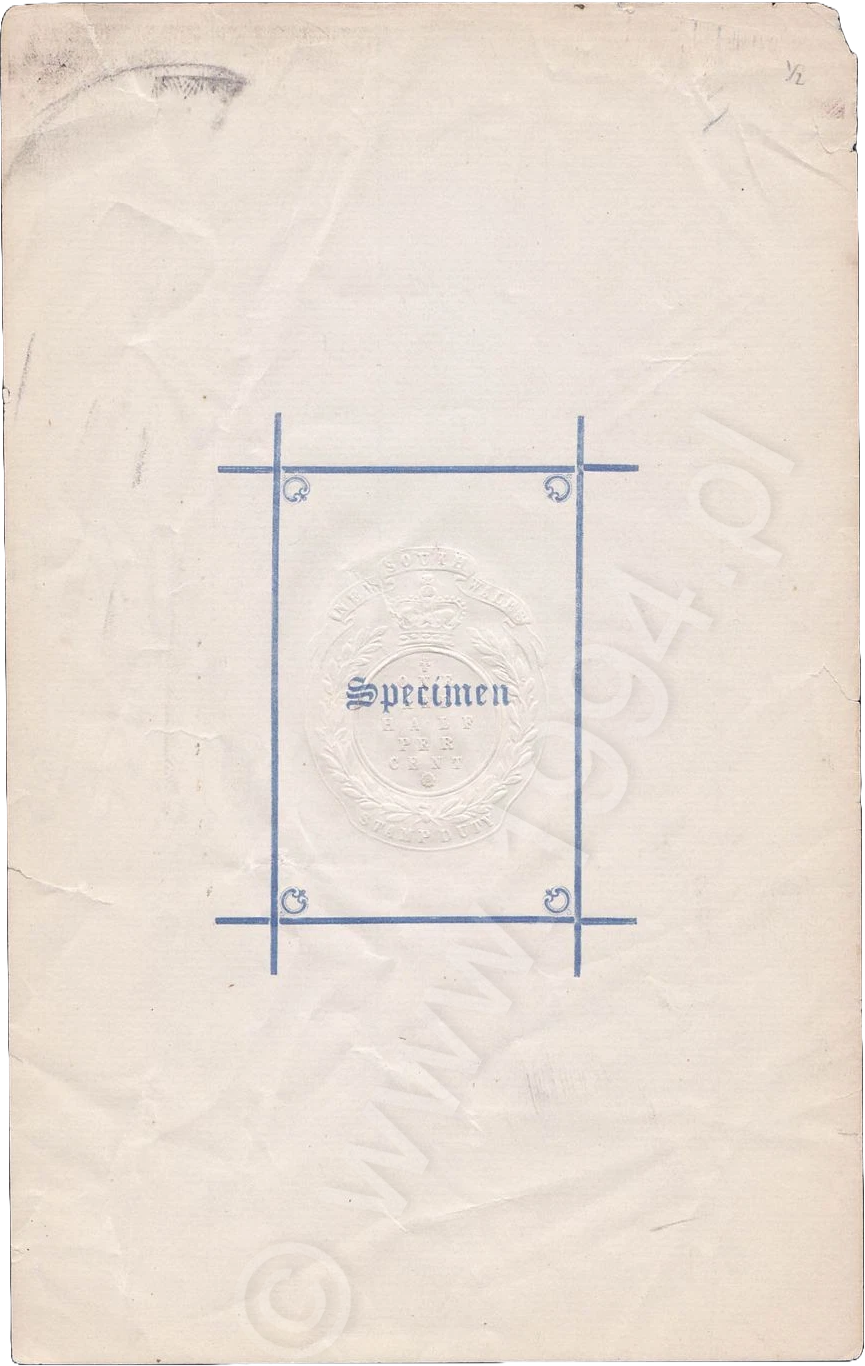
New South Wales 1865 embossed ONE HALF PERCENT stamp duty fiscal proof specimen with colourless embossing, blue layout frame and printed Specimen legend

New South Wales 1865 — Embossed 'ONE HALF PERCENT' Stamp Duty Fiscal Proof Specimen

This archival embossed proof was prepared for the Treasury of the Colony of New South Wales in 1865 as part of the design approval process for official stamp duty revenue paper. The piece displays the crowned colonial arms surrounded by a laurel wreath with the inscription 'ONE HALF PERCENT', executed in colourless embossing and framed by printer’s blue layout guide lines with a printed 'Specimen' designation. Unlike adhesive revenue stamps, this form of fiscal authentication was produced as embossed security paper intended to validate legal and financial documents. ... Read more →

AustraliaFiscal Die Proof1865One Half PercentUnissued archival proof (colourless embossing with printed SPECIMEN) Fiscal ProofDie ProofEmbossed Revenue PaperStamp Duty PaperAd Valorem DutyOne Half PercentNew South Wales TreasuryColonial Revenue SystemGovernment Fiscal PaperLegal Document AuthenticationThomas De La RueTDLRCowan & Sons PaperSecurity Paper ProductionEmbossed Die EngravingEarly Security PrintingAustraliaNew South Wales1865Colonial Fiscal PrintingRevenue Paper HistoryMuseum Grade
Held
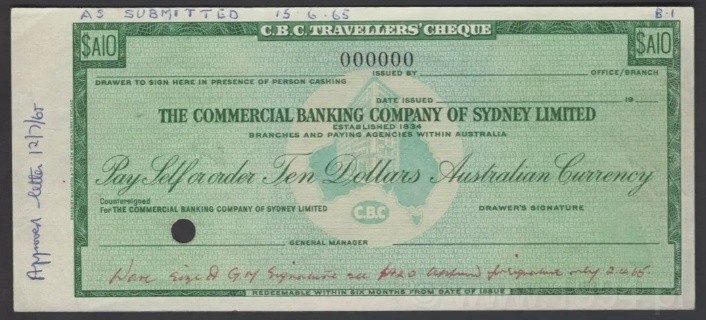
Australia 1965 10 Dollars traveller’s cheque approved design proof by Bradbury Wilkinson & Co. for The Commercial Banking Company of Sydney Limited, archival approval copy with left-side control punch and red approval line

Australia 1965 — Commercial Banking Company of Sydney Limited $10 Travellers Cheque Approved Design Proof (Pick Unlisted)

Approved design proof for the 10 Dollars traveller’s cheque prepared by Bradbury Wilkinson & Co., London, for The Commercial Banking Company of Sydney Limited. Dated 1965 and annotated “As Submitted – Approved,” this is the final approved version that advanced to production, forming the reference model for the bank’s post-decimal traveller’s cheque issue. The engraving combines subtle multi-tone guilloche in olive and emerald green with precise microline work and a centred map-and-harbour vignette, emblematic of Sydney’s trade and maritime identity. ... Read more →

AustraliaApproved Design Proof196510 DollarsPrinter’s Archival Proof AustraliaTravellers ChequeTravelers CheckCommercial Banking Company of Sydney LimitedApproved Design ProofBradbury WilkinsonBWC196510 DollarsArchival ProofDecimal TransitionBank History
Held
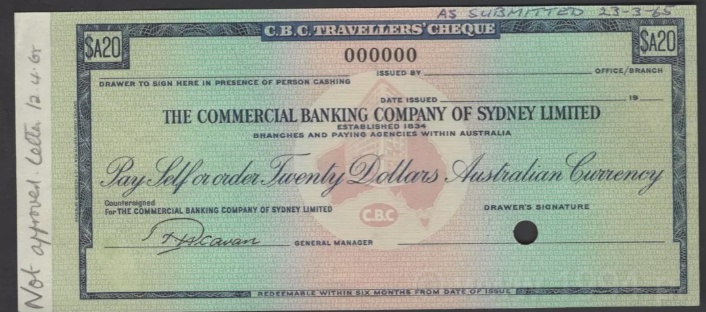
Australia 1965 20 Dollars traveller’s cheque rejected design proof by Bradbury Wilkinson & Co. for The Commercial Banking Company of Sydney Limited, marked Not Approved with right-side punch

Australia 1965 — Commercial Banking Company of Sydney Limited $20 Travellers Cheque Rejected Design Proof (Pick Unlisted)

Rejected design proof for the proposed 20 Dollars traveller’s cheque printed and engraved by Bradbury Wilkinson & Co., London, for The Commercial Banking Company of Sydney Limited. Submitted in 1965 and annotated “Not Approved,” it represents a parallel concept in the three-denomination traveller’s cheque proposal of that year. The composition features elegant guilloche borders in blue-green and lavender hues, overprinted with a large central watermark-style globe bearing the bank’s initials C.B.C. ... Read more →

AustraliaRejected Design Proof196520 DollarsPrinter’s Archival Proof AustraliaTravellers ChequeTravelers CheckCommercial Banking Company of Sydney LimitedRejected Design ProofBradbury WilkinsonBWC196520 DollarsArchival ProofUnissued DesignBank History
Held
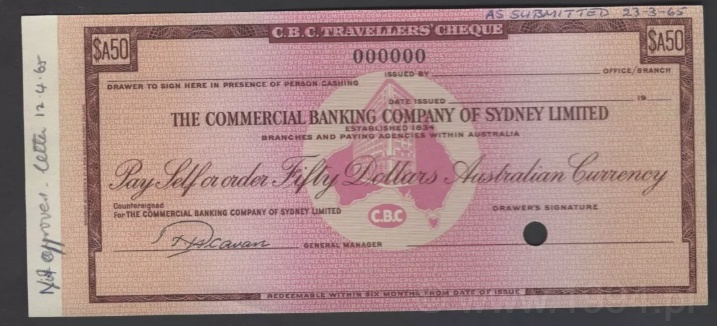
Australia 1965 50 Dollars traveller’s cheque rejected design proof by Bradbury Wilkinson & Co. for The Commercial Banking Company of Sydney Limited, marked Not Approved with right-side control punch

Australia 1965 — Commercial Banking Company of Sydney Limited $50 Travellers Cheque Rejected Design Proof (Pick Unlisted)

Rejected design proof for the 50 Dollars traveller’s cheque prepared by Bradbury Wilkinson & Co., London, for The Commercial Banking Company of Sydney Limited. Submitted in 1965 as the top denomination in the same three-value series, this pink-rose specimen bears the annotation “Not Approved” and the same submission date as the $20 proof. The engraving is rich and multi-layered, displaying Bradbury Wilkinson’s refined late-intaglio craftsmanship with deep guilloche patterns and broad, formal typography. ... Read more →

AustraliaRejected Design Proof196550 DollarsPrinter’s Archival Proof AustraliaTravellers ChequeTravelers CheckCommercial Banking Company of Sydney LimitedRejected Design ProofBradbury WilkinsonBWC196550 DollarsArchival ProofUnissued DesignBank History
Held
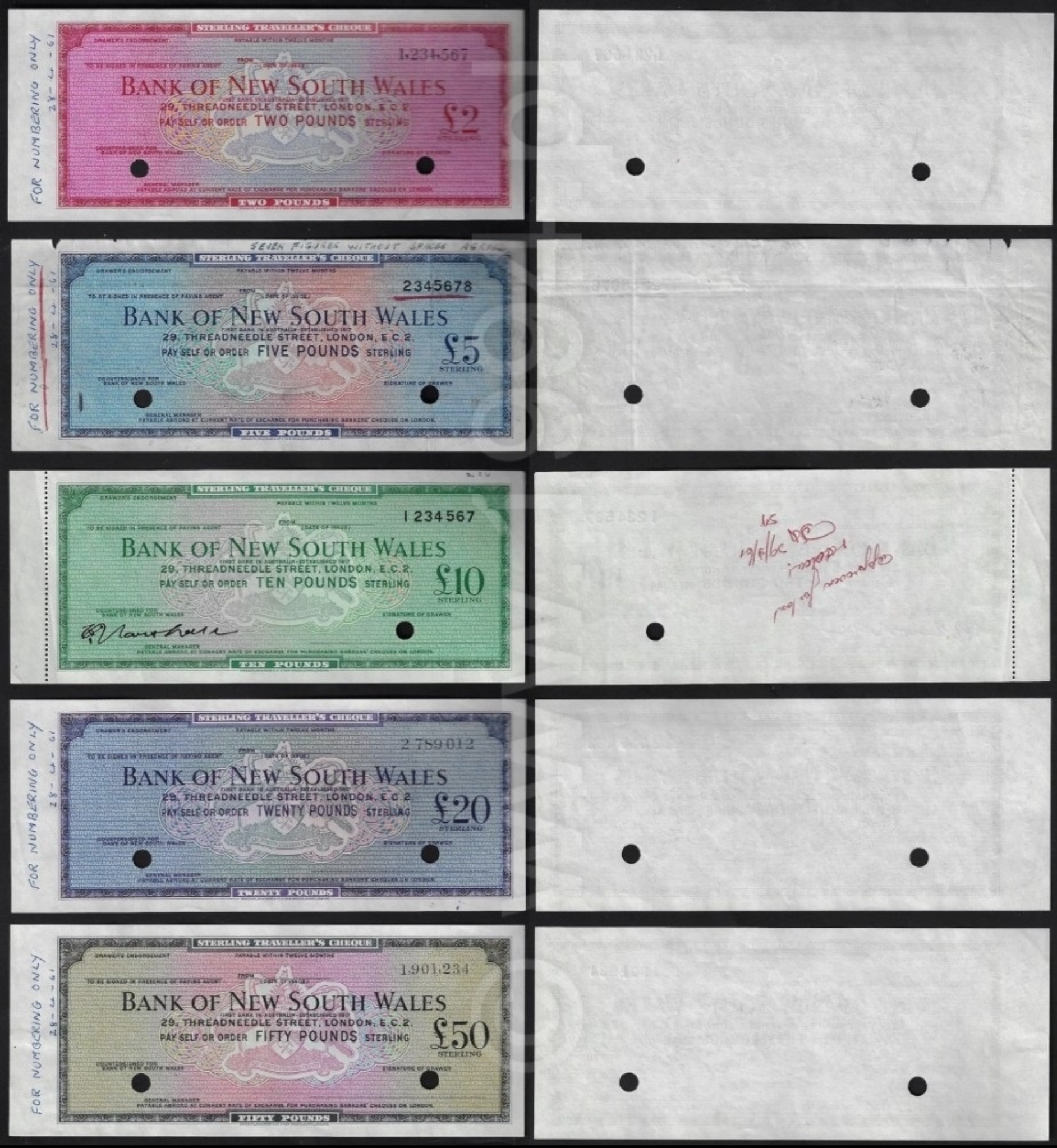
Australia 1961 Bank of New South Wales Sterling Traveller’s Cheques complete printer’s proof set by Bradbury Wilkinson & Company showing 2, 5, 10, 20 and 50 Pounds denominations with control punches, numbering annotations, and the 10 Pounds master approval sheet with perforated binding stub and red reverse sign-off

Australia 1961 — Bank of New South Wales Sterling Travellers Cheques, Complete Printer’s Proof Set £2-£50 (Pick Unlisted)

A complete archival printer’s proof set of five Sterling Traveller’s Cheques produced by Bradbury Wilkinson & Company in London for the Bank of New South Wales in April 1961. The set comprises the full denomination range — 2 Pounds, 5 Pounds, 10 Pounds, 20 Pounds, and 50 Pounds — preserved together from a single, documented submission event within the printer’s internal approval and numbering workflow. Each sheet displays the finished engraved face design adopted by the Bank of New South Wales for its early-1960s traveller’s cheque issue. ... Read more →

AustraliaPrinter’s Archival Proof Set19612 Pounds • 5 Pounds • 10 Pounds • 20 Pounds • 50 PoundsPrinter’s Archival Proofs Printer’s Proof Set2 Pounds5 Pounds10 Pounds20 Pounds50 PoundsSterling DenominationsIntaglio Security PrintingNumbering Trial ProofsApproval Workflow MaterialBradbury Wilkinson & CompanyPrinter’s ArchiveProof Room PracticeSerial Layout TestingColour Separation by DenominationBank of New South WalesAustralian Private BankingPre-Decimal CurrencyTraveller’s Cheque HistoryTravelers Check HistoryTravellers ChequeTravelers CheckAustralia1961R9 Extremely RareUniqueUnique SetMuseum Grade
Held
Australia 1929 Commercial Banking Company of Sydney Limited Circular Letter of Introduction photographic proof mounted on cardstock PCGS 50 About New

Australia 1929 — Commercial Banking Company of Sydney Limited — Circular Letter of Introduction Photographic Proof (Mounted on Cardstock, PCGS 50 About New)

This photographic proof represents a Circular Letter of Introduction prepared for the Commercial Banking Company of Sydney Limited during the late interwar period. Such documents functioned as formal financial identification instruments, issued to bank clients traveling abroad to establish identity, credibility, and recognized standing within an international banking network. In practical use, the holder would present the letter to correspondent banks, which would acknowledge the issuing institution and extend services based on that established relationship. ... Read more →

AustraliaPhotographic Proof Letter of Introduction1929Not Applicable (Letter of Introduction)PCGS 50 About New Photographic ProofLetter of IntroductionCircular Letter of IntroductionIdentity Financial InstrumentBanking Correspondence DocumentHigh Security DocumentGuilloche DesignCentral RosetteMounted on CardstockArchival ProofLondon Security PrintingPre engraving production stageCommercial Banking Company of Sydney LimitedCorrespondent Banking NetworkInternational Banking SystemFinancial Identity VerificationInterwar FinanceHistoryAustralia1929PCGS 50About NewMuseum Grade
Held
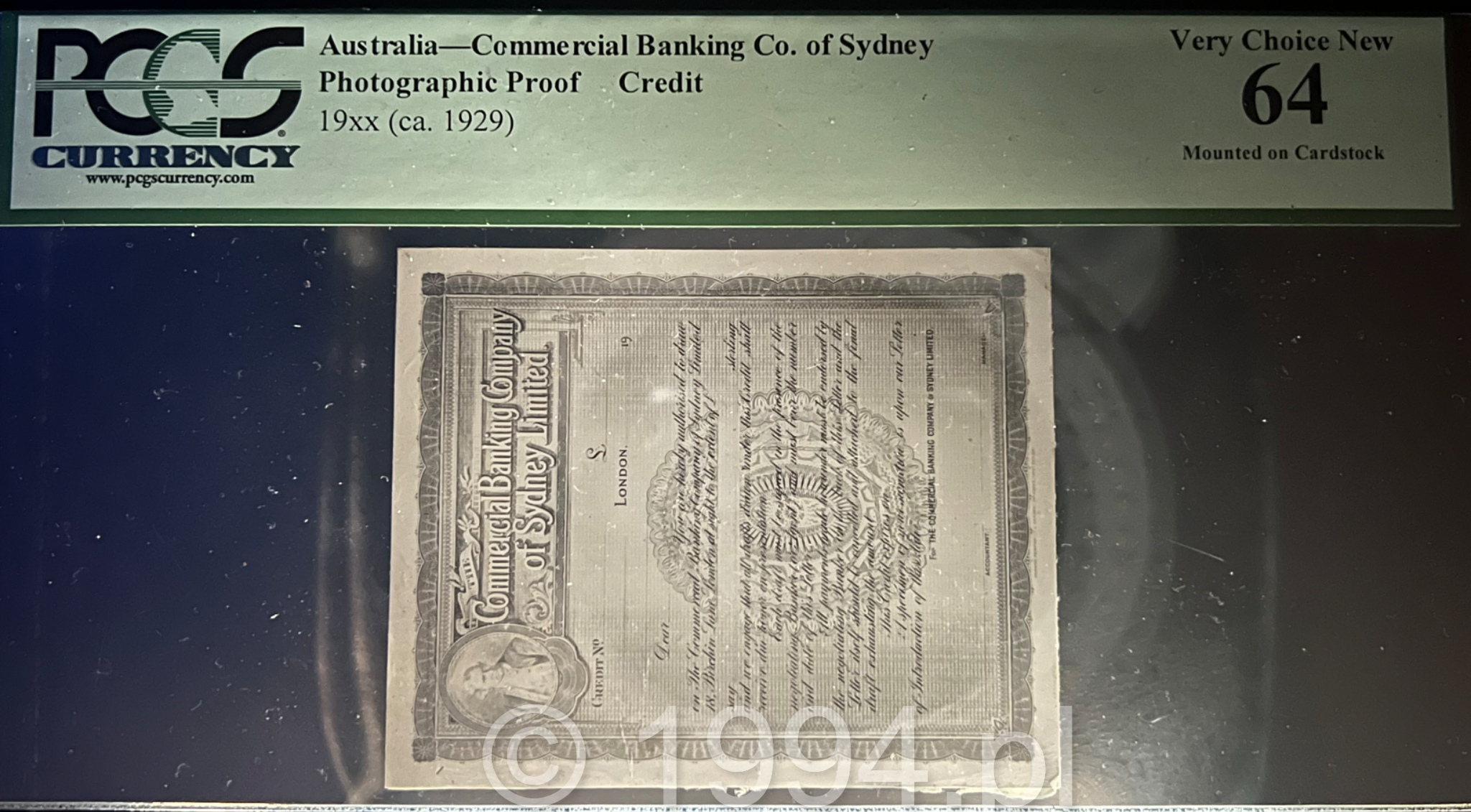
Australia 1929 Commercial Banking Company of Sydney Limited Circular Letter of Credit photographic proof mounted on cardstock PCGS 64 Very Choice New

Australia 1929 — Commercial Banking Company of Sydney Limited — Circular Letter of Credit Photographic Proof (Mounted on Cardstock, PCGS 64 Very Choice New)

This photographic proof represents a Circular Letter of Credit issued by the Commercial Banking Company of Sydney Limited during the late interwar period, forming part of an international financial system that enabled secure cross-border access to funds. Unlike Letters of Introduction, which served primarily as identity credentials, the Letter of Credit functioned as a direct monetary instrument, allowing the holder to withdraw funds abroad through a structured and verifiable process. It stands as a precursor to modern traveler’s checks and early credit-based financial systems. ... Read more →

AustraliaPhotographic Proof Circular Letter of Credit1929Not Applicable (Letter of Credit)PCGS 64 Very Choice New Circular Letter of CreditLetter of Credit SystemEarly Credit InstrumentPre Travelers CheckInternational Banking DocumentCredit Withdrawal InstrumentFinancial Draft DocumentGlobal Credit AccessPhotographic ProofMounted on CardstockArchival ProofPre engraving production stageSecurity PrintingGuilloche DesignCentral RosettePortrait VignetteCommercial Banking Company of Sydney LimitedLondon Security PrintingCorrespondent Banking NetworkInternational Credit SystemGlobal Financial InfrastructureInterwar FinanceHistoryAustralia1929PCGS 64Very Choice NewMuseum Grade
Held
↑ Top