Collection PL

About

New Zealand’s paper money developed under a private-bank system long before monetary centralization. Through the late nineteenth and early twentieth centuries, trading banks operating under statute—most prominently the Bank of New Zealand—placed London-engraved notes into circulation, redeemable on demand and trusted across a geographically dispersed, export-driven economy. Design and production standards were aligned with British practice, ensuring that New Zealand notes would be accepted both domestically and within imperial settlement networks.

The private-bank sequence represented here was engraved and printed by Bradbury, Wilkinson & Co., London, whose disciplined approach to denomination hierarchy, color coding, and serial logic defined the visual and functional grammar of Bank of New Zealand issues. The lineage progresses from the early £1 Green through the £5 Orange and £10 Brown, culminating in the seldom-seen £20 Blue—the highest practical denomination issued by New Zealand’s private banks prior to 1934.

The £20 Blue audit-range specimen (Pick S194s) represents the apex of this system. Executed in subdued blue-slate tones reserved for the highest settlement tier, it carries dual live serials rather than a zero-serial format, identifying it as an internal audit and approval piece retained by Bradbury Wilkinson during plate alignment, tint calibration, and numbering verification. Such audit-range specimens were never intended for public or institutional circulation and were almost universally destroyed once approval was complete.

Wartime production introduces a second layer of complexity. The £5 Red-Rose specimen (Pick S227s), printed during the 1916–1920 period, reflects material constraints and pigment shifts imposed by the First World War while preserving its position within the established BNZ color hierarchy. This specimen retains dual live serial prefixes and carries contemporary printer annotations, confirming its role as an internal audit and control document rather than a display specimen. Its survival provides rare evidence of how Bradbury Wilkinson managed quality control under wartime conditions.

Together, these specimens document more than denomination progression. They preserve the internal mechanics of private-bank note production: audit-range serial blocks, multi-serial approval formats, pencilled press annotations, and cancellation strategies designed to prevent accidental circulation. These features are not peripheral details—they are the operational language of the system.

Monetary centralization arrived with the establishment of the Reserve Bank of New Zealand in 1934, ending private note issue and introducing a unified national currency. The Bank of New Zealand specimens shown here therefore represent the final, fully matured phase of New Zealand’s private-bank era. Read together, they trace a complete arc: from early commercial trust-building, through wartime adaptation, to the threshold of central banking.
51 results · Page 2 of 5
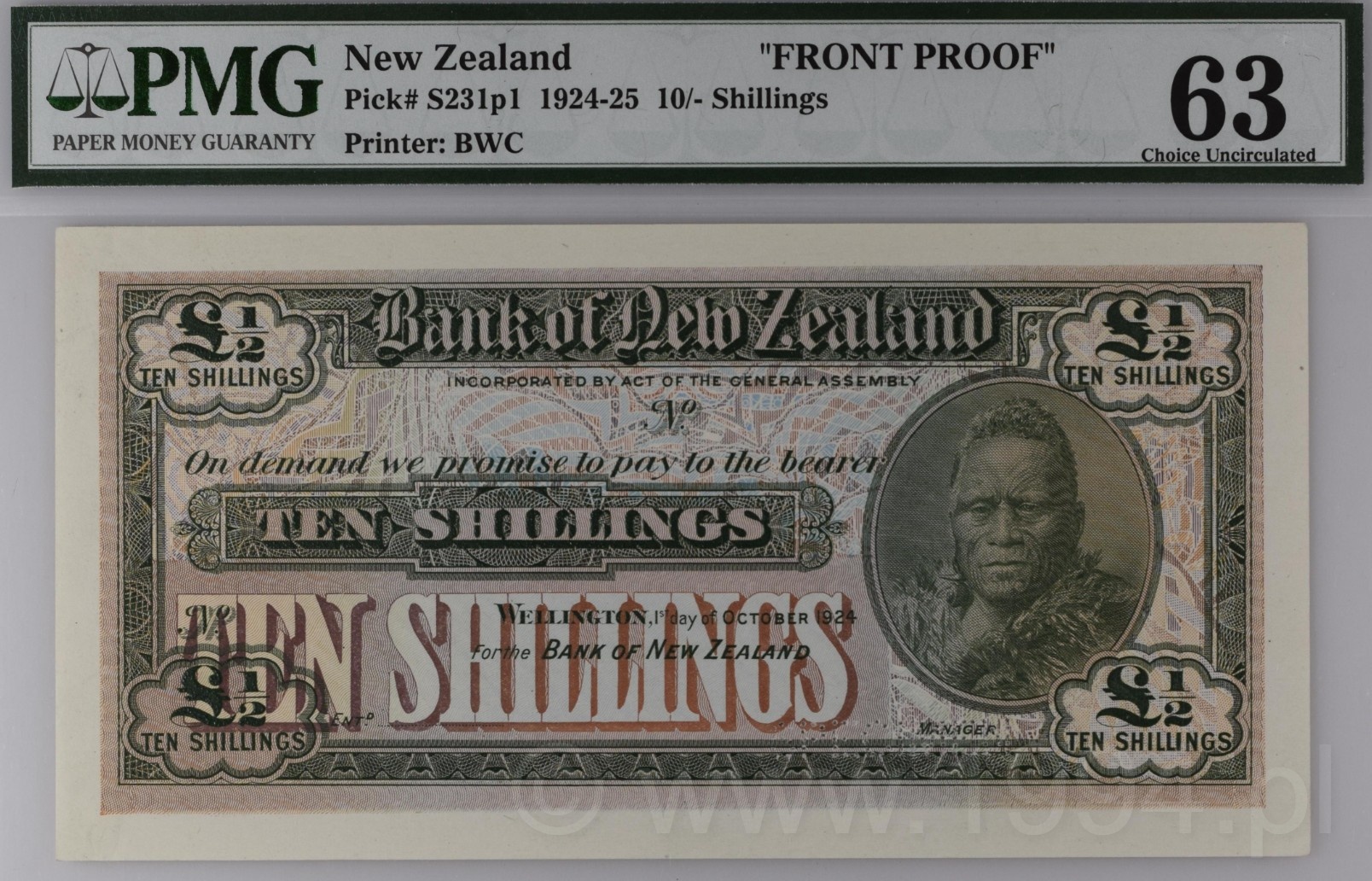
New Zealand 1924–1925 Bank of New Zealand 10 Shillings Front Proof Pick S231p1 with SPECIMEN perforation, Bradbury Wilkinson & Co.

New Zealand 1924–1925 — Bank of New Zealand 10 Shillings Front Proof with SPECIMEN Perforation (Pick S231p1)

Front proof of the Bank of New Zealand 10 Shillings (Pick S231p1), printed by Bradbury, Wilkinson & Co., London, for the post-war re-engraved issue dated 1924–25. Perforated SPECIMEN through the lower margin and certified by PMG as Choice Uncirculated 63 Top Pop, this example shows the completed obverse design prior to overprinting and serial application. The note features a finely engraved portrait of the Māori rangatira Tamati Waka Nene (1780–1871), leader of Ngāpuhi and an early ally of British settlement—one of the first indigenous statesmen ever depicted on a Commonwealth banknote. ... Read more →

New ZealandFront Proof192410 ShillingsPMG 63 Choice Uncirculated (Top Pop, Front Proof with SPECIMEN Perforation) Front Proof10 ShillingsSpecimen PerforationIntaglioBradbury WilkinsonBWCTamati Waka NeneBank of New ZealandNew Zealand Banking HistoryPre-Reserve BankPrivate Banknote EraInterwar Currency DesignEngraved Security PrintingLate Edwardian PlateworkTint-Stone UnderprintMāori Portrait SeriesNew Zealand192419251924–1925PMG 63Top PopMuseum GradeR8 Extremely Rare
Held
New Zealand 1934 Reserve Bank of New Zealand 10 Shillings photographic face proof Pick 154p showing kiwi vignette and portrait of Maori King Tawhiao

New Zealand 1934 — Reserve Bank of New Zealand 10 Shillings Photographic Face Proof (Pick 154p)

This photographic face proof preserves the engraved design prepared for the first 10 Shillings banknote issued by the Reserve Bank of New Zealand following the creation of the central bank under the Reserve Bank Act of 1933. The proof represents the pre-press stage of the denomination, recording the completed engraving before the design was transferred to printing plates for circulation production. The note belongs to the inaugural Reserve Bank series commonly known as the "Lefeaux series", named for Leslie Lefeaux, the institution’s first Governor. ... Read more →

New ZealandPhotographic Proof193410 ShillingsPCGS 64 Very Choice New Photographic ProofFace ProofEngraving ProofArchival ProofLefeaux SeriesReserve Bank First IssueReserve Bank Act 1933Leslie LefeauxKiwi VignetteMaori King TawhiaoNew Zealand Coat of ArmsNew Zealand193410 ShillingsPick 154pPick 154PCGS 64Very Choice NewMuseum GradeR8 Extremely Rare
Held
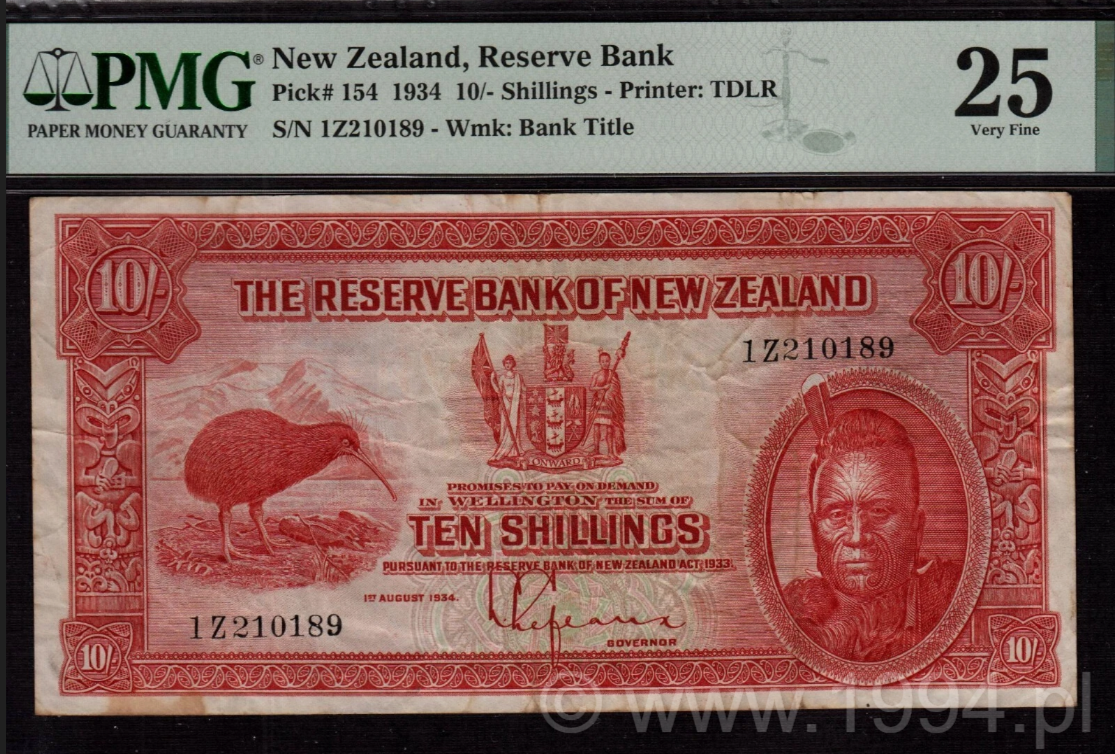
New Zealand 1934 Reserve Bank of New Zealand 10 Shillings issued banknote Pick 154 with kiwi vignette and portrait of Maori King Tawhiao

New Zealand 1934 — Reserve Bank of New Zealand 10 Shillings Issued Note (Pick 154)

The 10 Shillings banknote issued on 1 August 1934 forms part of the first national paper money series produced for the Reserve Bank of New Zealand after its establishment under the Reserve Bank Act of 1933. The creation of the Reserve Bank replaced the fragmented system of private trading bank notes with a unified national currency, marking a major milestone in the country’s monetary history. This inaugural series is widely known as the "Lefeaux series", named after Leslie Lefeaux, the first Governor of the Reserve Bank whose printed signature appears on the notes. ... Read more →

New ZealandIssued Note193410 ShillingsPMG 25 Very Fine Issued NoteLefeaux SeriesReserve Bank First IssueReserve Bank Act 1933Leslie LefeauxKiwi BirdMaori King TawhiaoNew Zealand Coat of ArmsMitre Peak FiordlandThomas De La RueTDLRSecurity EngravingNew Zealand193410 ShillingsPick 154PMG 25Very FineMuseum Grade
Held
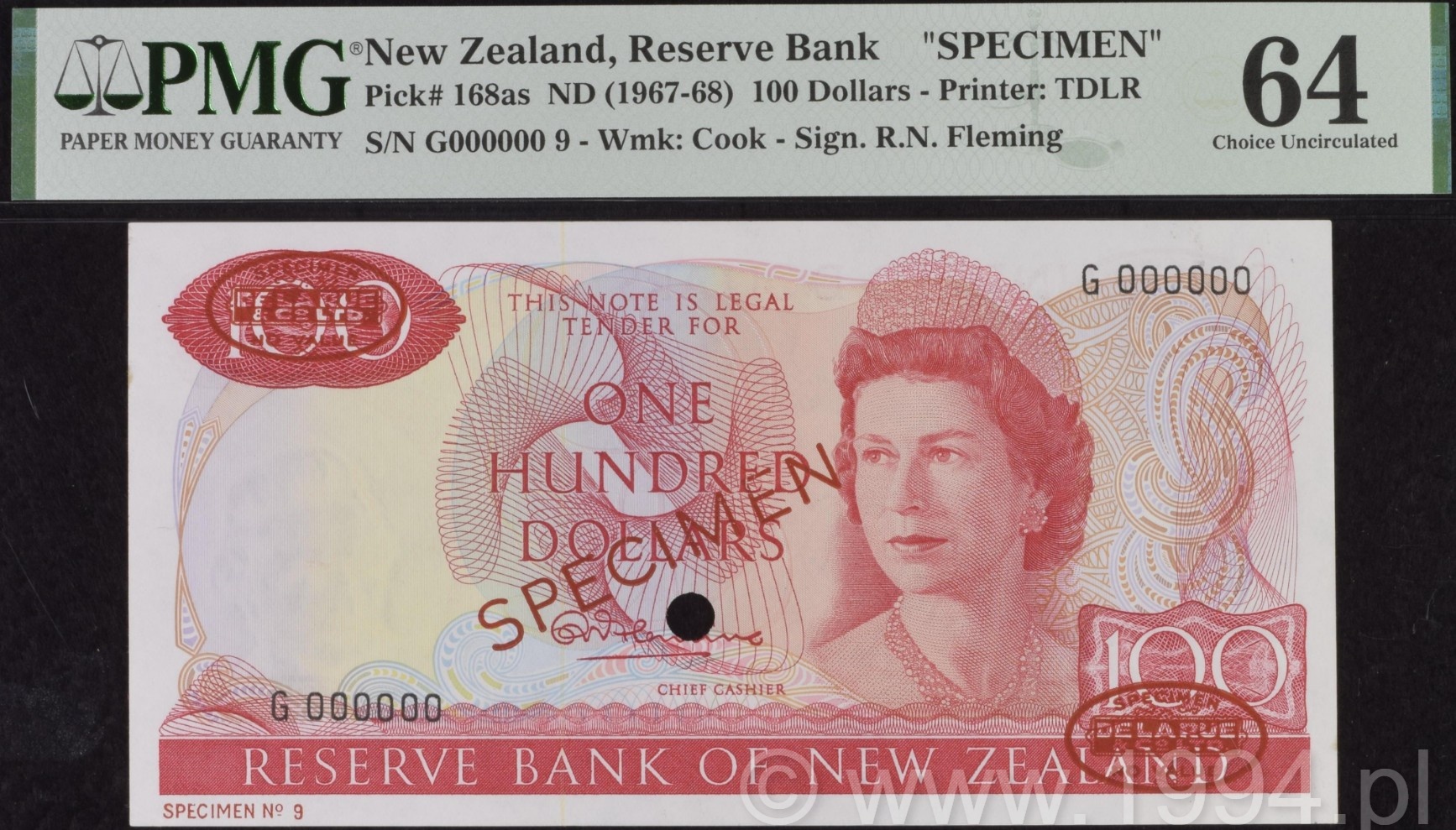
New Zealand 1967 100 Dollars Fleming Signature TDLR Overprint Specimen Serial G000000009 Specimen No. 9 with diagonal red overprint, oval stamp, and single punch hole, Pick 168as, PMG 64 Choice Uncirculated.

New Zealand 1967 — 100 Dollars (Pick 168as, Fleming Signature, TDLR Overprint Specimen, Serial G000000009, Specimen No. 9, PMG 64 Choice Uncirculated)

The 1967 one hundred dollars specimen represents the inaugural issue of New Zealand’s decimal currency system at its highest denomination, issued during the ND (1967–1968) period under the signature of Roderick Ninian Fleming as Chief Cashier. Fleming’s tenure was limited to the opening phase of decimalization, making his signature exclusive to the earliest production window of the new monetary system. Printed by Thomas De La Rue & Company, London, this specimen was prepared for formal distribution to central banks and institutional archives. ... Read more →

New ZealandSpecimen with Red Overprint and Oval Stamp1967100 DollarsPMG 64 Choice Uncirculated SpecimenRed OverprintTDLR OverprintDiagonal SPECIMEN overprintOval StampSingle Oval StampSingle Punch HolePunch Cancelled100 DollarsQueen Elizabeth II portraitCaptain James Cook watermarkThomas De La RueTDLRFleming SignatureRoderick Ninian FlemingSpecimen distribution formatDecimal SeriesReserve Bank of New ZealandFirst decimal issueNew Zealand currency reformHistoryNew Zealand196719681967-1968Specimen No. 9G000000009Pick 168asPick 168aPMG 64Choice UncirculatedMuseum Grade
Held
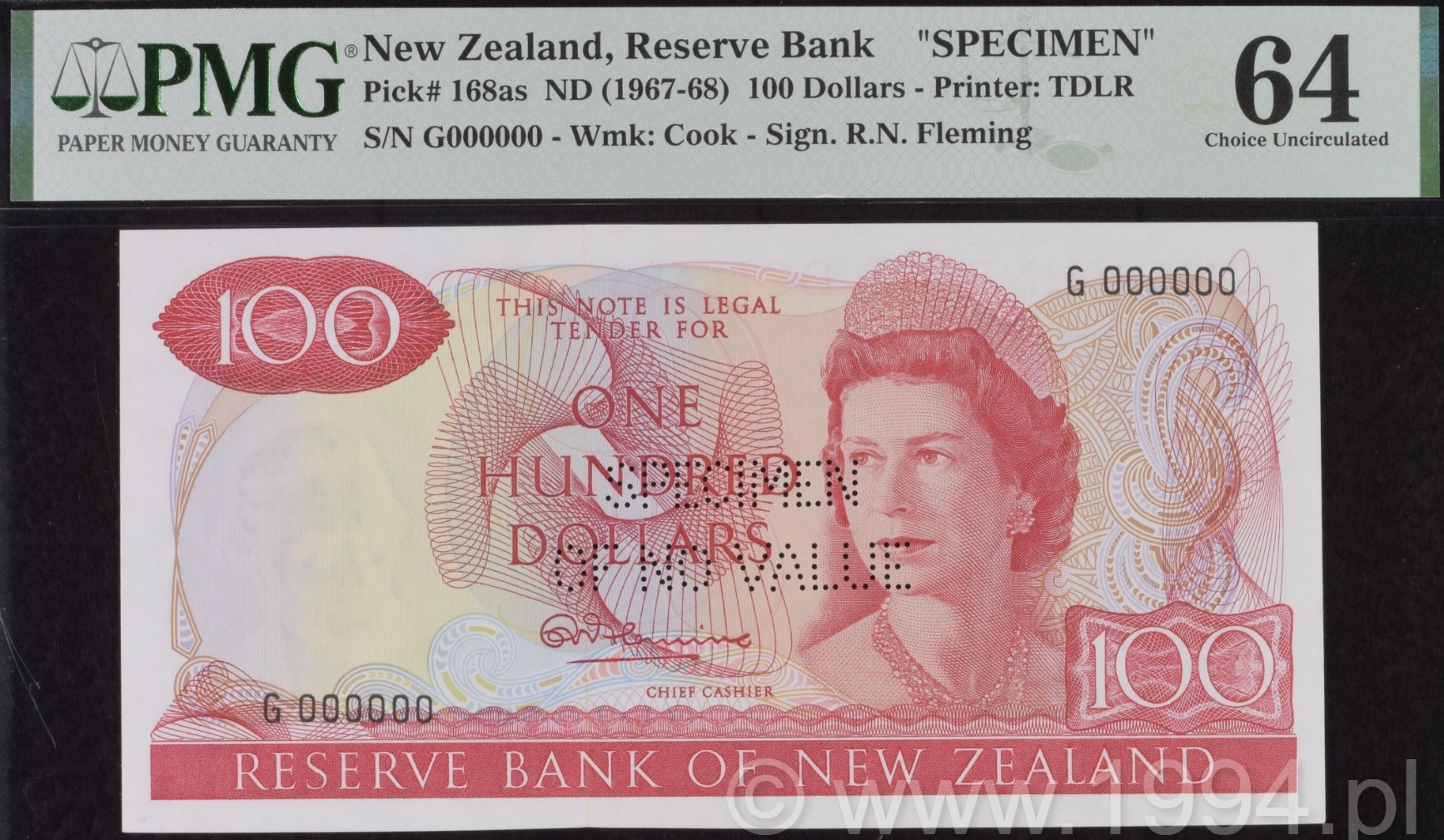
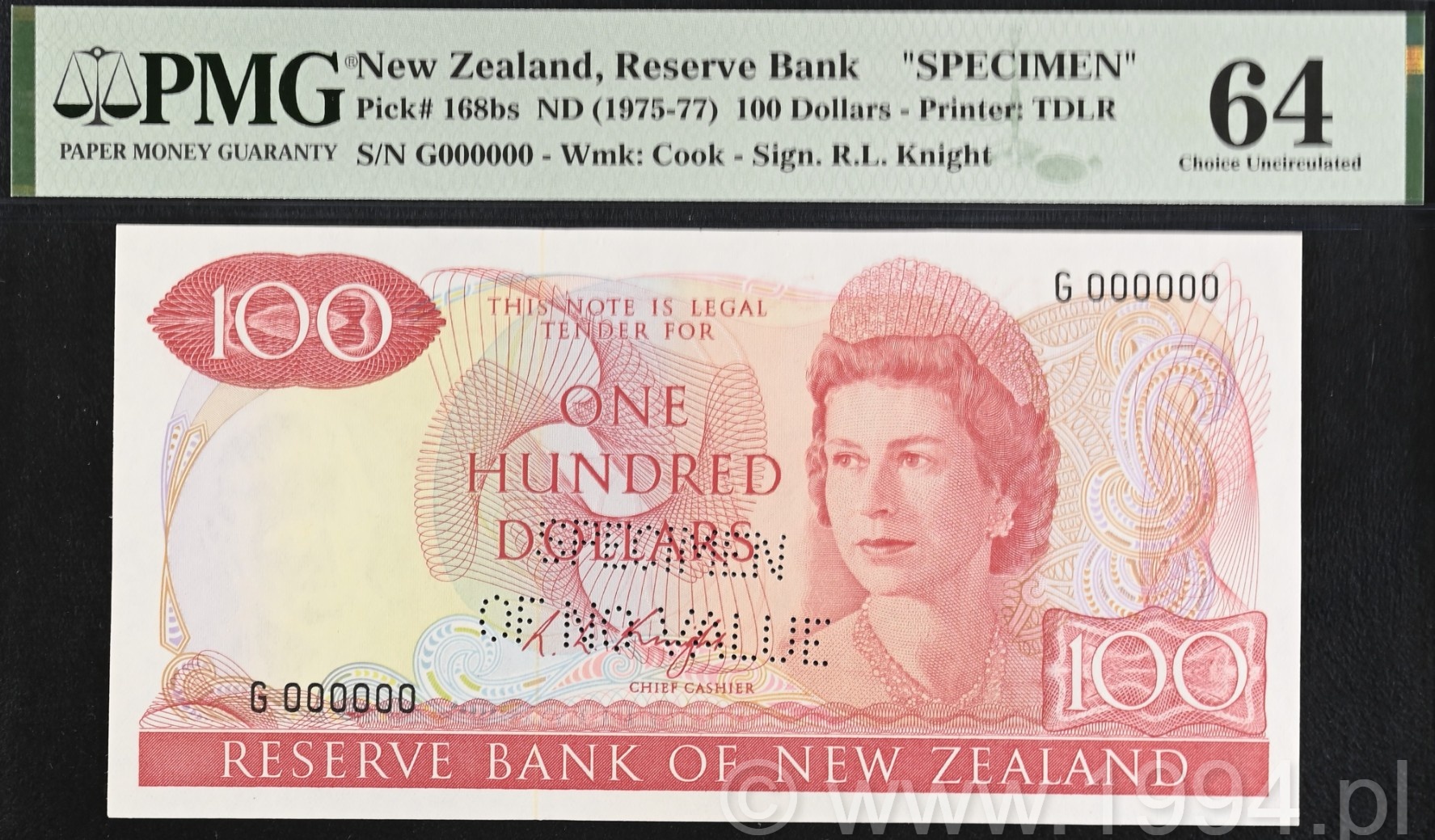
New Zealand 1967 100 Dollars Fleming Signature perforated SPECIMEN OF NO VALUE Serial G000000 Pick 168as PMG 64 Choice Uncirculated with no overprint, no oval stamp, and no punch holes.

New Zealand 1967 — 100 Dollars (Pick 168as, Fleming Signature, Perforated SPECIMEN OF NO VALUE, Serial G000000, PMG 64 Choice Uncirculated)

The 1967 one hundred dollars perforated specimen represents the highest denomination of New Zealand’s inaugural decimal currency issue, produced during the ND (1967–1968) period under the signature of Roderick Ninian Fleming as Chief Cashier. Fleming’s tenure was limited to the opening phase of decimalization, making his signature exclusive to the earliest production window of the modern dollar system. Printed by Thomas De La Rue & Company, London, this specimen belongs to the internal archival class rather than the externally distributed presentation format. ... Read more →

New ZealandPerforated Specimen of No Value1967100 DollarsPMG 64 Choice Uncirculated Perforated SpecimenSpecimen of No ValuePerforated SPECIMEN OF NO VALUENo OverprintNo Oval StampNo Punch Hole100 DollarsQueen Elizabeth II portraitCaptain James Cook watermarkThomas De La RueTDLRFleming SignatureRoderick Ninian FlemingInternal archival specimenDecimal SeriesReserve Bank of New ZealandFirst decimal issueNew Zealand currency reformHistoryNew Zealand196719681967-1968G000000Pick 168asPick 168aPMG 64Choice UncirculatedMuseum Grade
Held
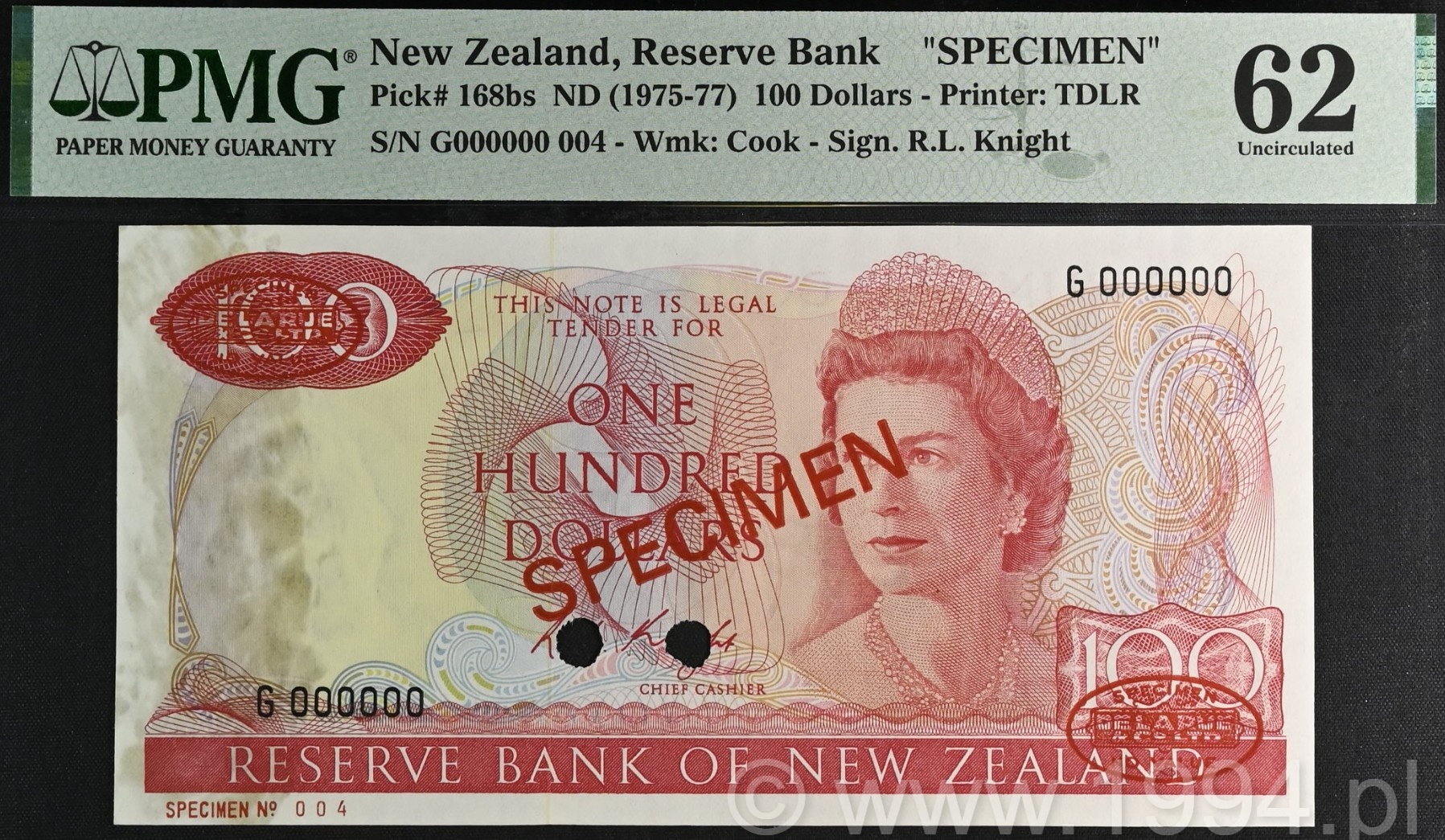
New Zealand 1975 100 Dollars R.L. Knight Signature TDLR Overprint Specimen Serial G000000004 Specimen No. 004 with diagonal red overprint, oval stamp, and double punch holes, Pick 168bs, PMG 62 Uncirculated.

New Zealand 1975 — 100 Dollars (Pick 168bs, R.L. Knight Signature, TDLR Overprint Specimen, Serial G000000004, Specimen No. 004, PMG 62 Uncirculated)

The 1975 one hundred dollars specimen represents the highest denomination of New Zealand’s decimal currency series during the tenure of R.L. Knight as Chief Cashier, issued within the ND (1975–1977) period. Knight’s signature defines the third phase of the decimal era, following the Fleming and Wilks periods, and reflects a stage in which the system had transitioned from initial introduction into a fully established national currency structure. ... Read more →

New ZealandSpecimen with Red Overprint and Oval Stamp1975100 DollarsPMG 62 Uncirculated SpecimenRed OverprintTDLR OverprintDiagonal SPECIMEN overprintOval StampSingle Oval StampDouble Punch HolePunch Cancelled100 DollarsQueen Elizabeth II portraitCaptain James Cook watermarkThomas De La RueTDLRKnight SignatureR.L. KnightSpecimen distribution formatDecimal SeriesReserve Bank of New ZealandHigh denomination noteNew Zealand currency evolutionHistoryNew Zealand197519771975-1977Specimen No. 004G000000004Pick 168bsPick 168bPMG 62UncirculatedMuseum Grade
Held
New Zealand 1975 100 Dollars R.L. Knight Signature perforated SPECIMEN OF NO VALUE Serial G000000000 Pick 168bs PMG 64 Choice Uncirculated with no overprint, no oval stamp, and no punch holes.

New Zealand 1975 — 100 Dollars (Pick 168bs, R.L. Knight Signature, Perforated SPECIMEN OF NO VALUE, Serial G000000000, PMG 64 Choice Uncirculated)

The 1975 one hundred dollars perforated specimen represents the highest denomination of New Zealand’s decimal currency during the tenure of R.L. Knight as Chief Cashier, issued within the ND (1975–1977) period. Knight’s signature defines the third phase of the decimal era, following the Fleming and Wilks periods, and reflects a stage in which the currency system had reached structural maturity. ... Read more →

New ZealandPerforated Specimen of No Value1975100 DollarsPMG 64 Choice Uncirculated Perforated SpecimenSpecimen of No ValuePerforated SPECIMEN OF NO VALUENo OverprintNo Oval StampNo Punch Hole100 DollarsQueen Elizabeth II portraitCaptain James Cook watermarkThomas De La RueTDLRKnight SignatureR.L. KnightInternal archival specimenDecimal SeriesReserve Bank of New ZealandHigh denomination noteNew Zealand currency evolutionHistoryNew Zealand197519771975-1977G000000000Pick 168bsPick 168bPMG 64Choice UncirculatedMuseum Grade
Held
New Zealand 1981 100 Dollars issued note H.R. Hardie signature revised Queen Elizabeth II portrait serial YAA173980 Pick 175a PMG 45 Choice Extremely Fine.

New Zealand 1981 — 100 Dollars (Pick 175a, H.R. Hardie Signature, Serial YAA173980, PMG 45 Choice Extremely Fine)

The 1981 one hundred dollars note represents the reintroduction and continuation of New Zealand’s highest denomination within the revised decimal currency series, issued during the ND (1981–1985) period under the signature of H.R. Hardie as Chief Cashier. This issue belongs to the later Hardie design phase, distinguished by the updated portrait of Queen Elizabeth II, presenting a more mature likeness compared to the earlier ND (1977–1981) series bearing the same signatory. ... Read more →

New ZealandIssued Note1981100 DollarsPMG 45 Choice Extremely Fine Issued Note100 DollarsQueen Elizabeth II portrait revisedCaptain James Cook watermarkDecimal currency noteHigh denomination noteSerial number noteBradbury WilkinsonBWCHardie SignatureH.R. HardieStandard circulation productionDecimal SeriesReserve Bank of New ZealandSecond design typeNew Zealand currency evolutionHistoryNew Zealand198119851981-1985YAA173980Pick 175aPMG 45Choice Extremely FineMuseum Grade
Held
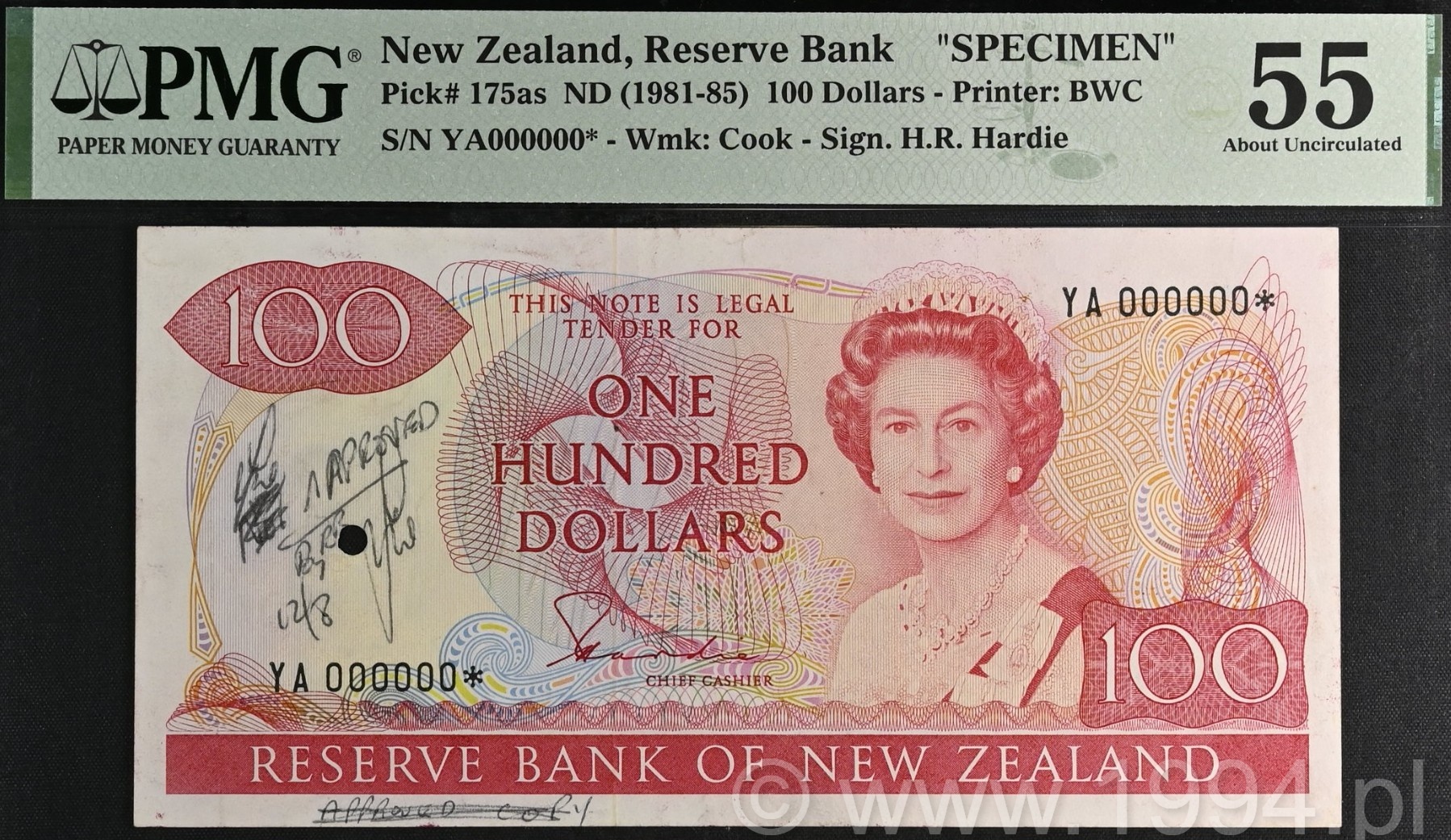
New Zealand 1981 100 Dollars printer annotation specimen with replacement star serial YA000000*, handwritten approval markings, single punch hole, no overprint or oval stamp, Pick 175as, PMG 55 About Uncirculated.

New Zealand 1981 — 100 Dollars (Pick 175as, H.R. Hardie Signature, Replacement Star Serial YA000000*, Printer Annotation Specimen, PMG 55 About Uncirculated)

The 1981 one hundred dollars printer annotation specimen represents an exceptional archival-stage artifact from New Zealand’s decimal currency series, issued within the ND (1981–1985) period under the signature of H.R. Hardie as Chief Cashier. This note belongs to the later Hardie design phase, distinguished by the revised portrait of Queen Elizabeth II, reflecting the mature design update that followed the earlier 1977–1981 issues. ... Read more →

New ZealandPrinter Annotation Specimen Replacement Star with Punch Hole1981100 DollarsPMG 55 About Uncirculated SpecimenPrinter annotation specimenPrinter’s annotationsHandwritten approvedApproval markingsStar serialReplacement style serialSingle Punch HolePunch CancelledNo OverprintNo Oval Stamp100 DollarsQueen Elizabeth II portrait revisedCaptain James Cook watermarkBradbury WilkinsonBWCHardie SignatureH.R. HardieProduction control stagePrinter evaluation pieceDecimal SeriesReserve Bank of New ZealandSecond design typeNew Zealand currency evolutionHistoryNew Zealand198119851981-1985YA000000*Pick 175asPick 175aPMG 55About UncirculatedMuseum Grade
Held
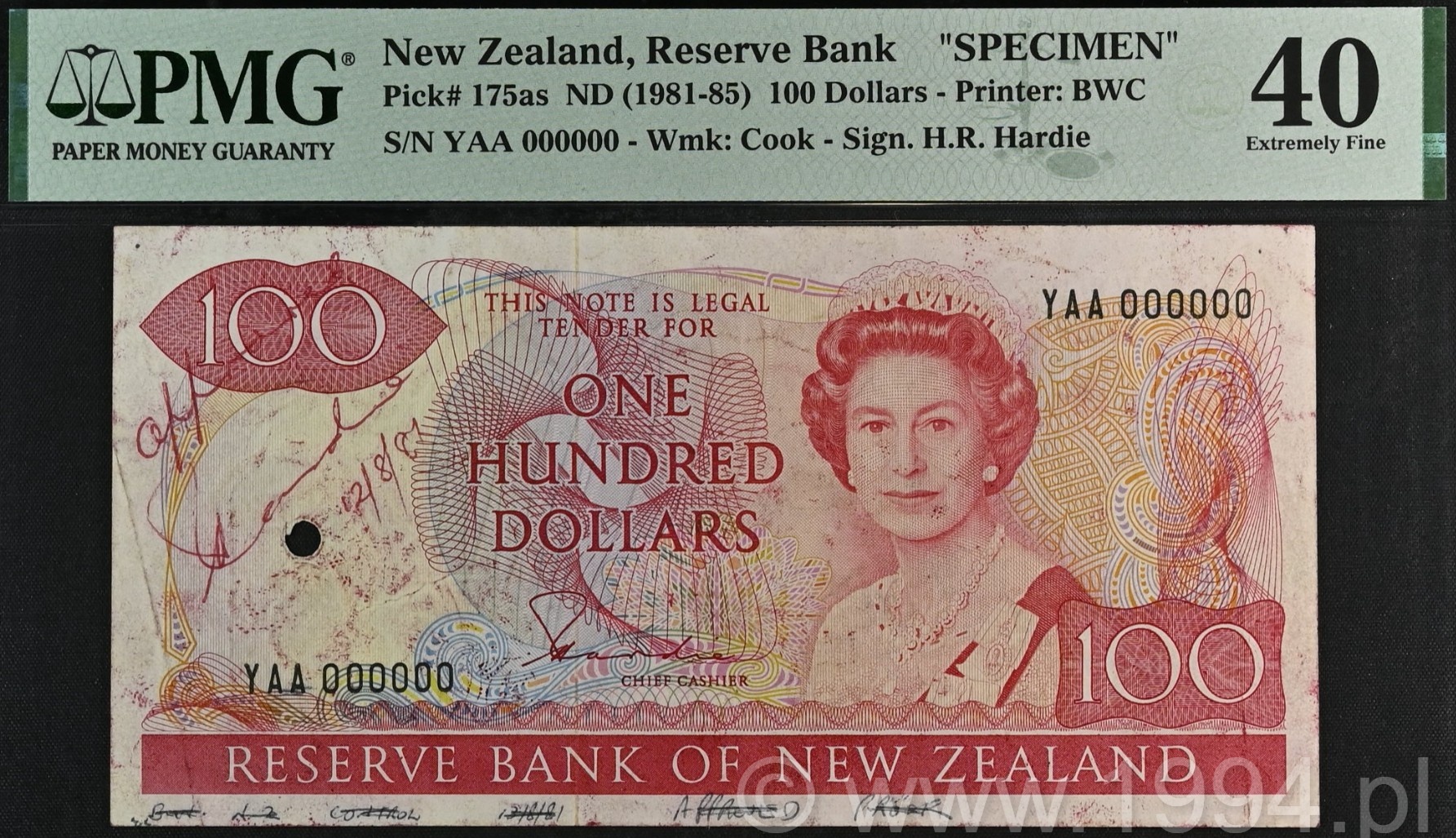
New Zealand 1981 100 Dollars printer annotation specimen with serial YAA000000, handwritten approval markings, single punch hole, no overprint or oval stamp, Pick 175as, PMG 40 Extremely Fine.

New Zealand 1981 — 100 Dollars (Pick 175as, H.R. Hardie Signature, Serial YAA000000, Printer Annotation Specimen with Single Punch Hole, PMG 40 Extremely Fine)

The 1981 one hundred dollars printer annotation specimen represents a working-stage production artifact from New Zealand’s decimal currency series, issued within the ND (1981–1985) period under the signature of H.R. Hardie as Chief Cashier. This note belongs to the later Hardie design phase, identified by the revised portrait of Queen Elizabeth II, reflecting the mature visual update of the series. ... Read more →

New ZealandPrinter Annotation Specimen with Punch Hole1981100 DollarsPMG 40 Extremely Fine SpecimenPrinter annotation specimenPrinter’s annotationsHandwritten approvedApproval markingsSingle Punch HolePunch CancelledNo OverprintNo Oval Stamp100 DollarsQueen Elizabeth II portrait revisedCaptain James Cook watermarkBradbury WilkinsonBWCHardie SignatureH.R. HardieProduction control stagePrinter evaluation pieceDecimal SeriesReserve Bank of New ZealandSecond design typeNew Zealand currency evolutionHistoryNew Zealand198119851981-1985YAA000000Pick 175asPick 175aPMG 40Extremely FineMuseum Grade
Held
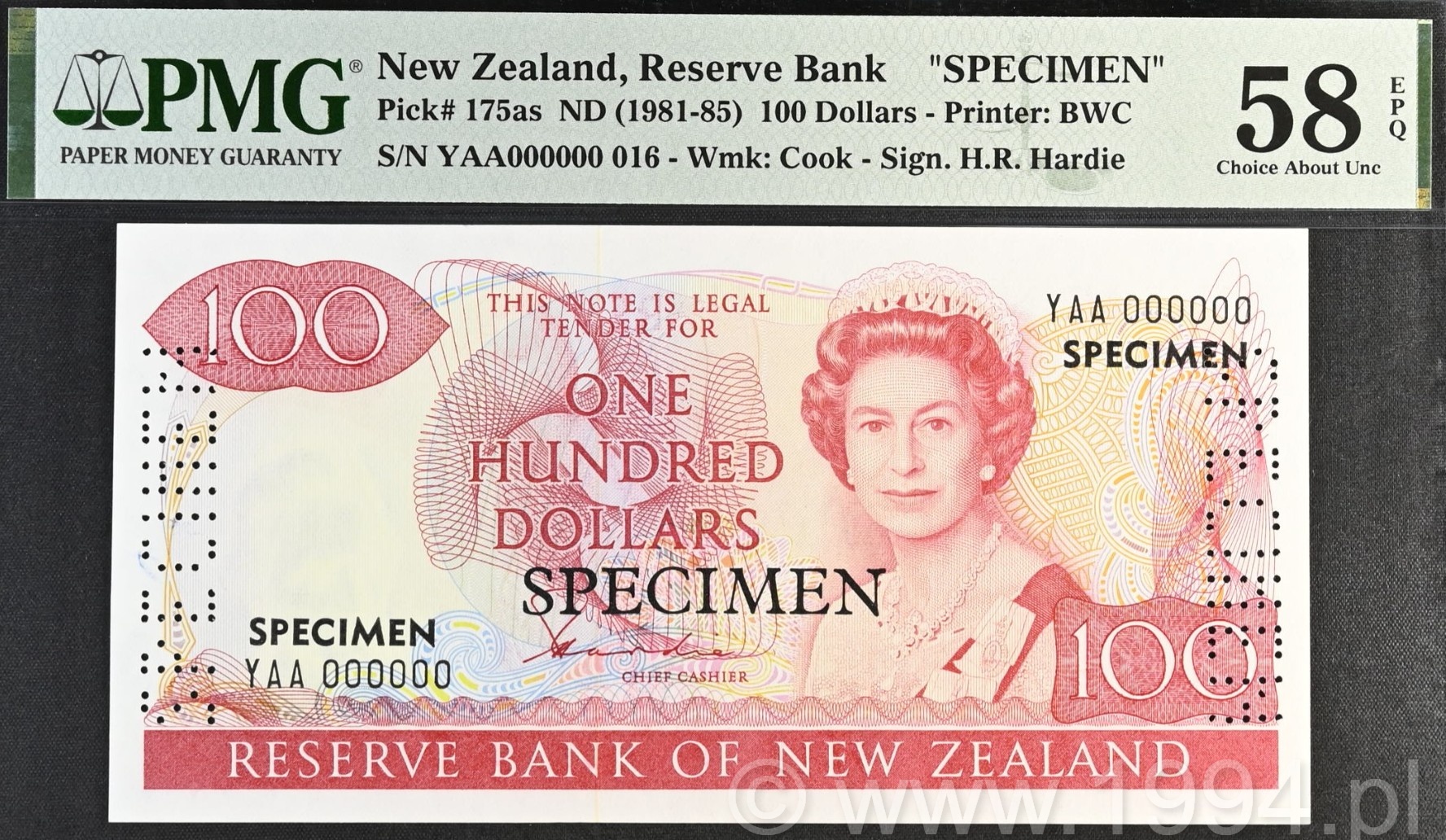
New Zealand 1981 100 Dollars H.R. Hardie Signature specimen with vertical perforated SPECIMEN on both sides and horizontal black SPECIMEN overprint, Serial YAA000000, Specimen No. 016, Pick 175as, PMG 58 Choice About Uncirculated.

New Zealand 1981 — 100 Dollars (Pick 175as, H.R. Hardie Signature, Vertical Perforated SPECIMEN, Black Overprint, Serial YAA000000, Specimen No. 016, PMG 58 Choice About Uncirculated)

The 1981 one hundred dollars specimen represents a later-stage development in New Zealand’s decimal currency specimen formats, issued during the ND (1981–1985) period under the signature of H.R. Hardie as Chief Cashier. This note belongs to the revised Hardie design phase, distinguished by the updated portrait of Queen Elizabeth II, reflecting the mature visual identity of the series. ... Read more →

New ZealandSpecimen with Vertical Perforations and Black Overprint1981100 DollarsPMG 58 Choice About Uncirculated SpecimenVertical Perforated SpecimenPerforated SPECIMENVertical perforation both sidesBlack OverprintHorizontal SPECIMEN overprintNo Punch HoleNo Oval Stamp100 DollarsQueen Elizabeth II portrait revisedCaptain James Cook watermarkBradbury WilkinsonBWCHardie SignatureH.R. HardieSpecimen perforation formatDecimal SeriesReserve Bank of New ZealandSecond design typeNew Zealand currency evolutionHistoryNew Zealand198119851981-1985Specimen No. 016YAA000000Pick 175asPick 175aPMG 58Choice About UncirculatedMuseum Grade
Held
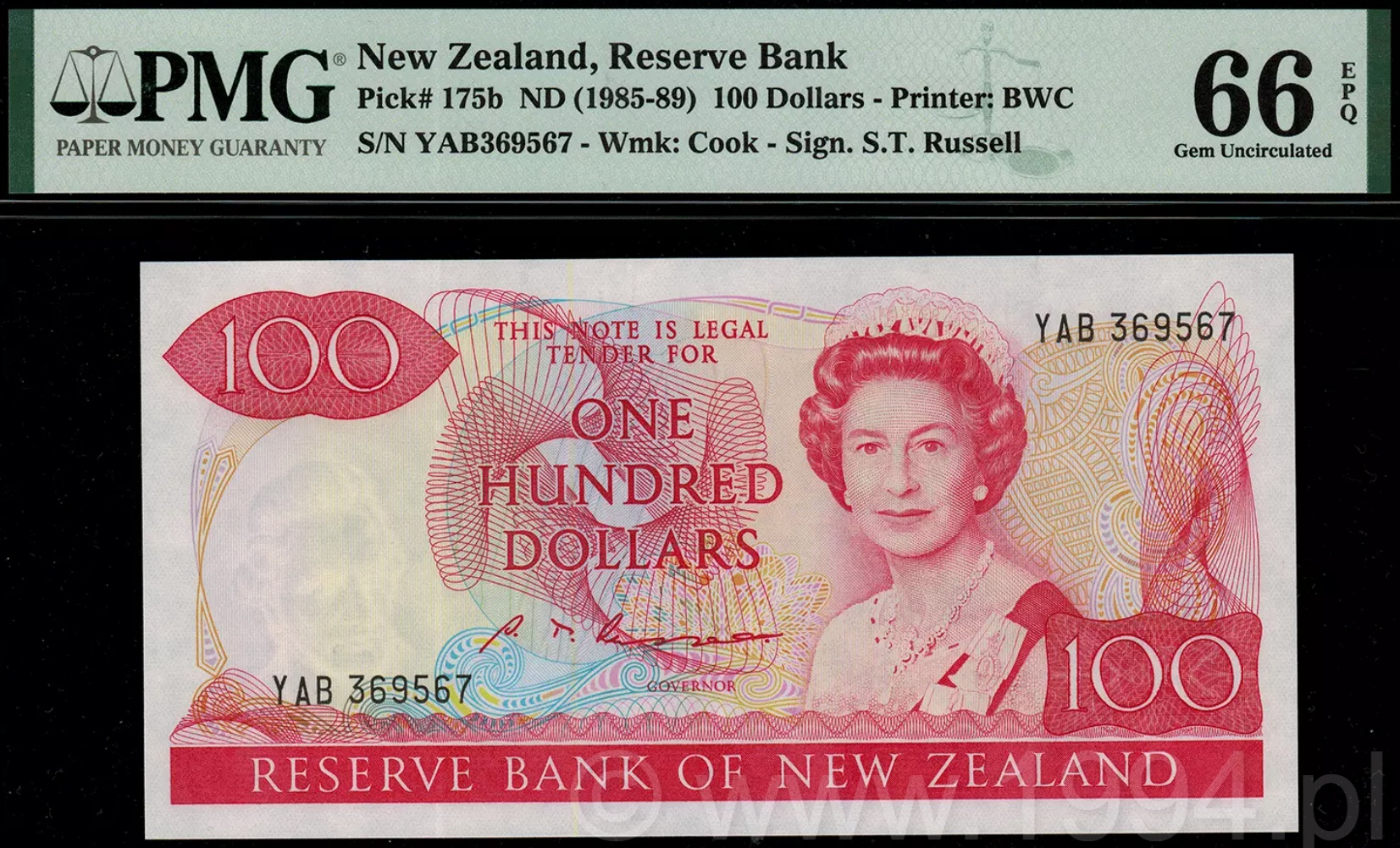
New Zealand 1985 100 Dollars issued note signed by S.T. Russell, serial YAB369567, refined Queen Elizabeth II portrait, Bradbury Wilkinson printing, Pick 175b, PMG 66 EPQ Gem Uncirculated.

New Zealand 1985 — 100 Dollars (Pick 175b, S.T. Russell Signature, Issued Note, Serial YAB369567, PMG 66 EPQ Gem Uncirculated)

The 1985 one hundred dollars note represents the final chapter of New Zealand’s traditional paper currency for its highest denomination, issued within the ND (1985–1989) period under the authority of the Reserve Bank of New Zealand and bearing the signature of S.T. Russell as Chief Cashier. This series marks the last fully developed paper format before the transition to polymer, preserving the culmination of decades of engraving, layout refinement, and security evolution. ... Read more →

New ZealandIssued Note1985100 DollarsPMG 66 EPQ Gem Uncirculated Issued Note100 DollarsQueen Elizabeth II portrait revisedCaptain James Cook watermarkBradbury WilkinsonBWCRussell SignatureS.T. RussellLate paper seriesFinal paper issueDecimal SeriesReserve Bank of New ZealandNew Zealand currency evolutionHistoryNew Zealand198519891985-1989YAB369567Pick 175bPMG 66 EPQGem UncirculatedMuseum Grade
Held
↑ Top