Collection PL

About

New Zealand’s paper money developed under a private-bank system long before monetary centralization. Through the late nineteenth and early twentieth centuries, trading banks operating under statute—most prominently the Bank of New Zealand—placed London-engraved notes into circulation, redeemable on demand and trusted across a geographically dispersed, export-driven economy. Design and production standards were aligned with British practice, ensuring that New Zealand notes would be accepted both domestically and within imperial settlement networks.

The private-bank sequence represented here was engraved and printed by Bradbury, Wilkinson & Co., London, whose disciplined approach to denomination hierarchy, color coding, and serial logic defined the visual and functional grammar of Bank of New Zealand issues. The lineage progresses from the early £1 Green through the £5 Orange and £10 Brown, culminating in the seldom-seen £20 Blue—the highest practical denomination issued by New Zealand’s private banks prior to 1934.

The £20 Blue audit-range specimen (Pick S194s) represents the apex of this system. Executed in subdued blue-slate tones reserved for the highest settlement tier, it carries dual live serials rather than a zero-serial format, identifying it as an internal audit and approval piece retained by Bradbury Wilkinson during plate alignment, tint calibration, and numbering verification. Such audit-range specimens were never intended for public or institutional circulation and were almost universally destroyed once approval was complete.

Wartime production introduces a second layer of complexity. The £5 Red-Rose specimen (Pick S227s), printed during the 1916–1920 period, reflects material constraints and pigment shifts imposed by the First World War while preserving its position within the established BNZ color hierarchy. This specimen retains dual live serial prefixes and carries contemporary printer annotations, confirming its role as an internal audit and control document rather than a display specimen. Its survival provides rare evidence of how Bradbury Wilkinson managed quality control under wartime conditions.

Together, these specimens document more than denomination progression. They preserve the internal mechanics of private-bank note production: audit-range serial blocks, multi-serial approval formats, pencilled press annotations, and cancellation strategies designed to prevent accidental circulation. These features are not peripheral details—they are the operational language of the system.

Monetary centralization arrived with the establishment of the Reserve Bank of New Zealand in 1934, ending private note issue and introducing a unified national currency. The Bank of New Zealand specimens shown here therefore represent the final, fully matured phase of New Zealand’s private-bank era. Read together, they trace a complete arc: from early commercial trust-building, through wartime adaptation, to the threshold of central banking.
51 results · Page 3 of 5
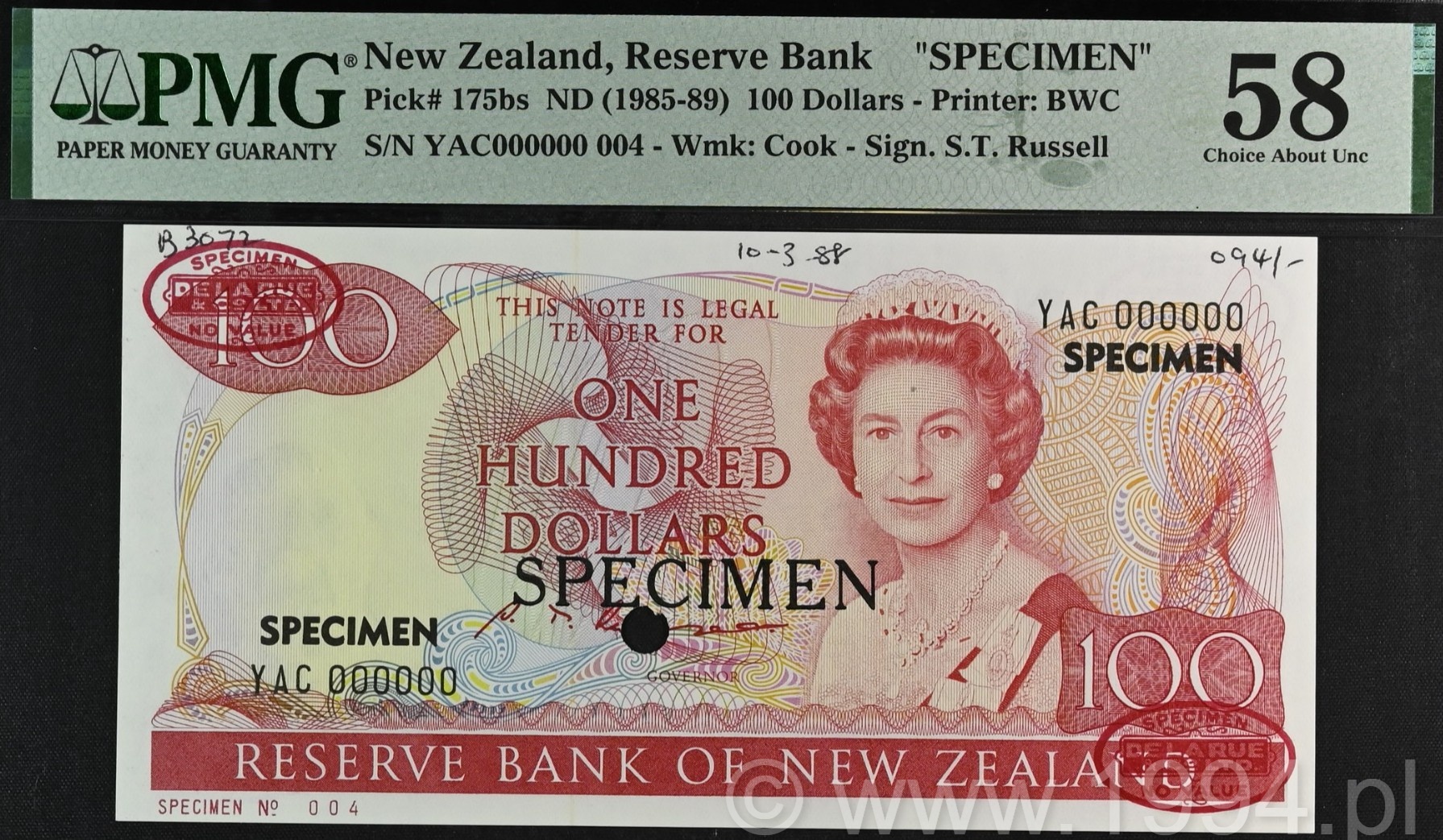
New Zealand 1985 100 Dollars specimen with black SPECIMEN overprints, dual oval DE LA RUE stamps, single punch hole, handwritten top margin annotations, Serial YAC000000, Specimen No. 004, Pick 175bs, PMG 58 Choice About Uncirculated.

New Zealand 1985 — 100 Dollars (Pick 175bs, S.T. Russell Signature, Black Overprint SPECIMEN, Dual Oval Stamps, Specimen No. 004, Serial YAC000000, PMG 58 Choice About Uncirculated)

The 1985 one hundred dollars specimen represents one of the most complex and information-rich specimen formats produced during the final paper-currency era of New Zealand, issued within the ND (1985–1989) period under the signature of S.T. Russell as Chief Cashier. This series marks the closing stage of the traditional engraved paper hundreds before the transition to polymer. ... Read more →

New ZealandSpecimen with Black Overprint, Oval Stamps, and Punch Hole1985100 DollarsPMG 58 Choice About Uncirculated SpecimenOverprint SpecimenBlack OverprintHorizontal SPECIMEN overprintMultiple SPECIMEN markingsDual Oval StampOval Stamp DE LA RUESingle Punch HolePunch CancelledPrinter AnnotationsHandwritten annotationsTop margin annotations100 DollarsQueen Elizabeth II portrait revisedCaptain James Cook watermarkBradbury WilkinsonBWCRussell SignatureS.T. RussellLate paper seriesFinal paper issueSpecimen control systemDecimal SeriesReserve Bank of New ZealandNew Zealand currency evolutionHistoryNew Zealand198519891985-1989Specimen No. 004YAC000000Pick 175bsPick 175bPMG 58Choice About UncirculatedMuseum Grade
Held
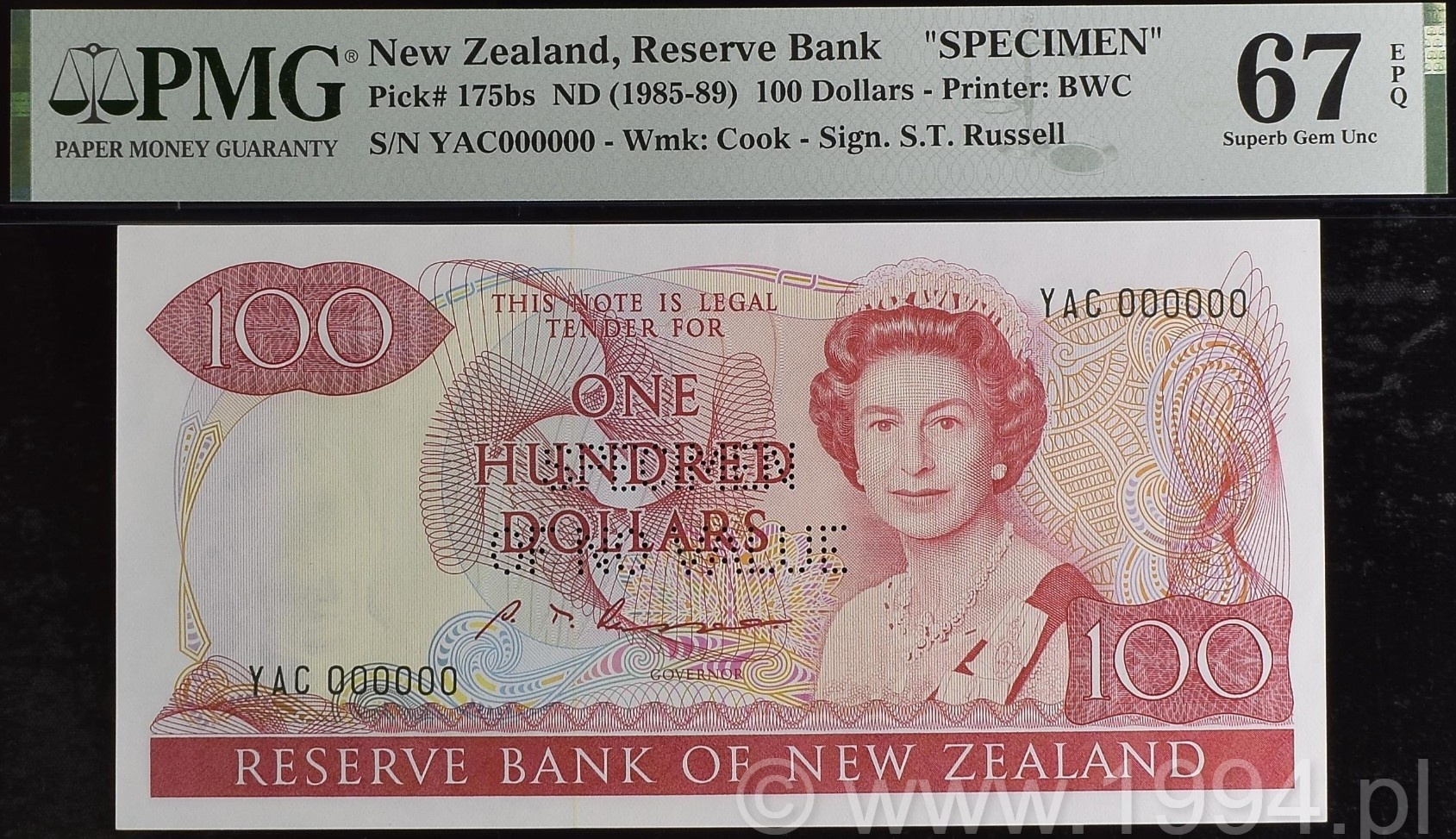
New Zealand 1985 100 Dollars perforated SPECIMEN OF NO VALUE with no punch holes, S.T. Russell signature, serial YAC000000, top population PMG 67 EPQ Superb Gem Uncirculated, Pick 175bs.

New Zealand 1985 — 100 Dollars (Pick 175bs, S.T. Russell Signature, Perforated SPECIMEN OF NO VALUE, Serial YAC000000, PMG 67 EPQ Superb Gem Uncirculated)

The 1985 one hundred dollars perforated specimen represents a highly specialized internal control format from the final paper-currency series of New Zealand, issued within the ND (1985–1989) period under the signature of S.T. Russell as Chief Cashier. This series marks the closing phase of engraved paper production before the transition to polymer substrates. ... Read more →

New ZealandPerforated SPECIMEN OF NO VALUE1985100 DollarsPMG 67 EPQ Superb Gem Uncirculated SpecimenPerforated SpecimenSPECIMEN OF NO VALUE perforationPerforated cancellationNo Punch HoleNo OverprintNo Oval Stamp100 DollarsQueen Elizabeth II portrait revisedCaptain James Cook watermarkBradbury WilkinsonBWCRussell SignatureS.T. RussellPerforation control formatDecimal SeriesReserve Bank of New ZealandFinal paper issueNew Zealand currency evolutionHistoryNew Zealand198519891985-1989YAC000000Pick 175bsPick 175bPMG 67 EPQSuperb Gem UncirculatedTop PopMuseum Grade
Held
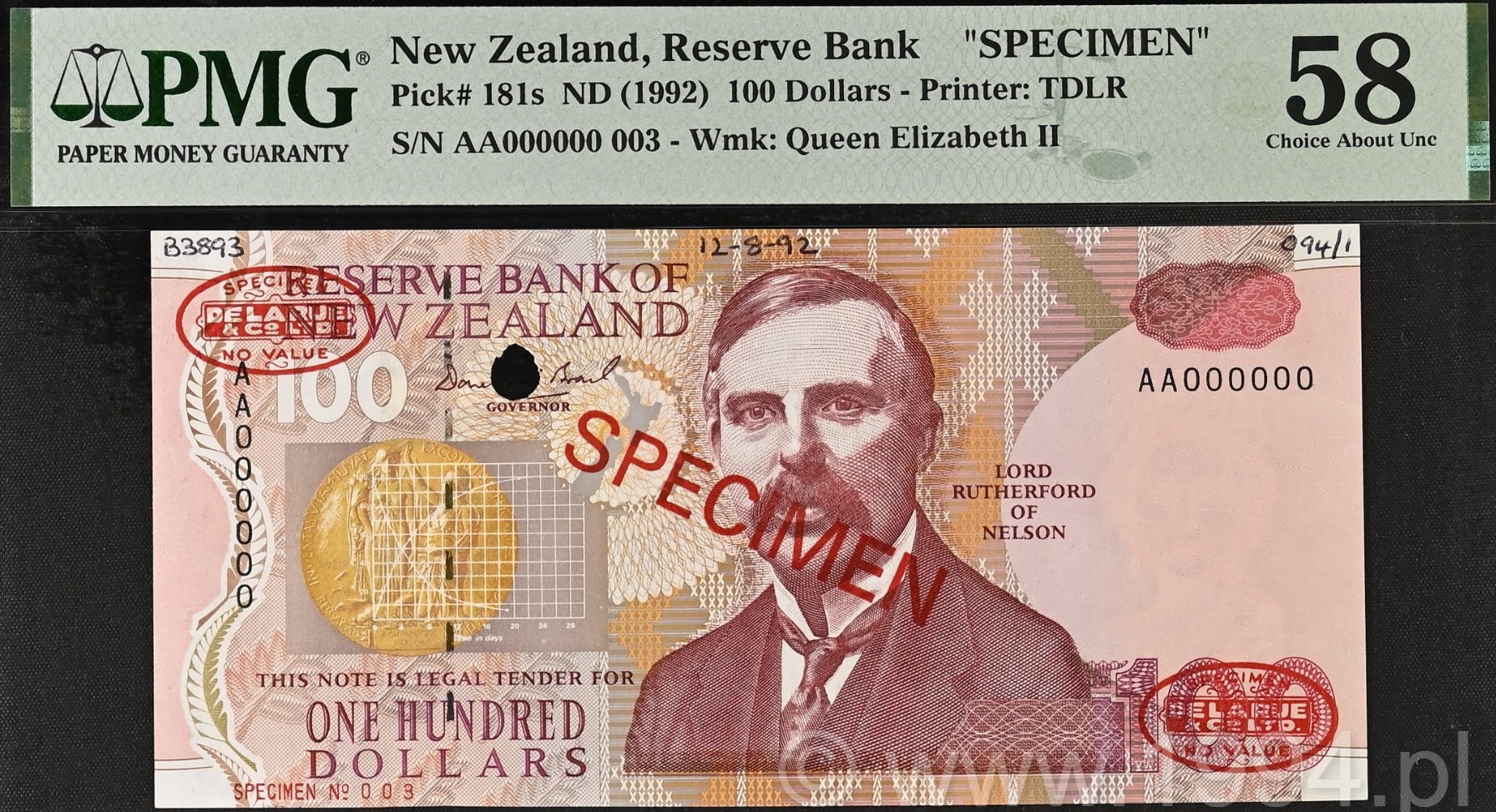
New Zealand 1992 100 Dollars Rutherford specimen with vertical red SPECIMEN overprint, dual De La Rue oval stamps, punch hole cancellation, extensive handwritten printer annotations, serial AA000000 003, Pick 181s, PMG 58.

New Zealand 1992 — 100 Dollars (Pick 181s, Rutherford Design, Vertical Red SPECIMEN Overprint, Printer-Annotated TDLR Specimen, PMG 58 Choice About Uncirculated)

The 1992 one hundred dollars specimen marks the introduction of the Rutherford design and the beginning of New Zealand’s final paper currency series before the transition to polymer. Issued by the Reserve Bank of New Zealand and printed by Thomas De La Rue & Company, London, this note replaces the long-standing Queen Elizabeth II portrait with Lord Ernest Rutherford of Nelson, symbolizing a decisive shift toward national scientific identity within the country’s banknote iconography. This example represents a complex internal printer specimen, combining multiple control and approval features rarely encountered together on a single note. ... Read more →

New ZealandSpecimen with Red Overprint, Oval Stamps and Printer Annotations1992100 DollarsPMG 58 Choice About Uncirculated SpecimenRed SPECIMEN overprintVertical SPECIMEN overprintUnusual overprint orientationDual oval control stampsSPECIMEN NO VALUE stampSingle Punch HolePunch CancelledPrinter AnnotationsHandwritten approval markingsArchival working specimen100 DollarsRutherford designLord Rutherford of NelsonAtomic model imageryNobel Prize referenceThomas De La RueTDLRDon Brash signatureGovernor signatureSpecimen control processDecimal SeriesReserve Bank of New ZealandFinal paper seriesTransition to polymerHistoryNew Zealand1992AA000000Specimen 3Pick 181sPMG 58Museum Grade
Held
New Zealand 1967 1 Dollar Fleming Signature TDLR Overprint Specimen Serial 2A000000 Specimen No. 35 with double De La Rue oval stamps and single punch hole, Pick 163as, PMG 66 EPQ Gem Uncirculated.

New Zealand 1967 — 1 Dollar (Pick 163as, Fleming Signature, TDLR Overprint Specimen, PMG 66 EPQ Gem Uncirculated)

The 1967 one-dollar specimen represents the inaugural issue of New Zealand’s decimal currency system and carries the signature of Roderick Ninian Fleming, the first Chief Cashier to appear on the new dollar series. Issued during the ND (1967–1968) period, Fleming’s tenure covered only the opening phase of decimalization—from the introduction of the currency in July 1967 until his retirement in 1969—making his signature scarce across all denominations and particularly significant on early specimen formats. Printed by Thomas De La Rue & Company, London, this specimen was produced as part of the initial reference and presentation group prepared for institutional distribution. ... Read more →

New ZealandSpecimen with Red Overprint and Oval Stamps19671 DollarPMG 66 EPQ Gem Uncirculated SpecimenRed OverprintTDLR OverprintOval StampDouble Oval StampSingle Punch HolePunch Cancelled1 DollarQueen Elizabeth II portraitCaptain James Cook watermarkThomas De La RueTDLRFleming SignatureRoderick Ninian FlemingSpecimen distribution formatDecimal SeriesReserve Bank of New ZealandFirst decimal issueNew Zealand currency reformHistoryNew Zealand196719681967-1968Specimen No. 352A000000Pick 163asPick 163aPMG 66 EPQGem UncirculatedMuseum Grade
Held
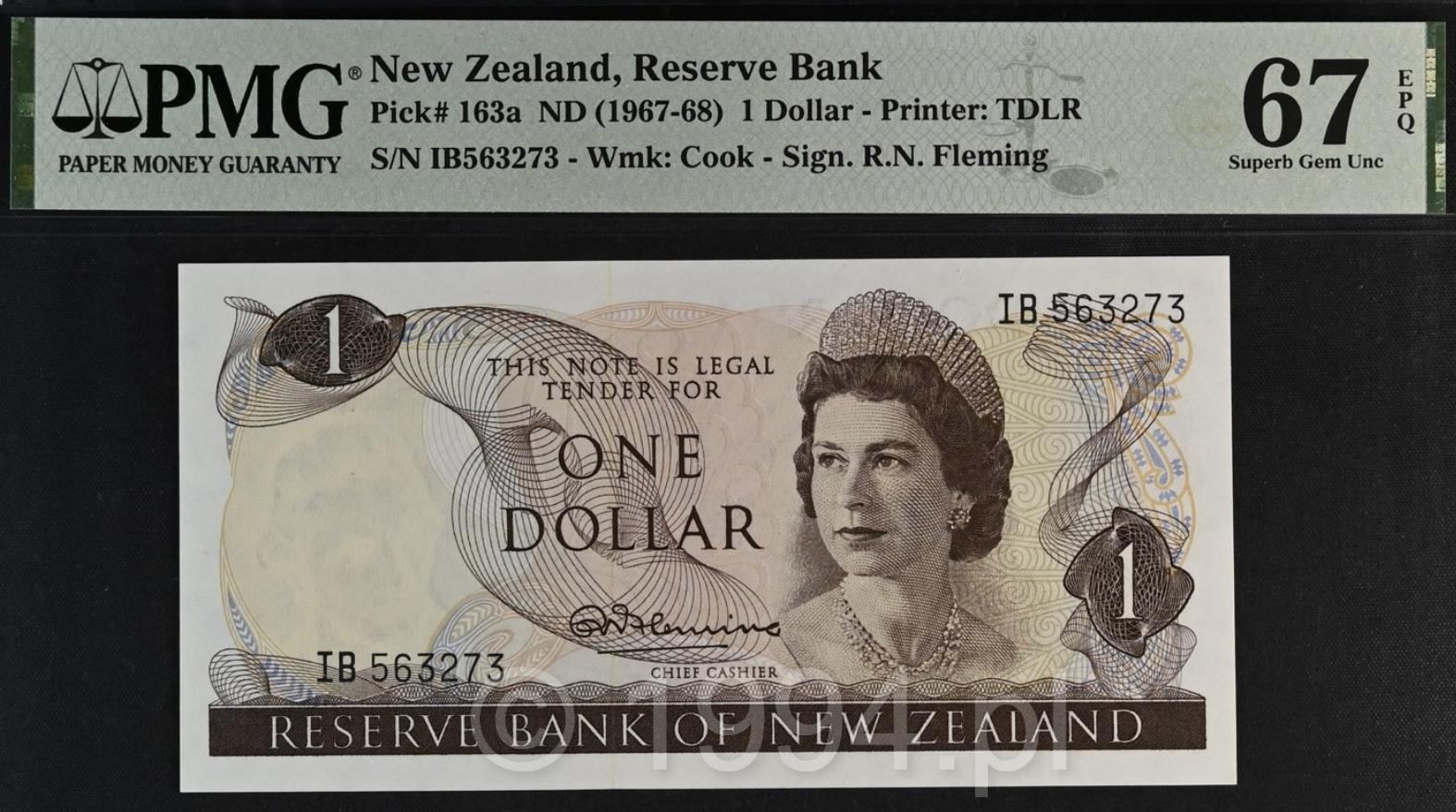
New Zealand 1967 1 Dollar issued note with Fleming signature, serial IB563273, Pick 163a, graded PMG 67 EPQ Superb Gem Uncirculated, top population example.

New Zealand 1967 — 1 Dollar (Pick 163a, Fleming Signature, Serial IB563273, PMG 67 EPQ Superb Gem Uncirculated)

The 1967 one-dollar note represents the inaugural circulating issue of New Zealand’s decimal currency system, introduced in July 1967 to replace the long-standing sterling-based structure. This example bears the signature of Roderick Ninian Fleming, issued during the ND (1967–1968) period, marking the first Chief Cashier to appear on the decimal series. Fleming’s tenure, extending until 1969, defines a narrow production window at the very beginning of New Zealand’s modern monetary era. ... Read more →

New ZealandIssued Note19671 DollarPMG 67 EPQ Superb Gem Uncirculated Issued Note1 DollarQueen Elizabeth II portraitCaptain James Cook watermarkDecimal currency noteOriginal issueSerial number noteThomas De La RueTDLRFleming SignatureRoderick Ninian FlemingStandard circulation productionDecimal SeriesReserve Bank of New ZealandFirst decimal issueNew Zealand currency reformHistoryNew Zealand196719681967-1968IB563273Pick 163aPMG 67 EPQSuperb Gem UncirculatedTop PopMuseum Grade
Held
New Zealand 1967 2 Dollars Fleming Signature TDLR Overprint Specimen Serial 0A000000 Specimen No. 72 with double De La Rue oval stamps and single punch hole, Pick 164as, PMG 65 EPQ Gem Uncirculated.

New Zealand 1967 — 2 Dollars (Pick 164as, Fleming Signature, TDLR Overprint Specimen, Serial 0A000000, PMG 65 EPQ Gem Uncirculated)

The 1967 two-dollar specimen forms part of the inaugural decimal currency series issued by the Reserve Bank of New Zealand, marking the country’s transition from the sterling-based system to the modern dollar framework. This example carries the signature of Roderick Ninian Fleming, issued during the ND (1967–1968) period, whose tenure as Chief Cashier defined the opening phase of decimalization and makes his signed notes among the earliest outputs of the new monetary era. Printed by Thomas De La Rue & Company, London, the specimen was produced for formal distribution to central banks and institutional archives. ... Read more →

New ZealandSpecimen with Red Overprint and Oval Stamps19672 DollarsPMG 65 EPQ Gem Uncirculated SpecimenRed OverprintTDLR OverprintOval StampDouble Oval StampSingle Punch HolePunch Cancelled2 DollarsQueen Elizabeth II portraitCaptain James Cook watermarkThomas De La RueTDLRFleming SignatureRoderick Ninian FlemingSpecimen distribution formatDecimal SeriesReserve Bank of New ZealandFirst decimal issueNew Zealand currency reformHistoryNew Zealand196719681967-1968Specimen No. 720A000000Pick 164asPick 164aPMG 65 EPQGem UncirculatedMuseum Grade
Held
New Zealand 1967 5 Dollars Fleming Signature TDLR Overprint Specimen Serial 001000000 Specimen No. 75 with double De La Rue oval stamps and single punch hole, Pick 165as, PMG 66 EPQ Gem Uncirculated.

New Zealand 1967 — 5 Dollars (Pick 165as, Fleming Signature, TDLR Overprint Specimen, Serial 001000000, PMG 66 EPQ Gem Uncirculated)

The 1967 five-dollar specimen belongs to the inaugural decimal currency series issued by the Reserve Bank of New Zealand, representing the transition from the sterling-based system to the modern dollar structure introduced in July 1967. This example bears the signature of Roderick Ninian Fleming, issued during the ND (1967–1968) period, whose brief tenure as Chief Cashier defined the earliest phase of decimal issuance and makes his signed notes among the first outputs of the new monetary system. Printed by Thomas De La Rue & Company, London, the specimen was prepared for official distribution to central banks and institutional collections. ... Read more →

New ZealandSpecimen with Red Overprint and Oval Stamps19675 DollarsPMG 66 EPQ Gem Uncirculated SpecimenRed OverprintTDLR OverprintOval StampDouble Oval StampSingle Punch HolePunch Cancelled5 DollarsQueen Elizabeth II portraitCaptain James Cook watermarkThomas De La RueTDLRFleming SignatureRoderick Ninian FlemingSpecimen distribution formatDecimal SeriesReserve Bank of New ZealandFirst decimal issueNew Zealand currency reformHistoryNew Zealand196719681967-1968Specimen No. 75001000000Pick 165asPick 165aPMG 66 EPQGem UncirculatedMuseum Grade
Held
New Zealand 1967 10 Dollars Fleming Signature TDLR Overprint Specimen Serial C4000000 Specimen No. 93 with double De La Rue oval stamps and single punch hole, Pick 166as, PMG 67 EPQ Superb Gem Uncirculated Top Population.

New Zealand 1967 — 10 Dollars (Pick 166as, Fleming Signature, TDLR Overprint Specimen, Serial C4000000, PMG 67 EPQ Superb Gem Uncirculated)

The 1967 ten-dollar specimen forms part of the inaugural decimal currency series issued by the Reserve Bank of New Zealand, marking the country’s transition from the sterling-based system to the modern dollar structure introduced in July 1967. This example carries the signature of Roderick Ninian Fleming, issued during the ND (1967–1968) period, whose tenure as Chief Cashier defined the initial phase of decimalization and makes his signed notes among the earliest products of the new monetary system. Printed by Thomas De La Rue & Company, London, the specimen was prepared for formal distribution to central banks and institutional collections. ... Read more →

New ZealandSpecimen with Red Overprint and Oval Stamps196710 DollarsPMG 67 EPQ Superb Gem Uncirculated SpecimenRed OverprintTDLR OverprintOval StampDouble Oval StampSingle Punch HolePunch Cancelled10 DollarsQueen Elizabeth II portraitNew Zealand falcon reverseCaptain James Cook watermarkThomas De La RueTDLRFleming SignatureRoderick Ninian FlemingSpecimen distribution formatDecimal SeriesReserve Bank of New ZealandFirst decimal issueNew Zealand currency reformHistoryNew Zealand196719681967-1968Specimen No. 93C4000000Pick 166asPick 166aPMG 67 EPQSuperb Gem UncirculatedTop PopMuseum Grade
Held
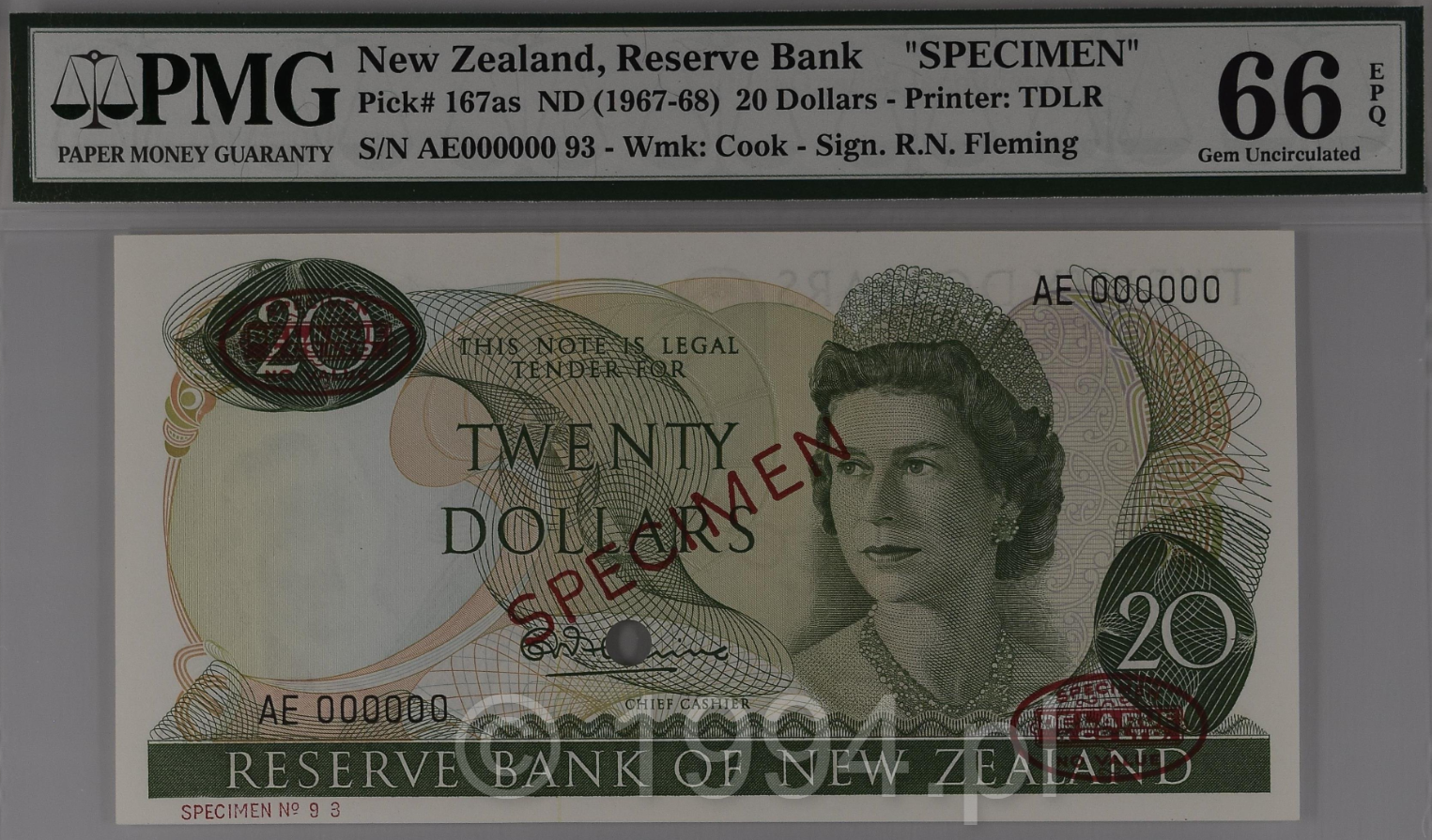
New Zealand 1967 20 Dollars Fleming Signature TDLR Overprint Specimen Serial AE000000 Specimen No. 93 with double De La Rue oval stamps and single punch hole, Pick 167as, PMG 66 EPQ Gem Uncirculated.

New Zealand 1967 — 20 Dollars (Pick 167as, Fleming Signature, TDLR Overprint Specimen, Serial AE000000, PMG 66 EPQ Gem Uncirculated)

The 1967 twenty-dollar specimen forms part of the inaugural decimal currency series issued by the Reserve Bank of New Zealand, marking the country’s transition from the sterling-based system to the modern dollar framework introduced in July 1967. This example bears the signature of Roderick Ninian Fleming, issued during the ND (1967–1968) period, whose tenure as Chief Cashier defined the earliest phase of decimalization and makes his signed notes among the first outputs of the new monetary system. Printed by Thomas De La Rue & Company, London, the specimen was prepared for formal distribution to central banks and institutional collections. ... Read more →

New ZealandSpecimen with Red Overprint and Oval Stamps196720 DollarsPMG 66 EPQ Gem Uncirculated SpecimenRed OverprintTDLR OverprintOval StampDouble Oval StampSingle Punch HolePunch Cancelled20 DollarsQueen Elizabeth II portraitCaptain James Cook watermarkThomas De La RueTDLRFleming SignatureRoderick Ninian FlemingSpecimen distribution formatDecimal SeriesReserve Bank of New ZealandFirst decimal issueNew Zealand currency reformHistoryNew Zealand196719681967-1968Specimen No. 93AE000000Pick 167asPick 167aPMG 66 EPQGem UncirculatedMuseum Grade
Held
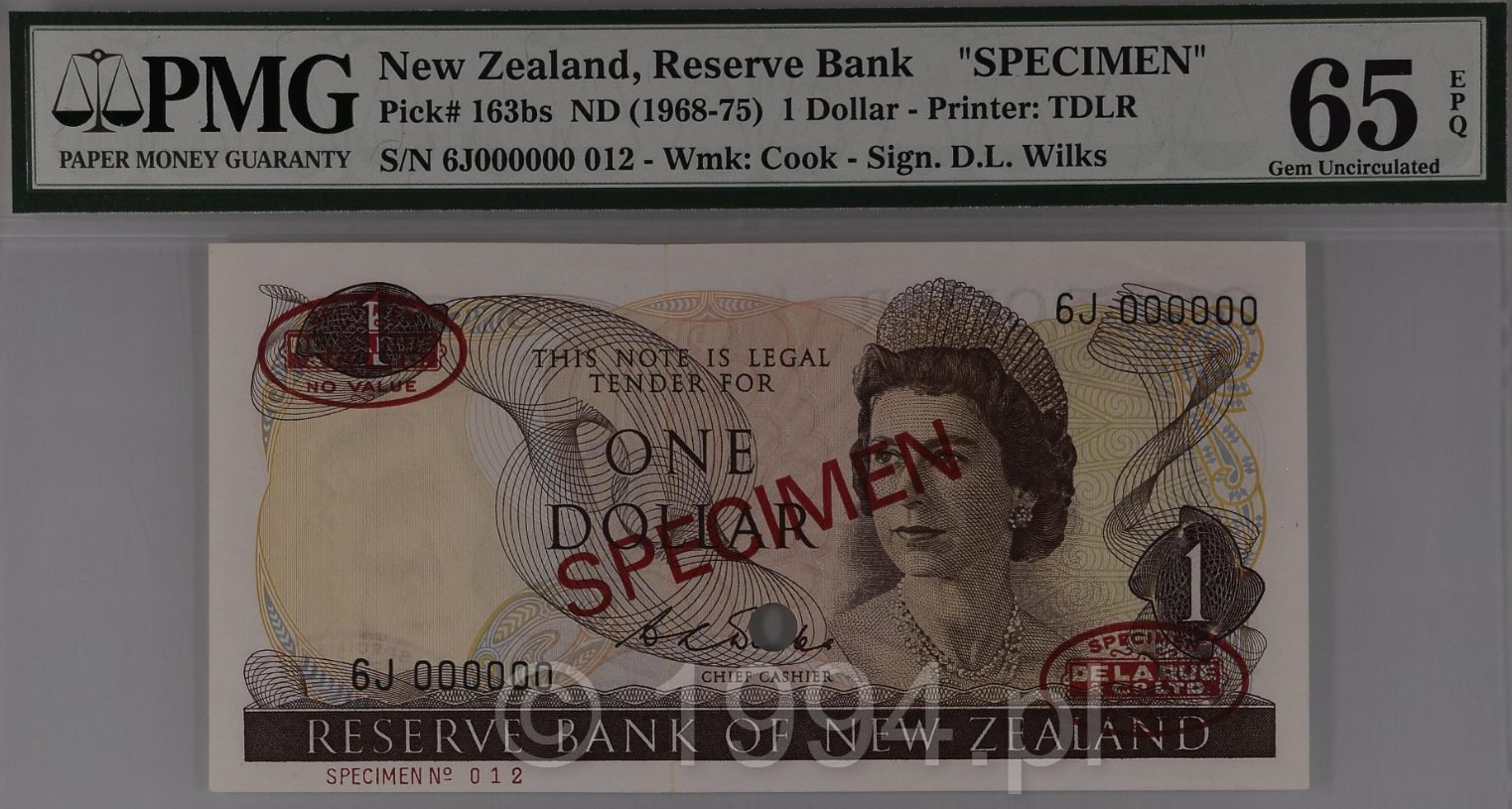
New Zealand 1968 1 Dollar D.L. Wilks Signature TDLR Overprint Specimen Serial 6J000000 Specimen No. 012 with double De La Rue oval stamps and single punch hole, Pick 163bs, PMG 65 EPQ Gem Uncirculated.

New Zealand 1968 — 1 Dollar (Pick 163bs, D.L. Wilks Signature, TDLR Overprint Specimen, Serial 6J000000, PMG 65 EPQ Gem Uncirculated)

The 1968 one-dollar specimen represents the continuation of New Zealand’s decimal currency series following its initial introduction in 1967, now bearing the signature of D.L. Wilks as Chief Cashier. Issued during the ND (1968–1975) period, Wilks’ tenure marks the second signature phase of the decimal era, extending production beyond the short Fleming window and into the early years of system stabilization. ... Read more →

New ZealandSpecimen with Red Overprint and Oval Stamps19681 DollarPMG 65 EPQ Gem Uncirculated SpecimenRed OverprintTDLR OverprintOval StampDouble Oval StampSingle Punch HolePunch Cancelled1 DollarQueen Elizabeth II portraitCaptain James Cook watermarkThomas De La RueTDLRWilks SignatureD.L. WilksSpecimen distribution formatDecimal SeriesReserve Bank of New ZealandEarly decimal continuationNew Zealand currency reformHistoryNew Zealand19681968-19751975Specimen No. 0126J000000Pick 163bsPick 163bPMG 65 EPQGem UncirculatedMuseum Grade
Held
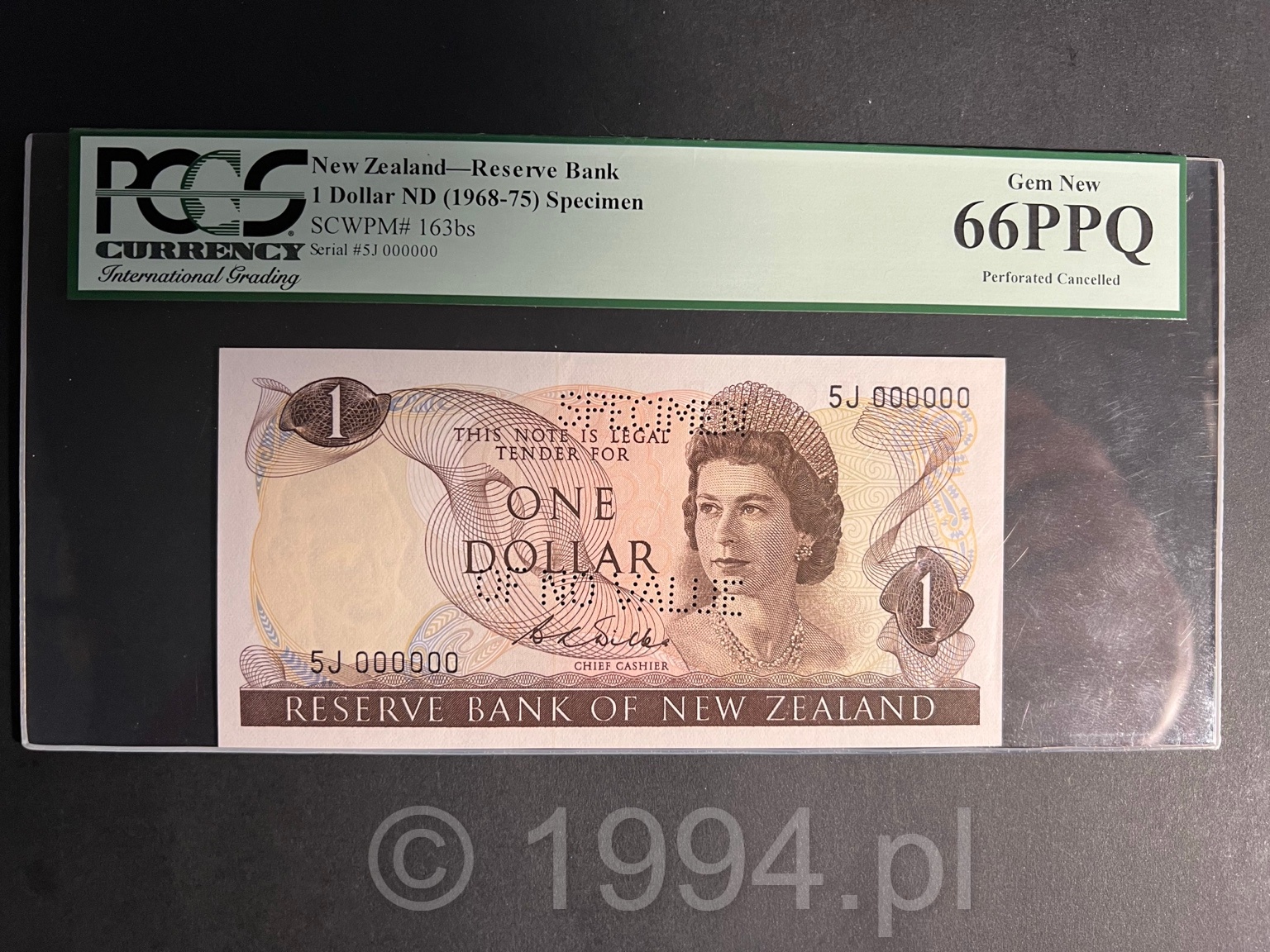
New Zealand 1968 1 Dollar Wilks Signature Perforated SPECIMEN OF NO VALUE Pick 163bs serial 5J000000 PCGS 66 PPQ Gem New

New Zealand 1968 — 1 Dollar (Pick 163bs, Wilks Signature, Perforated 'SPECIMEN OF NO VALUE', Serial 5J000000, PCGS 66 PPQ Gem New)

Perforated specimen of the 1968 one-dollar issue bearing the signature of D.L. Wilks, issued during the 1968-1975 period following the initial decimal introduction of 1967. Wilks succeeded Roderick Ninian Fleming, marking the continuation of New Zealand’s decimal currency system beyond its inaugural phase. ... Read more →

New ZealandSpecimen Perforated 'SPECIMEN OF NO VALUE'19681 DollarPCGS 66 PPQ Gem New SpecimenPerforated SpecimenSpecimen of No ValuePerforated Cancelled1 DollarQueen Elizabeth II portraitCaptain James Cook watermarkThomas De La RueTDLRWilks SignatureD.L. WilksPerforated cancellation formatDecimal SeriesReserve Bank of New ZealandNew Zealand currency reformHistoryNew Zealand196819751968-19755J000000Pick 163bsPick 163bPCGS 66 PPQGem NewMuseum Grade
Held
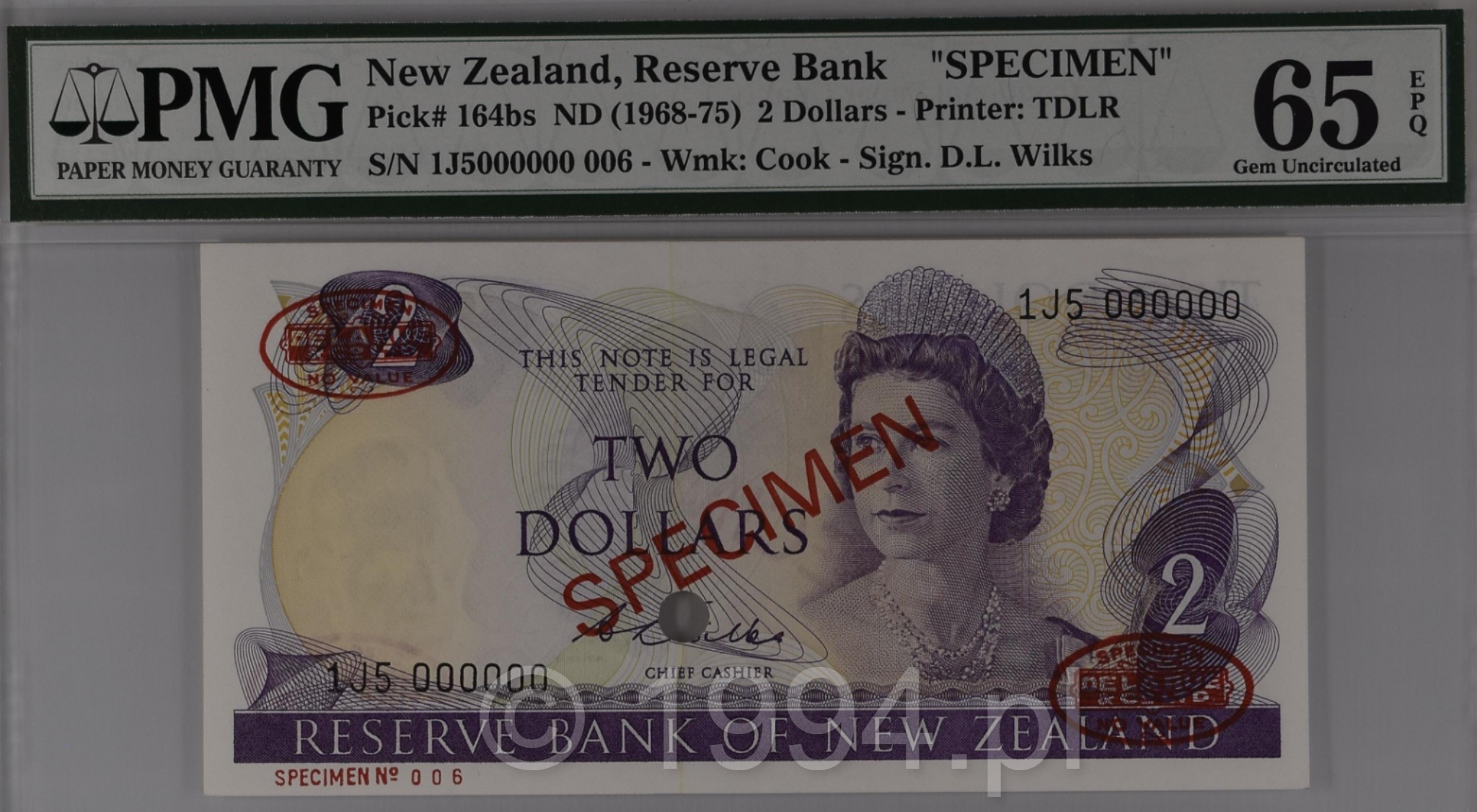
New Zealand 1968 2 Dollars Wilks Signature TDLR Overprint Specimen Pick 164bs serial 1J5000000 Specimen 006 PMG 65 Gem Uncirculated

New Zealand 1968 — 2 Dollars (Pick 164bs, Wilks Signature, TDLR Overprint Specimen, Serial 1J5000000, Specimen No. 006, PMG 65 Gem Uncirculated)

The 1968 two-dollar specimen belongs to the second signature phase of New Zealand’s decimal currency series and bears the signature of D.L. Wilks as Chief Cashier, issued during the 1968-1975 period following the initial decimal introduction of 1967. Wilks succeeded Roderick Ninian Fleming, marking the continuation and stabilization of decimal currency production beyond its inaugural phase. ... Read more →

New ZealandSpecimen with Red Overprint & Oval Stamp19682 DollarsPMG 65 Gem Uncirculated SpecimenRed OverprintTDLR OverprintOval StampDouble Oval StampSingle Punch HolePunch Cancelled2 DollarsQueen Elizabeth II portraitCaptain James Cook watermarkThomas De La RueTDLRWilks SignatureD.L. WilksSpecimen distribution formatDecimal SeriesReserve Bank of New ZealandNew Zealand currency reformHistoryNew Zealand196819751968-1975Specimen No. 0061J5000000Pick 164bsPick 164bPMG 65Gem UncirculatedMuseum Grade
Held
↑ Top