Uruguay’s paper money mirrors its passage from a provincial economy to a modern republic confident in global finance. The earliest notes of the 1860s, engraved in London by Bradbury, Wilkinson & Co., introduced the British idiom of guilloché precision and allegorical restraint. By the 1890s, production shifted to the American Bank Note Company in New York, whose craftsmanship redefined the visual identity of the Banco de la República Oriental del Uruguay. The photographic and presentation proofs preserved from this period reveal how trans-Atlantic engraving shaped national credibility.

The 1896 ABNC series—from the 1 Peso to the monumental 100 Pesos—established Uruguay’s modern numismatic language: Artigas portrayed as civic virtue, Montevideo’s harbor as prosperity, and classical symmetry as stability. Transitional proofs around 1900–1915 show refinement toward monumental clarity, while a Bradbury Wilkinson die proof of Artigas from circa 1920 preserves the British influence that lingered in official iconography.

The 1935 – 1939 Departamento de Emisión series completed the transformation. Large-format photographic proofs of denominations up to 1 000 Pesos document Uruguay’s entry into the Art Deco era—balanced geometry, allegories of labor and liberty, and the precision of intaglio modernism. Viewed together, these archival proofs trace half a century of design evolution, where foreign engraving houses translated a small republic’s faith in progress into a lasting visual currency.

This section is built around production-stage material—photographic proofs, presentation pairs, and specimens—rather than issued notes alone. The grouping reflects a deliberate focus on how designs evolved through approval and printing stages, based on surviving archival examples. The collection continues to expand, with additional material not yet publicly listed.

60 results · Page 1 of 5
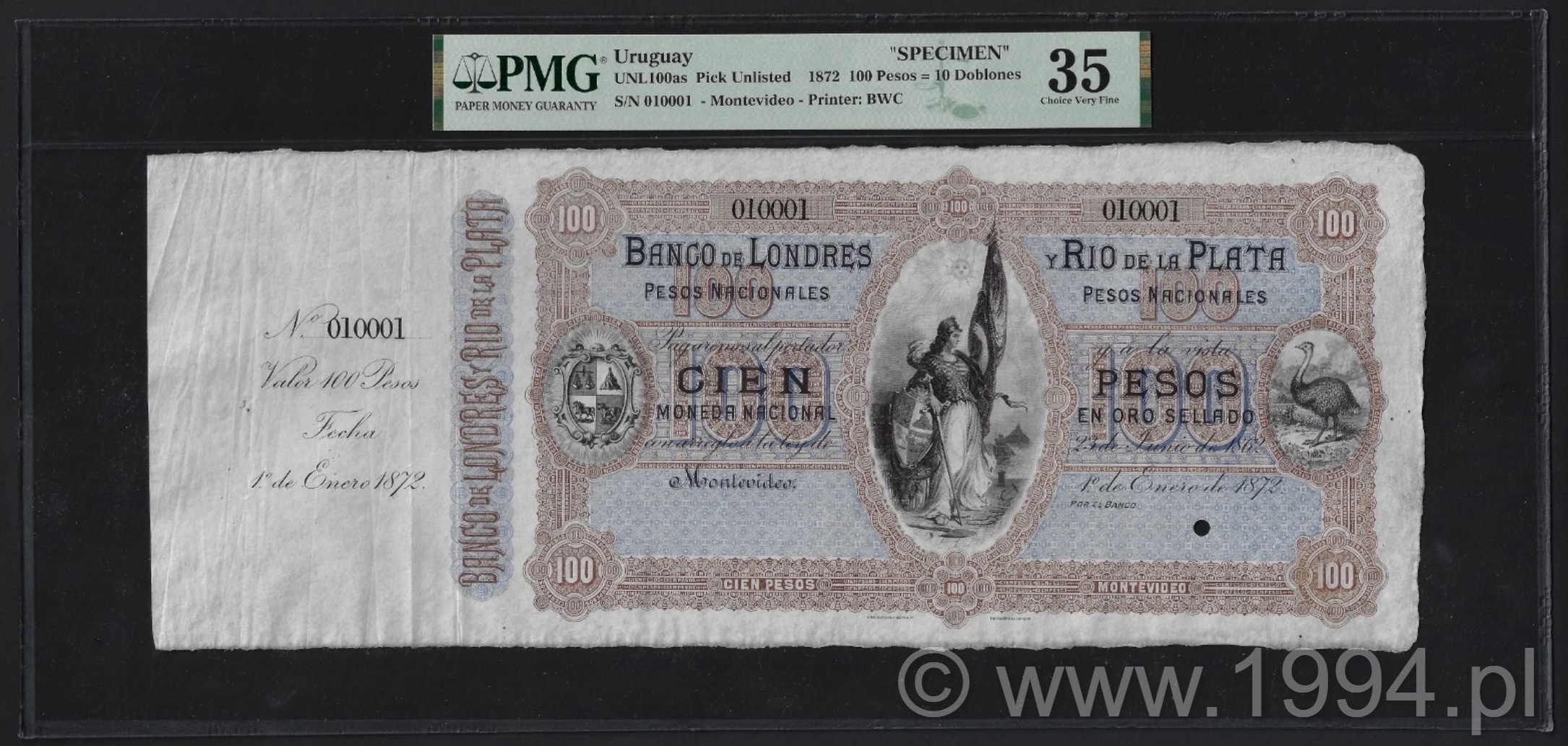
Uruguay 1872 100 Pesos equals 10 Doblones printer archival specimen, early serial number 010001, printed by Bradbury Wilkinson

Uruguay 1872 - Banco de Londres y Rio de la Plata 100 Pesos = 10 Doblones Specimen (Pick Unlisted)

This specimen stands as a singular documentary witness to Uruguay’s most explicit gold-standard experiment in paper form. It occupies a reference position not only within Uruguayan numismatics, but within the broader study of nineteenth-century Latin American monetary policy, where few surviving instruments state gold equivalence with such precision. Its uniqueness, early serial placement, and archival character place it firmly in the highest rarity tier. Read more →

UruguaySpecimen1872100 Pesos = 10 DoblonesPMG 35 Choice Very Fine SpecimenPrinter Archival SpecimenDual DenominationGold EquivalenceEarly Pull Serial 010001Oversized FormatBradbury WilkinsonBWCLondon Security PrintingNineteenth Century EngravingArchival Reference NoteGold Standard ExperimentPeso Doblone ParityBanco de Londres y Rio de la PlataLatin American Monetary HistoryNineteenth Century State FinanceUruguayMontevideo1872Pick UnlistedMuseum GradeR9 Extremely RareUnique
Held
Uruguay 1867 Banco Oriental 10 Pesos equals 1 Doblón de Oro Sellado issued banknote, American Bank Note Company, single handwritten right-side circulation signature, serial number 55818, Pick S385a, PMG 15 Choice Fine, plate position pp B

Uruguay 1867 - Banco Oriental 10 Pesos = 1 Doblón de Oro Sellado Handwritten Right-Side Signature Serial 55818 Issued Note (Pick S385a)

Issued banknote of the Banco Oriental of Uruguay, dated 1 de Agosto de 1867 and printed by the American Bank Note Company in New York. This issue represents the foundational appearance of the Banco Oriental 10 Pesos = 1 Doblón de Oro Sellado denomination and establishes the complete visual, symbolic, and technical template later reused for subsequent reauthorizations in the early 1870s. Read more →

UruguayIssued Note186710 Pesos = 1 Doblón de Oro SelladoPMG 15 Choice Fine Issued BanknoteHandwritten SignatureRight Side Signature PlacementPlate Position BGold Convertible DenominationABNCAmerican Bank Note CompanyNineteenth Century Security PrintingEngraved Allegorical DesignGuilloche Security PatternBanco OrientalUruguay1867MontevideoPick S385aHistoryMuseum GradeAnnotationsHandwritten Annotations
Held
Uruguay 1867 Banco Oriental 10 Pesos equals 1 Doblón de Oro Sellado issued banknote, dual handwritten circulation signatures at left and right, serial number 23286, Pick S385a, plate position pp B

Uruguay 1867 - Banco Oriental 10 Pesos = 1 Doblón de Oro Sellado Dual Handwritten Signatures at Left and Right Serial 23286 Issued Note (Pick S385a)

The obverse design is identical to the standard 1867 Banco Oriental issue, featuring allegorical female figures representing Commerce and Abundance at left, the national coat of arms at right, and a prominent central orange guilloche bearing the inscription “UN DOBLÓN DE ORO SELLADO.” This inscription emphasized gold convertibility and was central to public confidence in privately issued paper money during Uruguay’s mid-nineteenth-century monetary development. Read more →

UruguayIssued Note186710 Pesos = 1 Doblón de Oro SelladoFine to Very Fine (estimated) Issued BanknoteDual Handwritten SignaturesLeft and Right Signature PlacementPlate Position BGold Convertible DenominationABNCAmerican Bank Note CompanyNineteenth Century Security PrintingAuthorization ExperimentAdministrative Control VariantBanco OrientalUruguay1867MontevideoPick S385aHistoryRarityMuseum GradeAnnotationsHandwritten Annotations
Held
Uruguay 1867 Banco Oriental 10 Pesos equals 1 Doblón de Oro Sellado issued banknote, centered handwritten circulation signature, serial number 35345, Pick S385a, plate position pp A

Uruguay 1867 - Banco Oriental 10 Pesos = 1 Doblón de Oro Sellado Centered Handwritten Signature Serial 35345 Issued Note (Pick S385a)

Within a complete study of the Banco Oriental Doblón series, serial 35345 occupies a critical transitional position, bridging the rare dual handwritten signature state and the later standardized facsimile signature issue. It provides direct physical evidence of an otherwise undocumented intermediate authorization practice. Read more →

UruguayIssued Note186710 Pesos = 1 Doblón de Oro SelladoVery Fine (estimated) Issued BanknoteHandwritten SignatureCentered Signature PlacementPlate Position AGold Convertible DenominationABNCAmerican Bank Note CompanyNineteenth Century Security PrintingAuthorization TransitionAdministrative AdjustmentBanco OrientalUruguay1867MontevideoPick S385aHistoryMuseum GradeAnnotationsHandwritten Annotations
Held
Uruguay 1867 Banco Oriental 10 Pesos equals 1 Doblón de Oro Sellado issued banknote, engraved facsimile circulation signature at right, serial number 74487, Pick S385a, plate position pp C

Uruguay 1867 - Banco Oriental 10 Pesos = 1 Doblón de Oro Sellado Facsimile Signature at Right Serial 74487 Issued Note (Pick S385a)

The adoption of a printed signature marks the final stage in the Banco Oriental’s evolution of authorization practice for this denomination. Following a brief period of dual handwritten signatures and a subsequent centered single-signature adjustment, the bank reverted to the original right-side format while eliminating the need for manual application entirely. This configuration remained in use for the remainder of the issue’s production. Read more →

UruguayIssued Note186710 Pesos = 1 Doblón de Oro SelladoVery Fine to Extremely Fine (estimated) Issued BanknoteFacsimile SignatureRight Side Signature PlacementPlate Position CGold Convertible DenominationABNCAmerican Bank Note CompanyNineteenth Century Security PrintingMechanized AuthorizationStandardized ProductionBanco OrientalUruguay1867MontevideoPick S385aHistoryMuseum GradeAnnotationsHandwritten Annotations
Held
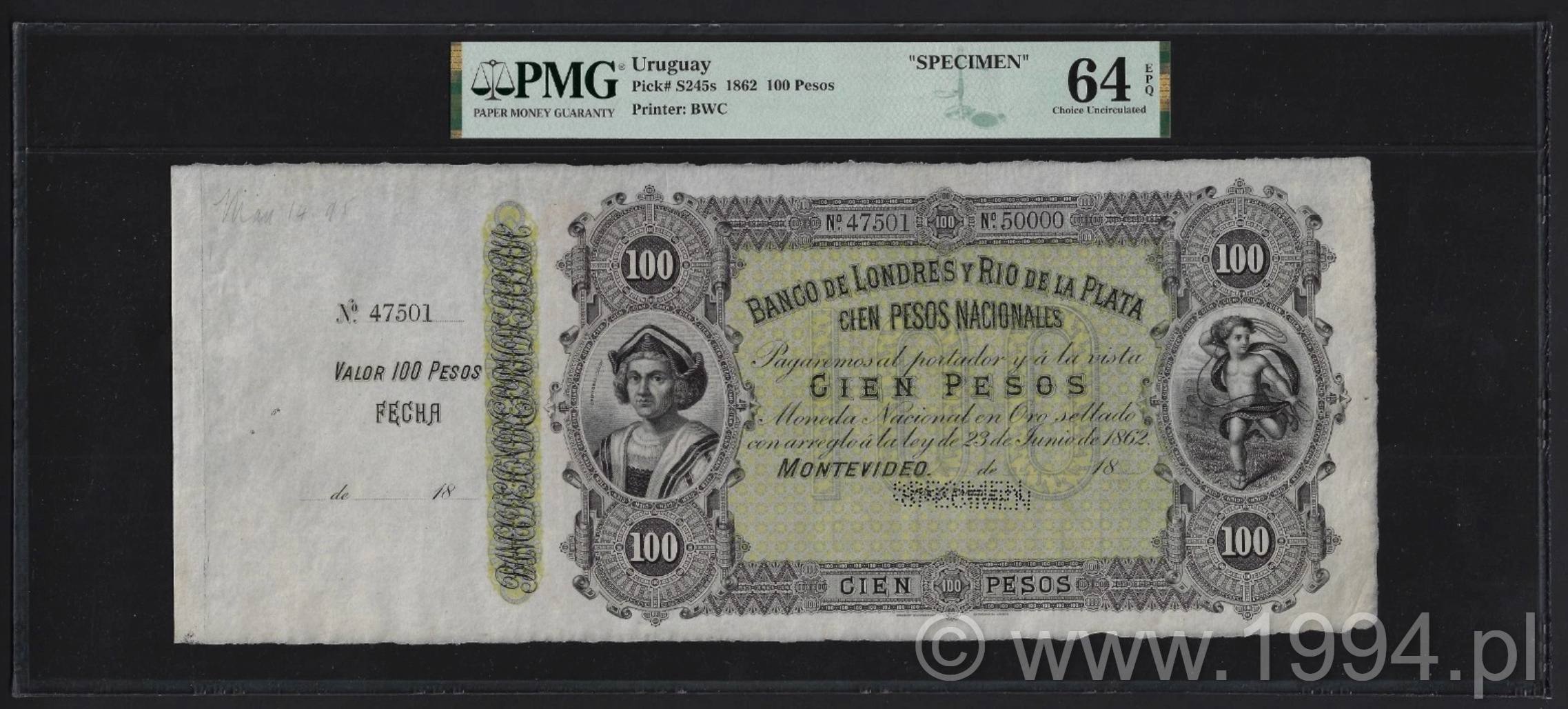
Uruguay 1862 Banco de Londres y Rio de la Plata 100 Pesos Pick S245s specimen, perforated SPECIMEN, engraved by Bradbury Wilkinson & Co., graded PMG 64 EPQ

Uruguay 1862 - Banco de Londres y Rio de la Plata 100 Pesos Specimen (Pick S245s)

This perforated specimen of the 1862 100 Pesos note was prepared for the Banco de Londres y Rio de la Plata, among the earliest private commercial banks to operate in Uruguay and the wider River Plate region. Founded in Buenos Aires in 1862 with a Montevideo branch soon after, the bank served as a critical financial link between South American trade and British capital-handling customs revenue, shipping finance, and early railway projects. Read more →

UruguaySpecimen1862100 PesosPMG 64 EPQ Pick S245sPick S245SpecimenBanco de Londres y Rio de la PlataBradbury WilkinsonBWCUruguay 19th Century100 PesosUruguay1862
Held
Uruguay 1862 Banco de Londres y Rio de la Plata 100 Pesos Pick S245r remainder, unissued and unsigned, engraved by Bradbury Wilkinson & Co., PMG 63 Choice Uncirculated

Uruguay 1862 - Banco de Londres y Rio de la Plata 100 Pesos Remainder (Pick S245r)

With fewer than five graded examples known, this PMG 63 Choice Uncirculated note stands among the rarest survivors. Placed beside the 1862 specimen, it completes the story-the specimen representing approval, the remainder preservation. Two different paths, one design, both critical to understanding how Uruguay’s first modern banknote was born and survived. Read more →

UruguayRemainder1862100 PesosPMG 63 Choice Uncirculated Pick S245rPick S245RemainderBanco de Londres y Rio de la PlataBradbury WilkinsonBWCUruguay 19th Century100 PesosUruguay1862
Held
Uruguay 1872 P. Valdez & Co. Tacuarembo 10 Centesimos unissued note with harvest scene, lith. Bauer, Rincon 72 Montevideo

Uruguay 1872 - P. Valdez & Co., Tacuarembo 10 Centesimos Unissued (Pick Unlisted)

Unissued 10 Centesimos note dated 1 July 1872 from P. Valdez & Co. of Tacuarembo (then San Fructuoso), printed by Lit. F. Bauer, Rincon 72, Montevideo. Pablo Valdez was a leading figure of 19th-century Tacuarembo: a stage-coach operator connecting San Fructuoso with Paso de los Toros, the town’s first agent of livestock brands and marks, and founder of the large soap works Jaboneria de Pablo Valdez near Arroyo Tranqueras. His firm issued these small bearer chits to replace missing fractional coinage during the post-conflict period following the Revolution of the Lances (1870-1872). Read more →

UruguayPrivate Scrip187210 CentesimosRaw (VF est.) UruguayPick UnlistedUnissued NotePrivate ScripEmergency MoneyTacuaremboP. Valdez & Co.F. Bauer LithographyUruguay 19th Century10 Centesimos1872Local Issue
Held
Uruguay 1872 P. Valdez & Co. Tacuarembo 20 Centesimos unissued note with classical vignette, lith. Bauer, Rincon 72 Montevideo

Uruguay 1872 - P. Valdez & Co., Tacuarembo 20 Centesimos Unissued (Pick Unlisted)

Considerably scarcer than the 10 Centesimos, this 20 Centesimos note represents one of the few surviving examples of private merchant scrip from Uruguay’s frontier economy. Together, the two Valdez denominations illustrate how local initiative substituted trust and commerce for absent national coinage in 1870s Uruguay. Read more →

UruguayPrivate Scrip187220 CentesimosRaw (VF est.) UruguayPick UnlistedUnissued NotePrivate ScripEmergency MoneyTacuaremboP. Valdez & Co.F. Bauer LithographyUruguay 19th Century20 Centesimos1872Local Issue
Held
Uruguay 1939 50 Pesos specimen with red ESPECIMEN overprint, SIN VALOR perforation, punch cancels and specimen number 000235, printed by Thomas De La Rue

Uruguay 1939 - Banco de la Republica Oriental del Uruguay 50 Pesos Perforated SIN VALOR Specimen with Specimen Number 000235 (Pick 38s)

The 'SIN VALOR' perforation is a formal cancellation applied by the printer to invalidate the note for circulation while preserving it as an official reference specimen. This is not a generic perforation pattern but a deliberate textual cancellation used within the De La Rue control system. Read more →

UruguaySpecimen193950 PesosRaw (AU/UNC) UruguayPick 38sPick 38SpecimenEspecimenSIN VALOR PerforationPerforated SIN VALORSpecimen Number 000235Specimen NumberedThomas De La RueTDLRBanco de la Republica Oriental del UruguayDepartamento de Emision50 PesosPrewar1939
Held
Uruguay 1939 Banco de la Republica Oriental del Uruguay 50 Pesos Serie C specimen, Specimen No. 9, Pick 38bs, with all-zero serial numbers, diagonal red SPECIMEN overprint, red oval printer control stamps, Indigenous warrior portrait, Jose Gervasio Artigas watermark, and ceremonial historical reverse, certified Paper Money Guaranty 65 Gem Uncirculated Exceptional Paper Quality

Uruguay 1939 - Banco de la Republica Oriental del Uruguay 50 Pesos Serie C Specimen, Specimen No. 9 (Pick 38bs)

The red specimen markings continue across the reverse, forming a complete two-sided reference format. Their placement preserves the central historical scene and surrounding engraving while clearly recording the note's controlled institutional status. The complete treatment across both faces demonstrates that the specimen was prepared as a finished reference example of the full banknote design. Read more →

UruguaySpecimen with Red Overprint and Oval Printer Control Stamps193950 PesosPMG 65 EPQ Specimen50 PesosSerie CSpecimen No 9All Zero Serial NumbersRed SPECIMEN OverprintRed Oval Printer Control StampsTwo Sided Specimen CancellationIndigenous Warrior PortraitFeathered HeaddressJose Gervasio Artigas WatermarkCeremonial Historical ReverseBanco de la Republica Oriental del UruguayThomas De La Rue and Company LimitedIntaglio PrintingSecurity EngravingGuilloche DesignWatermarked PaperMulti Color Security PrintingPrinted Specimen ControlNumbered Institutional SpecimenLondon Security PrintingUruguay Monetary HistoryLaw of 2 January 1939Interwar Monetary SystemState Issued CurrencyInstitutional Reference NoteHigh Value Commercial CurrencySpecimen DistributionBanknote Production HistoryHistoryUruguay193950 PesosPick 38bsPick 38bPMG 65Gem UncirculatedExceptional Paper QualityR8 Extremely RareMuseum Grade
Held
Uruguay 1939 design authorized for Banco Central del Uruguay in 1967, 50 Pesos Serie D specimen, Specimen No. 2, Pick 42As, with all-zero serial numbers, diagonal red SPECIMEN overprint, red oval Thomas De La Rue printer control stamps, Indigenous warrior portrait, Jose Gervasio Artigas watermark, and historical assembly reverse, certified Paper Money Guaranty 66 Gem Uncirculated Exceptional Paper Quality

Uruguay 1939 (1967 Authorization) - Banco Central del Uruguay 50 Pesos Serie D Specimen, Specimen No. 2 (Pick 42As)

The Indigenous figure gives the design a historical and territorial dimension that extends beyond the formal language of monetary authority. Its commanding scale balances the national title, denomination, and watermark field, joining cultural memory with the technical structure of a high-security banknote. The continued use of this portrait under the later central bank authorization demonstrates the enduring symbolic value assigned to the original 1939 composition. Read more →

UruguaySpecimen with Red Overprint and Oval Printer Control Stamps193950 PesosPaper Money Guaranty 66 Gem Uncirculated Exceptional Paper Quality Specimen50 PesosSerie DSpecimen No 2All Zero Serial NumbersRed SPECIMEN OverprintRed Oval Printer Control StampsTwo Sided Specimen CancellationIndigenous Warrior PortraitFeathered HeaddressJose Gervasio Artigas WatermarkHistorical Assembly ReverseBanco Central del UruguayBanco de la Republica Oriental del UruguayDepartamento de EmisionThomas De La Rue and Company LimitedIntaglio PrintingSecurity EngravingGuilloche DesignWatermarked PaperMulticolor Security PrintingPrinted Specimen ControlNumbered Institutional SpecimenLondon Security PrintingReused Banknote Plate DesignUruguay Monetary HistoryLaw of 2 January 19391967 Central Bank AuthorizationBanco Central del Uruguay ReissueCentral Bank TransitionInstitutional ContinuityInterwar Banknote DesignPostwar Monetary AdministrationState Issued CurrencyInstitutional Reference NoteBanknote Production HistoryHistoryUruguay1939196750 PesosPick 42AsPick 42APaper Money Guaranty 66Gem UncirculatedExceptional Paper QualityR8 Extremely RareMuseum Grade
Held
↑ Top