Description and research notes
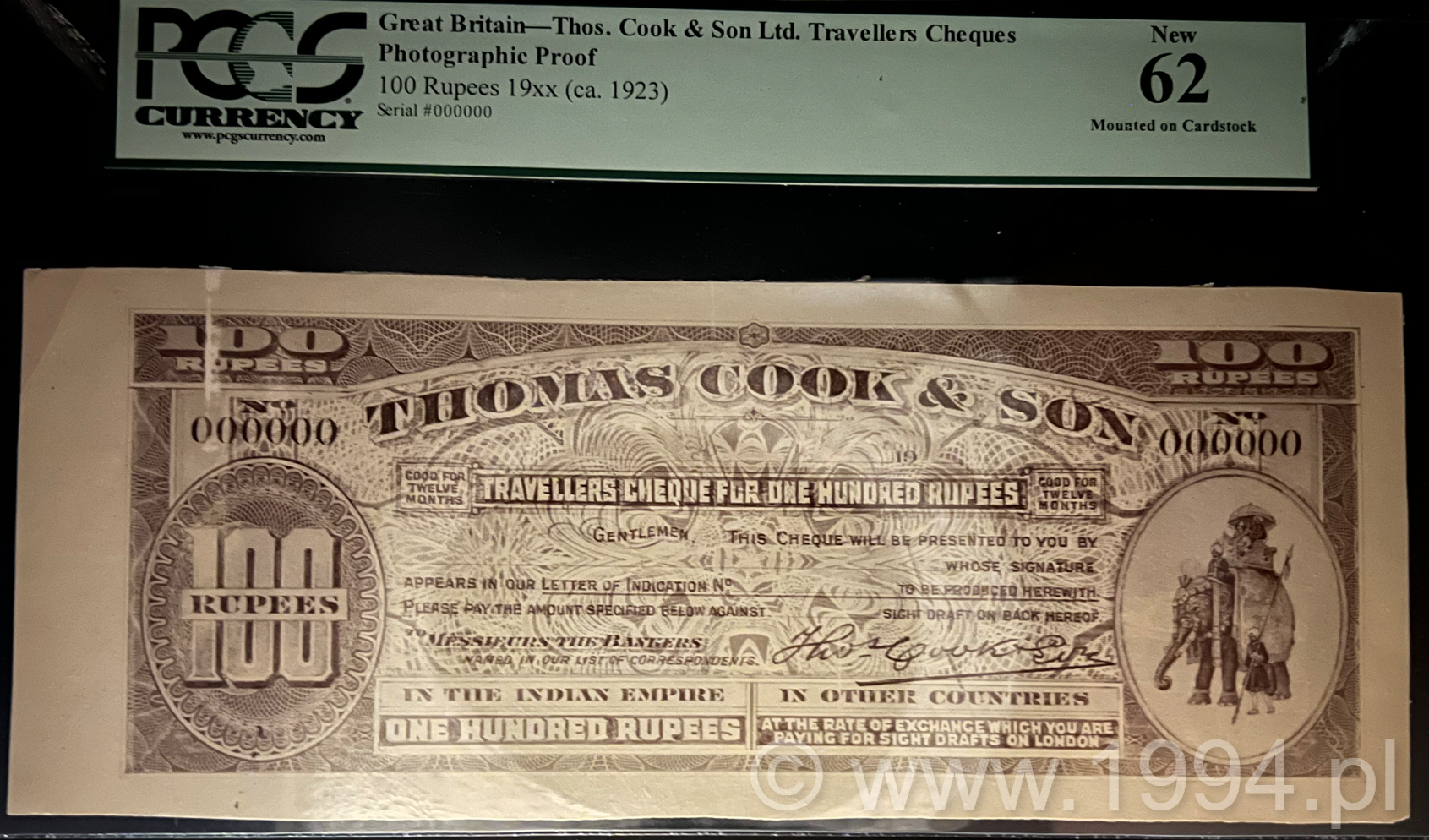
A photographic proof of the Thomas Cook & Son 100 Rupees Travellers Cheque produced circa 1923 for use in the Indian Empire. Mounted on original card stock, the piece preserves the face design during the production and approval stage for one of Thomas Cook's rupee-denominated financial instruments.
The most distinctive visual feature is the large oval vignette at right showing an elephant accompanied by attendants. The image gives the cheque an immediate Indian identity and forms the strongest pictorial element in the composition. The elephant and figures are integrated into the engraved security design, surrounded by ornamental line work and balanced against the large denomination panel on the opposite side.
Across the upper center appears the THOMAS COOK & SON name in large engraved lettering. The denomination is repeated prominently throughout the design: 100 RUPEES appears in both upper corners, while the left side is dominated by a large circular 100 RUPEES medallion. Dense guilloche patterning fills the background and borders, combining decorative complexity with the security requirements of a negotiable financial instrument.
The central inscription identifies the piece as a "TRAVELLERS CHEQUE FOR ONE HUNDRED RUPEES." A boxed panel at upper right states "GOOD FOR TWELVE MONTHS," establishing the period during which the cheque could be presented. Both serial positions display No. 000000, preserving the unissued production-stage form of the design.
The payment instructions reveal how the Thomas Cook system operated. The face refers to the traveller's "Letter of Indication No." and requires the holder's signature to be reproduced when the cheque is presented. These features formed part of the identification and authentication process connecting the traveller, the cheque, and the accompanying documentation.
The wording also directs attention to a "sight draft on back hereof," showing that the reverse formed an active part of the payment mechanism. The front and back therefore worked together as a complete financial instrument, with the face carrying identification, denomination, signature controls, and presentation instructions.
The lower panel separates payment terms by location. Within the Indian Empire, the cheque was payable at its stated value of one hundred rupees. In other countries, payment was made at the applicable exchange rate used for sight drafts on London. This wording places the instrument directly within Thomas Cook's international settlement network, linking rupee payments in India with London-based financial exchange.
By the early 1920s, Thomas Cook & Son had developed a worldwide private payment network serving international travellers, merchants, and customers moving between currencies. Rupee-denominated travellers cheques formed part of that system and allowed substantial sums to be carried and converted through Thomas Cook's established offices and correspondents. The 100 Rupees denomination represented a significant value and was suited to extended travel and major expenditure within the Indian Empire.
The proof also preserves several fine security and design details. A small floral device appears at the top center of the border. Repeated denomination panels, layered guilloche fields, the large engraved company name, the circular 100 Rupees medallion, and the elephant vignette create a highly structured visual hierarchy across the face. Each element contributes to the identity and security of the instrument while giving the design a strong geographic character.
At present, no other photographic proofs of the 100 Rupees Thomas Cook Travellers Cheque from this period are documented in grading census records, auction archives, institutional collections, or published references. No second example has been produced or observed. This establishes the piece as a unique visible example of its specific type.
As a production-stage artifact, this photographic proof occupies a reference-level position in the study of early twentieth-century private finance, imperial monetary systems, and the evolution of traveller-based payment instruments. It documents Thomas Cook’s adaptation of its cheque system to the Indian monetary environment at a moment when private financial media were central to global mobility and colonial commerce.